
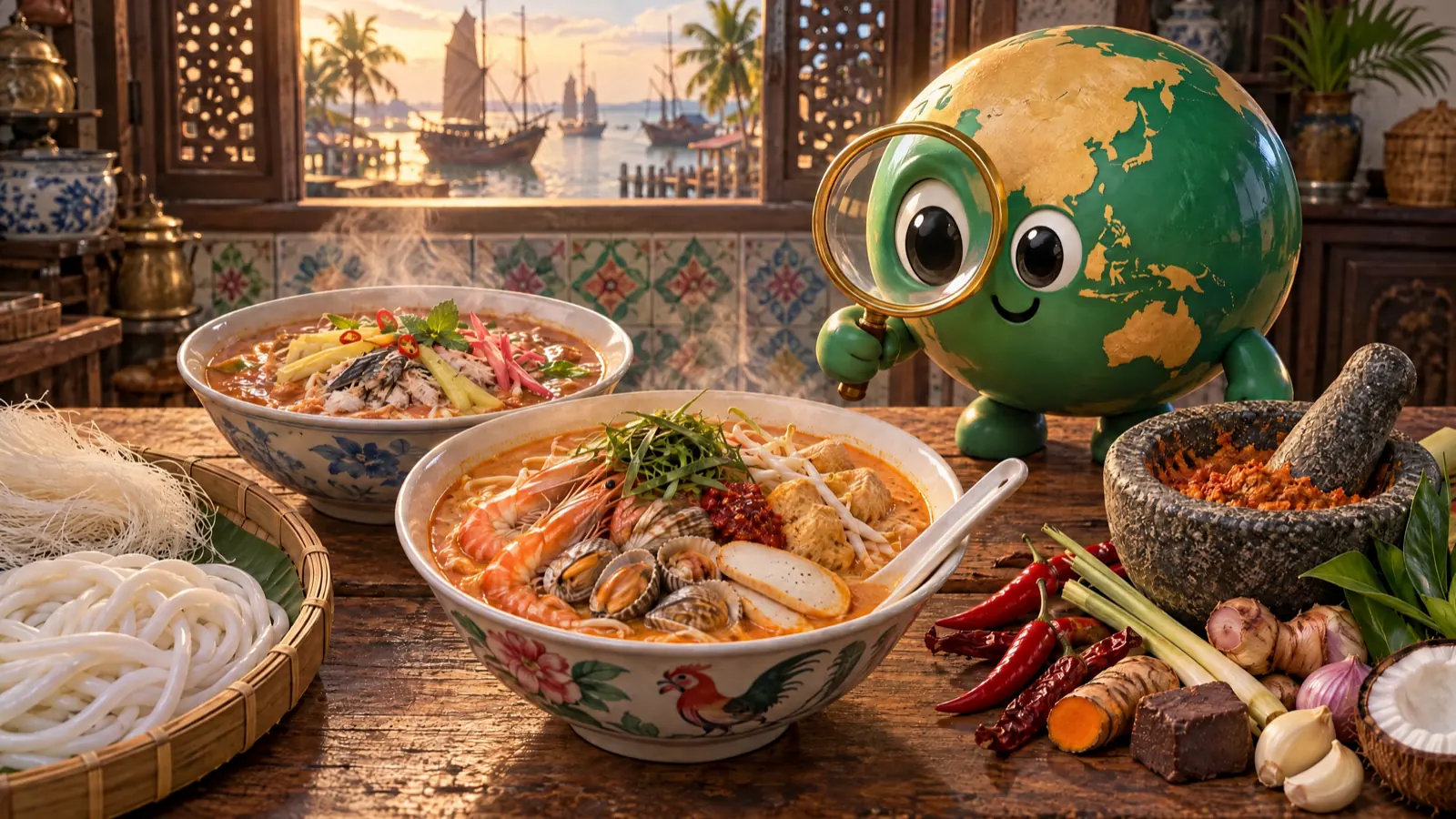
Laksa: born where Chinese noodles met Malay spice
The noodles came with Chinese traders, the paste from Malay kitchens. In 1950s Katong, two hawker brothers gave Singapore its own version of the bowl.
Almost nothing here started here. Almost everything here was perfected here.
Singapore is a port. Ports collect things. Almost nothing on this bureau started here. A great deal of it was reshaped here.
Katong laksa was made famous by two brothers who hawked it in the 1950s. Kopi took its roast from Hainanese cooks who had worked in British kitchens and then opened shops of their own. Roti canai arrived with Tamil Muslim migrants and took a new name, roti prata, on this side of the causeway.
Nearly every story here is shared with Malaysia or Indonesia. We say so on every page. The shared part is the good part.
This bureau lists every story tagged Singapore, desk by desk.
The noodles came with Chinese traders, the paste from Malay kitchens. In 1950s Katong, two hawker brothers gave Singapore its own version of the bowl.

Hainanese cooks from British kitchens opened their own coffee shops. Roasting beans with margarine and sugar kept each cup cheap.
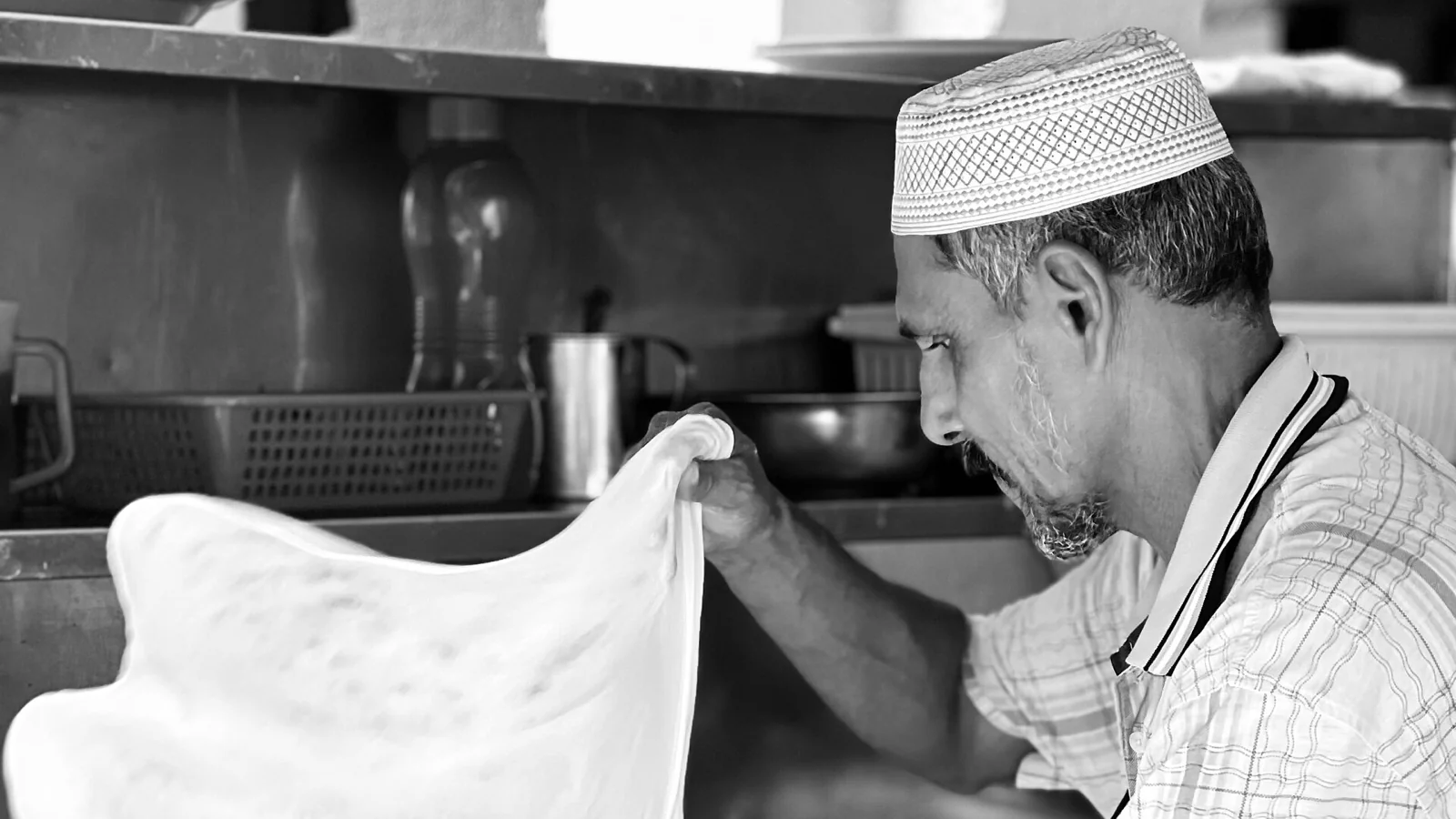
The word canai traces to Chennai. Here is how Tamil Muslim migrants carried the flatbread to Penang and Melaka, where it took a name India never used.
| Roti canai: a name that points to Chennai | The word canai traces to Chennai. Here is how Tamil Muslim migrants carried the flatbread to Penang and Melaka, where it took a name India never used. | Malaysia · Singapore |
|---|---|---|
| Laksa: born where Chinese noodles met Malay spice | The noodles came with Chinese traders, the paste from Malay kitchens. In 1950s Katong, two hawker brothers gave Singapore its own version of the bowl. | Malaysia · Singapore · Indonesia |
| Indomie: Japanese know-how, an Indonesian staple | Instant noodles were a Japanese idea. In 1972, Jakarta firm PT Sanmaru made Indomie the Indonesian version, and its 1982 Mi Goreng became a category of its own. | Indonesia · Malaysia · Singapore |
| Nasi lemak: the farmer's coconut rice first printed in 1875 | It began as a hearty breakfast for Malay farmers. Its first print record is from 1875: a Malay-French dictionary defines it as rice cooked with coconut milk. | Malaysia · Singapore |
| Hainanese chicken rice: from Wenchang to Singapore | The dish starts with Wenchang chicken from Hainan island. Hainanese cooks reworked it in 1920s and 1930s Singapore into the chicken rice plate you know today. | Singapore · Malaysia |
| Kopi: beans roasted with margarine and sugar | Hainanese cooks from British kitchens opened their own coffee shops. Roasting beans with margarine and sugar kept each cup cheap. | Singapore · Malaysia |
| Char kway teow: cheap fuel for Penang's dockworkers | Teochew migrants cooked it at night for Penang's dockworkers and cockle gatherers. The fat kept them going. The add-ins tasted of home. | Malaysia · Singapore |
| Kaya toast: a Hainanese take on British jam | Hainanese cooks learnt jam-making on British ships and in colonial kitchens. In their own coffee shops, they made it with coconut and egg. | Singapore · Malaysia |
| Satay: a kebab reworked on the streets of Java | Satay is thought to come from the Indian kebab, itself from the Turkish one. Java's street cooks reshaped it before it crossed the strait. | Indonesia · Malaysia · Singapore · Thailand |
| Murtabak: a stuffed bread that came by way of Yemen | Murtabak began in Yemen as mutabbaq, carried by Arab and Indian traders, then reshaped by Hadhrami and Tamil Muslim communities across Southeast Asia. | Malaysia · Singapore · Indonesia |
| Rendang: slow-cooked to keep meat without a fridge | The name comes from merendang, to slow-cook. Minangkabau cooks in 16th-century West Sumatra used it to keep meat for weeks or months without a fridge. | Indonesia · Malaysia · Singapore · Brunei |
| Nasi goreng: Chinese fried rice, remade with sweet soy | Chinese traders brought fried rice to the islands as early as the 10th century. Shrimp paste and sweet soy sauce later made it distinctly Indonesian. | Indonesia · Malaysia · Singapore · Brunei |
| Congee: a Chinese rice porridge with a Tamil name | Rice porridge goes back about 3,000 years in China. Its English name, congee, comes from the Tamil word kanji, and the dish goes by many names across Asia. | Singapore · Malaysia · Indonesia · Philippines · Thailand |
| Curry puff: a pasty, an empanada and a samosa in one | The pastry likely comes from the Cornish pasty and Portuguese empanada, the curry from the samosa. Colonial Malacca and Penang folded them together. | Malaysia · Singapore |
| Otak-otak: why a fish parcel is named after brains | Otak means brain in Malay. The name points to the soft, custard-like texture of this fish paste wrapped in banana leaves. It is believed to come from Palembang. | Malaysia · Singapore · Indonesia |
| Cendol: a sweet with roots in a 12th-century text | Green rice-flour drops like cendol appear in a 12th-century Javanese text. Today Indonesia, Malaysia, Singapore and their neighbours all claim it. | Indonesia · Malaysia · Singapore |
| Popiah: a thin pancake that left Fujian | The name means thin pancake in Teochew. Hokkien and Teochew migrants brought it from Fujian and filled it with what their new home grew. | Singapore · Malaysia |
| Chilli crab: born when the tomato sauce ran out | A home cook in 1950s Singapore was frying crab and had no bottled tomato sauce left. Chilli sauce went in instead, and a signature dish began. | Singapore |
| Rojak: a mixed salad with roots in a 901 CE inscription | Rojak simply means mixture in Malay. A Javanese inscription from 901 CE already names rurujak, an early form of the fruit salad you know. | Singapore · Malaysia · Indonesia |
| Kuih: from a Fujian tortoise cake to Nyonya kueh | The word comes from the Chinese character 粿. The red tortoise-shaped ang ku kueh came from Fujian, and Peranakan cooks later made it fully their own. | Singapore · Malaysia · Indonesia |
| Bak kut teh: a dockworkers' meal traced to a 1938 ledger | The earliest solid trace of bak kut teh is a Singapore tea merchant's 1938 ledger, not a newspaper. We follow that clue, and the family tales from Klang too. | Malaysia · Singapore |
| Sambal: the sauce that came before the chilli | The name comes from Javanese sambel. Chillies only reached these shores from the Americas in the 1500s, with Portuguese traders. | Indonesia · Malaysia · Singapore · Brunei |
| Teh tarik: the pulled tea that grew up at Mamak stalls | The high pour and catch came from Mamak stalls, roadside tea shops that Indian Muslim migrants set up near Malaya's rubber estates after the war. | Malaysia · Singapore |
| Durian: grown in Borneo long before any Western account | Indigenous people in Borneo and Sumatra farmed wild durian long before any Western account. The name comes from duri, the Malay word for thorn. | Malaysia · Indonesia · Thailand · Singapore · Philippines · Vietnam |
| Belacan: one shrimp paste, many names across the region | Belacan, terasi, kapi. The paste likely began with the Cham and Mon peoples of mainland Southeast Asia, then spread to the islands under new names. | Malaysia · Singapore · Indonesia · Brunei · Thailand · Philippines |
| Batik: the cloth whose name means to write in dots | The name joins two Javanese words. This hot-wax cloth craft travelled the whole Malay world, and many homes now make it and call it their own. | Indonesia · Malaysia · Singapore · Brunei |
|---|---|---|
| Kebaya: a Javanese court blouse with a Portuguese name | Its roots reach Java's Majapahit court, and its name likely came by sea from the Portuguese cabaya. Many homes across Southeast Asia still wear it today. | Indonesia · Malaysia · Singapore · Brunei · Thailand |
| Tingkat: the stacked lunchbox whose name means tier | It grew out of India's dabba, a lunch tin, and reached colonial Malaya in the 1800s. Its Malay name says what it is: tier, or storey. | Singapore · Malaysia |
| Milo: the Australian health drink born in the Depression | In 1934, an Australian chemist made a malted drink for hard times. Malaysia and Singapore turned it into a daily habit. | Malaysia · Singapore |
|---|---|---|
| Tiger Beer: a Singapore lager with Dutch brewing roots | In 1931, a Singapore drinks firm and a Dutch brewer joined hands. A year later, the first batch of Tiger Beer was brewed in Singapore. | Singapore · Malaysia |
| Yeo's: a soy sauce shop in Fujian that moved to Singapore | It began in 1900 as a soy sauce shop in China. In 1938, the founder moved it to Singapore. Soy milk came later. | Singapore · Malaysia |
| Bengawan Solo: a Singapore cake shop named for a Java song | Bengawan means river. The name comes from a song about Java's Solo River. The first shop opened in 1979, after cakes baked in a home kitchen. | Singapore |
| Eu Yan Sang: a medicine hall for a tin town hooked on opium | In 1879, Eu Kong opened his first medicine hall in Gopeng, a Malayan tin town, to help miners give up opium with herbs. Two Japanese firms now own the brand. | Malaysia · Singapore |
A new story publishes every weekday.
The monthly email
Get the best new stories once a month
One short email a month, free.
No spam. Leave with one click, any time.