
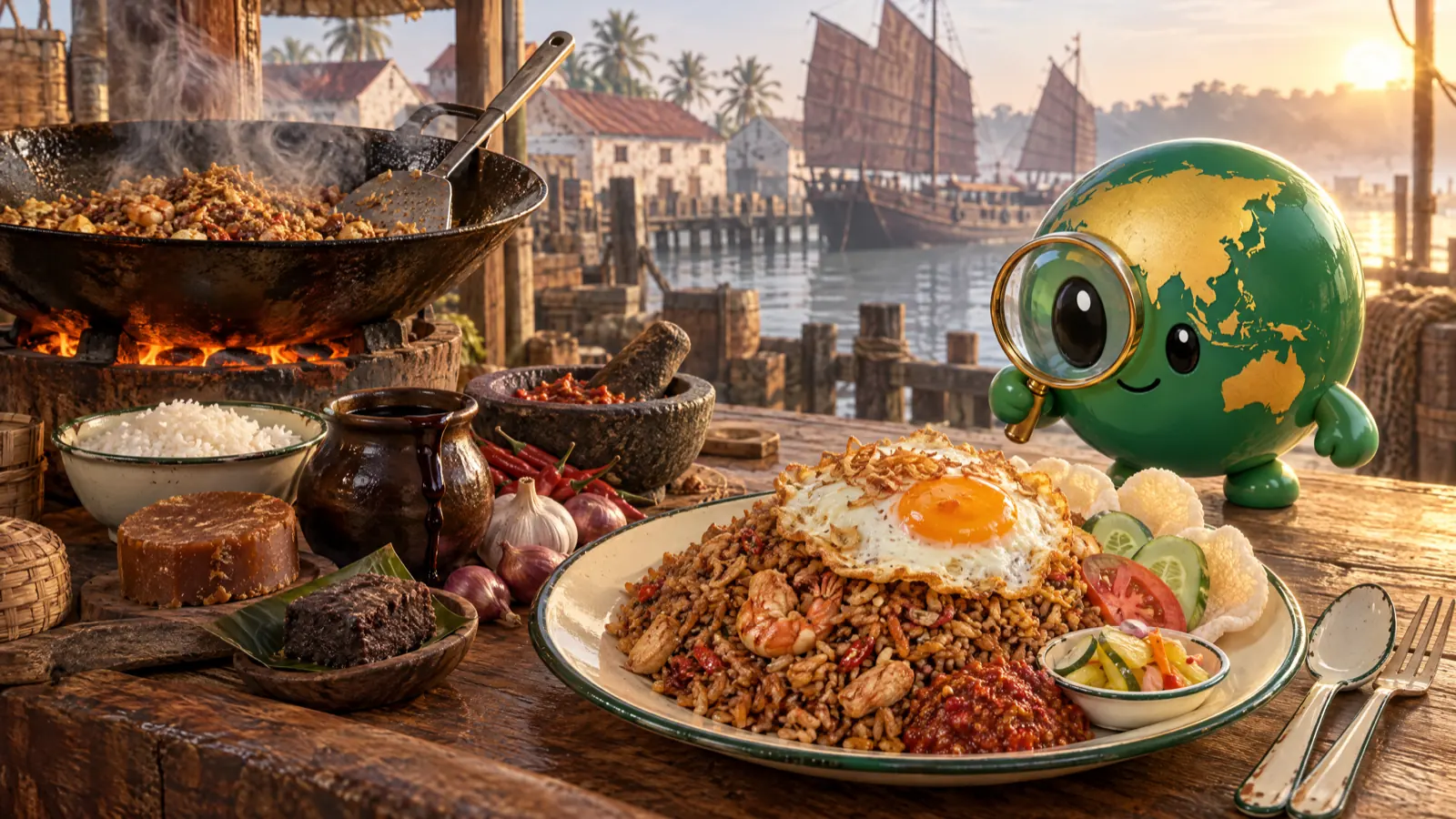
You think nasi goreng is Indonesian. It is, and it isn't. The dish began with Chinese immigrants who fried leftover rice in a wok, and it became something new when Javanese cooks added sweet soy sauce, chilli and fermented shrimp paste.
Nasi goreng means "fried rice" in Malay and Indonesian. It is an indonesian rice dish built on Southern Chinese fried rice traditions, reshaped over centuries by local hands, local heat and local condiments. The stir-frying technique for nasi goreng was introduced by Chinese immigrants who settled in the port towns of what is now Indonesia. Local cooks swapped light soy for kecap manis, a thick sweet soy sauce made with palm sugar, and stirred in shallots, garlic, chilli and shrimp paste. That swap gave the dish its dark colour, its caramelised sweetness and its identity. Nasi goreng is one of Indonesia's official national dishes since 2018, and it is eaten across Malaysia, Singapore, Brunei and beyond.
The history of nasi goreng reflects centuries of migration, trade, and cultural exchange. This is that story.
The name: what it means and where the word came from
Nasi is the everyday word for cooked rice in Malay languages across Indonesia, Malaysia, Singapore and Brunei. Linguists trace it back to the root *asi, from Proto-Malayo-Polynesian, the old ancestor language behind Malay, Javanese and over a thousand other languages spoken across the islands today. That root is old. The evidence beyond Proto-Malayo-Polynesian is thin, so we stop there.
Goreng means "fried in oil." It is not special to rice. You hear it in ayam goreng (fried chicken), pisang goreng (fried banana) and dozens of other dishes. The full phrase nasi goreng is younger than either word on its own. Nobody wrote it down, as far as we know, until the late 19th or early 20th century.
The earliest written mentions we can point to come from colonial-era publications. In 1918, the Malay-language novel Student Hidjo, serialised in the newspaper Sinar Hindia, names nasi goreng as ordinary food. In 1925, the Dutch cookbook Groot Nieuw Volledig Oost-Indisch Kookboek, published in The Hague, included a recipe under that name. Domestic and street-stall use almost certainly predates both of these by years, possibly decades. People cooked it before anyone thought to write it down.
Spelling shifts a little by place. In Indonesia the standard is nasi goreng. In Malaysia you also hear nasi goreng kampung, meaning village-style fried rice. Singapore hawker signs use the same two words.
Where it began: the place, the time, the people
Nasi goreng originated from Southern Chinese fried rice. It grew out of a Chinese cooking habit, a Malay pantry and a practical problem: how to avoid wasting rice in a hot, humid climate where leftovers spoil fast.
Trade between China and Indonesia flourished from the 10th century. Southern Chinese traders, many from Fujian and Guangdong, arrived in port towns across the archipelago. By the Majapahit era (13th to 16th century), Chinese communities had settled in Javanese and Sumatran ports like Semarang and what is now Jakarta. They brought the wok, the habit of frying day old rice at high heat, and soy sauce. Chinese sources on chǎofàn (fried rice) record the same logic: old rice, re-fried, lasts longer and fills a belly cheaply.
As Chinese settler communities in Batavia and other towns grew over these centuries, so did the mixing of pantries. Local cooks kept the wok and the frying method but reached for their own condiments: bawang merah (shallots), bawang putih (garlic), fresh chilli, and terasi (fermented shrimp paste, a salty, pungent block that adds deep umami). Chinese communities in Java began adapting soy sauce to Javanese tastes by adding palm sugar. That new sauce, kecap manis, became the ingredient that separated nasi goreng from chinese fried rice for good.
Chinese and Peranakan homes cooked fried rice in the mornings. By the late 19th and early 20th century, warungs (small roadside stalls) and pushcarts in Dutch East Indies towns were selling fried rice by the plate. Street vendors played a big part in popularising nasi goreng across social classes.
There is no single inventor. There is no exact birth year. What we have is a pattern: Chinese frying skills, Malay and Indonesian ingredients, port-town kitchens, and a few hundred years.
Anatomy: what goes into nasi goreng and how it is cooked
At its core, the contents of nasi goreng are simple. Cooked rice, fried on high heat in a wok with a spice base, seasoned with sweet soy sauce, served hot, often with an egg on top.
The base is day old rice, ideally white, medium or long grain, left to cool and dry overnight. Nasi goreng uses leftover white rice for best results. Fresh rice holds too much moisture and turns soggy in the wok. Letting it sit dries each grain, so the grains stay separate when they hit the oil.
The flavour base is a simple paste of shallots, garlic and fresh chili, sometimes ground together with a little terasi or belacan (fermented shrimp paste). Nasi goreng incorporates indigenous ingredients such as chili paste and shrimp paste, and the dish's unique flavour profile is achieved by using these local spices and cooking methods. The paste goes into hot oil first to release its smell and colour. Rich spices meet hot fat, and the kitchen fills with smoke.
What protein goes in depends on what is in the kitchen. Typical ingredients include chicken, shrimp, and vegetables. Small bits of beef, goat meat, mutton, prawns, dried anchovies or sausage all work. Eggs are common, sometimes scrambled into the rice. Often the protein is leftovers from last night's meal, stretched into a new dish.
Rice and kecap manis carry most of the dish's character, alongside the paste and protein. Kecap manis is a thick, dark, caramelised sweet soy sauce that stains everything brown and gives the dish its signature taste. Some cooks also use light soy sauce or a pinch of salt and white pepper to balance the sweetness. A few modern home versions add tomato ketchup, though older recipes do not.
The wok stays on fierce heat throughout, which keeps the rice dry rather than steamed and gives the dish a slight smoky flavour from the hot metal.
Nasi goreng is often topped with a fried egg, sunny side up. Alongside it come prawn crackers (krupuk or keropok), fresh cucumber, tomato slices, pickles like acar, and a spoonful of sambal on the side. Fried shallots are commonly used as a topping; you taste fried shallots in many plates before you see them, because the crisp bits sit right on top and their smell rises with the heat. Some versions add a garnish of peanuts or a stick of sate.
This anatomy is what separates nasi goreng from most Chinese fried rice styles. Chinese versions tend toward lighter soy, less sweetness, fewer chilli-based pastes and less dark colour. Nasi goreng leans into caramelised sweetness, fermented shrimp and heat.
One thing, many homes: how each place made it its own
Indonesia, Malaysia, Singapore, Brunei and the Malay communities of southern Thailand all have nasi goreng. There are 104 distinct types of nasi goreng across Indonesia alone. Nasi goreng has evolved into various regional styles with different ingredients and cooking techniques. Here is how a few places finished the dish in their own way.
Indonesia: from warung plate to national dish
In Indonesia, nasi goreng is everywhere. Street food carts, roadside warungs, kaki lima pushcarts, hotel breakfast buffets in Bali. It is the default plate when you do not know what to order. Nasi goreng is enjoyed at any time of day in Indonesia. It transitioned from a breakfast dish to a popular all-day comfort food, and it was served during the drafting of Indonesia's independence proclamation in 1945.
In 2018, the Indonesian government named nasi goreng as one of its official national dishes, alongside rendang, soto and others. It is a symbol of Indonesian culinary culture and national identity.
Javanese styles vary. Nasi goreng Jawa often carries more chilli and sometimes skips kecap manis entirely, leaning salty and hot. Nasi goreng kampung uses dried anchovies, local greens and more terasi. Betawi style, from Jakarta, sometimes includes goat meat and samin (a kind of ghee), served on a tin plate.
Late-night nasi goreng carts in cities like Jakarta, Yogyakarta and Surabaya are part of daily life. Big woks over gas burners, stacks of krupuk, sambal in jars, a fried egg laid on top. Many Indonesians remember eating nasi goreng at two in the morning after studying or working late.
Malaysia: kampung style and city style plates
In Malaysia, nasi goreng sits on every mamak stall menu and hawker centre board, often eaten for breakfast or supper, the same stall that often serves nasi lemak too. Nasi goreng kampung is the village version: ikan bilis (small dried anchovies), leafy greens, a heavier hand with belacan. It tends saltier and less sweet than many Indonesian plates.
Nasi goreng Cina is lighter, closer to Chinese fried rice, with little or no kecap manis. Nasi goreng Pattaya wraps the rice inside a thin omelette. Nasi goreng USA piles on meat and a fried egg, the name a nod to the generous, mixed-everything approach.
These dishes sit next to mee goreng and kway teow on the same stall, a reflection of Malay, Indian Muslim and Chinese roots sharing one counter.
Singapore and Brunei: kopitiam and canteen fried rice
In Singapore, nasi goreng appears at Malay and Indian Muslim stalls in hawker centres and kopitiams. It is usually dark and sweet from kecap manis, noticeably different from the Chinese fried rice at zi char stalls nearby. School canteens and food courts sell it as a cheap one-plate meal for workers and students. The version there is often simpler: fewer proteins, a pre-mixed seasoning, and vegetables on the side.
In Brunei, a similar Malay-style nasi goreng is served at kedai kopi (coffee shops) and night markets, with chicken or beef, sweet soy, and eggs cooked on top.
Beyond the Malay world: Thai, Dutch and diaspora plates
In southern Thailand, Malay communities cook fried rice close to nasi goreng, using similar chilli pastes and fish-based condiments, sometimes under local names.
In the Netherlands, nasi goreng became part of "Indische" or Indo-Dutch cooking. After Indonesian independence, Indo families who left for the Netherlands carried the recipe with them. It appeared in toko shops, home kitchens and rijsttafel spreads. Nasi goreng gained international visibility during the mid-20th century as a representation of Indonesian cuisine.
In other countries, from Sydney to Melbourne to London to New York, Indonesian and Malaysian restaurants serve nasi goreng to locals and to Southeast Asian students and workers. For many, it is comfort food cooked in a shared kitchen with bottled kecap manis, sambal and whatever protein is in the fridge.
Different regions in Indonesia and neighbouring countries create their own variations of nasi goreng. We are not picking a most authentic version. We are showing how one fried rice idea found many homes.
From the stall to the world: how nasi goreng spread
Nasi goreng moved with people. First inside the Malay and Indonesian worlds, then across oceans with migrants and students.
Nasi goreng's popularity grew in urban areas during the colonial and postcolonial periods in Indonesia. In the late 19th and early 20th century, fried rice stalls in Dutch East Indies towns, often run by Chinese or Peranakan cooks, served both locals and colonial staff. The dish appeared in Dutch cookbooks published in The Hague and in Malay novels read on the streets of Java.
After Indonesian independence in 1945 and the end of Dutch rule, Indo-Dutch families who resettled in the Netherlands kept cooking nasi goreng at home. The word entered everyday Dutch. Toko shops sold pre-mixed seasonings. The Indonesian dish became a Dutch weeknight staple.
Tourism played a part too. From the 1980s onward, visitors to Bali and other Indonesian destinations met nasi goreng at hotel breakfasts and beach cafes. They carried the name home. Some tried to recreate it. Most could not find kecap manis in their local shops, so they improvised.
Instant seasoning mixes labelled "nasi goreng" appeared on supermarket shelves far from Southeast Asia. They gave people an approximation of the taste without a wok or a shrimp paste block. Ready-to-use sauces followed.
Indonesian nasi goreng has since turned up on food lists and television shows alongside other Southeast Asian street foods. That boosted curiosity about its origin story and pushed more people to look up what the words actually mean.
More than a dish: what nasi goreng means today
Nasi goreng is comfort food, identity and a quick fix, all on one plate.
In Indonesia, it is a default choice. It is what you order when you are tired or uncertain. It is cooked and served at any hour, on any street, from upscale restaurants to a man with a wok and a gas burner on a pavement.
For Malaysians and Singaporeans, the smell of nasi goreng on a flat-top at a mamak stall or hawker centre is tied to school days, late study nights and long conversations with friends. Eating nasi goreng is an act of memory as much as hunger.
For migrants and students abroad, cooking a simple bowl of nasi goreng in a small shared kitchen, using bottled kecap manis and sambal, is a taste of home. The dish travels light. It asks for little. Day old rice, a few condiments, heat.
Tourism boards, embassies and cultural centres use nasi goreng at food fairs and national day events as a symbol of Indonesian cuisine. That is fair. But the framing we keep here is one of shared heritage: Chinese frying skills, Malay and Indonesian ingredients, centuries of people cooking side by side.
Some chefs now make high-end versions with premium seafood, wagyu beef or truffle oil. Many families still see it as the fastest way to turn yesterday's rice into a hot meal. Both versions are nasi goreng. The distance between them is the same distance between the pushcart and the dining room, and that distance was always part of the story.
What began as a Chinese way to save old rice is now one of Southeast Asia's clearest shared plates. It sits alongside laksa and Hainanese chicken rice in a wider record of Southeast Asian dishes reshaped by migration: many hands, one plate, each kept alive by people who never stopped cooking it.
If you like stories like this, join the Backstory Asia email list. One origin story a week, nothing else.