
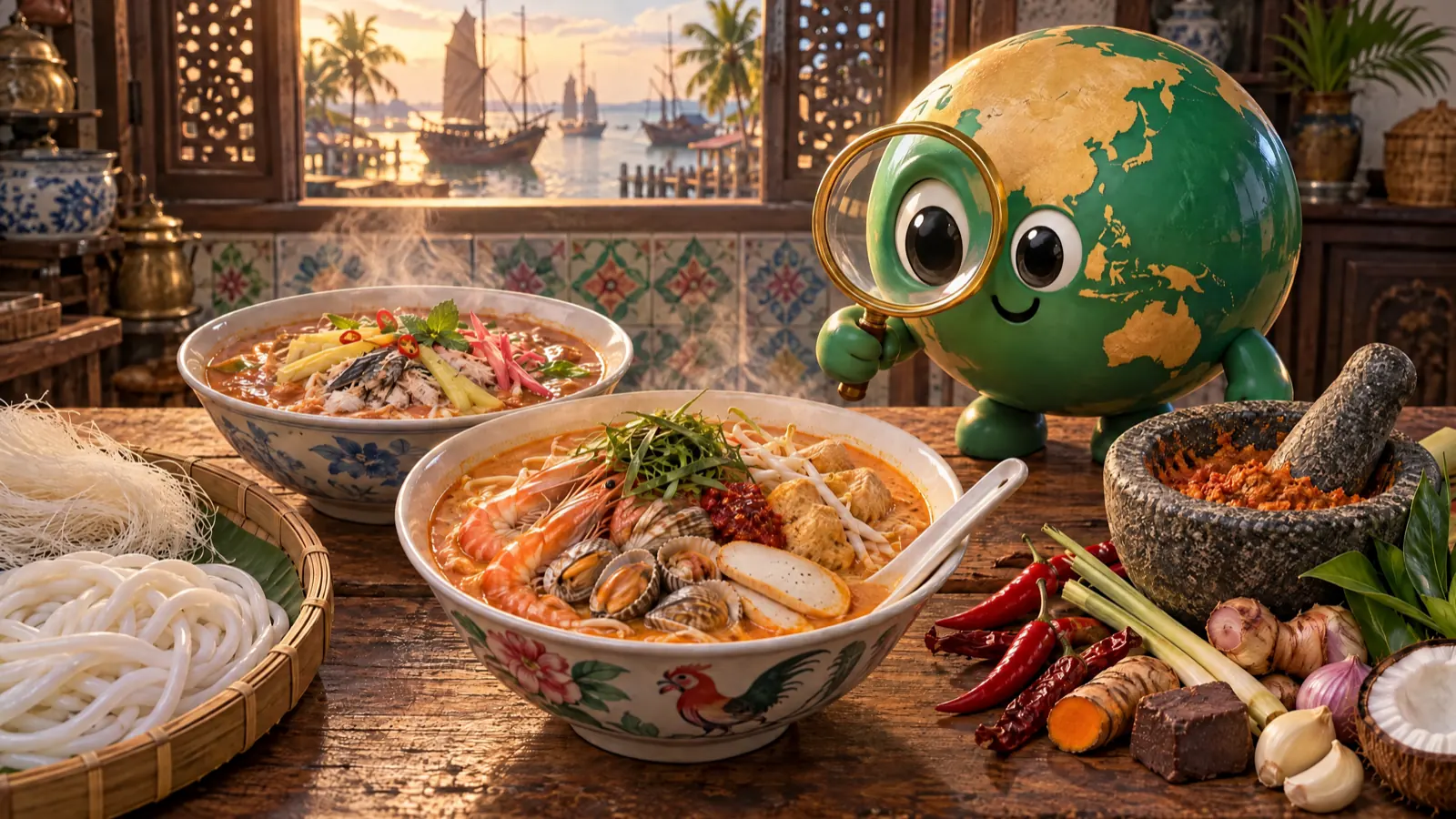
You think laksa is one national dish from one country. It is not. Laksa is a family of noodle soups born in port towns, from mixed homes and shared trade routes across Southeast Asia.
Here is the short answer. Laksa first formed among Peranakan communities, the families of Chinese traders who married Malay women, in port towns around the Straits of Melaka. Places like Melaka, Penang, Singapore, and parts of coastal Java and Sumatra. That mixing started in the 1400s, when Chinese traders settled in the region, and the dish took clearer shape in Peranakan kitchens through the 1800s. Chinese immigrants first created a simple rice noodle soup. Malay spice pastes, coconut milk and fish broths turned it into something new. Laksa is a fusion of Chinese and Malay cuisines, shaped by the same maritime trade routes that carried spices, silk and people across the region.
What we call laksa grew over several centuries. It did not appear in one kitchen on one afternoon. This page tells the story of that slow, shared making. We at Backstory Asia tell it as one story with many families, not as one country owning the bowl.
The name: what it means and where the word came from
Laksa history starts with its name. The honest truth is that nobody can prove a single origin for the word.
The best-supported idea points to the Persian word lakhshah, meaning "slippery," a term used for noodles. The term laksa may derive from this Persian word, carried east along trade routes that connected Central Asia to the ports of the Malay world.
Early written records give us a few fixed points. The Biluluk inscription from 1391, carved during the Majapahit era in Java, uses the word hanglaksa, thought to mean "vermicelli maker" in Old Javanese. An early English mention of "laksa" appeared in a Royal Geographical Society journal in 1846.
No single theory has a first date plus a recipe that closes the case. For laksa history, we treat the name as shared.
Where it began: the place, the time, the people
Laksa likely originated in the Straits of Malacca. The strongest evidence points to Peranakan communities in the port towns that lined those waters.
The Peranakan, also called Straits Chinese, are the descendants of Chinese traders, mostly Hokkien and Teochew, who settled in Melaka, Penang, Singapore, and parts of coastal Java from the 1400s onward. They married local Malay women. Over time, these families built a culture that was neither fully Chinese nor fully Malay. Peranakan culture is what grew in between. The dish reflects the Peranakan culture of mixed Chinese and Malay communities.
Ming dynasty voyages in the early 1400s, led by the admiral Zheng He, increased the Chinese presence in Southeast Asian ports. Later, Portuguese, Dutch and British colonial periods grew those port towns further, pulling in Indian, Arab and European traders too. Ports are where people meet. Melaka, Penang, Singapore, Batavia (now Jakarta), these were the crossroads. Maritime trade routes brought spices, ingredients and cooking habits from every direction. That same crossroads later gave the region other hybrid dishes still eaten today, from nasi kandar to char kway teow.
Chinese traders brought rice noodles, wheat noodles and the habit of eating them in a hot soup. Malay and local communities brought spice pastes (called rempah), coconut milk, tamarind, fish broths and fresh herbs like laksa leaves, also known as Vietnamese coriander. Put the two pantries together in one kitchen and you get a noodle soup that belongs to both. Laksa evolved due to the integration of ingredients from local ecosystems.
Early bowls may not yet have been called "laksa." The trail of paper starts in the 1800s, though family cooking almost certainly ran ahead of the printed page.
Several towns claim to be the birthplace. Melaka points to its early Peranakan households. Penang cites its long tradition of asam laksa and its Peranakan families. Singapore's claim rests on mid-20th-century hawker stalls, especially in the Katong neighbourhood. Nobody wrote down the first bowl. Each of these places grew similar soups at around the same time, fed by the same trade winds and the same mixed families. We take no side.
Anatomy: what it is made of
What sits in the bowl tells its own story. Most versions share the same structure: noodles, a flavorful broth, a spice paste and fresh toppings.
Noodles. The base can be thick rice noodles, thin rice noodles (bee hoon), yellow mee (egg noodles) or even spaghetti, as in Johor. As rice milling grew through the 19th and 20th centuries, noodles became cheaper, and that helped laksa move from festival food to everyday food.
Broth. Laksa has two primary families. Curry laksa uses a spicy coconut milk base, related to the Malay and Indonesian gulai and kari traditions. Asam laksa uses a sour fish broth, sharpened with tamarind, without coconut. Each family has its own geography: coconut broths are stronger in Singapore and parts of Melaka, sour broths in Penang and parts of northern Malaysia.
Spice paste. Cooks create deep flavours in laksa using a spice paste known as rempah. The core items are chilli (fresh and dried), lemongrass, galangal, turmeric, garlic, shallots and shrimp paste (belacan). These spices came through centuries of trade across the Malay Archipelago. The paste is pounded by hand or ground, then fried in oil until fragrant. A good rempah is what separates a flat bowl from a memorable one.
Herbs and toppings. Laksa leaves (daun kesum, or Vietnamese coriander) give many versions their sharp, clean smell. Torch ginger flower and fresh mint appear in sour styles. Toppings range from prawns, shrimp, shredded chicken and fish cakes to cockles, bean sprouts, fried tofu, tofu puffs (also called bean curd puffs), hard boiled egg, long beans and vegetables.
Over time, ingredients shifted. Modern urban stalls tend to use more coconut milk and prawns. Processed items like fish cakes, fish balls and tofu puffs became common in 20th-century hawker centres. In some places, ready-made laksa paste replaced hand-pounded rempah. The structure of the bowl stayed the same; the details changed with access and price.
One thing, many homes: how each country or community made it its own
Laksa has evolved into various regional variations across Southeast Asia. Each town personalised the same noodle soup idea with local ingredients, local people and local habit. Different regional variations of laksa have emerged based on historical trade routes. Here is how the family tree branches.
Penang asam laksa
Penang asam laksa is the sour, fish-based branch. The broth is made from flaked mackerel, soured with tamarind, and sharpened with torch ginger flower, mint and pineapple. There is no coconut milk. In Malaysia, asam laksa is a signature dish of Penang.
Penang was settled by the British East India Company in 1786, and became part of the Straits Settlements when Britain grouped it with Malacca and Singapore in 1826. Its mixed Malay, Chinese and Indian population created fertile ground for hybrid food. The earliest strong references to Penang asam laksa come from mid-20th-century hawker culture, though the soup was almost certainly cooked earlier in Peranakan homes. When CNN Travel named assam laksa among the world's 50 best foods in 2011, Penang took the praise as a compliment to the whole island.
Sarawak laksa
Sarawak laksa has a lighter, spiced broth with some coconut milk, served with thin rice vermicelli noodles, prawns, shredded chicken, strips of omelette and sambal belacan. East Malaysia, where Kuching sits on the coast of Borneo, had its own mix of Malay, Chinese, Melanau and Dayak communities trading through coastal ports.
Local memory places the creation of a recognisable Sarawak laksa style around the mid-20th century, though exact dates and names are fuzzy. What did help fix the recipe was the packaging of a bottled Sarawak laksa paste, which spread the flavour profile across Sarawak and beyond.
Katong and Singapore-style curry laksa
Singapore laksa, sometimes called laksa lemak, is usually a rich, orange-hued, spicy coconut broth ladled over thick rice noodles. Toppings include prawns, fish cakes, cockles, bean sprouts and tofu puffs. A spoonful of chilli paste sits on the surface.
Katong laksa comes from the Katong area, a Peranakan and Eurasian neighbourhood by the sea in Singapore. Two hawking brothers opened a stall there in the 1950s, and the laksa they sold became known simply as Katong laksa. The practical twist: noodles were cut short so the whole dish could be eaten with a spoon alone, no chopsticks or fork needed. That is the story told in Katong, and it fits Singapore's working-city character.
Several stalls along East Coast Road have each claimed the original Katong laksa recipe. That rivalry shows how strong the identity had become. Laksa serves as a representation of multicultural identity in Singapore. We name the claims and take no side. Many families, one bowl.
Johor laksa and other Malaysian styles
Johor laksa is the oddest branch of the family. It is the one version that uses spaghetti instead of rice noodles. The broth is often coconut-based with a thick gravy of fish and spices. Local stories link it to royal-household recipes, though this is oral history, not printed record.
Elsewhere in Malaysia, curry mee in Penang offers a spicy broth with yellow mee and cockles. Nyonya laksa, or laksa lemak, in Melaka uses a spicy coconut broth that is close kin to the Singapore version. Each adapted to its town's people and pantry.
Indonesian laksa: Betawi, Bogor and beyond
Betawi laksa in Jakarta has a coconut and turmeric broth with rice vermicelli and sometimes a hard boiled egg. It reflects the unique blend of Malay, Chinese, Arab and local cultures that lived in Batavia under Dutch rule. Bogor and other West Javanese towns have their own versions. In Indonesia, the word laksa lives beside many other noodle soups, soto, bakso, mie ayam, and it is one branch in a larger family tree.
Neighbours and cousins: southern Thailand and others
Close cousins to laksa appear in the coastal provinces of southern Thailand, sometimes under different names, using the same mix of noodles, fish broth, coconut milk and local spices. Historians see these not as copies but as parallel growth under the same trade and migration patterns. Shared coastline, shared food.
From the stall to the world: how it spread
Laksa history does not stop in Southeast Asia. The dish travelled with the people who left.
After the Second World War, urbanisation in Singapore, Malaysia and Indonesia pushed food from home kitchens into hawker centres and street stalls. Hawker culture in Southeast Asia made laksa widely accessible across all communities. Laksa is a popular street food, cheap enough for anyone. A bowl that once appeared at festivals or family gatherings became an everyday lunch.
In the 1970s and 1980s, students and migrants from Malaysia, Singapore and Indonesia moved to Australia, the United Kingdom and later the United States. They opened restaurants and cafes, and laksa went on the menu. Cities like Sydney and Melbourne saw it so often that some locals came to think of it as a regular comfort food. Laksa is deeply rooted in Southeast Asian street food culture, yet it now sits comfortably on menus in London, New York and beyond. Laksa attracts food tourists seeking local culinary experiences wherever it is served.
From the 2000s onward, instant laksa noodles and ready-made laksa paste, manufactured in Malaysia and Singapore, reached supermarket shelves worldwide. That changed who could taste a version of the dish. It was no longer necessary to live near a hawker stall.
Tourism boards and food media from the 1990s into the 2000s began using Penang asam laksa, Katong laksa and Sarawak laksa as identity markers in travel guides and cooking shows. That boosted the profile of laksa as an iconic dish but also fixed certain city names to certain styles in the global mind.
More than a dish: what it means to people today
This dish carries more than what goes into the bowl. It is about identity, memory and shared roots. Laksa showcases Southeast Asia's rich culinary heritage.
For Peranakan communities, laksa, especially nyonya laksa, is a taste of who they are. It is proof that Chinese and Malay ancestors lived side by side long enough to cook together. Peranakan cuisine holds this bowl as one of its clearest expressions.
For cities, laksa works as a badge. Penang ties its name to asam laksa. Singapore points visitors to Katong. Kuching claims its own Sarawak laksa. These bowls show up in festivals, on tourism posters and in family stories passed from grandmother to grandchild.
For the Southeast Asian diaspora in places like London, Sydney and Melbourne, laksa is often the first bowl to look for after landing. Parents use it to teach children about where their grandparents came from. Making laksa in a foreign kitchen is a quiet act of remembering.
Debates over the "best" or "original" laksa appear online and in food media. We see these as signs of love, not rivalry. Many families, one thing. Laksa is a popular dish because it belongs to everyone who helped shape it.
Laksa started in port towns where nobody asked for a passport before sharing a meal. It grew in mixed homes. It spread with people on the move. That is the story most people skip. It is the best part.
If you like stories like this, join the Backstory Asia email list. One origin story a week, nothing else.