
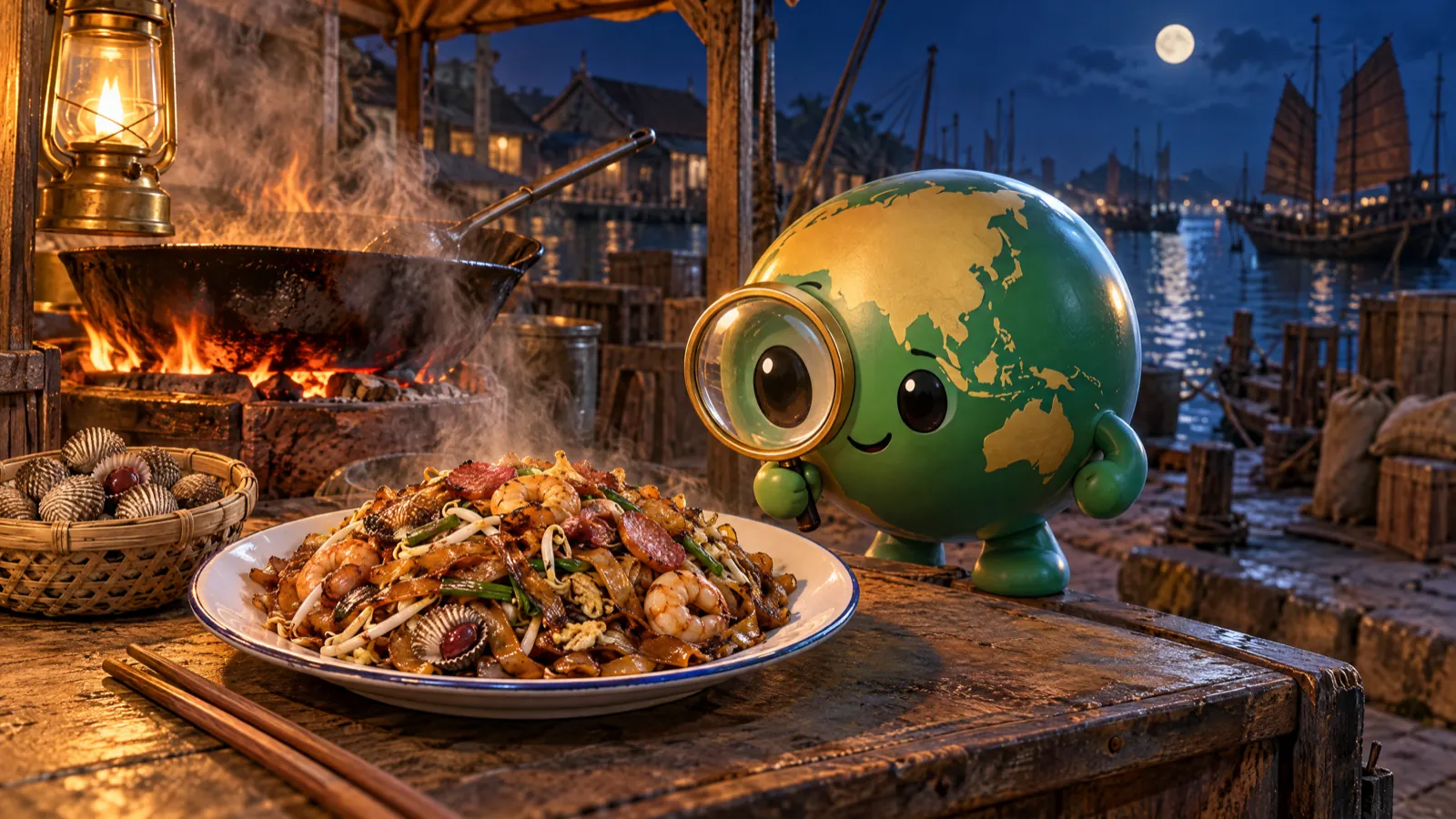
You think char kway teow is a fancy hawker plate. It was not. It was cheap fuel, fried fast in pork fat, built to fill the bellies of tired dockworkers who could not afford much else.
The dish originated in 19th-century maritime Southeast Asia with Chinese immigrant labourers. Char kway teow was historically a cheap and energy-dense meal for labourers and fishermen working the ports of British Malaya. The name means "stir-fried ricecake strips" in Hokkien, the dialect of Fujian province in southern China. Nobody wrote down who fried the first plate or when. The earliest clear mentions come from the mid-1900s. That is the story we tell here.
The name: what it means and where the word came from
Three small words make the name. "Char" (炒) means to stir-fry. "Kway" (粿) means ricecake. "Teow" (條) means strips. Put them together and you get stir-fried ricecake strips. Simple.
The words come from Hokkien, a Chinese dialect spoken in Fujian and by many people in Penang and Singapore. They are not Malay words and not English words. Teochew speakers, from nearby Chaozhou in Guangdong province, say something very close, because Hokkien and Teochew share roots in the Southern Min language family. Char kway teow is believed to have come from Chaozhou, Guangdong province, and Penang's char kway teow evolved from Teochew immigrants' adaptations of what they already knew.
You will see many spellings in English: char kway teow, char koay teow, char kuey teow, and others. The differences come from local accents and from the way British colonial officers tried to write Chinese sounds using the English alphabet. In Penang, "koay" is common. In Singapore, "kway" or "kuey" appears more often. They all point to the same flat rice noodles in the same hot wok.
In Penang, people often shorten the name to just "koay teow" in daily speech. But be careful. Kway teow refers to flat rice noodles in general, not only the fried dish. Ask for "koay teow" in some shops and you might get noodle soup instead. The word "char" at the front is what tells the cook to fry it.
Where it began: the place, the time, the people
Char kway teow as we know it grew in British Malaya, in port towns where ships docked and labourers sweated. Penang is usually named first.
Penang became a British free port in 1786. Over the next hundred years, waves of Chinese migrants arrived from Fujian and from the Chaoshan region of Guangdong. Many came as coolies, dockworkers and fishermen. They needed food that was cheap, hot, fast and full of energy. Flat rice noodles already existed in southern China and other parts of Southeast Asia. The new thing was frying them hard in pork fat with dark soy sauce, small prawns and whatever seafood was at hand, in a wok over charcoal, often at night when labourers came off their shifts.
Street vendors sold char kway teow as a quick and filling meal for the urban working class. Early hawkers carried their stalls on shoulder poles or pushed wooden carts. They set up near docks, markets and tin mines in towns across Malaya and Singapore. The dish fit into a cash side-hustle economy. Fishermen and farmers sold char kway teow to supplement their income, using leftover lard and cheap offcuts from butchers.
Using inexpensive and readily available ingredients mattered for the dish's popularity among workers. A plate of rice noodles fried in lard cost very little, yet it packed enough calories to keep a man going through a long night shift. That made it an inexpensive dish by design, not by accident.
Nobody recorded the name of the first stall. No single inventor is known. The earliest written mentions we have come from food writers and travelogues in the mid-1900s. Before that, the dish lived in spoken memory and in the smoke of a thousand street woks. We say "likely the late 1800s" and leave it there, because that is what the evidence allows.
Anatomy: what it is made of, or how it is done
Today, char kway teow is a plate of flat rice noodles fried over high heat with soy sauce, lard, egg, prawns, cockles, bean sprouts and chives. Every part of that list tells you something about the past.
The noodles are wide, soft rice noodles, about one centimetre across. They come from southern Chinese foodways. Fresh rice noodles are less prone to breakage when cooked, which matters when you are tossing them fast in a hot wok. They were the cheapest way to fill a plate for workers who needed bulk.
The fat is pork lard, rendered from scraps at Chinese butcher stalls and roast meat shops. Crisp lard bits add crunch. Pork fat was cheaper than good cooking oil and gave both energy and flavour. Cooks reached for it because it was a cheap by-product from the butcher's stall, not a luxury ingredient.
Penang char kway teow includes prawns, cockles, and Chinese sausages. The prawns are small and local, from the sea nearby. The blood cockles come from the tidal mudflats around Penang's coast. The Chinese sausage, called lap cheong or lup cheong, is a preserved pork sausage sliced thin. In Penang, duck eggs are common. Gourmet versions in Malaysia may include crab meat and duck eggs, though these are later additions, not part of the old worker's plate.
Char kway teow sauce includes dark soy sauce and oyster sauce. The seasoning is a mix of light soy sauce and dark soy sauce, sometimes a splash of fish sauce, garlic and chilli paste. The dark soy sauce gives the noodles their brown gloss and a touch of sweet, salty depth. Some cooks add a little sweet soy sauce for extra colour.
Wok hei refers to the smoky aroma from stir-frying. It means "breath of the wok" in Cantonese. Char kway teow requires high heat for proper cooking, the kind of heat that comes from a seasoned iron wok sitting over charcoal or wood flame. The fire chars the edges of the noodles just slightly. That smoky taste is what people mean when they talk about good char kway teow. It cannot be faked on a low flame or in a large batch. Cooking ingredients individually can simplify home preparation, but it will never match the sear of a hawker's charcoal fire.
Malaysian Muslim versions exclude lard and pork products. Muslim and Indian Muslim cooks kept the same noodle, the same soy base, the same high heat, but swapped lard for vegetable oil and pork for beef or chicken. The structure stayed. The faith changed the fat.
One thing, many homes: how each country or community made it its own
There is no single "authentic" char kway teow. Different regions in Southeast Asia adapted char kway teow to suit local tastes, resulting in distinct styles. Each port, each town, each community finished the dish in its own way. Many families, one thing.
In Penang, the dish is cooked on narrow streets and lanes. The Penang version is lighter and spicier. Hawkers fry one or two plates at a time in a blackened iron wok over charcoal. All the ingredients go in fast: beansprouts, chives, prawns, cockles, slices of Chinese sausage, a duck egg cracked straight in, and a heavy hand of lard. Old-timers remember plates heavy on noodles and lard, light on meat, because meat was dear. Richness was never the point. The taste came from a hot fire and a fast cook. Penang CKT, as locals sometimes write it, remains the version many people think of first.
In Singapore, the plate looks different. Singaporean char kway teow mixes yellow wheat noodles with flat rice noodles, giving a chewier, more varied texture. The flavour leans sweeter and darker, with more dark soy sauce and sweet soy sauce in the mix. Hawker food culture in Singapore institutionalized char kway teow, expanding its availability through the regulated hawker centre system that grew from the 1960s onward. The wok hei is sometimes less intense in food stalls using gas rather than charcoal, but the dish is eaten everywhere, from breakfast to supper.
Malay and Muslim stalls across Malaysia and Singapore kept the core method but removed pork. Vegetable oil replaced lard. Beef or chicken replaced Chinese sausage. Cockles stayed in some stalls, depending on local halal norms. The soy sauce base, the garlic, the high heat, the flat rice noodles: all remained.
Cantonese-style char kway teow uses curry powder and is bright yellow, a version quite unlike the dark Hokkien or Teochew plates. In other Malaysian towns like Ipoh and Johor Bahru, local soy sauces, more gravy, or extra seafood shifted the feel of the dish. Some versions are wetter, some saltier, some served with fish cake or other ingredients on the side. The orr koay teow variation adds oyster or egg omelette on top, blurring the line between fried noodle and egg dish.
Each city claims its version is best. We name the claims. We take no side. Char kway teow's many homes sit alongside other noodle dishes shaped by the same currents of migration and trade, like Vietnam's pho.
From the stall to the world: how it spread
Char kway teow left its first streets with the people who cooked it and the people who ate it.
After the Second World War, cities across Malaya and Singapore grew fast. Hawker regulations in the 1960s and 1970s moved pushcarts into fixed hawker centres and food stalls. Char kway teow became a regular city lunch, not only a dockside meal cooked after dark. Widespread popularity of char kway teow emerged by the late 20th century as it became a culinary icon in both Malaysia and Singapore. Char kway teow is served as part of hawker culture, the tradition UNESCO listed as Singapore's intangible cultural heritage in 2020.
As generations of Malaysians and Singaporeans settled in Australia, Britain, Canada and beyond, they opened eateries and put char kway teow on menus, sometimes under "Malaysian fried noodles" or "stir fried rice noodles". Many overseas versions dropped blood cockles because of import rules or supply problems. Lard gave way to vegetable oil because of health rules or local taste. The plate looked different, but the idea held.
Food media changed the dish's standing. Travel shows, food blogs and ranking lists have long named Penang char koay teow a must-eat. What had been a low cost plate for labourers became a heritage symbol served on food trails and at festival stalls. The dish has shifted from being perceived as a migrants' meal to a celebrated culinary staple.
From the 2010s onward, instant noodle and sauce-pack versions appeared in supermarkets in Malaysia, Singapore and abroad. These freeze one particular taste, often sweeter and less smoky, as the "official" char kway teow for people who have never stood in front of a hawker's charcoal fire. Halal-friendly packs widened the reach further.
More than a dish: what it means to people today
Char kway teow now carries more than calories. It holds memory, class stories and shared roots for many people across Malaysia, Singapore and the wider region. Char kway teow reflects the culinary heritage of the migrant communities throughout Southeast Asia, standing alongside other dishes shaped by the same journeys, like nasi lemak and laksa, within a wider record of Southeast Asian dishes reshaped by migration.
For older Penang and Singapore residents, the dish brings back blue-collar life. It was the food of dockworkers, farmers, fishermen. It was what you ate after a hard shift because it was cheap and it filled you up. For younger urban eaters, it is comfort food, a popular dish ordered on a weekend night out or a late supper with friends. The cost has risen. What was once a few cents is now a plate that can command a premium at well-known hawker stalls.
Health worries have followed the dish into the present. Singapore's Health Promotion Board publicised the health risks of eating lard back in 2006. Wok smoke at high heat raises questions. Some stalls now offer versions cooked in vegetable oil, with smaller portions, or with less grease. Others hold to the old way, insisting that lard and charcoal fire are what make the flavours right. The argument is ongoing and friendly.
For the diaspora, a Malaysian in London or a Singaporean in Melbourne, char kway teow is one of the first tastes of home. The plate at a Chinese restaurant in Sydney may have no cockles, less lard and more vegetables than the one on Lorong Selamat. It still matters. The dish evolved as immigrants adapted recipes using locally available ingredients such as cockles and prawns, and it keeps evolving wherever people carry it.
A plate built for tired labourers to fill their bellies now sits on tables across the world. That is the thing worth remembering. The smoke, the fat, the cheap noodles: they were never meant to last. They did.
If you like stories like this, join the Backstory Asia email list. One origin story a week, nothing else.