
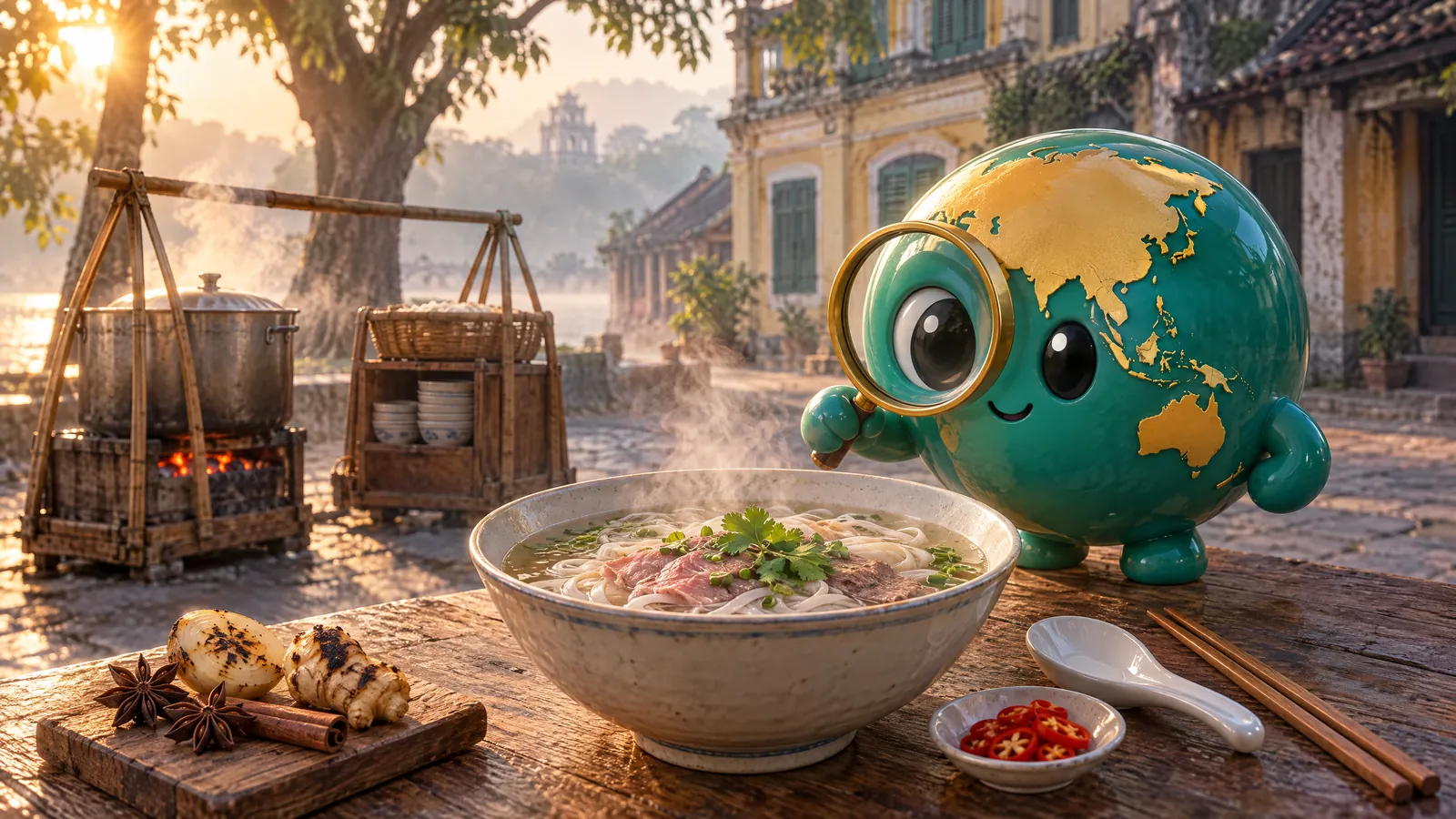
You think pho is old. It is not. Vietnamese pho appeared only about a hundred years ago in the Red River Delta, born from a mix of French beef, Chinese noodles and Vietnamese fish sauce. The dish we now call phở bò, or beef pho, started as cheap street food sold from shoulder poles in Nam Định and Hanoi. That mixing of traditions is what makes its story worth telling. We at Backstory Asia traced it. Here is what we found.
The name: what it means and where the word came from
To understand the history of pho, we start with the word itself. In Vietnamese the dish is written phở, with a horn under the "o" and a rising tone mark above it. Outside Vietnam most people drop the marks and write "pho". The tone matters: say it wrong and you say a different word.
Where did the word pho come from? Nobody knows for certain. There are three main ideas, and each has supporters.
The first links it to the French word for fire: colonial officers in Hanoi ate pot au feu, a slow-cooked beef stew, and "feu" sounds a bit like "phở" to Vietnamese ears. Some historians think local cooks heard French soldiers order it and shortened the sound.
The second points to Chinese: Cantonese traders in the Delta sold a beef noodle soup, ngưu nhục phấn (牛肉粉), and some language experts think "phấn" was shortened into "phở" as Vietnamese speakers made the word their own.
The third starts with an older Vietnamese soup, xáo trâu, made with water buffalo meat and rice vermicelli. As cooks switched from buffalo to beef, the name may have shifted too, landing on "phở" as a street short form.
There is no single dated record that proves one origin. Vietnamese culinary experts still discuss all three paths kindly.
Where it began: the place, the time, the people
Pho appeared in northern Vietnam in the late 1800s to early 1900s, most linked to Nam Định province and Hanoi, both in the Red River Delta.
Vietnam was then under French colonial rule, and French demand for beef led to slaughterhouses near Nam Định and Hanoi. The prime cuts went to French tables; the leftover bones and off-cuts went to Vietnamese and Chinese workers, who simmered them with charred onion, ginger, star anise and fish sauce, ladling the broth over rice noodles: a new dish born from contact and exchange.
Early phở was sold by mobile vendors, gánh phở, who carried hot broth and noodles on a bamboo pole through Hanoi's streets at dawn and dusk, for mill and market workers. Written records appear only in the 1910s and 1920s: a Vietnamese dictionary from around 1931 defines it against Chinese rice-noodle words, while food essays from 1907 do not mention it at all, a gap that tells us phở was new, not ancient.
Nam Định is widely called the cradle of phở: villages like Vân Cù and Dao Cù in Nam Trực District already made fresh rice noodles before phở took shape, and Nam Định pho still uses more fish sauce and wider noodles than Hanoi pho. By the 1930s phở stalls in Hanoi had moved from poles to fixed shops in the Old Quarter.
Anatomy: what it is made of
The parts of a bowl of phở tell the story of who made it and when.
The broth: clear, long-simmered, full of bones
Traditional pho broth starts with beef bones, sometimes oxtail or knuckles. At Phở Thìn in Hanoi and at Monster Pho in Oakland, California, cooks parboil the bones to clear away impurities, then simmer them for up to 12 hours, adding star anise, cinnamon, cloves, coriander seeds and charred onion and ginger, with fish sauce (nước mắm) going in near the end, tying the dish to Vietnam's long coastal trade in fermented fish.
In Hanoi, a clear, light broth that tastes of beef, not of fat or sweetness, has long been the sign of a skilled cook.
The noodles and meat: from buffalo to beef, then to chicken
Pho uses flat rice noodles, bánh phở, made from rice flour and water, a technique that likely came from Chinese noodle-makers already working the Delta.
Early phở used cheap beef cuts: flank, brisket, tendon. As pho restaurants grew, pho tai (rare beef sliced thin, cooked by the hot broth poured over it) became a favourite, along with tripe and meatballs.
Chicken phở, or phở gà, seems to have started around 1939 in Hanoi, possibly because beef was not sold at the markets on certain days. Pho vendors switched to chicken bones and broth, lighter and faster to cook, and it stayed on the menu long after.
The green plate: herbs, vegetables and sauces
In the north, garnishes were spare: spring onions, coriander, sometimes pickled garlic, a few slices of fresh chilli. Hoisin sauce, bean sprouts and Thai basil mark a southern or overseas bowl instead.
One thing, many homes: how each region or community made it its own
One dish name, many local bowls: no single town can fully own phở.
Northern phở: Hanoi and Nam Định
Pho Bac, or northern pho, is the older style, served with fewer garnishes and a savoury, clean broth. Streets like Bát Đàn and Lý Quốc Sư are known for bowls of phở bò with little more than noodles, beef and a scattering of spring onion, and phở is often eaten for breakfast in Hanoi.
Nam Định holds its own claim as birthplace, where pho noodles ran wider and fish sauce was poured with a heavier hand than in Hanoi.
Southern phở: Saigon's sweeter, greener bowl
In 1954 the Geneva Accords, an international agreement, split the country in two. Over a million northerners moved south, carrying phở with them, and in Saigon, now Ho Chi Minh City, cooks adapted it into a sweeter, richer broth with more herbs and sauces: Thai basil, bean sprouts, lime and hoisin.
Southern cooks also turned phở into an all-day dish rather than only a breakfast, and Saigon's phở culture grew through the 1960s into a bowl bigger, greener and sweeter than Hanoi's.
Central Vietnam and other local twists
In central Vietnam, cities like Huế and Đà Nẵng serve their own takes: bowls may be smaller, broths lighter or slightly spicier, and Central Vietnam's pho includes unique toppings like pickled papaya.
From the stall to the world: how it spread
Phở began as a street breakfast in north Vietnam. It is now served in Vietnamese restaurants from Paris to Sydney.
War, peace and the move south
The First Indochina War and the 1954 division moved northern phở to Saigon, where it met new ingredients, new eaters and new habits. By the early 1970s, phở stalls were common across Saigon.
After 1975: the refugee bowl overseas
After the fall of Saigon in April 1975, many Vietnamese people left by boat or by plane, and phở spread globally with the Vietnamese diaspora. Refugees opened small pho restaurants in places like Orange County in California, Paris, Australia and Canada, and most early overseas phở followed the southern style, because most refugees came from southern Vietnam. Local beef stock and herbs replaced the exact Vietnamese ingredients, but the idea held: a clear broth, flat rice noodles, sliced meat and a plate of greens.
More than a dish: what it means to people today
The history of pho is not only about dates and wars. It is also about comfort, identity and memory, eaten at any time of day across social and economic divides.
A national symbol inside Vietnam
Phở is widely seen as Vietnam's national dish. December 12 is "Day of Pho," started by the newspaper Tuổi Trẻ in 2017 and co-sponsored by Acecook Vietnam, marked that first year with a gala in Ho Chi Minh City. In 2024 Vietnam's Ministry of Culture, Sports and Tourism named the pho of both Hanoi and Nam Định a national intangible cultural heritage.
Home in a bowl for the Vietnamese diaspora
Overseas Vietnamese people use phở to feel close to home. Tee Tran fled Saigon by boat in 1987 at age three, with his mother and brothers, and grew up in refugee camps before the family settled in California. In 2014 he opened Monster Pho in Oakland, cooking the southern-style broth his mother made, rock sugar and all. "Pho is our staple," he says. "We'd beg our mom to make it when we were little." Stories like his fill diaspora kitchens, where debates about authentic pho are really about identity, not the exact recipe.
Pho's diaspora road did not run only west. Vietnam's government once sent workers to study and labour in the Soviet Union and its allies; some stayed on, building Vietnamese communities in the Czech Republic and Germany. "A lot of Chinese restaurants were run by Vietnamese people who didn't have the confidence to introduce Vietnamese food," says Trinh Thuy Duong, a Hanoi-born food blogger who settled in Prague with her family in the 1990s. Around 2010 a pho restaurant opened in the city's centre; lines formed out the door, and Prague has had a pho scene since.
Shared heritage, shared table
Phở sits within Backstory Asia's record of Southeast Asian food origins, in a wider family of Asian noodle histories: Chinese beef noodle soup, Cambodian kuy teav, Thai boat noodles. They are cousins, not rivals, each carrying its own colonial-era fusion story, the way nasi lemak and roti canai do for Malaysia. Phở reflects Vietnam's adaptability, shaped by trade routes, mixed streets in river cities and cooks who borrowed and changed freely.
If you like stories like this, join the Backstory Asia email list for one new origin story each week.