
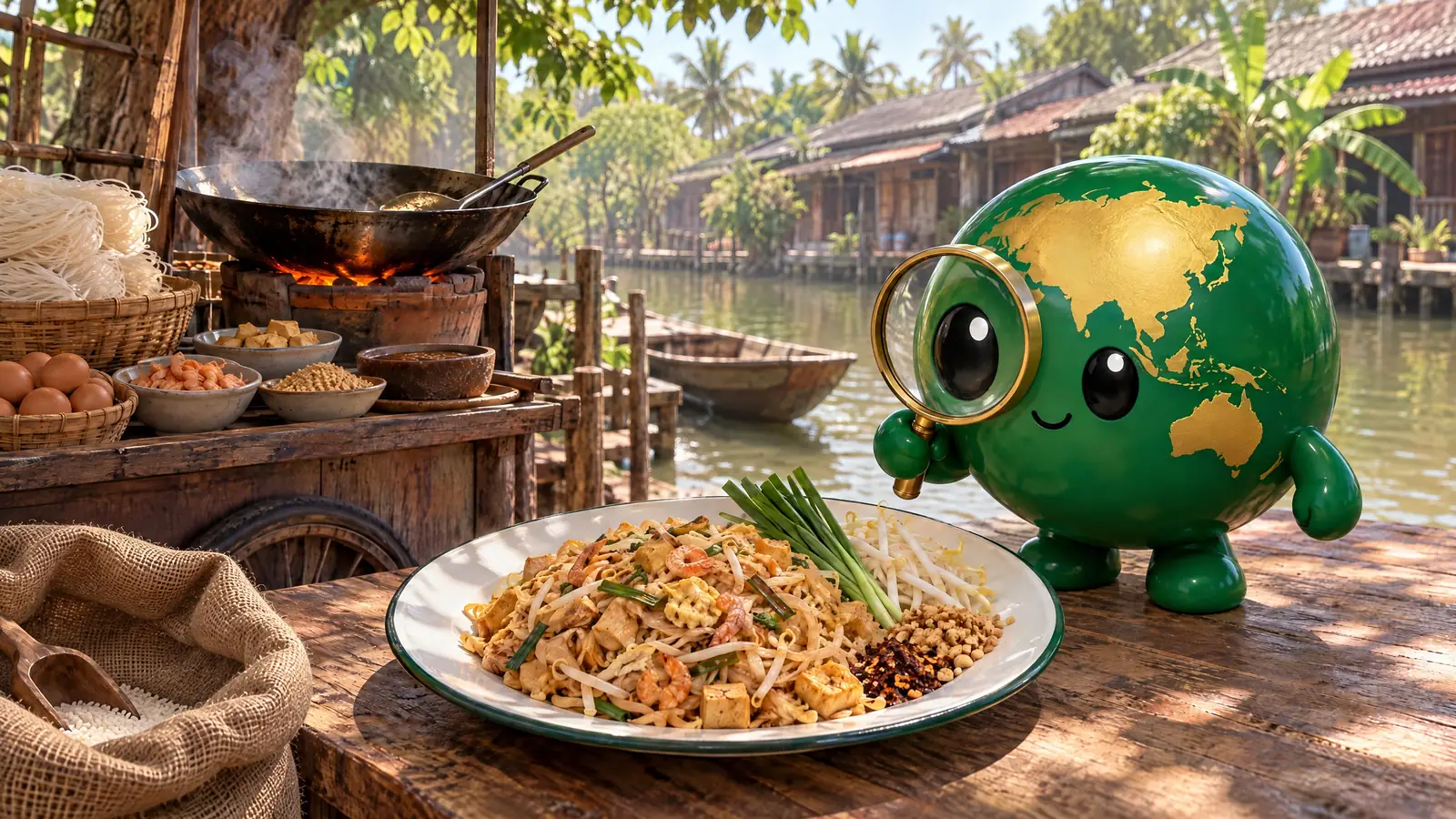
Most people think pad thai is ancient. It is not. The dish, as named and recognised today, rose to prominence in the 1930s and 1940s in Bangkok, pushed by a government facing a rice shortage and trying to build a new national identity. Pad thai became Thailand's national dish because a prime minister needed people to eat fewer bowls of plain rice. That is the twist. The rest of this page is the full story.
The name: what it means and where the word came from
People treat the words "pad thai" as though they have always existed. They have not. The name is young, and it is tied to 20th century politics.
The Thai word pad (ผัด) means stir fried. You hear it in dozens of wok dishes across Thailand, from pad see ew to pad kra pao. It is not special to this one noodle dish.
The word thai (ไทย) points to the Thai people and their language. The country we now call Thailand only took that name officially in 1939. Before that it was Siam. The renaming happened under Prime Minister Plaek Phibunsongkhram, often called Phibun, as part of a larger push to shape a modern Thai identity.
Older menus and documents used a longer name: kuai tiao pad thai. The words kuai tiao come from Teochew and other Southern Chinese dialects. Chinese traders and migrants in Siam used them for flat rice noodles. So the original name itself tells you the dish sits at a meeting point of Chinese influence and Thai cooking.
Over time the name shortened. Kuai tiao pad became kuai tiao pad thai, which became simply pad thai. That shift matched the state push to label things as "Thai" during the cultural mandates known as Ratthaniyom. The name Pad Thai translates to Thai-style stir fry, a compact, national label for a noodle dish that had Chinese roots.
No source puts the words "pad thai" on paper before the 20th century. Stir fried rice noodles existed in some form before the 1930s, but nobody called them pad thai. As the food historian Mark Padoongpatt puts it, pad thai is "not this traditional, authentic, going back hundreds of years dish"; it was built in the 1930s as part of a nation-building push. The name, and the recipe as we know it, are modern.
Here are the name changes, laid out simply:
Kuai tiao pad: a general term for fried rice noodles, used by Chinese-Thai vendors before the 1940s.
Kuai tiao pad thai: the mid-1940s version, combining the Chinese noodle word with "Thai style."
Pad thai (also written phad thai or phat thai): the shortened form that stuck after official promotion.
Where it began: the place, the time, the people
Pad thai, as a named dish, was born in Bangkok in the late 1930s and early 1940s. It was promoted by Prime Minister Plaek Phibunsongkhram during a time of war, rice shortages and nation-building. It was not handed down from palace kitchens or temple feasts.
After the 1932 revolution ended absolute monarchy, Siam turned towards nationalism. Phibun came to power in 1938. His government launched the Ratthaniyom cultural mandates, a set of rules meant to shape how people dressed, spoke and ate. Food was part of the plan.
During World War II, Thailand faced a rice shortage, worsened by the war and by floods. Noodle dishes were promoted as an economical alternative to plain rice, to stretch limited rice supplies further.
By one often-repeated account, the Thai government encouraged the spread of pad thai by backing street food vendors: officials created or standardised a recipe, originally called kuai tiao pad thai, and sent vendors out with carts across Bangkok. Some accounts say carts were given away free. We should be honest here: written proof from the time is thin. Much of what we know comes from later memoirs and historians' reconstructions, not official documents. Nobody wrote it all down at the time.
What we do know is that Chinese-Thai cooks and noodle vendors were the real hands behind early pad thai. Stir-fried rice noodles were introduced to Thailand by Chinese traders. These cooks already worked with woks, dried shrimp, tofu and rice noodles. The government gave the dish a name and a purpose. The cooks gave it life.
Three forces came together to create pad thai:
War-time rice policy: the need to reduce rice consumption during shortages.
Chinese-Thai wok skills and an existing noodle culture in Bangkok's markets.
Phibun's nation-building campaigns, which wanted a national dish to match the new national name.
Anatomy: what it is made of, or how it is done
The version described here is the classic central Thai pad thai of the 1930s and 1940s, not the modern fusion plates you might find in a London restaurant or a hip cafe in Chiang Mai.
Pad thai uses thin rice noodles as a base. The government-era dish was itself named sen chan pad thai, after Chanthaburi province in eastern Thailand, where this noodle style is made. Thipsamai, a famous Bangkok pad thai restaurant, still markets sen chan noodles as something special today.
The sauce is where the flavour lives. Pad thai sauce is made from tamarind, fish sauce, and palm sugar, with dried chilli for heat. These four tastes, sour from tamarind paste, sweet from palm sugar, salty from fish sauce, and spicy from chilli, form the backbone of the dish. Pad thai combines local elements like tamarind, fish sauce, garlic, dried shrimp, palm sugar, and peanuts into a single wok.
Key ingredients include shrimp, eggs, and tofu. Early recipes used firm tofu, small dried shrimp, garlic chives, bean sprouts and egg, with ground roasted peanuts tossed on at the end. Large fresh prawns were not the standard. Dried shrimp kept well and cost less, which mattered during shortages. Preserved radish, called chai poh, added crunchy, sweet-salty bursts.
The flavour code of pad thai
The dish balances sweet, sour, salty, and spicy flavors. No single taste is meant to take over. That balance of four tastes is a core idea in Thai culinary culture.
Early stall versions were lighter and drier than many restaurant plates today.
This habit of letting each eater season their own plate is standard Thai street food practice, not something pad thai invented, but it helped visitors later see the dish as customisable.
One thing, many homes: how each country or community made it its own
Pad thai began as a central Thai street dish. Over time, Thai regional towns, migrant communities and foreign diners each bent it to fit their own kitchen and taste. Many families, one dish.
Within Thailand itself, people describe variations, though we found no sourced survey of them by region: southern cooks are said to add fresher seafood or prawns, and in rural homes, the plate is said to run simpler, with less sugar, seasonal greens instead of store-bought chives, and whatever protein is on hand.
Community-based twists add more layers. Muslim Thai cooks keep every sauce and paste halal, rather than removing pork that was never in the recipe to begin with. Chinese-Thai families are said to add extra preserved radish or tofu, echoing Teochew stir fries. Vegetarian and vegan versions, increasingly offered across Thai cities, swap fish sauce for soy sauce and skip the eggs.
Neighbours in Southeast Asia, such as Laos and Cambodia, have noodle dishes that sit close to pad thai in technique or flavour, the same hybrid-kitchen story told in laksa and pho. They are named and remembered differently in their own languages. We note the family likeness. We take no side.
By common account, pad thai became the safe entry dish on overseas Thai restaurant menus, from Los Angeles to Sydney to Singapore to London. It is often tuned to local habits: less chilli, more sugar, chicken as the default protein instead of dried shrimp. Pad thai's development reflects its Chinese roots, and each new place it lands adds another layer. On many of those menus, mango sticky rice is the dessert, a sweet first shaped in Siam's royal kitchens.
Four plates, four contexts:
Bangkok worker's lunch: small portion, cheap protein like dried shrimp and tofu, strong sour notes, modest garnish.
Thai home-cooked version: balanced flavours, seasonal other vegetables, no commercial preserved radish.
Thai-American restaurant plate: larger serving, generous prawns or chicken, brighter colour, more sauce, more oil.
Hip cafe version: brown rice noodles or gluten-free noodles, plant-based protein, less fish sauce, more garnish, culinary creativity on display.
From the stall to the world: how it spread
Pad thai's global fame is recent. In the late 20th century, pad thai became associated with Thai street food and later gained international recognition, riding on migration, tourism and state food diplomacy.
From the 1960s onwards, Thai students and other migrants settled in the United States in growing numbers, climbing from about 5,000 arrivals in the 1960s to roughly 44,000 in the 1970s. Many of the early arrivals were students, among the first to open small restaurants, at times filling in with Chinese ingredients where real Thai ones were hard to find. Pad thai sat near the top of the menu because it used simple pantry items and was easy to cook fast.
By one often-repeated account, the tourism boom from the 1970s onwards brought backpackers to Bangkok and beach towns like Hua Hin, with Khao San Road becoming their best-known base a little later. Pad thai was cheap, filling, and not too spicy for visitors. It was often their first taste of Thai cuisine. Few dishes crossed the language barrier as easily.
In the early 2000s, the Thai government took a more deliberate approach. In 2001, Thailand established the Global Thai Restaurant Company to expand the country's restaurant presence abroad. Pad thai featured as one of the flagship dishes. This was gastrodiplomacy: using food to project the country's image. Thailand offers its cooking as a kind of ambassador.
English-language cookbooks and food shows are often credited with turning pad thai into a gateway recipe into Thai cooking from the 1990s onwards, and packet sauces and instant noodle kits followed it onto supermarket shelves far from any Bangkok stall.
Pad Thai has evolved into a global symbol of Thai cuisine. Its modern identity traces back to Phibun's nation-building campaigns of the late 1930s and early 1940s, carried further by the tourism and migration waves that followed.
Key moments in pad thai's rise
Late 1930s to early 1940s, Bangkok: Government promotion during rice shortage and national identity campaigns under Phibun. Pad Thai became Thailand's national dish.
1950s to 1960s, Thailand's cities: Pad thai is said to settle in as common street food, cooked on charcoal in markets and alleys.
1970s to 1980s, tourism boom: Travellers taste pad thai in Bangkok and coastal towns, then look for it back home.
1980s to 1990s, overseas Thai restaurants: Pad thai is said to appear on menus from Los Angeles to London, becoming a familiar choice for many diners.
2000s onwards, food diplomacy and global media: Thai government supports restaurant spread. Food shows and blogs present pad thai as the face of the country's history in a bowl.
2010s onwards, supermarket kits and instant noodles: Branded pad thai sauces and noodle packs take a simplified authentic version of the dish into home kitchens around the world.
More than a dish: what it means to people today
Pad thai now carries many layers of meaning. In Bangkok it is comfort food, a quick lunch for workers and students. Abroad it is often the first Thai dish people try. For the Thai state it is a national symbol, printed on tourism posters and served on airline trays.
Inside Thailand, pad thai sits in a different place from rice-based meals like curry and rice. It is quick, urban, often eaten outside the home, tied to work breaks, school canteens and late-night suppers. It is not a royal or temple dish. It belongs to the street. Pad Thai is often perceived as a traditional Thai dish despite its modern origins.
Thai schoolbooks, posters and airline menus are said to have used pad thai as visual shorthand for the nation. Yet grandparents may remember a time before it was common. The dish reflects the cultural and historical influences that shape national cuisines over time.
For Thai people abroad, pad thai is a reminder of night streets, smoky woks and shared tables. In cities like New York, Singapore, Paris or Melbourne, ordering it is a small act of home. Even a simple restaurant plate can carry the memory of a Bangkok alley.
Some younger Thai chefs are said to go back to older, lighter styles of traditional pad thai, seeking out sen chan noodles, reducing sugar and oil, and stressing local ingredients and sustainable sourcing. They use the dish to talk about history and resource use, including the original link to rice policy and wartime hardship. Pad Thai illustrates the fusion of Chinese and Thai culinary traditions, and this story, of shortage and adaptation, is worth telling.
Pad thai is not just a famous dish you order when the menu is long and unfamiliar. It is a record of the 1930s rice shortage, of Chinese-Thai wok skills passed through market stalls, and of the choices made by families on both sides of the counter.
The next time you pick up a plate, you are holding a piece of a country's history. Pad thai remains proof that everyday food carries stories of people, policy and survival.
If you like stories like this, join the Backstory Asia email list.