
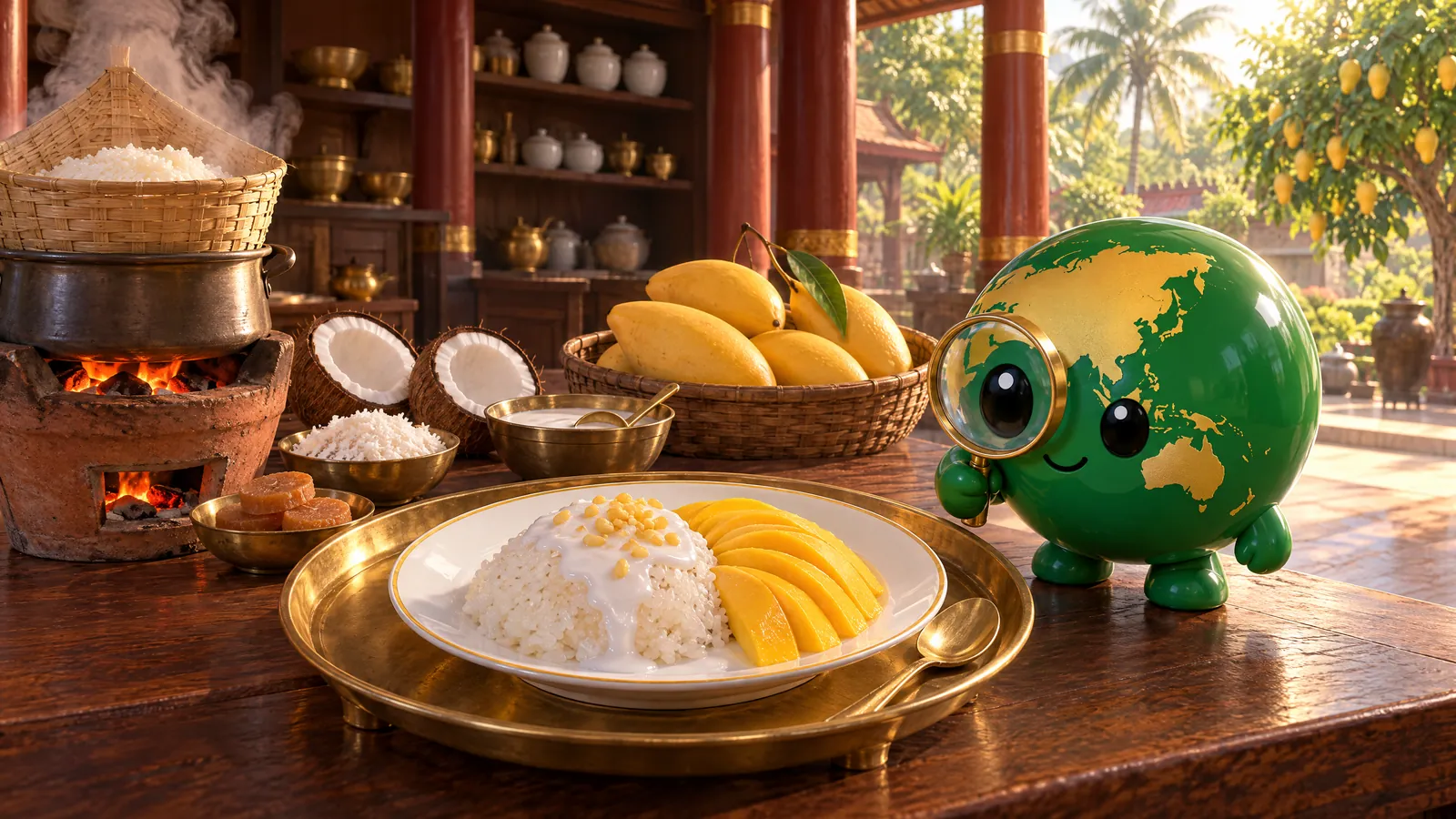
Most people think mango sticky rice is an ancient street food that appeared on a cart one day and never left. The twist is simpler: the dish we know was shaped in the royal kitchens of Siam, first clearly documented at the court of King Rama V, and only later walked out to the street stalls and then the world.
Mango sticky rice originated in Thailand during the Ayutthaya period, when coconut sticky rice sweets already existed in palace cooking. The dish was refined during the Rattanakosin Kingdom, with sticky rice recorded alongside ripe mango during King Chulalongkorn's reign in the late 1800s. Its Thai name is khao neow mamuang, and the classic version includes glutinous rice, ripe mango, and coconut milk. Today it is a staple dessert across Southeast Asia and one of the most recognised examples of Thai food anywhere on earth.
The name: what it means and where the word came from
The full Thai name is khao neow mamuang (ข้าวเหนียวมะม่วง). Three words, three ingredients.
Khao means rice. Neow means sticky or glutinous, the type of rice that clings together when cooked instead of falling apart into fluffy grains. Mamuang means mango. Say the three words together and you have described the whole plate.
Some older Thai cookbooks add extra words like nam kathi (coconut milk) or wan (sweet) to signal the coconut cream side of the dish. But in common speech, the short form is what people use today.
In English the dish appears as "mango sticky rice", "Thai mango sticky rice" or "sticky rice with mango". All point back to the same Thai phrase. The dish is known as khao neow mamuang in Thai, and that name has not changed.
A brief note on neighbours: Lao and Khmer languages have their own close phrases for sticky rice and mango desserts. In Lao, sticky rice is khao niao. In Khmer, a similar concept exists. But the exact three-word name khao neow mamuang is Thai in its spelling and its sound.
Where it began: the place, the time, the people
The best evidence places mango sticky rice as a Thai dessert that took shape in central Siam during the late Ayutthaya period, which ended in 1767, and the early Rattanakosin era that followed. Mango sticky rice originated in Thailand during the Ayutthaya period, when court kitchens were already making coconut sweetened sticky rice desserts with seasonal fruit.
The setting matters. Central Thailand sits on wide, flat plains with wet rice fields, coconut palms and mango orchards. After Bangkok was founded as the capital in 1782, the royal courts there had easy access to all three ingredients. Glutinous rice has been cultivated in Southeast Asia for thousands of years, with early evidence of rice farming in what is now northern and northeastern Thailand reaching back to around 2000 to 1500 BCE. Sticky rice was everyday food in Isaan and the north. In the central plains it became a dessert starch, something court cooks worked with to make sweets.
King Rama II (reign 1809 to 1824) is often linked to this story. He was known for poetry, drama and a deep interest in food. In 1800, while still Prince Itsarasundhorn, he wrote a poem called Kap He Chom Khrueang Khao Wan, a set of verses praising fruits and desserts served at court. The poem itself praises lychee, persimmon, custard-apple, pomegranate, durian, langsat and salak; it does not name mango. The clearer evidence sits later: a written record from the late Ayutthaya period already describes ok rong mango, a cultivar native to Thailand, and during King Rama V's reign (1868 to 1910) a source describes sticky rice served alongside ripe mango.
Mango's own story reaches back further. It is often said to have been domesticated in India around 4,000 years ago, though botanists still debate the exact origin. By the late Ayutthaya period, mango was already an established, named cultivar in Thailand. Glutinous rice grew across mainland Southeast Asia long before any kingdom wrote it down. What Siam's royal kitchens did was bring these three together, add sugar and salt, and set a form that people still recognise today.
We should say plainly: people in Laos, Cambodia and Myanmar also had sticky rice sweets with fruit. Variations of sweet sticky rice with mango exist across Southeast Asia, including Laos and Cambodia. That makes it hard to fix a single first bowl. What looks like invention is often the moment a mix becomes famous at court or in a capital, not the first time anyone tried it.
Anatomy: what it is made of, or how it is done
Thai mango sticky rice incorporates a combination of sweetened coconut sauce, glutinous rice, and ripe mango. Picture it: warm, creamy coconut sticky rice on one side, cool slices of fresh mango on the other, the whole thing covered in a thin pour of coconut cream. The taste is sweet, a little salty, and deeply tropical.
Mango sticky rice uses glutinous rice as a base, a type grown across Southeast Asia and parts of South Asia. It does not get fluffy like the long-grain rice you may know. Instead, it turns soft and sticky when steamed rather than boiled, and that difference is what gives it its texture.
The coconut part is simple. Coconut milk is squeezed from the grated flesh of a mature coconut. Sugar is added, along with a pinch of salt to balance the sweetness. Old recipes use palm sugar or cane sugar depending on price and region. Coconut cream is mixed with sticky rice for flavour while the rice is still hot, so the grains absorb it fully.
Ripe mangoes are essential for authentic mango sticky rice. The most common mango variety used is Nam Dok Mai, a yellow, fragrant, sweet fruit grown across central Thailand. Another good variety is Ok Rong. These are not the green, fibrous mangoes eaten in salads. Their peak season in central Thailand runs from about March to May, which is why the dish is traditionally consumed during the hot season from April to May.
Over the finished plate, extra thickened coconut cream is poured. Then comes a handful of garnish: crispy yellow mung beans or toasted sesame seeds are sprinkled on top for crunch.
Each part of this dish came from a different place in time. Mango from India. Sticky rice from the paddies of Southeast Asia. Sugar from cane and palm. They met in the kitchens of central Siam and have not parted since.
One thing, many homes: how each country or community made it its own
The mango sticky rice most people picture is Thai. But coconut sticky rice paired with seasonal fruit belongs to many homes across mainland Southeast Asia.
In Thailand, Bangkok vendors set neat fans of mango beside gleaming white rice, pour coconut cream over the top, and add a scatter of mung beans. Some shops in central Thailand now offer pandan-scented green sticky rice or use black glutinous rice for colour and earthiness. These are recent twists, mostly from 21st-century cafés.
In Laos, sticky rice is the main daily starch, eaten by hand at every meal. Lao families make sweet coconut sticky rice and serve it with whatever ripe fruit is on hand, including mango when the season arrives. It is not always given a special name. It is simply food at home.
In Cambodia, Khmer cooks make coconut sticky rice desserts with banana or jackfruit. When mango is available, mango takes the place of the other fruit. The result looks very close to the Thai version, but it belongs to its own kitchen and its own day.
Variations of mango sticky rice exist in the Philippines and Vietnam as well. In the Philippines, a coconut-milk sticky rice snack called puto maya is served with ripe mango. In Vietnam, sweet sticky rice called xôi has only recently taken on fruit pairings like mango, a trend that did not exist in past decades.
Overseas, Thai and Southeast Asian communities brought the dish with them. Thai restaurants in Singapore, Sydney, London and Los Angeles put mango sticky rice on menus as a signature Thai dessert. Diaspora cooks adapt to what they can buy: honey mango in one city, alphonso in another, tinned coconut milk when fresh coconut is hard to find. The ingredients change. The idea stays the same.
From the stall to the world: how it spread
Mango sticky rice is popular street food in Thailand today. But it was not always sold from a cart.
After Bangkok was set as the capital in 1782, royal styles of cooking slowly spread from court to noble households, and then to town homes. By the reign of King Rama II, sweets and fruits had their own poetic praise at court. By the time of King Rama V (reign 1868 to 1910), the pairing of mango with sweet sticky rice appears more clearly in written sources.
In the mid-20th century, Bangkok grew fast. Street food culture expanded with the city. Mango sticky rice became a common street dessert, sold during mango season in paper and foam boxes to office workers and students. Thai-language cookbooks from that era set a standard form of the dish for home cooks: soak the rice, steam it, mix in coconut, serve with sliced mango.
Then came tourism. From the 1980s onward, Thailand welcomed millions of visitors a year. Hotels and tourist-facing restaurants put mango sticky rice on English menus alongside pad thai. Guidebooks named it the national dessert. Mango sticky rice is commonly sold during Thailand's mango season, and visitors learned to time their trips for it.
Thai families and migrants carried the dish further. Thai restaurants opened in cities across the world, and mango sticky rice became their reliable dessert, because it used familiar ingredients but tasted different enough to feel new. Food TV and YouTube brought it to screens. The dessert saw a surge in international fame when Thai rapper Milli ate it live at Coachella in 2022, an image that spread fast and drew younger fans to watch and learn about the dish.
Mango sticky rice is a staple across Southeast Asia today, and its reach has only grown. Black sticky rice versions, vegan plates, mango-inspired ice creams and cakes all add new layers. The street stall did not disappear. It just gained company.
More than a dish: what it means to people today
Mango sticky rice is not just a sweet plate. It holds memories of season, family and place.
In central Thailand, the dish signals the start of the hot season and mango time. Seasonal traditions connect the dish with agricultural practices and communal events, and mango sticky rice is heavily associated with Songkran, the Southeast Asian New Year. Families buy it from their regular vendors. Grandparents remember simpler, less sweet versions from their own childhood. Children learn to like the mix of warm rice and cold fruit one bowl at a time.
Across the region, people in Laos, Cambodia, Vietnam and Myanmar who taste mango sticky rice see their own sticky rice desserts in it. Many families recognise themselves in the same bowl, even when the name and the garnish differ.
For the diaspora, the dish takes on another weight. A Thai or Lao student in Melbourne or London finding it in a small restaurant can use it to feel closer to home. The smell of coconut and ripe mango can pull up the memory of a childhood market or a hot afternoon, even when eaten in a cold city on a grey day.
New meanings keep arriving. Vegan diners choose mango sticky rice because every ingredient is plant-based. Younger cooks turn it into cakes, ice creams and café-style plates. These changes add to the story instead of erasing older ways.
From the royal kitchens of Rama V to plastic boxes at night markets and dessert plates in cities that never see a mango tree, the same trio holds: rice, coconut, mango. That is a long life for three ingredients and one good idea.
Mango sticky rice is one of the journeys traced on Backstory Asia's food desk, alongside nasi lemak, laksa and hainanese chicken rice.
If you like stories like this, join the Backstory Asia email list. One origin story a week, nothing more.