
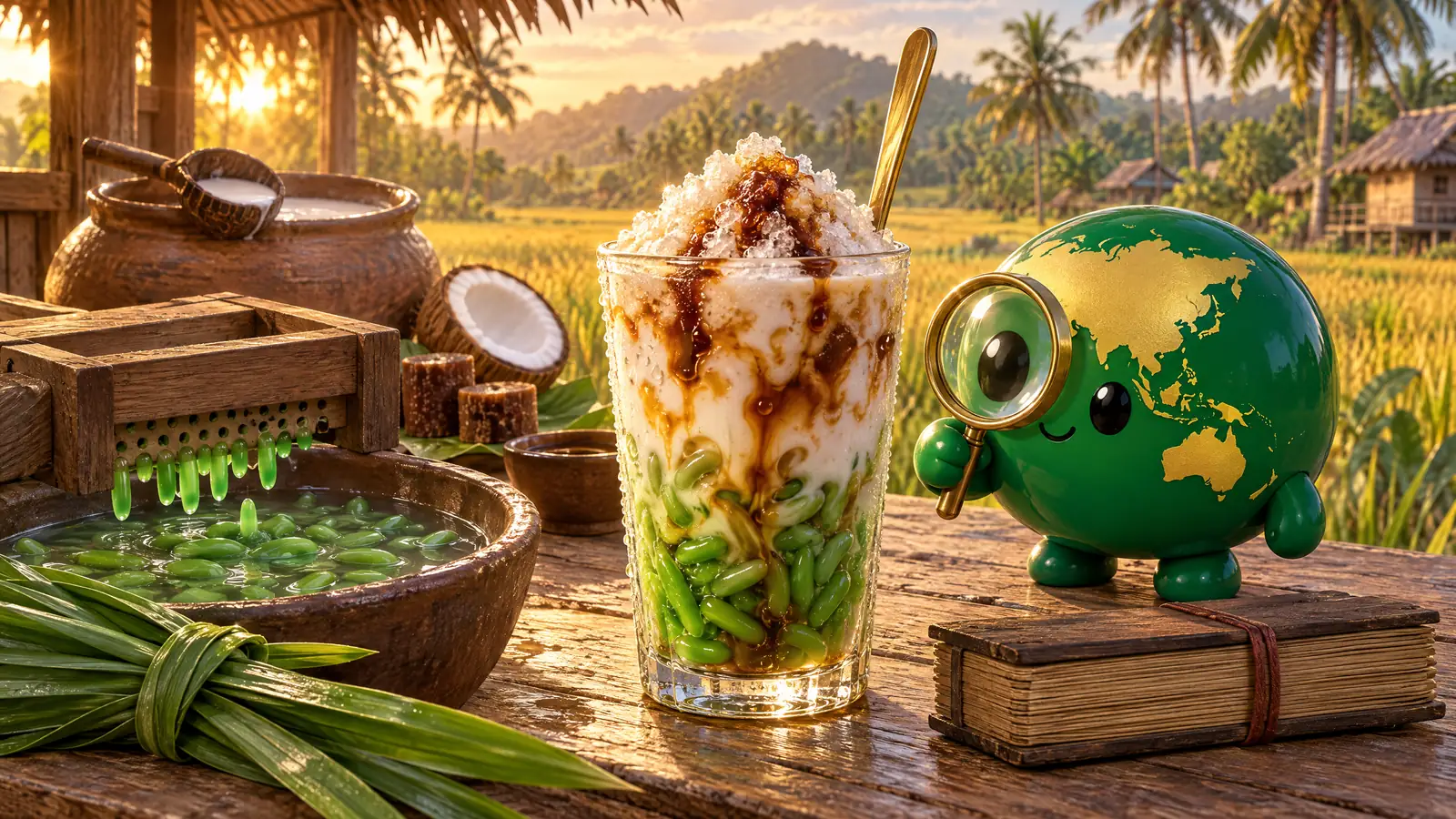
You think cendol is a modern hawker drink. It is not. The earliest written reference to a sweet resembling cendol appears in a 12th-century Old Javanese poem from the Kediri Kingdom in East Java.
Cendol is an iconic iced dessert across Maritime Southeast Asia. A glass holds three simple things: green rice flour jelly pressed into short, worm-like strands, dark palm sugar syrup, and cold coconut milk, usually poured over shaved ice. The dessert has evolved from a simple village snack to a global dessert icon, and its story runs through Java, Malaysia, Singapore, Thailand, Myanmar and Vietnam. The earliest written records of a dessert resembling cendol come from Java, Indonesia, but today it belongs to many homes. This is that story.

Prefer to watch? This story is Episode 4 on our YouTube channel: Chendol: The Dessert That Predates the Ice.
The name: what it means and where the word came from
We start the history of cendol by looking at the word itself.
The spelling changes by place. Indonesia and most parts of Malaysia spell it cendol. In Singapore, you will often see chendol, shaped by English writing habits. Older books from the Dutch colonial era wrote tjendol. In Central and East Java, many people call the same sweet dawet. Thailand calls it lot chong, Burma calls it mont let saung, and in Vietnam, the green noodles are called bánh lọt. All of these names refer to a similar concoction: green jelly strands served in coconut milk and sugar syrup.
The leading idea among language scholars links cendol to the word jendol in Javanese and Malay. Jendol means a bump, a bulge, or something swollen, a small lump. The thought is that the soft jelly pieces look like little bumps. This is the most widely accepted origin of the word.
There is another popular belief. Some Malay language writers suggest the name comes from the sensation of the jelly bumping against the palate when you drink it. It is a nice idea, but no dated early source supports it.
We should be honest: there is no single written record that proves one meaning over the other. The "bump or lump" family of words is the one most linguists favour.
One more thing about names. The Thai word lot chong translates roughly to "gone through the hole". It describes the way the dough is pressed through filters or a mould. This tells us something useful: in each language, the name describes the feel, the look, or the making of the sweet, not the country it came from.
Where it began: the place, the time, the people
The earliest written reference we have for a cendol-like sweet appears in Kakawin Kresnayana, a 12th-century Old Javanese poem from the Kediri Kingdom of East Java. The text mentions sweet drinks with rice flour and coconut that scholars believe resemble dawet. The reference is suggestive, not a detailed recipe, and we should say so plainly. Nobody wrote down an exact match at the time.
A clearer literary window comes from Serat Centhini, a large collection of Javanese poems and stories published in 1814, commissioned by the crown prince who later became Pakubuwono V of Surakarta, Central Java. The stories are set in an earlier Javanese world.
Dutch colonial records from the 1800s give us harder evidence. A Makassarese-Dutch dictionary from 1859 records tjêndoloka as a local sweet made from rice or sago flour, cooked, pressed through a frame with holes to form small pieces, then mixed with coconut milk and syrup. The 1866 Oost-Indisch Kookboek, an East Indies cookbook, includes a recipe titled "Tjendol of Dawet". Jan Pijnappel's 1869 Malay-Dutch dictionary describes tjendol in similar terms. By the 1890s, a Malay-English dictionary in Perak recorded the word chendul. These records show the name and the preparation were well established across Java and the Malay Peninsula by the mid-19th century.
Who made it first? We cannot name a single inventor. Cendol grew among Javanese villagers who had rice, coconut and palm sugar at hand, Malay cooks along the Straits of Melaka, and traders who carried ingredients and ideas between ports. The sweet originated in the rice and coconut belt of Java and the wider Malay world, then spread along trade and migration routes. Javanese sources use the word dawet early. Later Malay sources use cendol. Both describe a similar sweet, so we treat them as close cousins in the same dessert family: many families, one thing.
Anatomy: what it is made of, or how it is done
Let us pause the story and open the glass to see what is inside a bowl of cendol.
Three main parts. First, the green jelly strands. Chendol features green jelly noodles made from rice flour, sometimes mixed with mung bean starch or tapioca. Chendol's jelly noodles are flavoured with pandan leaves, a common leaf in South East Asia that gives a green colour and a soft, leafy smell. The cooked dough is pressed through a special sieve or mould into cold water so it forms short, worm-like pieces. This is the pandan jelly that gives cendol its look.
Second, the sweetener. Gula Melaka is the traditional sweetener for chendol in the Malay Peninsula. In Java it is called gula jawa. Both are types of coconut palm sugar or sugar palm (Arenga pinnata) sugar, boiled into a dark syrup with a smoky, caramel-like sweetness.
Third, coconut milk. Fresh milk pressed from grated mature coconut flesh, sometimes thinned with water and lightly salted so the sweet does not taste flat. Coconut milk has always been central to the drink.
Then there is the ice. Cendol was historically enjoyed warm or at room temperature. The modern edition of cendol relies on shaved ice for a refreshing treat, a change that came with the arrival of ice factories in colonial towns. Cendol's evolution was influenced by the introduction of refrigeration technology, turning older dawet into the cold dessert we know.
Other ingredients arrived later as stalls competed. Red beans, sweet corn, glutinous rice, grass jelly, and sometimes durian are common add-ins. Modern adaptations of cendol include creative toppings such as durian and avocado. These grew with supply chains and the business of hawker-centre rivalry, but the heart of the bowl stays the same: green rice flour jelly, palm sugar syrup and coconut milk.
One thing, many homes: how each country or community made it its own
Cendol history is shared. Each place shaped the sweet with its own name, starch and toppings. Regional variations of cendol exist in Indonesia, Malaysia, and Thailand, and beyond.
Cendol and dawet in Indonesia
In Java, the sweet is more often called dawet. In parts of Sumatra and other islands, people say cendol. Both names live side by side in Indonesia. The dessert is popular in Malaysia and Indonesia alike, but in Indonesian culture, dawet holds a special place.
Es Dawet Ayu from Banjarnegara in Central Java became famous across Indonesia in the 20th century. It uses soft green jelly, coconut milk, palm sugar syrup and sometimes tiny black sticky rice pearls, sold from large clay pots at markets. Dawet ireng from Purworejo uses black jelly formed with burnt rice husk or ash, an example of how local ingredients turned one base idea into many variations.
Cendol is often associated with community and traditional celebrations in Java. In Javanese weddings, village rites and harvest festivals, dawet is sold cheaply or given away, a kind of communal refreshment that points to its long roots in local social life.
Cendol in Malaysia and Singapore
In Penang, cendol became deeply embedded in local food culture: it was sold at first by itinerant street vendors, then found a permanent home in hawker stalls. Gula Melaka is a key ingredient in traditional chendol here, and the palm sugar from Melaka and nearby parts of Sumatra gave Malayan cendol its distinct taste. Cendol has been recognised as a national heritage food in Malaysia.
In Singapore, the spelling chendol took hold under English influence, but the drink stayed close to the Malacca style: fine shaved ice, cendol worms, coconut milk, gula melaka syrup and often red beans. Cendol is often served in local markets and hawker centres in Southeast Asia, and Singaporeans know it as a pasar malam and kopitiam staple. In Melaka, stall clusters along Jonker Street have served versions for decades, with some families claiming roots in the 1930s or 1940s, though these are family memories, not written records.
Older Malay cookbooks and food columns from the mid-20th century, printed in Kuala Lumpur and Singapore, helped fix cendol as a national comfort dessert in the public mind.
Cendol cousins in Thailand, Myanmar and Vietnam
Green flour worms in sweet coconut milk appear right across mainland Southeast Asia.
In Thailand, lot chong is a pair of short pandan jelly strands served with coconut milk and palm sugar syrup, sometimes over ice. Some Thai sources trace an earlier form, called nokploi, to Hindu and Brahmanical ritual food traditions, with evidence reaching back to the reign of King Narai, around 1672 to 1688.
In Burma, mont let saung is a close cousin: rice flour dumplings or strands in jaggery (a kind of palm sugar) syrup and coconut milk, eaten during the heat of the hot season and during Thingyan, the Burmese New Year water festival.
In Vietnam, chè bánh lọt includes green jelly strips in coconut and sugar. The word lọt means "to slip through", another reference to pressing dough through holes.
These are not copies with a clear parent and child. They are related sweets that grew in a region where rice flour, coconut and palm sugar were everywhere. Many families, one thing.
From the stall to the world: how it spread
Cendol moved first with people inside Southeast Asia. The ingredients of cendol highlight the influence of trade and migration in Southeast Asia. It is one entry in Backstory Asia's record of Southeast Asian food origins, the same trade and migration story that carried laksa through Peranakan port kitchens.
The growth of colonial port cities like Singapore, Penang and Batavia (now Jakarta) under Dutch and British rule created dense street food scenes. In these busy places, cendol stalls became a cheap way to cool down in tropical heat. Travel writing and newspapers from the period mention cold sweets with green worms and coconut milk sold by hawkers along busy roads. Ice factories built in colonial towns made shaved ice desserts like es cendol and ais kacang easier to sell daily. The drink now called es cendol took shape in that era. In Manila, cheap ice from a colonial ice plant fed the Japanese-run stalls that grew into halo-halo.
After the Second World War, migration spread cendol beyond the region. Malay, Indonesian and Singaporean communities opened restaurants in the Netherlands, the United Kingdom, Australia and the United States, often putting cendol on the menu. Commercial production has made cendol more widely available: instant cendol kits, canned coconut milk and frozen versions let home cooks overseas recreate parts of the taste. Food bloggers and video channels carried the image and story further still.
Even so, cendol remains mostly a Southeast Asian sweet. Outside the region it is still a niche find, located in Indonesian warungs, Malaysian eateries and Southeast Asian dessert shops. Cendol has become an iconic symbol of street food in Southeast Asia, but a quiet one abroad.
More than a dish: what it means to people today
Cendol history is about more than a recipe. It is about memory, heat and home.
In Indonesia, dawet and cendol mark both everyday refreshment and special moments. A scoop of green jelly in a glass of coconut milk is sold in village markets, mixed into wedding processions, and served at harvest events. Sharing a glass is tied to wishes for smooth life and sweet fortune. Cendol is significant in Indonesian and Malaysian culinary heritage, a traditional dessert that quietly connects rice farmers, palm tappers and coconut growers to the region's taste.
In Malaysia and Singapore, cendol is linked to childhood, school holidays, pasar malam treats and hawker-centre lunches. Many of the same hawker centres and kopitiams that serve cendol also serve nasi lemak and Hainanese chicken rice, other dishes carried by the region's shared migrant kitchens. Many people abroad name it as the first dessert they miss. Chendol is believed to have originated in Southeast Asia, and for many Malay, Javanese and Peranakan families, it is proof of that shared origin in every bowl.
Artists, photographers and advertisers now use cendol's image as a marker of heritage culture, placing it on posters, murals and café walls. Sometimes it looks old-fashioned in these pictures, even though the iced form is a product of modern ice supply. Cendol represents a shared culinary tradition across Southeast Asia, and that is the better story: many places kept, named and loved the same cool idea, long before anyone thought to put a single country's name on it.
If you enjoy stories like this, join the Backstory Asia email list for one origin story a week.