
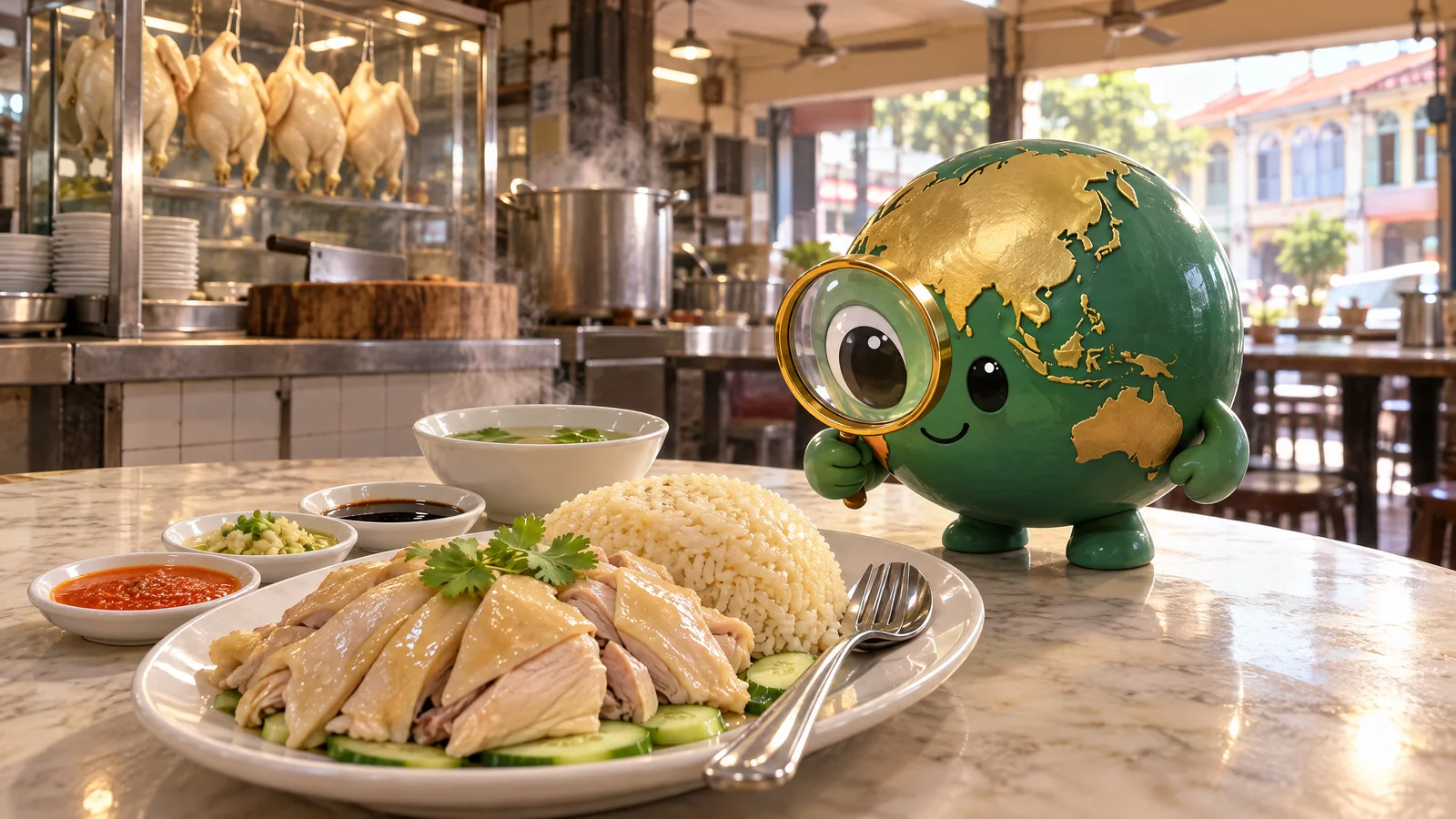
You thought hainanese chicken rice was always called that, a dish from the island of Hainan in China. The twist is the name was made later, in Southeast Asia, by people who had left that island and changed the dish along the way.
Hainanese chicken rice originated from Wenchang chicken in Hainan, a small bird poached whole and eaten with plain rice during family feasts. Hainanese immigrants brought the dish to Singapore in the early 20th century, and in the years that followed adapted it with local flavours across Southeast Asia. The first chicken rice restaurants in Singapore opened during World War II, and by the 1950s it had become a city staple. Today it is celebrated as a culinary icon of Southeast Asia, a deceptively simple plate that carries a long history of migration and adaptation. This is that history, told in plain words.
The name: what it means and where the word came from
"Hainanese chicken rice" is an English label, not a name from Hainan. In Hainan itself, nobody calls the dish that.
On the island, the core dish is called Wenchang ji (文昌鸡), meaning Wenchang chicken, after the town of Wenchang on the northeast coast where a famous breed of chicken has been raised for centuries. When rice is served alongside, locals say ji fan (鸡饭), which just means chicken rice. The Chinese characters 海南 (Hǎinán) mean "south of the sea" and refer to the whole island province. Among Chinese communities overseas, "Hainanese" became a word for anyone from that island. So "Hainanese chicken rice" really means "chicken rice made by people from Hainan".
The phrase likely took shape in local English and Malay use sometime in the early-to-mid 20th century, as the dish spread. A Hainanese street hawker named Wang Yiyuan started selling chicken rice balls wrapped in banana leaves in Singapore in the 1920s, one of the earliest hawkers on record.
Today the dish has many names across languages. In Mandarin it is Hainan ji fan (海南鸡饭). In Malay it is nasi ayam Hainan. In Thailand, khao man gai, meaning "oily rice chicken". In Vietnam, cơm gà Hải Nam. In Singapore, people often just say "chicken rice", dropping the word "Hainanese" entirely, which can hide its migrant roots.
Where it began: the place, the time, the people
The roots sit in Hainan, China's southernmost province. The dish as we know it today took shape in port towns of Southeast Asia in the early 20th century.
Hainan is a large island in the South China Sea. Wenchang, on its northeast coast, is famous for a small free-range chicken breed fed on coconut and peanut bran. These birds have thin skin, lean meat and strong flavour. The earliest written mention of Wenchang chicken sits in a Qing dynasty book, and the breed's history runs more than 400 years. The traditional way was to poach the whole chicken gently, chop it bone-in, and serve it with simple dips of ginger, garlic and salt. The rice on the side was plain, sometimes cooked in chicken broth or water. Families ate this during festivals and special occasions.
Beginning in the late 1800s and early 1900s, many men left Hainan. The soil was poor, jobs were few, and ports across Southeast Asia needed workers. They sailed to Singapore, Penang, Kuala Lumpur, Bangkok and Saigon. Many found work as household cooks in colonial homes and hotels, or as helpers in coffee shops. These jobs gave them skills, kitchen space and, often, leftover chickens. Hainanese cooks carried Wenchang chicken rice to Singapore as a home dish in the years after they arrived. By the early 1920s, hawkers such as Wang Yiyuan had adapted it into the chicken rice sold to a wider public across the region.
The dish evolved by incorporating local Malaysian and Singaporean flavours. Cantonese cooking methods were incorporated into hainanese chicken rice by immigrants who worked alongside Cantonese cooks. The early version of the plate was not one recipe frozen in time. It was the work of many migrant cooks making small choices over decades: a spoonful of sesame oil here, a pandan leaf there, a sharper chili sauce to match the local taste for heat.
Many families, one origin story
Several people and places tell "first" stories about chicken rice. We treat them as family versions of the same dish, not rivals.
One well-known claim comes from Swee Kee restaurant in Singapore. The dish was popularised in Singapore by Moh Lee Twee in the 1950s through this restaurant. Singapore writers often credit Swee Kee with making hainanese chicken rice a popular city food after World War II. Another early figure is Wang Yiyuan, a Hainanese street hawker who started selling chicken rice balls wrapped in banana leaves in Singapore in the 1920s.
In Malaysia too, family and community stories credit Hainanese coffee shops with an early version of the dish, though which towns and decades is remembered differently from family to family. The evidence is old menus, newspaper mentions and interviews with families. Few written records survive from those earliest days, so nobody can crown a single inventor with certainty.
We name each claim, say who makes it, and take no side. The dish is shared heritage across ports linked by Hainanese migrants, the same migrant pattern that carried roti canai from Tamil Muslim cooks into Malaysian kopitiams and turned nasi lemak from a farmer's breakfast into a national plate.
Anatomy: what it is made of
We break the dish into its parts to show which pieces came from Hainan and which grew in Southeast Asia.
The chicken is the most important part. The whole chicken is poached gently in hot water or chicken stock, then chopped bone-in and served sliced on a plate. Traditional Wenchang birds are lean and full of flavour. Singapore style often borrows a Cantonese technique: dunking the cooked bird in a tub of ice-cold water after poaching to tighten the skin and give it a silky, jelly-like feel. Traditional Hainanese cooking skips this step.
The rice is what turns chicken into a meal. In Hainan, the rice cooked alongside Wenchang chicken was plain, simmered in chicken broth or water, maybe with a little chicken fat. In Southeast Asia, cooks changed this. They began to fry garlic and ginger in rendered chicken fat, add pandan leaves for scent, then simmer the rice in chicken stock. This fragrant rice, sometimes called oily rice, is the version people know now. The traditional method involves poaching the chicken and serving it with rice cooked in chicken fat. In Thailand and Vietnam, jasmine rice became the standard grain, giving a softer, more fragrant result. Some home cooks today use a rice cooker, though hawker stall cooks still prefer large pots.
The sauces make each plate personal. In Hainan, dips were simple: salt, chopped ginger, garlic. In Singapore and Malaysia, a fiery chili sauce appeared: fresh chillies ground with garlic, ginger, sometimes lime or vinegar. A ginger sauce of minced ginger in spring onion oil sits alongside, closer to old Hainanese and Cantonese habits. Dark soy sauce and light soy sauce are used in Singapore and Malaysia for sweetness and salt, but neither was part of the old Hainan plate. These condiments, together, let each diner adjust the flavor of every bite.
A small bowl of soup completes the plate. The poaching liquid becomes a light chicken broth, sometimes with cabbage, chye sim (a leafy green) or winter melon floating in it. Fresh cucumber slices sit on the side as a cooling vegetable. Cilantro leaves scattered on top are a later addition, not something a Wenchang cook would have used.
One thing, many homes: how each region or community made it its own
The same Hainanese base became different dishes across Southeast Asia, shaped by each place's taste and produce. The dish evolved differently across the region, resulting in distinct regional variations. It is one entry in a wider record of Southeast Asian dishes reshaped by migration.
Hainan, China: Wenchang chicken and ji fan today
In Hainan today, Wenchang chicken is raised free-range, often on coconut and peanut bran. It is served chopped with skin on, poached gently, with plain white rice and simple dips of salt, chilli and ginger. Local diners do not usually call the full plate "hainanese chicken rice". They see the Singapore and Malaysian versions as distant relatives, not the same delicacy.
Singapore: from coffee shop plate to national dish
Hainanese street hawkers, among them Wang Yiyuan, sold chicken rice from the 1920s onward. The first chicken rice restaurants in Singapore opened during World War II. Stalls like Swee Kee made it a popular city dish across Singapore. After the war ended in 1945, economic hardship pushed many more Hainanese into street hawking, and chicken rice became a cheap, fast, everyday lunch. Hainanese chicken rice is popular in hawker centres across Singapore to this day.
Famous stalls grew over the decades. Yet Con opened in the early 1940s. Boon Tong Kee started in 1979 and expanded into a bunch of outlets. Local media and tourism bodies call it Singapore's national dish, and abroad it is often called "singapore chicken rice" or singapore hainanese chicken rice. Signature Singapore traits include a stronger garlic-chilli sauce, rice rich with chicken fat and pandan, clear soup on the side, and an optional roasted version that shows Cantonese influence.
Malaysia: kopitiams and regional tastes
In Kuala Lumpur, Ipoh, Penang and Malacca, Hainanese coffee shops, called kopitiams, served chicken rice alongside kaya toast and kopi. The dish is popular in Malaysia, known as nasi ayam. Malaysian plates sometimes use heavier dark soy sauce and offer both poached and roasted chicken. Malaysian adaptations include chicken rice balls in Melaka and roasted chicken variations. Malaysia and Singapore have both claimed hainanese chicken rice since 1965. In 2009, Malaysian Minister Ng Yen Yen called it "uniquely Malaysian" and said other countries had "hijacked" it; she later said she had been misquoted. Many Malaysian families see it as both a home dish for special days and a standard hawker option, with trusted stalls in each town carrying decades of history.
Thailand, Vietnam and beyond: cousins with new names
In Thailand the dish is known as khao man gai. Thai chicken rice, known as khao man gai, features a distinct dipping sauce and broth, carried there like the dish's other regional names by Hainanese migrants who settled across Southeast Asia. Thai touches include a sweeter dipping sauce with fermented soybean and fresh herbs, and a broth that often contains sliced daikon.
Vietnam's version is called cơm gà Hải Nam, incorporating local ingredients like fish sauce in the dip, which marks the Vietnamese palate. Local herbs and pickles are added. Elsewhere, diaspora communities in Indonesian cities, Hong Kong, Sydney, London and New York have adapted the dish, sometimes using boneless breast meat or "rice bowl" formats, but still using the Hainanese name.
Each of these is a local home for the same core idea: gentle poached chicken, fragrant rice cooked in its flavour, and a sharp, bright sauce.
From the stall to the world: how it spread
Once port towns loved it, hainanese chicken rice followed people as they moved for work, study and family.
Southeast Asian Chinese and Hainanese diaspora opened eateries in Australia, North America and Europe as they settled abroad. Early Singapore and Malaysian restaurants listed hainanese chicken rice to offer a taste of home and a simple, comforting meal for mixed crowds. The dish represents a cultural fusion shaped by migration and adaptation, and that story travelled with every new restaurant.
Hawker stalls in Singapore and Malaysia played a large role. Low stall rents and busy city workers turned chicken rice into cheap, fast, daily food. Over time, rice and chicken became one of the most eaten lunches in both countries. The dish's simplicity helped: it could be prepared quickly, served fast, and tasted delicious at any price point.
Pop culture pushed it further. International press and travel shows singled out singapore chicken rice as must-eat street food. Global "best food" lists featured the dish, boosting its fame abroad. In time, commercial products appeared: bottled chili sauce and ginger sauce labelled "Hainanese chicken rice", paste kits, and even instant noodle packs with chicken rice flavour. These spread the taste to home kitchens far from any hawker centre.
As the dish went global, many restaurants adjusted it: boneless chicken breast in Western cities, salad sides, modified sauces to suit local palates. The Hainanese name stayed on the menu even as the recipes changed.
More than a dish: what it means to people today
Hainanese chicken rice carries ideas of home, migration and shared roots for many groups at once.
For people from Hainan, Wenchang chicken and chicken rice remain festival and banquet dishes on the island. They connect families to local land, a local breed and childhood memories. Some Hainanese from China see overseas chicken rice shops as proof that their small island shaped global taste.
For Singaporeans, it is everyday comfort food. Almost every hawker centre and food court has chicken rice. It cuts across ethnicity and class. People eat it in school canteens, army camps and offices. That makes many shared memories. Calling it a national dish is less about strict origin and more about how deeply and often people eat it.
For Malaysians and other Southeast Asians, families have their own trusted stalls. They serve it at home during gatherings. In Thailand and Vietnam, the local names feel fully local, yet faint echoes of Hainan remain in every plate.
For the wider world, the dish now appears in travel shows, food vlogs and cookbooks as a simple way into Southeast Asian Chinese food history. For overseas students and migrants, it can be the first plate they seek on trips back, or a dish they try to recreate in small kitchens far from home.
Behind the neat plate is a story of island farmers, seafaring workers, city hawkers and many small choices over time. That is the history of hainanese chicken rice.
Join our email list at Backstory Asia to read one origin story a week, and nothing else.