
Most people think roti canai is a simple Malaysian flatbread. It is not simple at all. The word "canai" may point straight to Chennai, the old Indian port city once called Madras, where Tamil Muslim traders set out on ships for British Malaya. Or it may come from a Malay verb that means to knead and stretch dough with your hands. Both ideas are real, both are told by food historians, and nobody has settled the question with a dated document. What we do know is this: roti canai is more than just a popular flatbread; it reflects historical migration, shared kitchens and the mixing of two worlds across the Indian Ocean.
Roti canai originated from the Indian subcontinent's paratha. Tamil Muslim immigrants brought roti canai to British Malaya in the 19th century. Mamak street vendors then made it their own across Malaysia. Today the flatbread is also known as roti prata in Singapore and roti cane in Indonesia, and roti canai has evolved into a beloved staple across Southeast Asia.

Prefer to watch? This story is Episode 2 on our YouTube channel: It's Roti CHA-nai, Not Ka-nai: The Real Story.
The name: what it means and where the word came from
Start with the first word. Roti means bread in Sanskrit and Malay. It is the everyday word for bread across South Asia and much of Southeast Asia. In Malaysia and Indonesia, roti covers many flat breads: roti bakar (toasted bread), roti tisu (a thin, crisp cone), even roti pisang (a version with banana). The word is old and wide.
Now the second word. The name roti canai may reference Chennai or the Malay verb canai. That is the honest answer.
Chennai was called Madras under British colonial rule. Some food writers think "roti canai" started life as "roti Chennai", meaning bread from Chennai, sold by South Indian traders in the ports of Malaya. The idea makes sense because so many of the cooks came from that part of India. But evidence is sparse. No known printed document from early British Malaya spells it out as "roti Chennai".
The other reading is just as strong. In Malay, "canai tepung" means to flatten, roll and stretch flour dough. Watch a mamak cook slap and spin the dough on a metal table and you see the verb in action. Because the word matches the movement so closely, many historians think this is the more likely root.
Roti canai is attested in Malay print since at least 1970, per Wikipedia's sourced etymology account. No earlier dated use has been confirmed, and no record found explains the word. People just used it.
Both Chennai and canai live side by side in people's minds. That is fine. What matters is that the name itself points to links between Indian ports and Malay streets. Many families, one name.
Where it began: the place, the time, the people
Roti canai took shape in British Malaya in the late 1800s to early 1900s. Steamships were busy. Railways were being built. Port towns like Penang, Melaka and Singapore filled with new workers, new languages and new food.
It belongs to the family of Indian layered flatbreads: paratha from North India, parotta from Tamil Nadu and Kerala, porotta from Sri Lanka. These unleavened bread traditions are old. South Indian parotta uses maida, a refined wheat flour, and creates many thin layers by stretching and oiling the dough. Roti canai kept that idea and carried it across the water.
The people who carried it were Tamil Muslim traders and labourers, often called Mamaks in Malaysia and Singapore. They came from port towns across South India, from the city now called Chennai, and from parts of Sri Lanka. British shipping and colonial labour systems brought South Indian workers to rubber estates, railways and port services. Many opened small kopi stalls and roadside tea shops.
These early Mamak stalls served cheap breads with dhal and curry for dock workers and rickshaw pullers. The bread may have been called parotta or paratha first. Roti canai evolved through local adaptations by Indian Muslim vendors, changed by local flour, local fat and local taste, over several decades. No single person invented it. Mamak street vendors popularised roti canai in Malaysia, and the bread was sold widely across Peninsular Malaya.
Ports like Penang, Klang, Singapore and Medan were the true homes where it took shape. Not one country acting alone, but many busy harbours on the same warm sea.
Anatomy: what it is made of, and how it is done
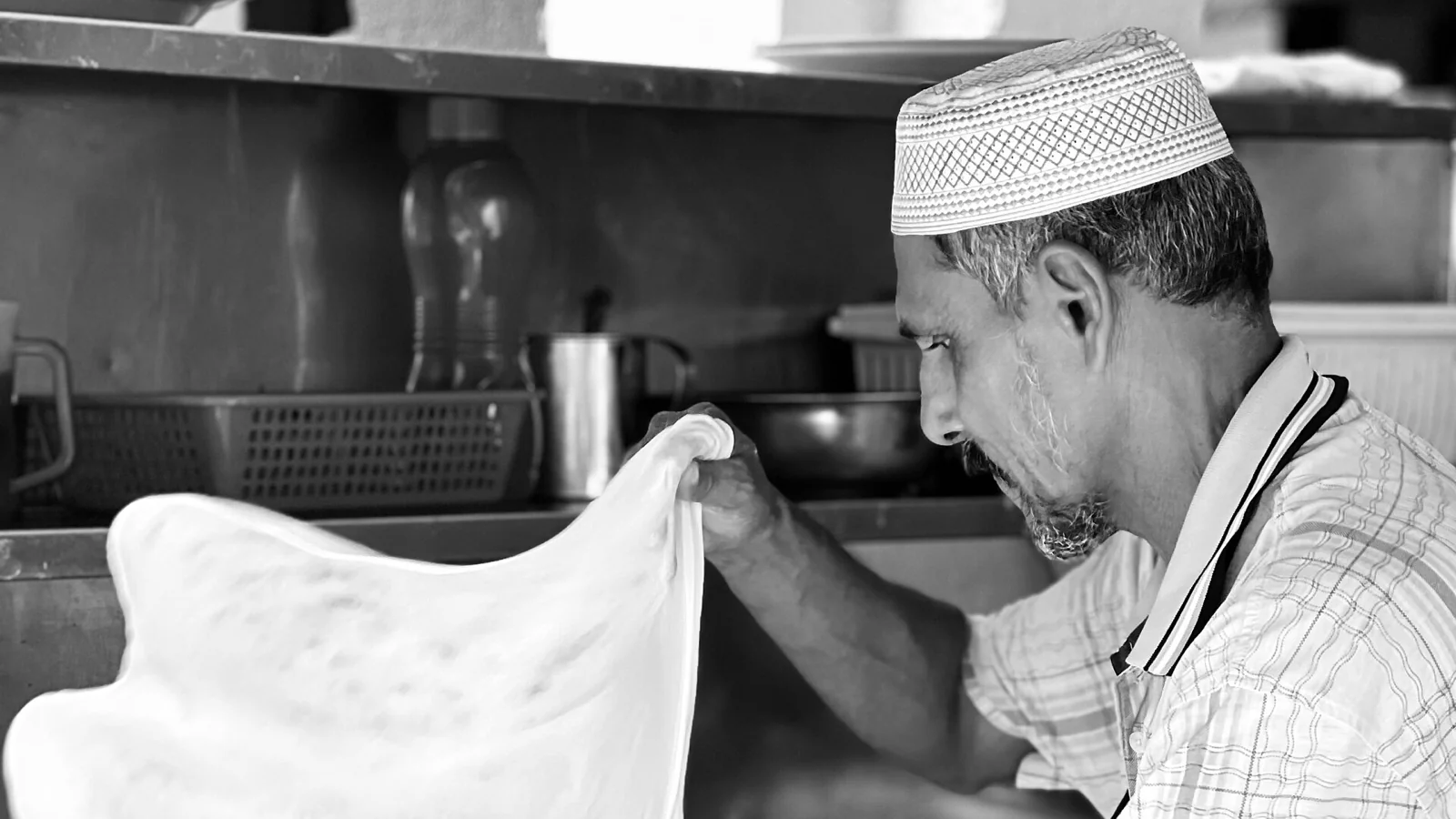
Picture a ball of dough, tossed and spun in the air above a metal table in a mamak stall, then folded again and again before it hits the hot griddle. The making of roti canai became a visual spectacle at food stalls, and it still is.
The dough is lean: flour, water, salt and fat, worked together by hand. The fat was once mostly ghee, clarified butter brought by Indian cooks. Now it is often blended with margarine or oil to cut cost. The cook works oil into the dough until it turns elastic, building the gluten, the stretchy part in wheat that lets the dough be pulled thin, almost like a sheet of paper you can see light through.
A rest lets the gluten relax, so the dough turns soft and willing before the stretch begins. The technique for making roti canai is a toss and flip in the air, the dough spun thinner with every turn. Once it is pulled nearly see-through, the cook folds it into pleats and coils it into a round, trapping a pocket of oil between each layer.
Cook roti canai on a hot griddle until golden. The result is flaky on the outside, soft inside. Southeast Asian versions of roti canai are characterised by flaky layers that puff and separate when you clap the bread between your hands after cooking.
The link back to its Indian cousins is clear. In Tamil Nadu and Kerala, parotta makers also stretch and fold dough into coils and layers, but they may roll instead of spin, and shape thicker rounds. Roti canai kept the drama and adapted the thickness.
Roti canai is often served with lentil curry or meat curries, specifically dhal made from yellow split peas, thin fish curry or chicken curry, all brought from South Indian cooking but thinned and spiced to local taste. The early main forms were plain roti, called kosong (meaning "empty"), roti telur (with egg), and roti bawang (with onion). Roti canai has inspired a variety of modern local adaptations and fillings: cheese, chocolate, sugar, condensed milk, even the tall crisp tissue cone. Those came later, with urban mamak culture. The same stalls also sell murtabak, a thin dough folded over egg, onion and meat.
One thing, many homes: how each country and community made it its own
The same basic flatbread appears under different names across the region. That is the surprise and the beauty.
Malaysia: roti canai at the mamak
In Malaysia, "roti canai" is the standard name. It is served any time of day in Mamak restaurants, warungs and roadside stalls, often with a cup of teh tarik, the pulled milk tea. It had become a staple breakfast and late-night meal, cheap enough for students and lorry drivers. In Malaysian memory, roti canai is tied to Mamak culture: TVs showing football, chrome kettles of tea, and 24-hour openings.
Singapore: roti prata on the kopitiam table
In Singapore the same bread is named roti prata, from "paratha". It is sold in kopitiams and Indian Muslim eateries. Singapore prata evolved its own forms: paper prata and tissue prata, very thin and tall, often sugared. Egg, cheese and even durian fillings followed. Prata is a place where Chinese, Malay and Indian friends share the same metal plates and similar stories.
Indonesia, Brunei and beyond: other names, same roots
In Indonesia the bread appears as roti maryam or roti cane, often a little thicker and sweeter. It is sometimes eaten with curry, sometimes with sugar and condensed milk. In Sumatra, Aceh and the Riau islands, Indian and Arab traders also brought layered breads that look and taste close to roti canai. In Brunei, roti canai and roti kosong are common at kedai kopi. In southern Thai provinces near the Malaysian border, roti flatbreads are eaten with sugar or curry, linked to Malay and Muslim communities. No one country owns it. Each port town took a shared Indian Muslim flatbread idea and bent it to its own breakfast habits.
From the stall to the world: how it spread
Roti canai did not stop at Southeast Asia. It rides in the memories of people who moved.
Waves of Malaysian and Singaporean students and workers who moved abroad carried a craving for the bread they grew up with. Malaysian restaurants overseas began serving roti canai on their menus, alongside satay and laksa, as a quick taste of home.
Frozen and packet roti canai also became available. Factories in Malaysia mass-produce and export it to Asian grocers worldwide, letting diaspora families cook it at home without the dough-tossing skill. You just flatten, fry and eat.
Global attention grew. In December 2024, UNESCO inscribed "Breakfast Culture in Malaysia: Dining Experience in a Multi-Ethnic Society," the wider element that carries roti canai, onto its Representative List of the Intangible Cultural Heritage of Humanity. Malaysia's National Heritage Department had submitted the nomination in March 2023, the country's first built around food. In 2023, TasteAtlas named it among top world dishes, sparking proud reactions in Malaysia and Singapore and fresh searches from abroad. Social media clips of dough spinning in mamak shops travel on TikTok and YouTube, turning the old stall performance into global food content shared with public audiences far from any port.
As it spreads, the bread keeps changing. Cafés in Europe and North America pair roti with fusion fillings, while still using the basic canai technique from Malaya. The dough stays the same. The butter or margarine stays the same. The hands change.
More than a dish: what it means to people today
Roti canai is a 3am mamak table after exams. It is breakfast with grandparents. It is the first plate you miss when you move away.
Roti canai is culturally significant as a food transcending ethnic divisions. In Malaysia, Malay, Chinese, Indian and foreign friends share the same metal plates and curry bowls in mamak shops. Roti canai has become a communal and social food in Malaysia and Singapore. Some people talk about mamak-table talk as a place where football and gossip are both safe over cheap bread and tea.
For Tamil Muslim families, running a roti canai or prata shop can be a path of work across generations, from a pushcart to a kopitiam stall to a glass-fronted restaurant. The bread is livelihood and identity at once.
Roti canai is a symbol of cultural synthesis in Southeast Asia, one of the journeys traced on Backstory Asia's food desk, alongside nasi lemak, hainanese chicken rice and laksa. It is one proof that Indian Ocean trade made this region's breakfast table. Roti canai serves as a symbol of migration and cultural integration in Southeast Asia, and no border can cut the links between Chennai, Penang and Singapore.
Picture a child tearing a piece of roti, dipping it into dhal, not knowing that this small move carries more than a hundred years of travel, work and mixing. That is the part most people skip. It is the best part.
If you like stories like this, join the Backstory Asia email list. One origin story a week, nothing else.