
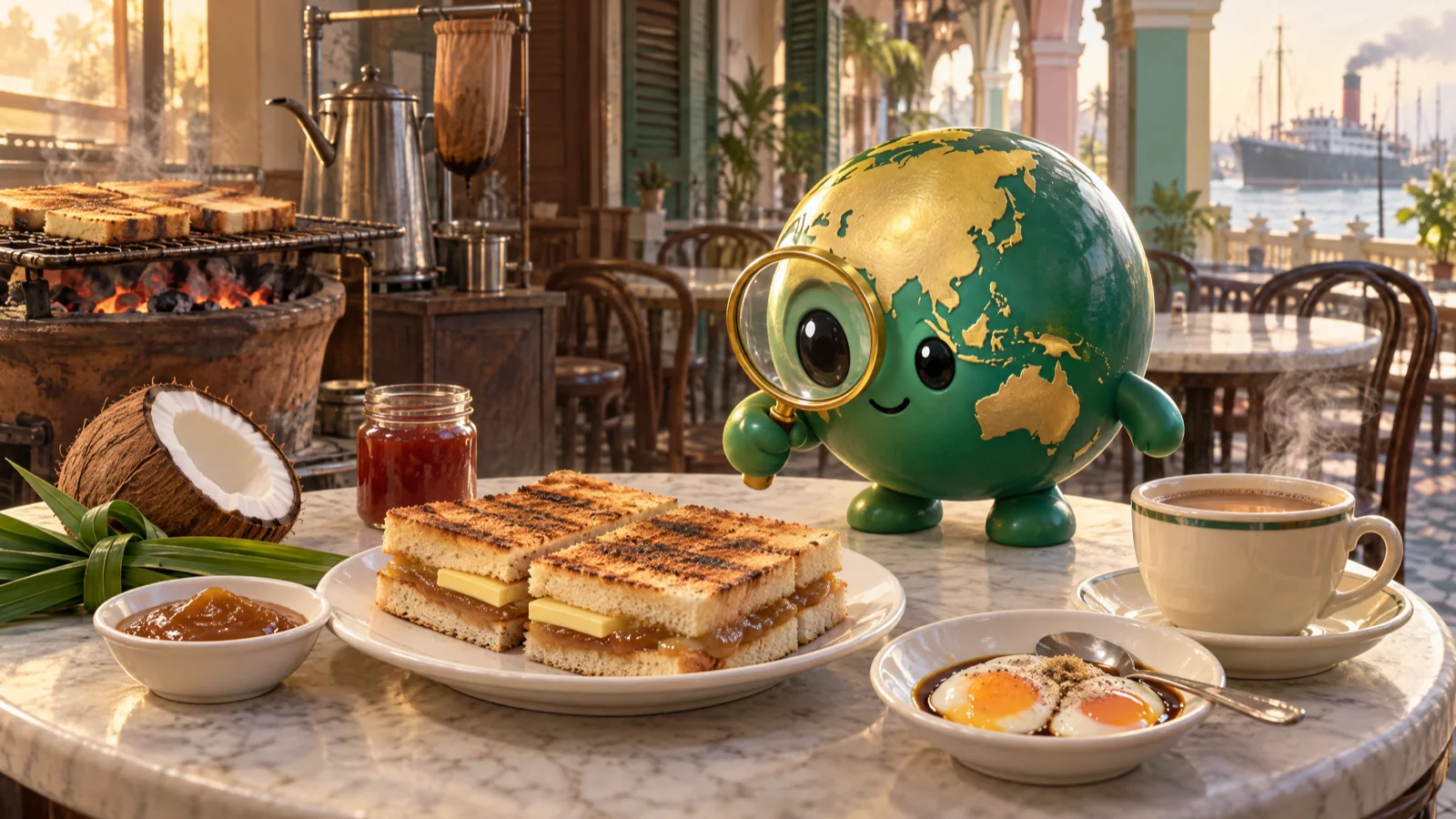
You think kaya toast is a modern café snack. It is older than your grandparents, and it was born when Hainanese cooks swapped British strawberry jam for coconut custard.
Kaya toast originated in the Straits Settlements, the British-run port colonies of Singapore, Penang and Melaka, during the 19th century, shaped by Hainanese immigrants who adapted British-style toast and jam using kaya, a sweet, thick spread made from coconut milk, eggs, and sugar. The dish represents a blend of British, Malay, and Hainanese culinary traditions, and it grew up in the busy kopitiams of Singapore, Penang and Melaka before anyone gave it a fixed name. Today it is served as part of hawker culture, which UNESCO listed as part of Singapore's intangible cultural heritage in 2020, but kaya toast's own roots run across the whole Straits region. To understand kaya toast, you need to know its name, its people and the simple breakfast set that turned a corner-stall food into something millions eat every day.
The name: what it means and where the word came from
Three words matter here: kaya, toast, kopitiam. Each one tells part of the story.
"Kaya" is a Malay and Indonesian word meaning "rich". Not rich as in money. Rich as in thick, heavy, full. It describes the texture of a coconut egg jam, a custard spread cooked slow from coconut milk, eggs and sugar, often scented with pandan leaf. Kaya is derived from serikaya, the older Malay custard made with coconut milk, eggs and sugar. In Indonesia and parts of Malaysia, the same kind of sweet spread sometimes goes by "selai kaya" or "sri kaya", but in the port towns where Malay, Hokkien, English and other tongues mixed, "kaya" became the common word.
"Toast" is an English word for sliced bread browned over heat. It arrived with British rule. Before that, local breads were steamed buns or flatbreads, not toasted slices. The word entered local speech during colonial times and stayed.
"Kopitiam" blends two languages. "Kopi" is Malay for coffee. "Tiam" is Hokkien for shop. A kopitiam is a coffee shop, and it is the home ground of kaya toast. Hainanese people, ethnic Chinese from Hainan Island in southern China, were the key kopitiam owners.
The fixed two-word phrase "kaya toast" only shows up in print later in the 20th century, after the breakfast was already common. Before that, old menus and memories say "bread with kaya and butter" or "toast and kaya". We are looking at a dish that existed before its name was settled.
Where it began: the place, the time, the people
Kaya toast, as we know it today, grew in early 20th century kopitiams in British Malaya, the British-ruled Malay Peninsula, and Singapore, in the hands of Hainanese coffee shop owners. Hainanese coffee shops began establishing during the early 20th century, serving kaya toast in port towns across British Malaya and Singapore.
These ports had everything the dish needed. Factory-made white bread, imported or baked locally. Tins of butter and margarine. Canned fruit jam. And a large population of workers, traders and clerks who needed a quick, cheap breakfast before the day began. British colonial rule brought European food items into these towns, and the Hainanese were the first to pick them up.
The Hainanese were latecomers among Chinese migrants to Southeast Asia. Many arrived from Hainan Island in the late 1800s and early 1900s. Because other dialect groups had already claimed the trades of shipping, retail and construction, Hainanese men often worked as cooks and house staff in European colonial homes, clubs and ships. In those kitchens they learned Western breakfast habits: sliced bread, butter, jam, tea and coffee. They carried those habits with them when they left service.
Between the 1910s and the 1930s, Hainanese men rented shophouses near docks, tram stops and markets and opened small coffee stalls. They sold coffee, tea, toast and soft boiled eggs. The pairing of toasted bread with butter and coconut jam appeared quickly, even if nobody called it "kaya toast" yet. Kaya toast originated from Hainan Island, China, in the sense that the people who shaped the dish came from there and brought their working knowledge of Western kitchens to Southeast Asian ports.
One documented signpost: Loi Ah Koon came from Hainan to Singapore in 1926 and first worked at another coffee stall. In 1944 he started his own stall at Telok Ayer Basin, registered as Ya Kun Coffeestall. His wife later suggested cutting bread and adding her homemade kaya. This is one early marker, but there was no single inventor. Many Hainanese families in different ports were doing the same thing at roughly the same time: swapping imported fruit jam for local coconut jam, grilling bread over charcoal, and serving it with kopi. Many families, one breakfast.
Contested and shared origins
In Singapore, kaya toast is often treated as a national icon. Brands like Ya Kun trace their own start to 1944, while Killiney Kopitiam, also Hainanese-owned, dates its founding to 1919 along Killiney Road. These dates are used to mark the start of something, but the practice was already spreading across the region.
In Penang, Ipoh, Kuala Lumpur and Johor, families remember bread with kaya and coffee in old Hainanese kopitiams from the pre-war years and the 1950s. Many of these shops never became big chains, and written records are scarcer. Oral histories mention charcoal grilling, thicker loaves and a slightly different feel.
In Indonesia, especially in the Riau Islands and Medan, coconut jam on bread also appears in family memories and local coffee shops, sometimes under the name "selai kaya" and sometimes without the exact phrase "kaya toast". Trade routes between Indonesia, Singapore and Malaya carried ingredients and ideas both ways.
We do not have a single dated "first kaya toast". No old menu sheet settles it. We treat it as a shared Straits and Malayan port creation.
Anatomy: what it is made of, or how it is done
Take the sandwich apart and each layer carries history. This is not a recipe. It is a way to see how the dish came together.
The bread was soft, factory-made white loaf, the kind that appeared in port towns under British influence. Slices were cut thin for speed and crispness, then grilled over charcoal or toasted on a hotplate. That charcoal taste is part of the memory for anyone who grew up eating it in an old kopitiam.
The kaya was a slow-cooked mix of coconut milk, eggs and sugar, scented with pandan leaf. There are two main styles. Hainanese kaya is brownish, from caramelised sugar. Nyonya kaya, sometimes called Peranakan kaya, is lighter and greenish from pandan. Both draw on serikaya, the older Malay and Indonesian coconut sweet that existed long before bread arrived. In early days, kaya was made at home or in the kopitiam kitchen in small batches, stirred by hand over low heat. Bottled and factory kaya came much later in the 20th century.
The butter was cold butter, usually salted, sliced as a thick slab from an imported tin or block. When placed between hot toast, the cold butter half-melted while the kaya stayed cool and sweet. That contrast, hot bread, cold butter, sweet jam, is part of the appeal.
The traditional serving of kaya toast includes cold butter, soft-boiled eggs, and coffee or tea. Two slices of toast sit beside a saucer of two soft boiled eggs, seasoned with dark soy sauce and white pepper. A cup of kopi completes the set. The kopi is made from robusta beans roasted with sugar and sometimes margarine, pulled through a cloth sock-filter, and served with condensed or evaporated milk. Kaya toast became a breakfast staple by the postwar period, often served with kopi and soft-boiled eggs.
From home jam to kopitiam standard
Kaya started as a home dessert spread, something mothers and grandmothers cooked for children and family. Hainanese shop owners adopted it for their toast because it was cheaper than imported fruit jam and because their customers already loved coconut sweets.
Some kopitiams offered both fruit jam and kaya on their bread. But kaya plus butter on toast quickly out-sold plain jam in many Straits towns after the 1930s and 1940s. That simple swap, from strawberry jam to kaya, is the core of this story. A Hainanese take on British jam. It stayed.
One thing, many homes: how each country or community made it its own
Kaya toast history did not stop in those early kopitiams. Each place shaped it while keeping the same basic trio: toast, kaya, butter.
In Singapore, the kaya toast set with soft boiled eggs became a standard hawker-centre breakfast by the 1970s and 1980s. Old brands like Ya Kun, Killiney and Tong Ah became icons of kopitiam culture. Some shops removed crusts, used extra-thin slices, or steamed bread briefly before grilling to soften the centre. Ya Kun's expansion accelerated in 1999 under new leadership, turning a single stall into a business known across the island. Kaya toast became a cultural icon in Singapore.
In Peninsular Malaysia, towns like Ipoh, Penang, Kuala Lumpur and Johor Bahru have their own Hainanese kopitiam traditions. The bread is often thicker. Charcoal grilling is more common in old-town shops. Kaya toast sits alongside other Hainanese dishes like Hainanese chicken rice, chicken chop, curry rice and coffee buns. Both old shophouse kopitiams and modern chains in malls serve it.
In Indonesian ports and islands, especially in Medan, Batam and the Riau area, coconut jam on bread appears under names like "selai kaya" or "sri kaya". The sweetness may be heavier. Bread styles sometimes follow Dutch-influenced bakery loaves rather than thin Hainanese-style slices. The trade routes that connect Sumatra and the Riau Islands to Singapore and Malaya carried the taste both ways.
Across the wider Chinese communities in Malaysia and Singapore, Teochew, Hokkien and Cantonese customers adopted kaya toast as their daily food even though the shops were mostly Hainanese-owned. The kopitiam became a social space where diverse communities mingled over kaya toast and coffee. Some newer cafés use a French toast style, dipping bread in egg and frying it before adding kaya, but the majority keep the classic way: grill the bread, add butter, spread kaya.
No place owns kaya toast on its own. Each community holds a slightly different picture when they say those two words.
Old kopitiam rituals
Small acts hold the history. Dipping a corner of toast into a runny soft boiled egg. Stirring dark soy sauce and white pepper into the eggs with a teaspoon. Balancing a saucer of kopi on a marble-top table in a five-foot-way corridor.
These shared habits cut across class and background in port cities. Dock workers, clerks, students and retirees all sat at the same tables, ate the same bread with kaya, and started the day the same way.
From the stall to the world: how it spread
Kaya toast moved with people. After the Japanese Occupation ended in 1945, many kopitiams opened in the years that followed. Kaya toast became a daily breakfast for millions across Singapore and Malaya.
From the 1990s onward, the shift from old-town kopitiams to air-conditioned chain outlets changed how people ate the same food. Ya Kun launched its first overseas outlet in Indonesia in 2002, and has since expanded to China, Japan, Myanmar, South Korea, Taiwan and the Philippines. In the 1990s and 2000s, Singapore promoted kaya toast globally as a local delicacy, and the dish began to appear on international food lists.
Independent cafés run by Singaporean and Malaysian migrants in cities like London, Melbourne and New York also carry the taste abroad. On their menus, kaya toast sometimes appears as "Singapore-style breakfast". Kaya toast has evolved into a globally recognised dish, appearing on international food lists and travel shows.
Supermarket jars of kaya, instant kaya toast snack packs and kaya-flavoured biscuits helped people share the taste at home, free from any kopitiam counter. The dish has changed through this spread: more butter, thicker bread, electric grills instead of charcoal. But the core idea, toasted bread, coconut jam, cold butter, eggs and coffee, is still the same.
New spins on an old breakfast
Modern bakeries and cafés now offer kaya-filled buns, waffles with kaya and butter, ice cream with a kaya swirl, and kaya croissants. These are playful takes, but they only work because people already know the classic toast.
Purists may view the old charcoal toast and wobbly boiled eggs as perfection. But both old and new keep the same taste pairing: coconut, egg, sugar, bread and coffee. The simple idea adapts without breaking.
More than a dish: what it means to people today
For many people in Singapore, Malaysia and nearby, kaya toast is a daily time marker. It is the first food of the day. Parents and grandparents remember breakfast in small kopitiams. Children grow up with the same taste in chain outlets in shopping malls. The food connects generations.
Kaya toast is served as part of hawker culture, the tradition UNESCO listed as Singapore's intangible cultural heritage in 2020. Tourism boards use images of the breakfast set in campaigns. Heritage trails and museum talks include kopitiams and kaya toast as part of local culture. It is recommended to visitors as a way to understand everyday life in the region. Kaya toast's layered history sits alongside other regional staples like nasi lemak and laksa, each carrying its own mix of migration and trade, within a wider record of Southeast Asian dishes reshaped by migration.
For Singaporeans, Malaysians and Indonesians abroad, kaya toast is comfort. Some pack jars of kaya in their luggage. The scrape of toast, the clink of a cup on a saucer, these small sounds carry the feeling of home.
There is a challenge. Rising rents push old kopitiams out of city centres. Chains preserve some parts of the ritual but change others: self-service counters replace shouted orders, electric grills replace charcoal. Something is kept. Something is lost.
Kaya toast is a Hainanese take on British jam, shaped in Malay and Indonesian coconut kitchens, kept alive in Straits kopitiams, and now standing as a small, daily proof that cultures met, mixed and stayed together.
If you like stories like this, join the Backstory Asia email list. One origin story a week, nothing else.