
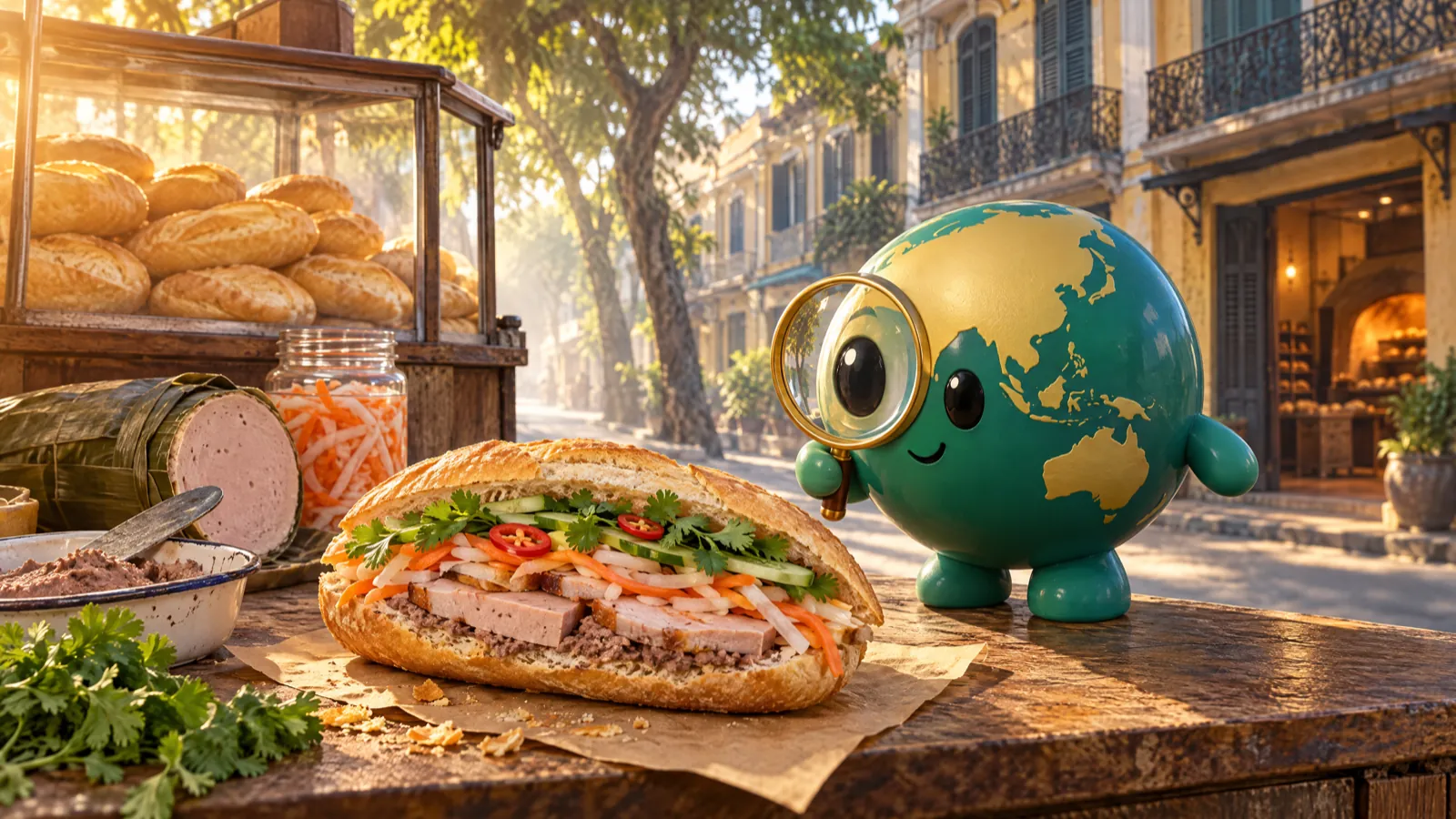
You think banh mi is a French baguette with Vietnamese fillings. It is not. The bread itself was rebuilt. Vietnamese bakers adapted traditional French bread by adding rice flour, creating a lighter, airier loaf that suits a hot country and stretches expensive wheat. The fillings were invented in Saigon's street stalls, not in any Paris kitchen. Banh mi originated from French colonial influence in Vietnam, but what came out the other side is something France never made. It is one entry in Backstory Asia's record of Southeast Asian food origins.
The short answer to where banh mi comes from: the baguette was introduced to Vietnam during the colonial period, starting in the 1860s. For decades it stayed a luxury. Then Vietnamese bakers, vendors and home cooks took it apart and put it back together with local ingredients, fresh herbs, tangy pickled vegetables and meats from their own tradition of cured and prepared meats (charcuterie). By the late 1950s, Saigon had the stuffed sandwich we now call banh mi. The global spread of bánh mì began after the Vietnam War in the 1970s, carried by families who opened bakeries wherever they settled.
That is the history. Here is the full story.
The name: what it means and where the word came from
The term bánh mì translates to "bread" in Vietnamese. That is all it meant at first. In Vietnamese, "bánh" is a catch-all word. It covers cakes, pastries, rice cakes, doughs, anything baked or steamed from flour. "Mì" here refers to wheat. Put them together and you get "wheat bread."
During French colonial rule, the two halves of the country named the new loaf differently. Northern Vietnamese called it "bánh tây," meaning "Western bánh"; Southern Vietnamese called it "bánh mì," meaning "wheat bánh." Both names marked the bread as something foreign, something that came off French ships. Over the 20th century, the Southern term won out everywhere, and its own meaning shifted too: in Vietnam, "bánh mì" came to mean the filled sandwich, not just the plain loaf.
Overseas, from the 1990s, English menus began writing "banh mi" without the tone marks. They used it as the name of a specific sandwich. The word bánh mì was added to the Oxford English Dictionary in 2011, listed as a loanword for the Vietnamese sandwich. That is how a word that once meant any wheat loaf became the name of one of the most famous street foods in the world.
Where it began: the place, the time, the people
The history of banh mi starts in the 1860s. France colonised parts of Vietnam, beginning in the south, in a region the French called Cochinchina. French officials, soldiers and settlers brought wheat flour, bakery ovens and the Paris-style baguette to cities like Saigon and Hanoi. Before this, most Vietnamese starch came from rice: steamed rice, rice noodles, rice cakes. Baked wheat bread was not part of the local pantry.
Initially, the baguette was considered a luxury item in Vietnam. French officials and the urban elite ate it with butter, cheese and pâté. Wheat had to be imported. The bread was expensive. Most Vietnamese people could not afford it.
Between World War I and World War II, things started to change. Wheat imports were sometimes disrupted. Vietnamese bakery workers and small shop owners began to adapt the baguette. They used cheaper fillings: local cold cuts, canned sardines, fried eggs. The loaf itself began to change shape, becoming shorter and lighter. Vietnamese vendors replaced heavy French ingredients with local flavors in bánh mì, and a new kind of sandwich started to form.
Saigon became the heart of the modern stuffed banh mi after 1954, when Vietnam was partitioned and many northerners migrated south. The city was a busy port, full of mixed communities, French troops, offices and bakeries that needed to sell bread every day. One documented early shop is Hòa Mã in Saigon's District 3, which began selling bánh mì thịt (meat banh mi) around 1958. Bánh mì became a portable meal due to the addition of fillings inside the baguette, and street carts multiplied. Banh mi became a popular street food in Vietnam over time.
There is no single inventor family we can prove with records. The earliest clear written evidence of stuffed bánh mì as a cheap meal appears around the 1950s in Saigon. Before that, nobody wrote it down at the time. The transformation was gradual, carried forward by many hands.
Anatomy: what it is made of, or how it is done
Banh mi is a light, crackly baguette-style roll, split and filled with French-style spreads and Vietnamese meats, fresh herbs and pickled vegetables. That one sentence covers the whole idea. The details are what make it sing.
The bread is shaped like a small baguette, shorter than a Paris loaf. It has a thin crust and a soft, airy crumb (the inside part). To suit hot, humid weather and to stretch imported wheat flour, bakers in southern Vietnam began mixing wheat flour with rice flour during the First World War, when wheat imports were disrupted. This gave the loaf its distinctive lightness. Some bakers and historians debate how common rice flour was in earlier decades. Wartime shortages pushed many experiments. Some contemporary bakeries say they do not use rice flour at all, getting their texture from water content and oven technique instead. The earliest record we have of rice flour use is patchy. We name the debate and take no side.
The classic Saigon-style filling starts with a base layer: butter or mayonnaise, and a smear of pâté, usually pork liver pâté. Both come directly from French sandwich habits. Then come the meats: chả lụa (a Vietnamese pork roll, made from ground pork that is seasoned, wrapped and steamed), roast pork, grilled pork, ham, cold cuts. Banh mi evolved to incorporate local Vietnamese flavors and ingredients at every layer.
On top of the meats go tangy pickled vegetables: shredded carrot and daikon radish (called đồ chua). Then cucumber slices, coriander (also called cilantro), fresh chilli slices, and a dash or drizzle of soy sauce or Maggi seasoning. These bring sour, refreshing and salty notes against the rich, savory base.
This mix is the heart of banh mi: French bread and spreads on one side, Vietnamese charcuterie, fragrant herbs and pickles on the other. Bánh mì demonstrates how colonial influences can be transformed into local cuisine.
One thing, many homes: how each country or community made it its own
Regional variations of bánh mì reflect local tastes and ingredients across Vietnam. There is no single standard. Each city and each community that picked up the sandwich shaped it around their own pantry.
Saigon and the South: the overloaded baguette
After 1954, Saigon filled with migrants. The sandwich grew large and heavily stuffed. Saigon's bánh mì is larger and features a thicker, crunchier crust. Common types include bánh mì thịt nguội (cold cuts), bánh mì xíu mại (meatballs in tomato sauce) and breakfast bánh mì with fried egg. Street carts and small shophouses shaped the way it was built and served: fast, cheap, wrapped in paper, eaten on the go. This Saigon style became the main template copied overseas after the 1970s. A banh mi today is still cheap, fast food, a world away from the luxury item the baguette started out as.
Hanoi and the North: a tighter, simpler roll
Hanoi had French bakeries too, but cooler weather and different Vietnamese tastes are often said to have shaped a plainer roll, with fewer fillings and less fuss than Saigon's. Local accounts describe a simpler bánh mì, eaten quickly as breakfast or a snack, a clear contrast with the South's habit of piling the bread full of textures.
Central Vietnam: Hoi An's compact, crunchy loaf
In central Vietnam, Hoi An is often named for its smaller, extra-crisp loaves, with queues outside a handful of well-known local shops. Local accounts describe fillings built around chicken and pork pâté, grilled meats and herbs particular to central Vietnamese cooking. This regional picture is not documented the way Saigon's history is; we report what is commonly said and take no further side.
Many families, one sandwich: the Vietnamese diaspora
After 1975, large numbers of Vietnamese left for the United States, France, Australia and Canada. They opened bakeries and sandwich shops wherever they settled. Opening a banh mi shop was a practical trade for new arrivals: low start-up cost, skills already learned in Saigon or Cholon.
In the US, fillings such as grilled chicken, meatballs and even fusion options appeared, while French baguette techniques remained strong. In France, some shops leaned back towards a Paris-style crust but kept Vietnamese herbs and pickled vegetables. In Australia, banh mi became a common lunch item, sold alongside meat pies and sausage rolls. Each diaspora community kept the basic shape but found a way to adapt to local meat cuts, sauces and customer habits.
From the stall to the world: how it spread
Banh mi spread first with the French empire, then with war, then with refugees and migrants who opened family bakeries abroad.
Inside French Indochina, baguettes and early Vietnamese bread travelled between Saigon, Hanoi and Phnom Penh along colonial trade and railway lines. Cambodian and Lao cities developed their own bread traditions from the same roots.
The key wave came after 1975. Vietnamese families resettled in countries like the US, France, Australia and Canada. Because making banh mi requires relatively low capital, many small family shops opened. California's Little Saigon, its Bolsa Avenue heart active from 1978 and officially named by Westminster's city council in the late 1980s, became one such hub. Paris suburbs and Sydney followed.
From the 2000s onwards, food shows, blogs and travel guides introduced "banh mi" as a familiar word to English-speaking audiences. That is when people began to explore banh mi history as a topic, as the sandwich appeared in cities with few Vietnamese residents.
Banh mi was not the only Southeast Asian street food to spread this way. Pho followed a similar path out of Vietnam and into cities worldwide, while dishes rooted in other home ports, from Singapore's hainanese chicken rice to the cross-border bowl of laksa, found their own ways abroad.
More than a dish: what it means to people today
Bánh mì is an important symbol of Vietnam's street food culture. It is a common daily breakfast across the country. Students, office workers, drivers, schoolchildren all eat it. It cuts across class lines. It is cheap and fast and tender enough to eat with one hand on a motorbike.
The sandwich exemplifies the intersection of food, culture, and identity in Vietnam. Many young Vietnamese no longer think of it as foreign at all. The French connection is part of the story, not part of the experience of taking a bite on a busy corner in Ho Chi Minh City.
In the diaspora, banh mi is a taste of home. A bakery can open next to a train station in Paris, a strip mall in California or a market in Sydney, and the smell of the bread still carries love and memory. Second-generation Vietnamese abroad use it to connect with parents' stories of Saigon, Hanoi or Hoi An.
For people who did not grow up with it, banh mi is a sign that Vietnamese foods include bread, butter, pâté and bold flavors used in ways that feel new, a burst of sweet, sour, rich and refreshing textures in a single soft roll. It shows that Asian food is not only rice and noodles.
Bánh mì represents Vietnamese ingenuity in adapting a colonial food to local tastes. The baguette came from France, but what makes banh mi as we know it was rebuilt in Saigon with rice flour, street-stall fillings and the things that grow in Vietnamese soil. It now belongs to many homes at once.
If you like stories like this, join the Backstory Asia email list. One food origin story a week, nothing else.