
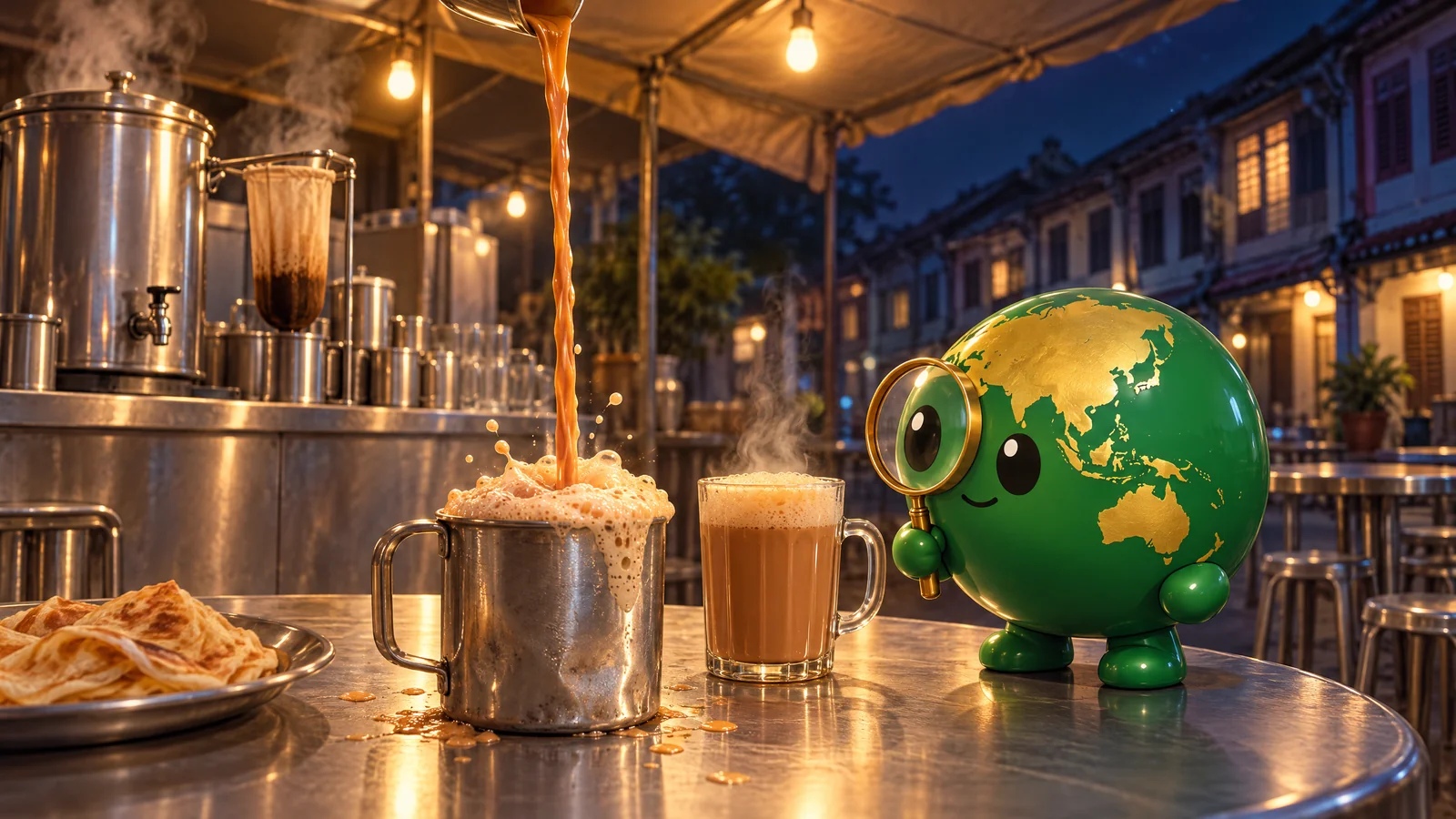
You think teh tarik is a simple cup of milk tea. It is a glass of trade, migration and shared history, pulled through the air by hands that learned the craft at roadside stalls across the Malay Peninsula.
Teh tarik literally means "pulled tea" in Malay. It originated from Indian Muslim immigrants in the 1870s, when drink sellers from South India set up small stands near rubber plantations in British Malaya. They brewed strong black tea with tea dust, stirred in sweetened condensed milk, and poured the hot liquid back and forth between two metal mugs in long arcs. That pulling action cooled the drink, mixed it evenly and created the frothy texture people now know. The drink became popular in Malaysia's mamak stalls after World War II, when cheap tea dust and canned milk were easy to find. Today teh tarik is recognised as an unofficial national drink of Malaysia, a common drink in Singapore, and a beverage enjoyed across ethnic divides.
The name: what it means and where the word came from
The name is Malay. "Teh" means tea. "Tarik" means pull. Together they describe an action, not a special tea leaf or a recipe.
The earliest printed records that clearly use "teh tarik" are hard to pin down. Nobody wrote it on a label or a newspaper headline before the war, as far as the best sources show. The phrase became common after the 1950s. Before that, Indian Muslim-run drink stalls already sold the same pulled tea, under whatever name each stall used.
The word "chai" comes from Hindi, itself from the Chinese word for tea. "Masala chai" means spiced tea. Those words describe flavour. The Malay name describes craft. Indian-style chai often included ginger, cardamom and cloves. Teh tarik in Malaya dropped most spices and leaned on milk, sugar and the pull instead.
Where it began: the place, the time, the people
Teh tarik history started with Indian Muslim drink sellers in British Malaya. The community is often called "mamak" in Malaysia and Singapore. "Mamak" means uncle in Tamil. It became the everyday word for Indian Muslim stallholders and the eateries they run.
British colonial rule brought large numbers of South Indian workers from Tamil Nadu to the Malay Peninsula from the mid-1800s onward. Estates needed labour. Traders followed. Indian Muslim-run drink stalls appeared at the entrances of rubber plantations. These were simple drink stalls, sometimes just a cart and a kettle, set up to serve workers who needed a hot beverage before or after a shift. The stallholders drew on masala chai habits from home but adapted. Spices cost money. Loose tea leaves cost money. Tea dust, the broken particles left after processing, was cheaper and brewed fast. Condensed milk came from European canning and was commonly found in markets like Hong Kong and Australia by the early 1900s. Its sweetness covered the bitter, tannic flavour of tea dust. After World War II, this combination became the standard.
Most writers date the present form of teh tarik to the years after the war. Cheap tea dust was widely available, condensed milk was plentiful, and Indian Muslim immigrants kept the pulling habit alive at stalls that grew into the mamak culture we see today. Port towns like Penang, Melaka, Singapore and Kuala Lumpur all played formative roles. Nobody wrote a single founding date at the time, so we work from the earliest mentions we have.
Contested but shared: Malaysia, Singapore and the Peninsula
There is no written record that says "here, on this day, teh tarik was made for the first time." What exists are many early mentions of plantation tea sellers and Indian Muslim vendors using tea dust and evaporated milk.
Malaysia's claim ties the drink to mamak stalls that grew beside rubber plantations and town streets after the war. Singapore's claim ties pulled tea to Indian Muslim-run drink stalls, independent pushcarts that later moved into purpose-built hawker centres in the 1970s. In 2024, UNESCO recognised Malaysia's "Breakfast Culture in Malaysia: Dining Experience in a Multi-Ethnic Society," and that listing names teh tarik alongside roti canai and nasi lemak. Teh tarik was added to UNESCO's Intangible Cultural Heritage list in 2024 as part of that wider practice. Singapore food guides also describe the drink as part of local heritage.
Our stance is plain. Indian Muslim traders made it. Malay, Chinese and other communities drank it. Tea merchants, colonial trade and estate labour all shaped it. Many families, one drink.
Anatomy: what it is made of, and how it is pulled
Strip traditional teh tarik down and the parts are few. Strong black tea, usually CTC tea dust. Hot water. Sweetened condensed milk. Sometimes evaporated milk. And the pull.
"Tea dust" is the factory name for broken, crushed particles of tea leaves processed by the CTC method. CTC stands for crush, tear, curl. It gives a fast, strong brew. The taste was harsh and tannic on its own. Condensed milk, already sweet, covered those rough notes and made the drink thick. Every stall guards its own blend. Some add hot milk. Some stir in a spoon of honey for a version locals call teh tarik madu.
The cloth tea sock filter is the old straining tool. It is a long cloth bag filled with tea dust, dipped in boiling water, stirred, then pulled out. It does the same job as a paper filter but lasts longer and is reused.
Then comes the pulling. Two metal mugs or pitchers. One holds the brewed tea mixed with milk. The stallholder lifts one mug high and pours in a long arc into the lower mug, then switches. Back and forth, again and again. The tea is poured from a height, and the process cools the hot tea to a drinkable temperature, mixes the milk evenly, softens the tannins with air and creates a thick froth on top. The technique of pulling tea evolved out of practical necessity. The preparation of teh tarik is considered a form of culinary theatre. Vendor competitions of pulling tea turn the pull into a performance art, with mamak workers pulling from higher and higher without spilling.
Science in the froth, craft in the hands
The pulling action forces air into the liquid. That aeration reduces bitterness, softens the taste and traps aroma in the froth. Think of how people swirl wine in a glass to open the smell, or how kopi is poured through a cloth sock. The idea is the same. Air changes flavour.
Stallholders judge the right moment by colour. A deep copper-brown means the tea and milk are balanced. Too pale means too much milk. Too dark means too little. Each stall keeps its own tea dust brand and its own ratio. A skilled mamak worker can pull one cup from above his head, sending a thin stream across a metre of air, and land every drop in the mug below. Practice, not magic.
One thing, many homes: how each country or community made it its own
One pulled tea, many styles, served across Malaysia, Singapore and beyond.
At the mamak stall in Malaysia
The classic image is stainless-steel tables, football on a screen, plates of roti canai and a glass of foamy teh tarik. Mamak stalls grew in Malaysian towns in the decades after the war. They stay open late, feeding shift workers, students and families after evening prayers. The drink is often shared among friends and families at meals. Teh tarik is commonly enjoyed during community gatherings in Malaysia.
Local naming is simple. "Biasa" means normal. "Kurang manis" means less sweet. Teh halia adds ginger. Teh o means tea without milk. Teh o kosong means tea with no milk and no sugar. All are pulled from the same base. Malaysian state events and tourism campaigns often feature a mamak teh tarik scene to signal unity in diversity.
At the kopitiam and hawker centre in Singapore
"Kopitiam" blends the Malay word for coffee, kopi, with the Hokkien word for shop, tiam. Many were run by Chinese families, but Indian Muslim tea men commonly prepared the pulled tea behind the counter. Breakfast sets from the 1960s to today pair teh tarik with kaya toast and soft-boiled eggs.
In the 1970s, Singapore moved its street food sellers into purpose-built hawker centres, and the old Indian Muslim-run drink stalls followed. The drink is often served at small mobile drink stalls, though today many stand inside permanent hawker centres. Singapore drink stalls created a whole teh code on the menu. Teh means tea with milk. Teh C uses evaporated milk instead of condensed. Teh o drops the milk. Teh peng adds ice cubes for a cold version. Each code traces back to the same history.
Across the straits and into the diaspora
In Brunei and parts of southern Thailand, where Malay and Indian Muslim communities live, pulled tea or close cousins appear under local names. Migrants from Malaysia and Singapore carried the habit further still: kopitiams and mamak restaurants abroad serve teh tarik as a key draw. The tea brand may differ, the milk may be fresh or UHT rather than condensed, but the pull and the froth remain.
From the stall to the world: how it spread
Teh tarik spread along with people leaving the Malay Peninsula for work, study and family life. Opening a mamak-style restaurant abroad became a way to give the migrant community a taste of home, and teh tarik was always on the menu.
Teh tarik has transitioned from a working-class beverage to a beloved icon.
Instant teh tarik sachets and canned pulled tea products have appeared too. They spread the name to supermarket shelves far from any stall, though the packets skip the pull. Many people still see the full pull at a mamak stall as the real experience.
UNESCO listings and national branding
UNESCO's Intangible Cultural Heritage list recognises living traditions and skills, not ownership of a food or a recipe. In 2024, UNESCO recognised teh tarik as cultural heritage, as part of Malaysia's wider breakfast culture inscription. That listing honours the daily practice of gathering to eat and drink together.
Tourism boards on both sides of the straits use images of pulled tea in their food campaigns. Teh tarik has become a cultural touchstone in Malaysia and Singapore. The drink features prominently in local food culture and social rituals in Malaysia. The recognition belongs to the tradition, not to a single country.
More than a dish: what it means to people today
A glass of steaming teh tarik on a metal table at night, friends talking around it. That is the image millions of people carry. Teh tarik is a popular beverage at late-night mamak stalls, where shift workers, students and families gather after a long day. The drink symbolises the multicultural fabric of Malaysia, enjoyed by various ethnic groups. Teh tarik symbolises harmony among Malaysia's diverse cultures. It is enjoyed across ethnic divides, making it a social equaliser. Malay, Chinese, Indian and many other communities share tables at the same stall.
Teh tarik is an important part of Malaysian social life, often enjoyed at mamak stalls. It is the drink of long chats, football screenings, study sessions and late suppers. Many Malaysians and Singaporeans abroad say they crave teh tarik as a taste of home.
Younger people post teh tarik pulls on social media. Stallholders perform higher, longer pulls for the camera. The craft stays, even as the audience grows. Teh tarik looks like a simple cup of sweet, hot tea. It holds trade, migration and shared history in every glass.
Teh tarik is one of the origin stories on Backstory Asia's food desk.
If you like stories like this, join the Backstory Asia email list. One origin story a week, nothing else.