
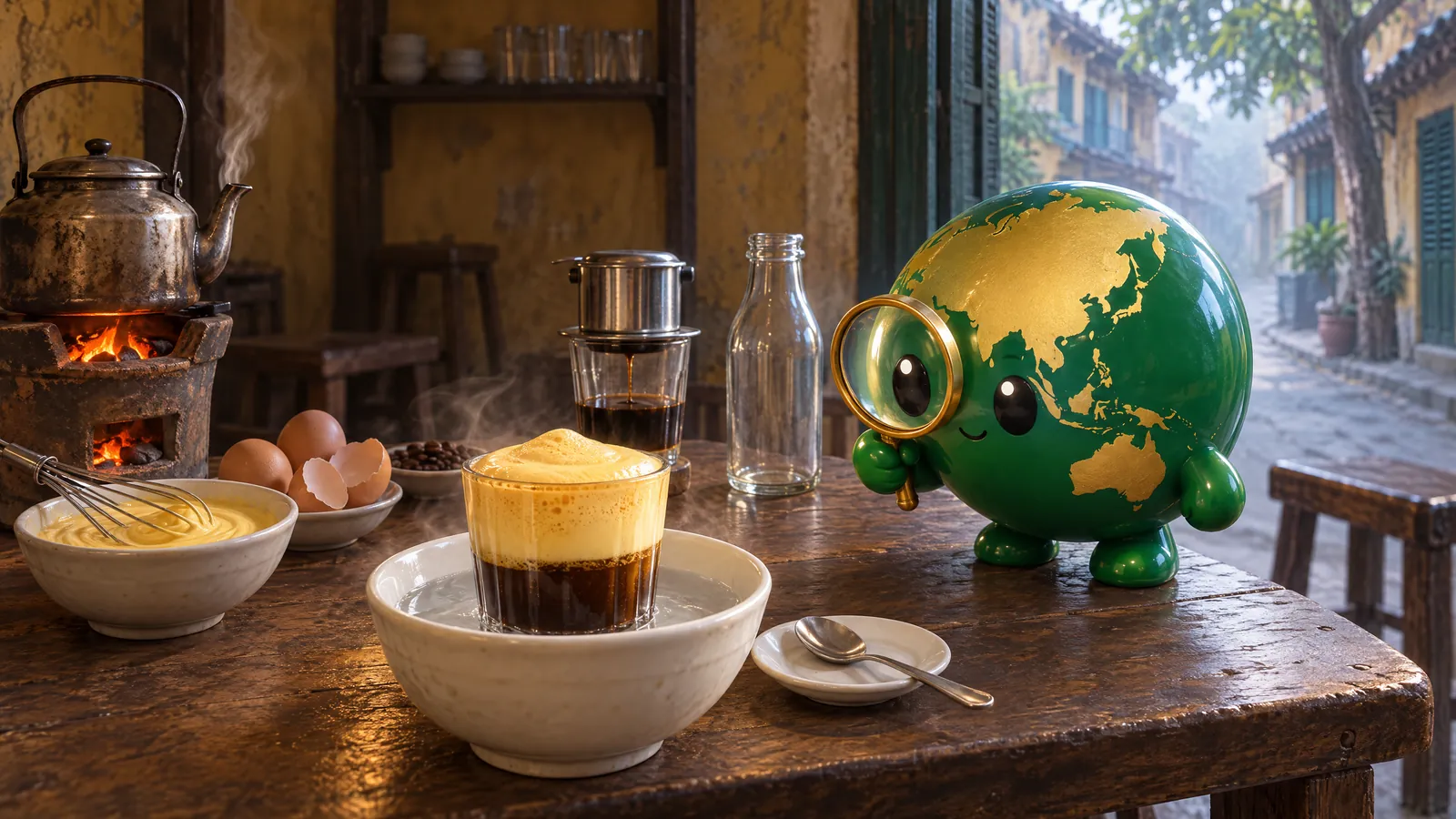
You think egg coffee is a trendy café invention. It is not. Vietnamese egg coffee was born in wartime Hanoi, in the late 1940s, when a bartender ran out of milk and reached for an egg instead.
The drink is called cà phê trứng in Vietnamese. It is a small cup of strong Vietnamese coffee with a thick, sweet, creamy foam of whipped egg yolks on top. Egg coffee was created in Hanoi in the late 1940s, during the First Indochina War (the fight against French colonial rule that had just started), because fresh milk had become almost impossible to find. A bartender named Nguyen Giang invented it as a way to give customers the creamy coffee they wanted, without any milk at all. What started as a fix for a shortage became a special drink that now travels the world. This is how it happened.
The name: what it means and where the word came from
In Vietnam, people call the drink cà phê trứng. "Cà phê" means coffee. The word comes from the French word "café," because the French brought coffee trees to Vietnam in the late 19th century. "Trứng" means egg in Vietnamese. Put them together and you get "egg coffee." That is exactly what it is.
In English, people say "Vietnamese egg coffee" or sometimes "Hanoi egg coffee." The Hanoi label exists because the drink was invented there, in the old capital, and the city is still the place most closely tied to it. The French introduced Arabica coffee plants to Vietnam in the mid-1800s, then robusta and other types arrived later. So the word for coffee and the habit of drinking it were already part of daily life in Vietnam long before anyone thought of putting an egg in a cup.
Where it began: the place, the time, the people
Vietnamese egg coffee history starts in Hanoi in the late 1940s. The city had been through years of trouble. French colonial rule, Japanese occupation during World War II, and then the early months of the First Indochina War had broken supply lines and left ordinary goods hard to find. Fresh milk and cream were among the things that ran out.
Nguyen Giang made the first cup, according to his son's own account of how it happened. Fresh milk had become scarce in Vietnam by the late 1940s, and often too expensive even when it could be found.
Giang tried something new. He started whisking egg yolks with sweetened condensed milk and sugar until the mixture turned thick and pale. He spooned this egg cream over strong hot coffee. The result was rich, smooth, and surprisingly close to the feeling of cream. It started as a fix for that same milk shortage.
After some experimenting, Giang opened his own place. That café is Café Giảng, known today as Giang Café. Some accounts say he set up a temporary spot in the late 1940s, then moved to a more settled address in Hanoi's Old Quarter. The café still stands today in that same part of Hanoi, and is run by his children.
Most of what we know comes from the Giảng family themselves, from interviews over the decades and from the café's own telling of the story. Nobody wrote down the recipe at the time. There is no dated newspaper clipping confirming the invention. But family accounts are steady on the key facts: the late 1940s, a milk shortage, and egg yolks as the answer. That is the story the family tells, and no other origin claim has come forward to challenge it.
Anatomy: what it is made of, or how it is done
This section is about what sits in the cup, not a step-by-step recipe.
A proper egg coffee has three main parts. At the bottom is strong, dark coffee. On top sits a thick, sweet egg cream. Underneath the cup, a bowl of hot water keeps everything warm.
The coffee base is made with robusta coffee beans, a stronger, more bitter bean than the Arabica most Western coffee drinkers know, usually grown in Vietnam's Central Highlands, in provinces like Đắk Lắk. Vietnamese egg coffee uses a phin filter for brewing, a small metal drip device that sits on top of the cup and lets hot water press inside and drip through finely ground coffee. The result is dark, bold, and a little bitter.
The egg layer uses egg yolks whisked with sugar or condensed milk. The egg mixture should be whipped until creamy and frothy, thick enough to look like custard. Some family versions add a small amount of vanilla or butter. High quality eggs matter here, because the yolks are the whole point. Fresh eggs give a cleaner taste and a smoother foam.
The look is striking. Dark coffee at the bottom, golden creamy foam on top. The foam is thick enough for a spoon to rest on before it slowly sinks. The smell is coffee with hints of caramel and egg. If you have never seen it, imagine something like a liquid tiramisu top sitting on strong black coffee.
In Hanoi, the traditional way to serve it is in a small cup or glass placed inside a bowl of hot water. The warm bath keeps the egg cream soft and the coffee hot while people sit on low stools in the Old Quarter and talk. The drink is meant to be slow.
Locals have also put the same whipped egg cream idea on other drinks. Egg cocoa, sometimes listed as trứng ca cao, uses cocoa powder instead of coffee beneath the foam. Egg green tea does the same with tea. Some cafés offer a cold version of egg coffee, called cà phê trứng đá, where the frothy egg cream sits over iced coffee. Egg coffee can be served hot or cold, depending on the season and the person.
One thing, many homes: how each country or community made it its own
Egg coffee began in Hanoi but now lives in many places, one chapter among many in the region's food stories. The drink is the same idea, but the setting, the sweetness, and the temperature change from city to city. It is not the only coffee specialty with its own origin story in Southeast Asia either; Singapore and Malaysia's kopi culture took coffee in its own sweetened direction, shaped by its own colonial-era history.
Hanoi: the original, thick and hot
In Hanoi, cà phê trứng is local pride. Egg coffee became popular in Hanoi's Old Quarter, and it is still tied to family cafés there. Café Giảng, connected to Nguyen Giang's family, is the best-known name. Egg coffee is deeply rooted in Hanoi's café culture and is a significant local specialty.
The style is quiet. Low stools, narrow shop fronts, mornings that stretch. Hot egg coffee is almost always what arrives, a small cup in a bowl of warm water. Locals prefer to eat a spoonful of foam first, then sip coffee through the remaining cream. It is not rushed.
Ho Chi Minh City and southern Vietnam: sweeter and colder
Egg coffee reached Saigon, now Ho Chi Minh City, later. After reunification in 1975, families and ideas moved south. The south already had a strong taste for very sweet iced coffee with condensed milk, the famous cà phê sữa đá. So when egg coffee arrived, it changed shape. It became sweeter, colder, more like a dessert drink.
Modern specialty coffee shops in Ho Chi Minh City sometimes put egg foam on cold brew or espresso, giving it a more playful café culture twist. The flavor is lighter, the serve is faster, and ice is almost always involved.
Vietnamese diaspora cafés: new cities, same story
Vietnamese migrants took their coffee culture, including phin coffee, condensed milk, and egg coffee, to new cities around the world, wherever diaspora communities put down roots from the late 1970s onward.
In third-wave coffee shops abroad, "Vietnamese egg coffee" sometimes appears with single-origin beans and a lighter roast. The wartime origin story is often printed on the menu or told by staff. Because food safety rules in many countries are stricter about raw or under-cooked eggs, some cafés use pasteurised eggs or gently cook the egg cream. The foam may be lighter and less sweet. But the story of 1940s shortages stays as the heart of the drink's identity.
Other countries, the same idea
Vietnam did not invent the thought of putting egg into coffee; it just made the best-known version. Italy has a breakfast drink called uovo sbattuto con caffè, coffee stirred into egg yolk beaten with sugar. The United States has what is oddly called "Swedish egg coffee," where an egg goes into the coffee grounds while they brew, not on top of the cup, to help the grounds settle and leave the coffee smooth. Cuba and Indonesia have their own egg-and-coffee drinks too. Each one grew up on its own, in its own kitchen, with no family tree connecting it to Hanoi.
From the stall to the world: how it spread
For many decades, egg coffee stayed a quiet Hanoi secret. From the 1940s through to the early 1990s, it was mostly a local drink, known to Hanoi residents and a few domestic visitors, not much more.
Vietnam's đổi mới reforms, which means "renovation," began in 1986 and opened the country to more tourism and foreign interest. By the 1990s and 2000s, backpackers and travel writers began mentioning "weird" but wonderful egg coffee from Hanoi. English-language articles in the 2000s and 2010s called it a "must-try" Hanoi drink.
The drink has become popular among both locals and international visitors as a cultural experience. Its look helped. The whipped egg foam creates a rich, custard-like texture that enhances coffee, and the layers of dark and gold are made for photographs. Videos on YouTube and TikTok show the foam being whipped and poured in Hanoi's Old Quarter lanes. Many cafés now display English signs reading "Egg Coffee" alongside "Cà phê trứng" to welcome visitors.
Inside Vietnam, the drink moved from small family cafés to hotel menus, airline magazines, and chain coffee shop lists, much as bánh mì, another dish born from colonial-era mixing, found its own way from street stalls to menus abroad. By the 2010s you could find it in many cities, not only Hanoi. The transition of egg coffee from necessity to a national culinary pride reflects its historical significance.
Outside Vietnam, independent cafés in London, Seoul and Tokyo sometimes use the idea, placing egg foam on espresso or cold brew. Some credit Hanoi directly. Others simply say "Vietnamese style." Egg coffee represents a blend of Vietnamese and European coffee traditions, and that blend is part of what makes it travel well.
More than a dish: what it means to people today
Egg coffee is not just a drink. It holds war memory, family pride, and everyday comfort in one small cup.
There is an emotional thread that runs through it. Grandparents in Hanoi tell children about the hard years of the 1940s and 1950s while they sit together over a modern cup of egg coffee in the same Old Quarter lanes. The physical space, Café Giảng, is tied to family lineage. Recipes are guarded, passed between siblings, and kept close. For the Giảng family, the drink is income, history, and identity all at once.
For younger Vietnamese and for tourists, egg coffee is now also a symbol of Vietnamese coffee culture, standing alongside phin drip and cà phê sữa đá as a marker of what makes Vietnam's coffee scene its own, the way phở does for the country's cooking. It is a must-try experience for visitors in Hanoi.
Some people worry about the drink being copied without its story, sweetened beyond balance, or turned into a gimmick. But many also enjoy watching it travel and change. Many families, one drink. Knowing that egg coffee came from war, shortage, invention, and family care makes each sip feel a little different.
If you like stories like this, join the Backstory Asia email list. One origin story a week, nothing else.