
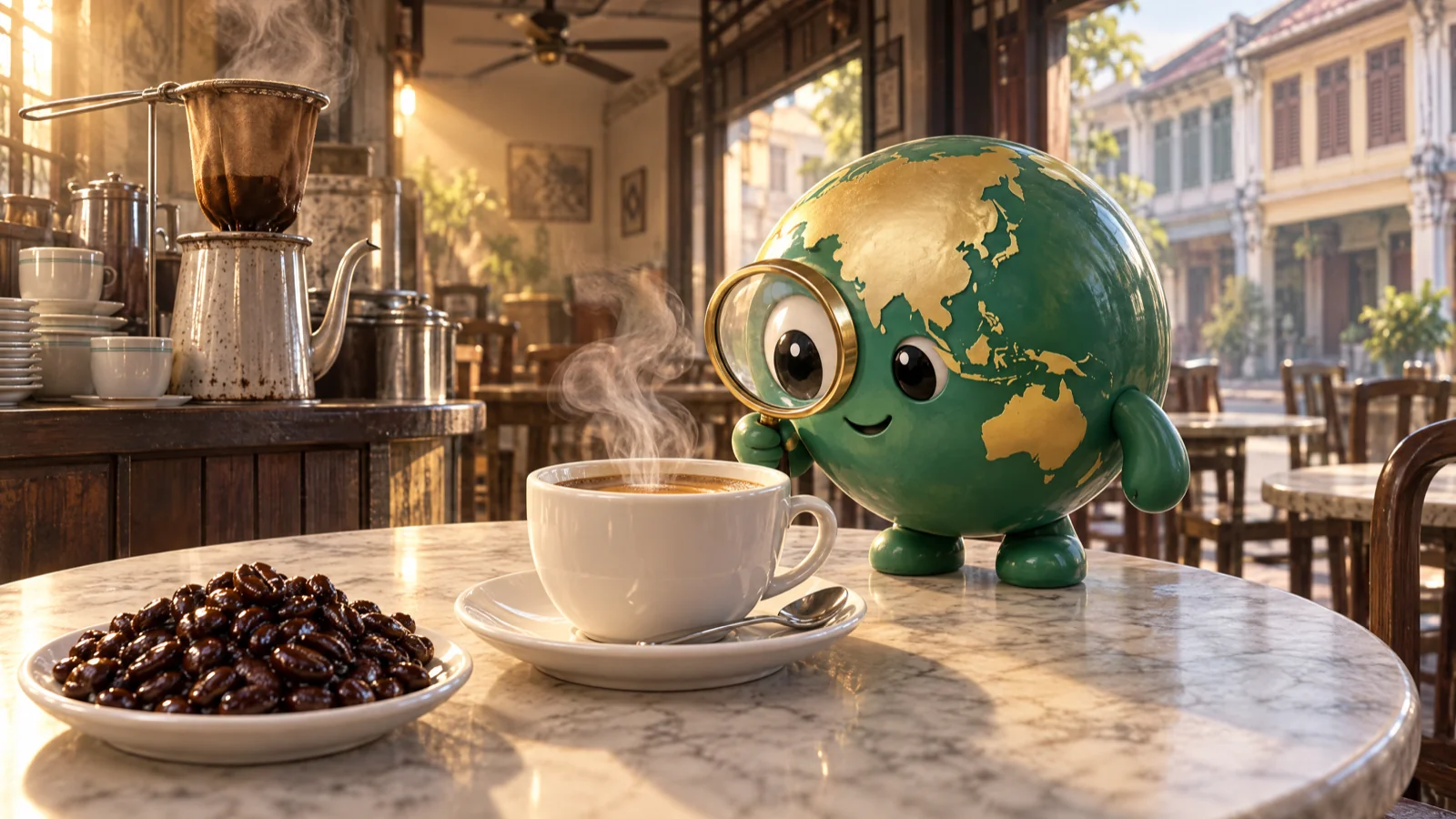
You think kopi is just coffee with a local name. It is not. Kopi is coffee beans roasted in margarine and sugar before they are even ground, a method born in the port towns of British Malaya over a hundred years ago. That roast is what makes kopi taste the way it does: thick, smoky, sweet, and strong. It is not an add-on. It is baked into the bean itself. The word kopi comes from the Dutch word koffie, carried to Southeast Asia during colonial times. In Singapore and Malaysia today, kopi does not mean any cup of coffee. It means this particular style, brewed through a cloth filter, served in a kopitiam, and shaped by generations of Hainanese roasters who turned cheap robusta beans into something people love.
The name: what it means and where the word came from
We start with the word, because the word tells a story of its own.
Kopi means coffee in Malay and Indonesian, borrowed from Dutch koffie during colonial rule. Koffie, like Italian caffè and French café, comes from Ottoman Turkish kahve, itself borrowed from the Arabic qahwah: sibling words that all emerged at roughly the same time, not one descended from another. Coffee reached Europe in the 16th century through Italy, and the first dedicated European coffeehouse opened in Venice in 1645. The word kept changing shape as it crossed each border, long before it reached the port towns where kopi would take its own shape.
In Singapore and Malaysia, kopi in daily speech does not mean just any coffee. It means the local style, tied to kopitiam culture. Kopitiam is itself a blend of languages: kopi from Malay, tiam from Hokkien Chinese, meaning "shop". So kopitiam is "coffee shop", and the word itself shows how Chinese dialects and Malay mixed together in these port towns. Traditional kopitiams have been part of Singapore's culture since the early 20th century.
Where it began: the place, the time, the people
Kopi in the Nanyang style ("Nanyang" is an old Chinese name for Southeast Asia, literally "southern ocean"), the style this article is about, grew up in the busy port cities of the late 1800s and early 1900s. Singapore, Penang, and Batavia (now Jakarta) were entry points for trade, colonial rule, and migrant labour. These were loud, crowded, multilingual places where people from many origins shared the same streets. Traditional kopi stalls have existed since the early 20th century.
Coffee plants came to Southeast Asia with European colonial powers. The Dutch brought Arabica seedlings from Yemen to Java in 1696, with another shipment in 1699. By 1711, the first coffee exports left Java for Europe. Coffee cultivation spread to Southeast Asia, particularly Java and Vietnam. But that early coffee was grown for export, not for locals to drink. Tea was more common. Coffee production has been linked to the history of colonialism and slavery, and the beans that stayed behind were often lower grade robusta, rough and bitter.
The port towns held a great diversity of people: Hokkien, Teochew, Cantonese and Hainanese migrants from southern China, Malay traders, Indian traders, and European officials. The Hainanese arrived in larger numbers in the late 19th and early 20th century, the same community behind Hainanese chicken rice. Many worked as cooks or domestic staff in British colonial households and on ships. From those kitchens, they learned to roast, brew and serve coffee. Hainanese families opened their own kopitiams across British Malaya and Singapore in the early 20th century, and it was in those kitchens that the sugar-and-margarine roast took hold, a method that would define nanyang coffee for the next hundred years. Nobody wrote down the exact year that roast began. The earliest kopitiams we can date, Killiney Kopitiam (1919) and Ya Kun (1944), place it somewhere in that same stretch of decades.
Parallel traditions formed in Indonesia, where warung kopi and kedai kopi served strong local brews. But the margarine and sugar roast is strongest in the Nanyang tradition, and that is where we focus.
Anatomy: what it is made of, or how it is done
Kopi is not one simple recipe. It is a system. Each step, from bean to cup, is tuned to keep cost low and flavour strong.
The beans are mostly robusta. Robusta plants grow easily, yield more, and cost less, but the flavour is rougher and more bitter than arabica. Sometimes roasters blend in a little Liberica (a hardier, less common bean) or Arabica, especially in places like Ipoh, where the local white coffee tradition uses mixed beans.
The roast is what makes kopi different from any other coffee in the world. Beans are roasted together with sugar and margarine. Margarine is a solid fat made from vegetable oil, cheaper and more shelf-stable than butter, which matters in tropical heat. Sometimes a little butter or salt goes in too. As the beans roast, the sugar caramelises and coats each bean in a thin, sweet, glossy layer. The fat distributes heat and adds body to the aroma. The result is dark, shiny coffee beans with a smoky, caramel smell.
After roasting, the beans are ground fine. They are brewed in a long-spouted metal pot with hot water, then poured through a cloth "sock" filter, a piece of muslin stretched over a wire frame. The brew often gets poured back and forth between pots, a pulling motion that mixes, cools and creates a light foam on top, similar to what you see in teh tarik. That long pour became part of the art of a kopi stall, something uncles and aunties performed dozens of times each morning.
The kopitiam menu has its own code. Kopi means coffee with sugar and condensed milk. Kopi C includes sugar and evaporated milk. Kopi O is black coffee with sugar. Kopi O kosong is black with no sugar at all. Kopi peng is iced. Kopi gu you means with butter. Kopi siew dai means less sweet. This code lets customers control exactly how their drink arrives. Kopi C is brewed using a cloth sock-like strainer, the same filter method used across every variation.
Why margarine and sugar went into the roast
This method was not a luxury trick. It was born from need.
Margarine cost less than butter, a difference that mattered to kopi sellers working on thin margins. Sugar in the roast created a crust on the beans, which helped protect them from scorching and added a shine that customers came to expect. Together, the fat and the sugar softened the harsh bitterness of lower-grade robusta, turning something rough into something smooth and round.
The people who drank kopi were dock workers, trishaw riders and office clerks, people who needed a strong pick-me-up but could not pay for fine arabica or fresh milk. This roasting method made that possible. It is the difference between Nanyang kopi and European or American dark roasts, which rarely add sugar or fat to the roast, even when they roast the same plant.
One thing, many homes: how each country or community made it its own
Kopi is one word, but it wears many faces, one chapter among many in the region's food stories. Each community shaped the drink to fit its own life.
In Singapore, kopitiams are integral to Singapore's social fabric. Hainanese families ran shops in the ground floors of shophouses, serving the standard breakfast of kaya toast, soft boiled eggs and kopi. From the 1970s, many kopitiams moved into hawker centres as the city redeveloped, but the drink and its rituals stayed the same. Kopi C is a popular coffee variation in Singapore, and it is often enjoyed with kaya toast and soft-boiled eggs. Some of the oldest stalls still run the same way they did decades ago: the same long pour, the same marble tables, the same uncle or auntie behind the counter.
In Malaysia, kopitiams in Penang, Kuala Lumpur and small towns each have their own habits. In rural areas, locals might ask for kopi O kampung, village black coffee, brewed overly thick and very sweet. The balance of sweetness, strength and milk changes from state to state. A plate of roti canai, the flatbread pulled thin and pan-fried, is kopi's other constant order at a Malaysian kopitiam table. Ipoh "white coffee" is a sibling style born in Ipoh's Old Town, where shops roast beans with palm-oil margarine over low heat but use little or no sugar in the roast, giving a lighter colour in the cup. It is part of the same wider Nanyang kopi family, sharing origins with Singapore and Penang roasting styles.
In Indonesia, warung kopi and kedai kopi serve strong brews, often unfiltered, with sugar at the bottom. Some urban kedai adopted margarine roasting methods over time, but many regions still use a plain roast. Different communities drink kopi in their own way: Malay patrons pair it with kuih and sometimes curry puffs, Chinese regulars read newspapers or play chess over their cups, Indian and Eurasian customers fold kopi into their own breakfast and tea-time habits. Many families, one drink.
Kopi in the language of the stall
There is a code spoken between the kopi uncle or auntie behind the counter and the customer in front of it. It is shared across Singapore and much of Malaysia.
Kopi O kosong means black, no sugar. Kopi C kosong is with evaporated milk but no sugar. Kopi siew dai means less sweet. Kopi gao is extra strong. Kopi peng is iced. These short calls grew from the practical needs of a busy stall, where clear words helped uncles and aunties keep dozens of orders straight. Each town might have slight twists in the code, but a traveller across the region can usually still be understood. The flavors may shift from spot to spot, but the language holds.
From the stall to the world: how it spread
Kopi did not stay in the alleyways where it was born. It moved with the people who left.
Migrants carried the kopi habit with them wherever they settled, opening kopi-style cafés in the cities where Singaporean and Malaysian communities put down roots. Some adapted the drink for foreign customers, adjusting sweetness or swapping condensed milk for something lighter. The desire for a familiar sip kept the tradition alive far from home.
Regional chains helped too. Ya Kun Kaya Toast, founded in 1944, expanded into dozens of outlets and overseas branches from the 2000s. Toast Box, another well-known chain, serves the same kopitiam menu in air-conditioned outlets across the region. OldTown White Coffee, started in 2005, commercialised the Ipoh white coffee style and built a chain across Malaysia and beyond. Meanwhile, the introduction of instant coffee made it a household staple in the 20th century, and since the late 1990s, instant 3-in-1 kopi sachets and Ipoh white coffee mixes have been exported to supermarket shelves worldwide, letting anyone grab a taste of margarine-roasted coffee at home.
The late 20th century saw the rise of specialty coffee culture emphasising origin and craft. Some specialty coffee shops now serve kopi-inspired drinks, using espresso but copying the condensed milk sweetness and local names. Tourists who visit Southeast Asia often meet kopi first at a hawker centre or kopitiam, then go hunting for it back home. Since the 2010s, YouTube videos, food blogs and social media have carried the story of kopitiam uncles and margarine roasting to a curious world far from any port town.
Kopi and the rise of "third wave" coffee in the region
Newer café waves did not replace kopi. They now sit side by side with it.
Third wave or specialty coffee means a focus on single-origin beans, lighter roasts and brewing methods like pour-over, where clarity of flavour matters most. From the 2010s, cafés in Singapore and Kuala Lumpur began serving both espresso drinks and traditional kopi under one roof. Some young roasters experimented with cleaner versions of the margarine and sugar roast, using less sugar or swapping fats, to bring kopi flavour into specialty contexts. Old kopitiams and novel cafés each have their own crowd, and many people enjoy both without seeing them as enemies. There is no need to pick a side.
More than a dish: what it means to people today
Kopi is more than a drink. It is a smell, a soundscape, a moment in the morning that anchors people in place and in time.
Picture a kopitiam at seven in the morning. Porcelain cups clink on saucers. An uncle calls out orders. An auntie carries three cups at once, saucers balanced on her arm. Old ceiling fans turn slowly overhead. Newspapers lie spread on sticky marble tables. The ambience has not changed in decades.
For older generations, kopi holds memories of the past: post-war years, early HDB towns in Singapore, tin mining communities in Perak, the pay-day treat of a cup and a rest at the corner shop. Some of the oldest kopitiams still stand, their interiors barely changed in decades, a reminder that some things endure. But in a kopitiam, the world shrinks to a single cup, brewed through a sock, sweetened with condensed milk, and served by someone who has been doing it the same way for decades.
For younger people, kopi can be both comfort and trend. Nostalgic images of enamel cups, antique tin coffee tins and faded shop signs fill social media feeds. New ideas appear too: butter kopi, iced kopi desserts, kopi-flavoured pastries. Friends grab kopi together the way their grandparents did, even if the setting is a food court and not a shophouse.
Kopitiams are social equalisers. Office workers, taxi drivers, students and retirees share tables for the price of a few dollars. A cup of kopi and a seat, that is the only thing you need. The drink carries a community's shared heritage: Hainanese shop names, Malay and Hokkien words on the menu, Indian-run stalls that adopted kopi lingo. No one group can claim to own it.
As rents rise and old kopitiams close, there is a harder truth to face. Younger generations are less willing to take over the stalls. Heritage groups, writers and filmmakers in Singapore and Malaysia are working to record kopi history, to remember the roasters and the recipes before they are lost. It is worth the effort. Every cup today still holds the long history of beans, margarine, sugar and people who crossed the sea, hoping to find something better and creating something that matters along the way.
If you like stories like this, join the Backstory Asia email list. One origin story a week, nothing else.