
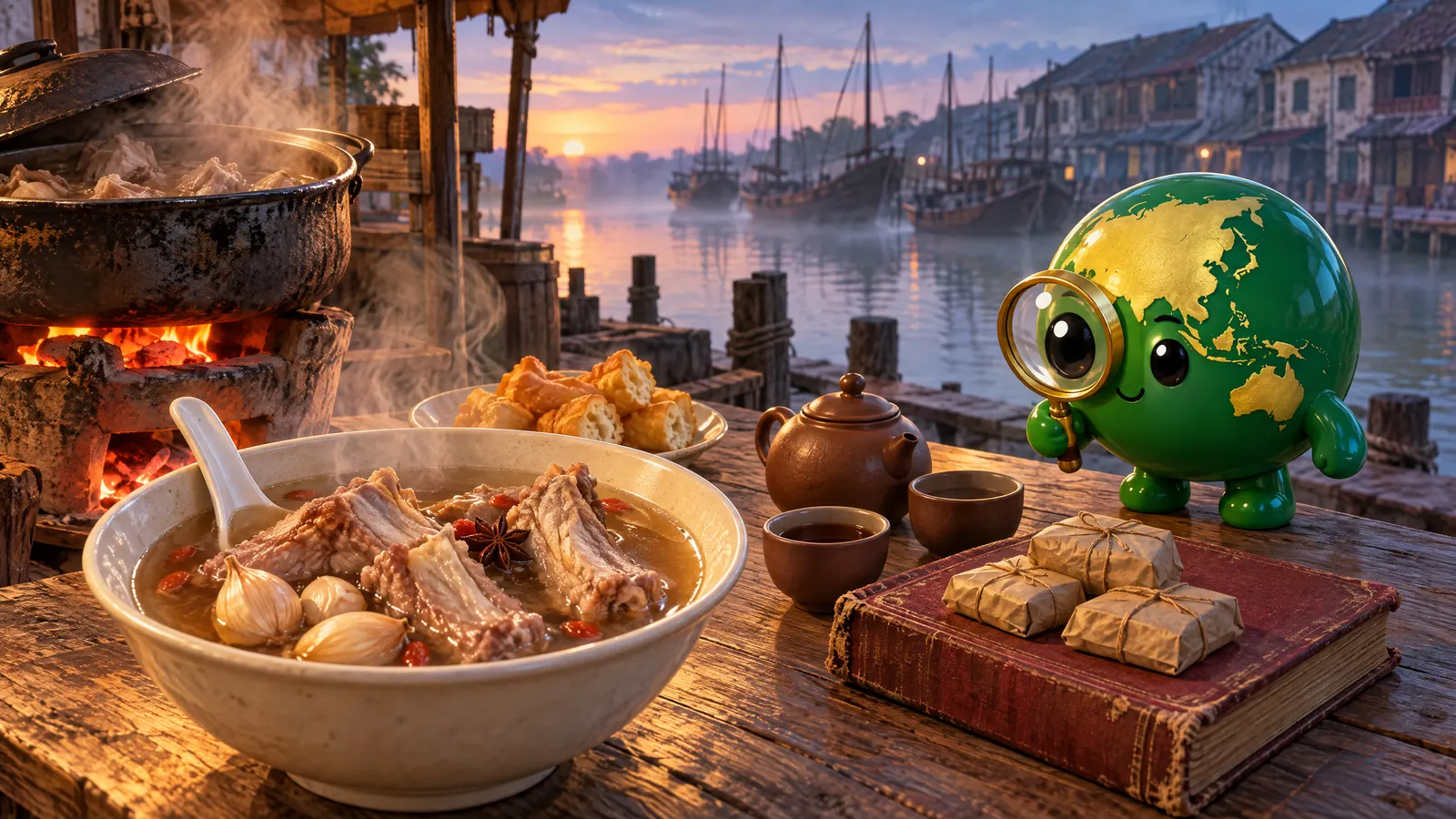
You think bak kut teh is a restaurant dish. It started as a pot of pork bones boiled by labourers before sunrise.
The earliest solid trace is not a newspaper story but a tea merchant's own paperwork. Pek Sin Choon, a Singapore tea supplier founded in 1925, says it has supplied tea to bak kut teh stalls since its earliest days, though its oldest surviving record only reaches back to 1938. That makes 1938 the earliest year anyone can back with paper. Nobody wrote down who made the first pot. Several accounts trace the dish to Chinese coolies working the docks of British Malaya in the early 20th century, who needed a cheap, hot, hearty meal before a hard day's labour. Many families in Klang, Singapore and Johor say their grandfather did it first. We tell their stories here, and we take no side.
The name: what it means and where the word came from
Bak kut teh means "meat bone tea" in Hokkien, a southern Chinese dialect spoken by many migrants who came to Malaya and Singapore. Each word in the name is simple:
Bak means meat, almost always pork.
Kut means bone or rib.
Teh means tea.
The "teh" part is the one that confuses people. There is no tea brewed into the soup itself. The word most likely refers to the pot of strong Chinese tea that workers drank alongside the soup to wash down the rich, fatty broth. The broth itself has no tea leaves in it, but people often describe it as akin to a herbal tea, which fits the herbal goodness of the older versions.
There is another story about the word "teh." In Klang, some say the name honours a man called Lee Boon Teh, who brought the dish from Fujian to Klang in the 1940s. His stall later moved into a shop known as Teck Teh, and today several well-known bak kut teh outlets in Klang are run by his descendants. No source we found backs an exact year or a trademark claim for this story. It is family and local memory, not a dated record.
You will see the name written in different ways. Singapore and most English writing use "bak kut teh." Malaysia often uses "bah kut teh." Indonesia sometimes spells it "bah kut teh" too. In Chinese characters, it is written 肉骨茶, which in Mandarin reads rou gu cha. All these forms point to the same bowl.
Where it began: the place, the time, the people
Pek Sin Choon's 1938 tea record is the clearest paper trail we have. It tells us the dish and its name were already established in Singapore by then. It does not tell us who made the first pot or in which town.
The setting was British Malaya, a place of busy ports and hard labour. Chinese migrants, mostly Hokkien from Fujian and Teochew from Chaozhou in southern Guangdong, came to work as dockworkers, tin miners and rubber tappers. They loaded ships along the Klang river, hauled goods at Port Swettenham (now Port Klang), and carried cargo along the Singapore harbour. The work was heavy. The pay was low. They needed a hearty dish that was cheap, hot and full of energy. Pork bones were among the cheapest cuts of meat. Boil them long enough with salt and herbs, and you had a flavorful broth that could fuel a morning of lifting. A similar instinct, cheap, available ingredients turned into a signature plate by migrant cooks, gave Singapore's Hainanese community Hainanese chicken rice.
Several towns claim the origin:
Klang, Selangor: Many Malaysians see Klang as the home of herbal bak kut teh. Stories describe roadside stalls near the port and the old town in the early 20th century. Lee Boon Teh's stall is believed to have started in the 1940s.
Singapore: Teochew migrants sold peppery pork rib soup from pushcarts near the Singapore River, Clarke Quay and River Valley, a trade the clearest record places after the Second World War.
Johor Bahru and other port towns: Families there tell similar stories of grandfathers selling pork bone soup by the river.
Each place has families who say they were first. Nobody wrote it down at the time. The honest answer is that bak kut teh likely appeared in several port towns at roughly the same period, because the same people, the same pork bones and the same herbs were present wherever Hokkien and Teochew workers gathered. The dish is linked to Chinese immigrants from Fujian and Teochew regions, and it grew from the herbal soup traditions those migrants carried from China. Chinese medicinal soup stalls were common in Fujian and Guangdong. Workers brought those habits south.
Bak kut teh became popular among laborers for its affordability and nourishment. It reflects the immigrant experience and cultural adaptation, a soup made from what was cheap and available in a new land.
Anatomy: what it is made of, or how it is done
Bak kut teh is a soup of pork ribs cooked for many hours in a flavorful broth, eaten with rice or fried dough sticks called you tiao. That is the shared frame across every version:
Pork ribs, sometimes belly, trotters or offal, as the main meat.
Long simmering in a claypot or big metal pot until the meat is tender.
Served very hot, often at breakfast or late at night after work.
The broth was traditionally made with pork bones and medicinal herbs. From there, two main styles split apart.
The herbal style, linked to Klang and much of Malaysia, has a dark, rich broth. Malaysian bak kut teh features a complex herbal blend. The herbs include dang gui (a root also called Chinese angelica), goji berries, star anise, cinnamon, cloves and sometimes fennel seeds. Dark soy sauce gives the soup its deep colour. Bak kut teh reflects Chinese medicinal influences in Malaysia, and many people see the herbal taste as warming and restorative.
The peppery style, linked to Singapore and Johor, uses a clearer broth. Singaporean bak kut teh is known for its clear, peppery broth, seasoned with white pepper and garlic. Whole garlic cloves sit in the bowl alongside the soft pork ribs. There are fewer herbs, less dark soy sauce, and the peppery taste is what you notice first.
Both Klang and Singapore styles evolved from shared culinary traditions but feature unique ingredients.
Side dishes complete the meal: steamed rice, you tiao dipped into the broth, braised tofu and tofu puffs, preserved vegetables, and a small saucer of soy sauce with sliced chilli on the side. Many stalls sit inside or beside a kopitiam, so a glass of kopi is often the next order.
Old stalls cooked over charcoal fires in big blackened pots. The smoke added its own flavour. Gas stoves came later and gave cooks more control and speed, but some older shops kept their charcoal pots as a point of pride.
One thing, many homes: how each country or community made it its own
Bak kut teh is one idea with many local faces. The dish showcases cultural diversity in Southeast Asia, and factors like immigration and local cultures have shaped its evolution across borders.
Bak kut teh in Klang and the rest of Malaysia
Many Malaysians see Klang as the home of authentic bak kut teh, though this is believed rather than proven by a single dated document. Early roadside stalls near the port and old town date to the early 20th century. Klang style bak kut teh is known for its rich broth, heavy with herbs and dark soy sauce.
Malaysian bak kut teh features a dark, herbal broth. The Malaysian version uses star anise, cinnamon, and cloves. Herb mixes are guarded family secrets. In Klang, Penang and Johor, different shops use slightly different combinations, and many sell packet herbs so customers can cook at home.
In later years, halal and non-pork versions appeared in some Malaysian towns. Muslim customers and mixed groups wanted a similar soup, so some shops offered chicken or herbal broth only.
Malaysia officially declared bak kut teh a National Heritage dish in 2024, reflecting how deeply the soup sits in the country's food story, alongside other dishes already stitched into that same heritage record, such as nasi lemak.
Bak kut teh in Singapore
Singapore bak kut teh has Teochew roots. Migrants from Chaozhou brought their love of clear soups, pepper and garlic. After the Second World War, pushcart stalls appeared near the Singapore River, around Clarke Quay and River Valley, feeding dockworkers and coolies in the early morning hours.
In the 1960s and 1970s, famous brands opened permanent shophouse outlets. One example is Song Fa, which started as a pushcart stall in 1969 and grew into a well-known restaurant chain. Pushcarts became shophouses, and shophouses became hawker centre stalls.
Over time, Singapore style became more pepper-forward and less herbal. Singaporean bak kut teh has a clear, peppery soup base. Garlic cloves floating in the bowl became a hallmark. The dish moved from a dockworkers' morning meal to a breakfast eaten by taxi drivers, office workers and families.
Singapore bak kut teh in three traits:
A clearer broth, light in colour.
Strong white pepper and garlic notes.
Minimal herbs and very little dark soy sauce.
Bak kut teh in Indonesia, Thailand and beyond Southeast Asia
In Indonesia, Chinese communities in cities like Medan and Jakarta have their own versions, often spelled "bah kut teh" and adjusted to local taste and herb availability. In southern Thailand, Thai-Chinese versions blend local herbs and sometimes add spicy or sour notes that reflect the local palate.
Overseas Chinese in cities like Sydney, Melbourne, London and Houston started bak kut teh shops in later decades, serving students and workers who missed the taste of home. Outside Southeast Asia, shops often pick one face for their branding, calling themselves "Singapore pepper bak kut teh" or "Klang herbal bak kut teh."
Many homes, one bowl idea. Wherever Hokkien or Teochew cooks settled, a version of bak kut teh followed.
From the stall to the world: how it spread
The first bak kut teh stalls were nothing more than a cook, a pot and a fire by the docks. In the decades that followed, these informal setups fed coolies and labourers at dawn. After the Second World War, cities grew and regulations changed. Street vendors moved into permanent shophouses and stalls inside coffeeshops. Its commercial popularity expanded from roadside stalls to restaurant chains.
As the postwar economy grew, more money reached more pockets. Families could afford pork ribs for breakfast more often. Bak kut teh was originally a laborer's breakfast but is now enjoyed at all times, as a weekend treat, a late-night sip of hot broth, or a weekday morning comfort.
Over time, some family stalls turned into branded restaurants, opening multiple outlets in malls. They began selling their herb packs and spice mixes in packets, a small but important form of innovation. Eventually, instant bak kut teh soup bases reached supermarket shelves in Malaysia, Singapore, Hong Kong and later in Europe and North America.
Food media helped the dish travel further. Television shows, blogs and later video channels filmed the 3 am bak kut teh breakfast, the steamy pork ribs, the dark broth, the you tiao dipped and dripping. That spread the image worldwide and boosted the dish's popularity far from its port-town origin.
No single brand or restaurant made bak kut teh global. Many small family chains and migrant cooks carried it abroad at the same time.
The main steps of spread:
Street stall or riverside cook pot.
Permanent shophouse or stall in a food centre.
Family chain or restaurant brand with branches.
Commercial spice packet and soup base.
Overseas outlets and diaspora home kitchens.
More than a dish: what it means to people today
Bak kut teh is no longer just fuel for hard work. It is a comfort food, a shared taste and a marker of heritage for many Southeast Asians. Bak kut teh is a beloved comfort food in both Malaysia and Singapore, and bak kut teh remains a dish that connects generations.
Older dockworkers and their children remember it as a cheap, smoky meal eaten before sunrise, when the morning air smelled of charcoal and pork bones. Younger people know it as a breakfast with air conditioning and bright lights, the same soup in a different room.
Its role in family life is real. Three generations sit at a table on a weekend morning, seasoned aunties ordering extra garlic, children dipping you tiao into the broth. Relatives visiting from overseas walk straight from the airport to a bak kut teh shop. Friends argue gently over whether the herbal or peppery version is better, reflecting the diversity of the tradition itself.
Some see herbal bak kut teh as a warming tonic, drawing on traditional Chinese medicine ideas about the immune system and balance. Others believe the peppery version helps on cold, rainy days. These are beliefs passed down through families, not tested medical claims. We note them because they are part of what the food means to people, not because they are proven.
Bak kut teh matters to Hokkien and Teochew identity in Malaysia and Singapore. But it has also become a shared dish across races and communities, with non-Chinese friends and colleagues meeting over it, ordering the same side dishes, pouring the same refreshing pot of strong Chinese tea.
Coal fires are mostly gone. The big blackened pots are fewer. But the slow boil of bones, the rich smell of herbs or pepper filling a small shop, the loud talk at the table, these have not changed much at all.
Bak kut teh is one entry in Backstory Asia's record of Southeast Asian food origins.
If you like stories like this, join the Backstory Asia email list for one origin story a week.