
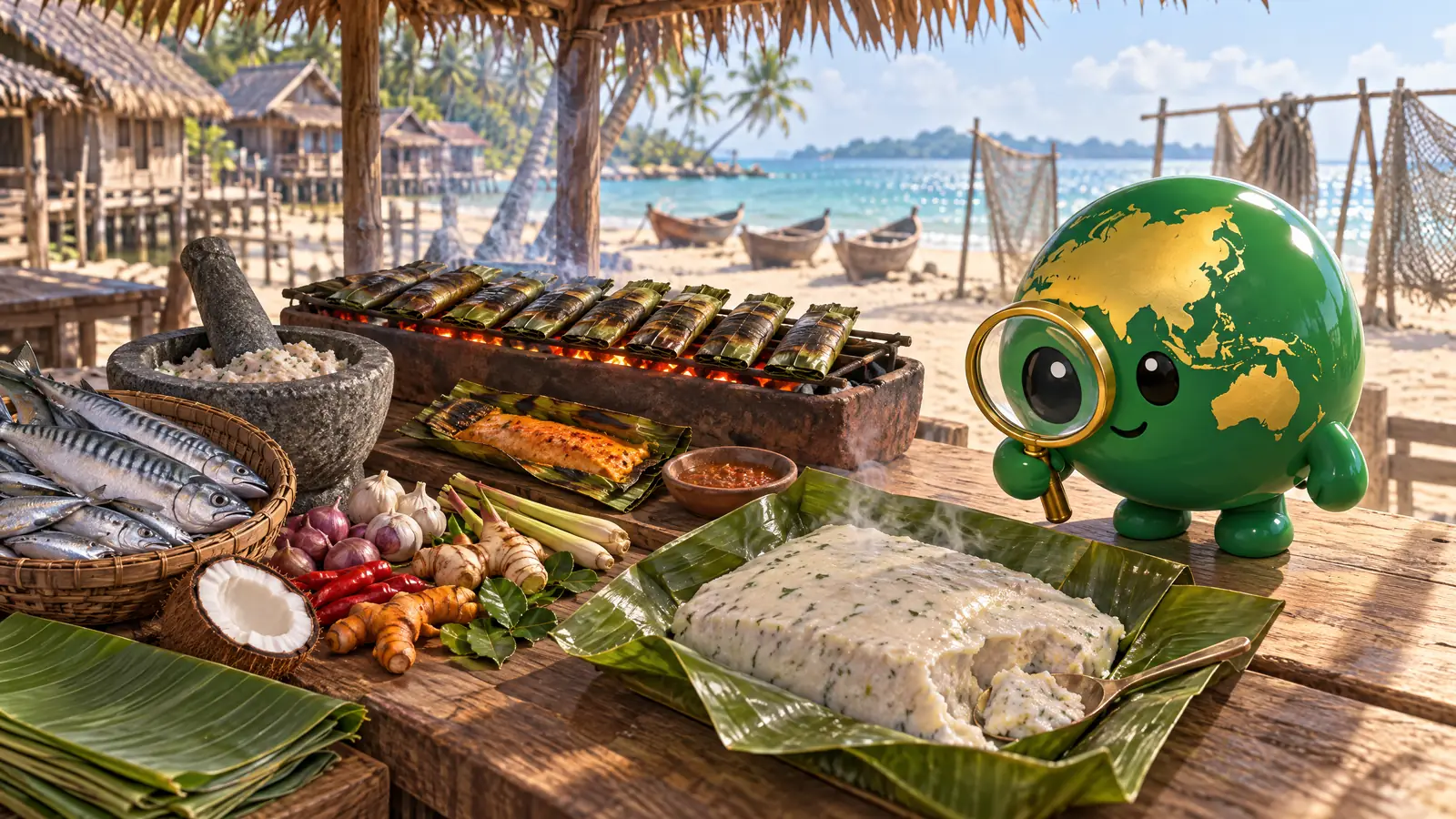
You think otak-otak is a grilled fish snack. It is. But the name means "brains" in Malay and Indonesian, and there is no brain inside.
Otak-otak is a soft fish paste seasoned with spices, wrapped in banana leaves, then grilled or steamed. The word "otak" means "brain" in Bahasa Melayu and Bahasa Indonesia. When you double it to "otak-otak", the reduplication makes it sound like "brainy bits" or "brain-like things". The most common explanation is that the cooked fish paste, pale and squishy, resembles brains. No real brains go into the mixture. The name is about how the food looks, not what it contains, one entry in Backstory Asia's record of Southeast Asian food origins.
The name: what it means and where the word came from
There are two ideas about why the dish got this name. The first is the look. When steamed, the fish paste turns grey and soft. It wobbles. It resembles brains sitting in a leaf. The Indonesian version from Palembang is especially pale and jiggly, and the resemblance is hard to miss. The second idea, raised in some older oral stories, is that early home versions in remote Malay villages once mixed actual animal brains with the fish meat. No printed recipe confirms this. Modern otak-otak across Indonesia, Malaysia, and Singapore uses only fish.
No early written recipe explains where the name came from. A 1964 school cookbook, Malayan Cookery Recipes Tested in Malayan Schools, was published by Eastern Universities Press.
People in different places talk about the name differently. In Singapore, hawkers sometimes joke with customers about "eating brains". In Palembang and Jakarta, Indonesian vendors explain it as just a funny old name. In Penang, sellers link it to the soft, custard-like feel of their steamed version.
Where it began: the place, the time, the people
Nobody wrote down the moment someone first pounded fish into a smooth paste, wrapped it in a leaf, and called it otak-otak. The dish likely grew in several coastal Malay communities at around the same time, shaped by the same needs and the same sea.
The strongest claim comes from Palembang in South Sumatra, where otak-otak sits alongside other fish cake traditions like pempek; from there, it is believed to have spread to the rest of Sumatra, to Java, and to the Malay Peninsula. The Riau Islands, especially Tanjung Pinang, also hold a deep local tradition. On the Malaysian side, Johor has a long history of making otak-otak.
The setting matters. These were coastal fishing towns in the late 19th and early 20th century. Small, bony, or less valuable fish were plentiful. Turning them into paste and cooking them in leaves was a clever way to make good food from what the sea offered freely.
The people who made it were Malay fishing families, mixed Malay and Chinese (Peranakan) communities in port towns, and Bugis or Javanese traders who carried recipes across the Straits of Melaka.
Many families, one thing.
Anatomy: what it is made of, or how it is done
Common fish used include milkfish and Spanish mackerel (called tenggiri in Malay). A binder, often sago or tapioca flour, holds the paste together. The fish paste can include shallots, garlic, and egg, along with chilli, turmeric, galangal, lemongrass, and kaffir lime leaves, plus coconut milk to make it richer. The result is a smooth paste that holds its shape once cooked but stays soft inside.
The wrapper is part of the flavour, giving the finished food a characteristic smoky aroma. In some Indonesian coastal towns, cooks use coconut leaf midribs or nipa palm leaves instead of banana leaf. In Johor and Muar, attap (nipa palm) leaf is common. Modern factory versions sometimes swap the leaf for plastic or foil, which is faster but loses the smell.
There are two main ways to cook otak-otak, and both are old. Charcoal-grilled otak-otak comes in narrow, thin leaf packets. It picks up a smoky taste and turns orange or reddish from the turmeric and chilli. Steamed otak-otak sits in wider banana leaf trays. It stays pale, almost grey, and has a soft custard feel. The grilled type is more common in Johor, Muar, and Singapore. The steamed type is more common in Penang and parts of Indonesia.
Non-fish versions exist today. You can find otak-otak made with prawns, cuttlefish, crab, or even chicken. But fish-based otak-otak is the older and most widespread type.
One thing, many homes: how each country or community made it its own
It is one family of food with many local children. Looking at each one shows how people shaped the same idea to fit their own taste, their own fish, and their own leaves.
In the Riau Islands and coastal Indonesia, otak-otak comes in long, slim grilled packets, usually made from mackerel or tenggiri, and sold at ferry terminals and seaside stalls. Otak-otak is often served with spicy peanut sauce, or sometimes sweet chilli.
In Palembang, South Sumatra, and on the Bangka Belitung Islands, otak-otak is close to the fish cake family that includes pempek. Cooks use sago or tapioca starch and local spices. The dish is sometimes eaten with a vinegar-based sauce called cuko, which gives it a sour, sharp edge. The texture leans softer and paler here than in Malaysian versions.
Johor and Muar in Malaysia are famous for a different experience: a bright reddish-orange colour and heavy spicing. Roadside stalls sell sticks by the dozen, the chopped chilli and turmeric in the paste giving it that colour and a warmth you feel on your tongue.
Penang and northern Malaysia take a gentler path. Penang-style otak-otak features a soft, custard-like texture with fresh herbs and coconut milk. The result is rich, fragrant, and enjoyed with rice as part of a meal rather than eaten as a standalone snack.
Singaporean otak-otak is commonly referred to as "otah" and is popular in hawker centres. Malay and Peranakan vendors grill it over charcoal. It appears alongside nasi lemak sets and as a side dish at kopitiams. Bakeries in Singapore now sell otah buns, a modern twist that stuffs the fish paste inside bread.
Peranakan homes, especially in Melaka and Singapore, blend Nyonya spice pastes with the Malay idea of fish otak-otak. They use thicker rempah (spice paste), more coconut milk, and wrap the mixture in banana leaves.
From the stall to the world: how it spread
Otak-otak started in small coastal stalls and fishing villages, staying local for a long time, until people moved and the food moved with them.
Improved roads and bus travel in Malaysia and Indonesia in the 1970s to 1990s helped otak-otak become a common stop along the way. Towns like Muar and Palembang became known as places to visit and buy it fresh. Travellers carried packets home in paper bags. The dish became a marker of place.
In Singapore from the 1970s onward, hawker centres gave Malay and Peranakan vendors a set place to sell otak-otak beside satay and nasi lemak. That exposed the dish to visitors, office workers, and new residents who might never have seen it in a village, and made it part of everyday eating there too.
Freezing and vacuum-packing from the late 20th century changed the range. Otak-otak could now travel from Johor to Kuala Lumpur to Hong Kong to Sydney without spoiling. In cities like Melbourne, London, and Amsterdam, Southeast Asian grocery shops sell frozen otak-otak, often labelled "fish cake" to explain it to people who do not read Bahasa Melayu.
From the 2000s onward, food shows, travel blogs, and social media began to feature otak-otak as a street food worth knowing. People who had never been to Muar or Palembang could now read about otak-otak, see a photo of the leaf parcels, and look for it the next month at an Asian grocery shop.
The story of how it spread is really a story of people on the move: students, workers, sailors, and their families, each one bringing a taste of home to a new place.
More than a dish: what it means to people today
Otak-otak today is more than food. It is a piece of memory, place, and identity for Malays, Indonesians, Singaporeans, and the wider Southeast Asian diaspora.
For coastal Malay communities in Riau, Johor, and Terengganu, otak-otak is local pride. It turns fishing work into income. Small-scale production at home stalls keeps families going.
In city life, otak-otak is a cheap side dish with rice, a comfort snack with a kopi at a kopitiam, a familiar sight at Ramadan bazaars. It is the kind of food people do not think about until they leave home and miss it.
In Peranakan and Malay homes, otak-otak is a taste linked to weekends, to visits to grandparents, to special meals. Many people now buy it ready-made instead of pounding the fish paste themselves. The love for it stays the same.
For people abroad, a frozen packet of otak-otak in a foreign freezer is a reminder of home. Ordering it at a Southeast Asian restaurant is a way to share their culture with friends who have never been to the region.
The name still works as a quiet reminder. A snack named after brains tells a story of clever use of humble fish, wrapped in leaves, shared across seas by many families. That is the part most people skip when they eat it. It is the good part.
If you love stories like the history of otak-otak, join the Backstory Asia email list. One origin story a week, nothing else.