
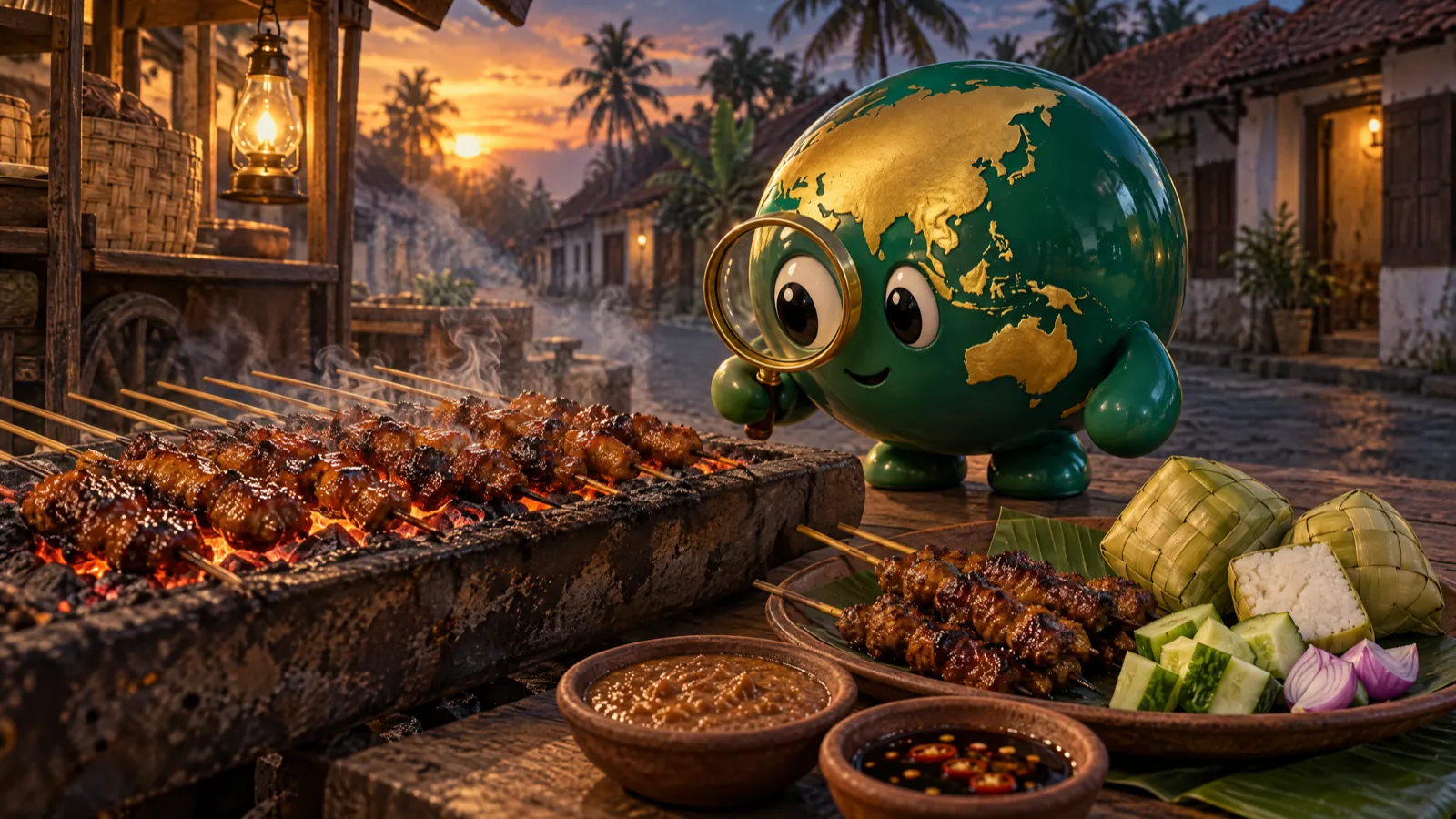
You think satay is a stick of chicken with peanut sauce. It is older than that, stranger than that, and it belongs to more people than you might expect. The earliest written record of satay comes from the Indonesian island of Java, in the early 1800s; the dish may be older, but nobody wrote it down before then. Javanese street vendors adapted the idea of grilled meat on a skewer from Arab and Indian traders, reworking it with local sugar, soy and spice into something new: a small, sweet, smoky bite that would travel across the world and never stop changing.
This is the history of that dish, from the first charcoal brazier to the hawker centres of Singapore and the dinner tables of Amsterdam.
The name: what it means and where the word came from
Satay is the English spelling. In Indonesian the word is sate. It means the skewered, grilled meat itself, not the peanut sauce on the side. The sauce has its own name: bumbu kacang or sambal kacang, which simply means peanut sauce.
Where did the word come from? Nobody is fully sure. We can share the main ideas, and we take no side.
One group of scholars links sate to a Tamil word, catai, meaning flesh or meat. Tamil traders from South India lived and worked in Javanese ports for centuries, so the connection is possible, though not proven.
A third idea connects the name to a Chinese dialect phrase. In Hokkien, sa tae bak can sound like "three pieces of meat". It is a good story, but sources call it a false etymology, unlikely to be true.
The word also appears as saté, the accented Javanese spelling behind satai, the Malay and Indonesian form that gave English its word "satay". Spelling shifts with language, but people across Southeast Asia are talking about the same basic street food: meat on a stick, cooked over fire, dipped in sauce.
Where it began: the place, the time, the people
The strongest early trail for satay history points to Central and East Java in the early 1800s. Towns like Surakarta, which most people call Solo, and Yogyakarta are mentioned most often. Satay originated from the Malay and Javanese communities living in and around these places during Dutch colonial rule.
Java at that time was a busy trading island in the Dutch East Indies, where Arab merchants, South Indian traders and settlers from southern China lived near the ports. The older cousins of satay are the skewered meat dishes of the Middle East and India: the shish kebab and the seekh kebab. But those dishes did not use sweet soy sauce, palm sugar or peanut sauce.
The earliest written traces we have come from mid- to late-1800s Dutch administrators and European visitors, who mentioned sate as a popular Javanese street snack.
The people behind early satay were hawker vendors selling to plantation workers, port labourers and office clerks. Many early sellers were Muslim, so they used goat and beef to follow their food rules; chicken and offal came in as cheaper options.
We cannot name one inventor. Satay was many cooks in many streets, adapting the foreign kebab model to local rice, sugar, soy and, in time, peanuts.
Anatomy: what it is made of, or how it is done
Satay is meat on thin sticks, marinated with sweet and salty spice, grilled over charcoal, then dipped or drenched in sauce.
The stick. Early vendors used thin bamboo sticks or the midribs of coconut leaves. Small sticks held small bites, so the meat cooked quickly over a portable brazier.
The meat. The most common early choices in Java were goat (sate kambing), beef, chicken and offal like liver or intestine. Pork satay appeared later, mostly in non-Muslim communities and Chinese households, and on the Hindu island of Bali.
The marinade. A typical Javanese sate marinade uses kecap manis, a thick, sweet soy sauce, along with crushed garlic, shallot, ground coriander seeds, galangal and palm sugar.
The fire. Grilling is done over charcoal on a long, narrow brazier; quick charring gives the meat a fragrant, smoky crust.
The sauce. Early satay in Java may have been paired with nothing more than salt, sambal (a spicy chili paste) or a soy dip. The thick ground peanut sauce came later. Peanuts were introduced to Asia by Spanish traders, and peanut sauce became a key accompaniment to satay in the 19th century.
On the plate. Satay is often served with rice cakes: lontong or ketupat, rice packed and boiled inside banana or coconut leaves until the grains press into a firm cake, with cucumber, raw onion and simple pickles on the side.
One thing, many homes: how each country or community made it its own
Satay is now found across Indonesia, Malaysia, Singapore, southern Thailand, Brunei and parts of the southern Philippines, each place steering the dish in its own way, shaped by local meat, spice, religion and habit. We will not crown one place as the owner. Many families, one thing.
Java and Madura: the early stronghold
In cities like Yogyakarta, Solo and Jakarta, sate ayam (chicken) and sate kambing (goat) remain street staples, glazed with kecap manis. Sate Madura, sold from distinctive wooden carts with hanging lamps at night, is a renowned regional style, slightly sweeter and thicker. Sate Padang from West Sumatra is a different branch entirely: beef or offal with a thick turmeric gravy, not peanut sauce. In Bali, sate lilit wraps minced fish or meat with grated coconut around lemongrass sticks instead of bamboo.
Malaysia: from Kajang to kampung feasts
Satay is a key part of Malay food culture in Peninsular Malaysia, especially in Selangor and Johor; Kajang town is renowned as a satay town. Malaysian satay tends to be turmeric-yellow, sweeter and more heavily spiced, with thick peanut sauce, cucumber, raw onion and compressed rice cakes called nasi impit, often served at open houses during Hari Raya, the same open houses where nasi lemak and roti canai often sit on the same table.
Singapore: hawker skewers in a port city
Satay arrived in Singapore with Malay, Javanese and Hainanese communities during colonial days, with early stalls lining Beach Road and the Esplanade. The old Satay Club near the Esplanade was a gathering place for a generation of customers through the 20th century before it moved locations.
Singapore satay today is grilled over live charcoal in hawker centres, the sauce given extra spice with lemongrass and galangal. A local twist worth knowing is satay bee hoon, which combines Teochew rice vermicelli and Malay satay. It came from cultural fusion between Malay, Javanese and Teochew communities in Singapore, with no single founder or date on record.
Southern Thailand, Brunei and beyond
In southern Thailand, moo satay (pork satay) is common, made with coconut milk, turmeric, peanut sauce and cucumber relish. Brunei's version is close to Malay styles: chicken and beef, thick peanut sauce, found at pasar malam and family gatherings. In the southern Philippines, Muslim Filipino communities eat dishes like satti, a close cousin served with spicy sauce and rice cakes.
From the stall to the world: how it spread
Satay did not stay on Javanese streets. It rode on ships, trains and planes with workers, students and migrants.
From the 18th to the early 20th century, Javanese workers moved to the Malay Peninsula for plantation work, bringing their sate carts and recipes. In colonial cities like Singapore, Penang and Medan, hawkers made satay a cheap night food that anyone could afford.
Colonial ties helped introduce satay to the Netherlands as part of Indo-Dutch cuisine. After World War Two and Indonesian independence, many Indonesians migrated there, bringing sate with peanut sauce into Dutch town centres and rijsttafel restaurants, where the "Indonesian rice table" became a meal in its own right.
From the mid-20th century onward, Indonesian, Malaysian, Singaporean and Thai emigrants opened restaurants across Asia, Europe, Australia and North America, carrying satay, a dish rooted in Indonesia and the Malay world, to new tables everywhere.
More than a dish: what it means to people today
Satay is smoke, crowd and memory on a stick.
In Jakarta, Kuala Lumpur and Singapore, office workers finishing the day meet friends at a night market or hawker stall for a plate of sate ayam or kambing with sauce and rice cake, and talk until the charcoal dies. At village feasts, weddings and religious holidays like Eid, satay is often among the first shared plates.
Satay holds identity too. For Indonesians, sate ayam and sate Padang sit beside dishes like rendang on "national" menus. It carries meaning far from home, too: a Malaysian in London or an Indonesian in Amsterdam will hunt for a satay stall when homesick, the smell bringing back a mother's table or a childhood trip to a night market.
Satay's roots are strongest in Java, but more than one country has cooked, sold and loved it for a long, long time. It sits alongside Hainanese chicken rice in Backstory Asia's record of Southeast Asian food origins: many families, one thing, each kept alive by the people who never stopped making it.
If you like learning the hidden origins of everyday Asian food, join the Backstory Asia email list. One origin story a week, nothing else.