
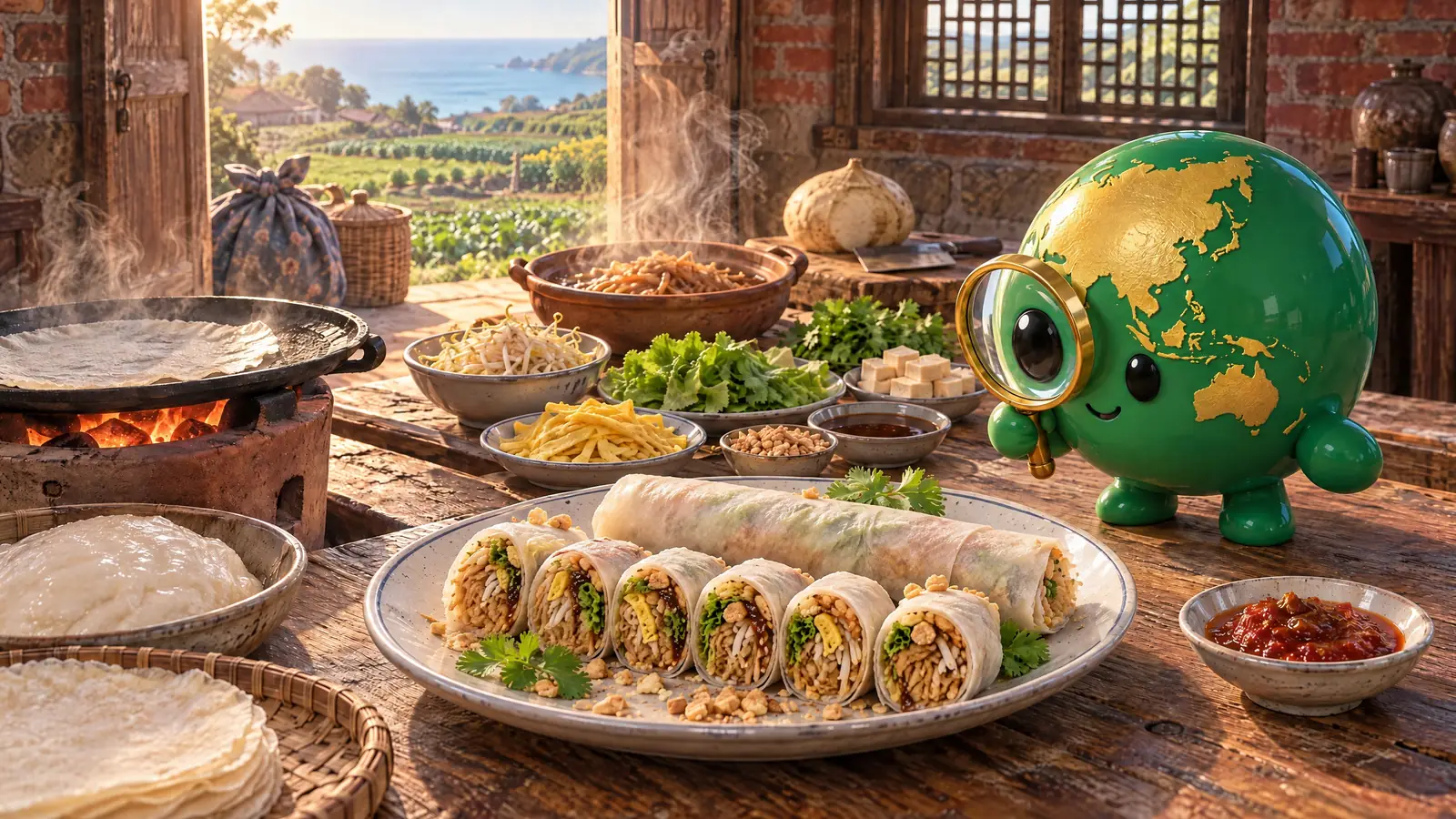
You think popiah is a snack you buy at a hawker stall in Singapore. It is older than that. Popiah started as a home food in Fujian province, where farming families wrapped cooked vegetables in a thin wheat sheet and ate it together around a table. Its origin goes back to the 17th century, when Hokkien and Teochew families began carrying it from Fujian to Melaka, Penang, Singapore, Jakarta and beyond. Each port changed the fillings, but the roll stayed the same: a soft, thin skin holding whatever the local land and sea could give.
The name: what it means and where the word came from
The word popiah translates literally to "thin pancake" in the Teochew dialect. It comes from Hokkien, a southern Chinese dialect spoken in Fujian province. The Chinese characters are 薄饼: 薄 means thin, 饼 means pancake or flatbread. Other dialect groups use their own sounds for the same characters: Hokkien speakers say something close to "pok piah," Teochew's own written form comes out closer to "boh biang," and Mandarin speakers say "baobing." All point to the same idea: a wrapper made from wheat flour, rolled thin, filled and eaten fresh.
In written sources from Fujian, the term also appears as 潤餅 (lun-piah in Hokkien), the form that later gave "lumpia" its name in the Philippines and Indonesia. The link is a little misleading: lumpia today is usually deep fried and crispy, while fresh popiah is soft and eaten right away. The shared root lies in the custom, not the cooking method.
Historians agree on what the word means. Where they are less certain is the exact moment and place when people first used "popiah" as a spoken name for the roll eaten today: no surviving text describes the full roll, with all its fillings and sauces, until much later than the word itself.
Where it began: the place, the time, the people
Popiah began in Fujian, on the southeast coast of China, among families who grew wheat and vegetables. The period is roughly the 17th century, in cities like Quanzhou and Zhangzhou, where people started wrapping cooked fillings in a very thin wheat sheet, tied to the seasons: during Qingming Festival, when families visited ancestral graves, the rolls appeared on the table.
One well known origin story says that an imperial official's wife created popiah for convenience: a thin pancake wrap so her husband could eat while working at his desk. The story is popular in Fujian and Taiwan, but no dated record confirms it, so it stays folklore.
What is confirmed is migration. From the 17th century onward, Hokkien and Teochew families left Fujian and eastern Guangdong for Melaka, Penang, Singapore and beyond, the same migration that carried the spice paste and noodles behind laksa into Peranakan kitchens. They carried popiah with them as a comfort food, made at home, for festival time.
Anatomy: what it is made of, or how it is done
Popiah looks simple, a roll eaten in a few bites, but every part, the skin, the filling, the sauces, has its own backstory from Fujian and Southeast Asia.
The popiah skin comes first: handmade from wheat flour, water and a pinch of salt, mixed into a sticky, elastic dough. A skilled maker holds the dough ball and rubs it against a hot steel pan in a fast, circular sweep, and the thin film that sticks cooks in seconds into a sheet thin enough to see through. A few family-run stalls still make skin this way by hand instead of buying it ready-made. Unlike deep fried spring roll pastry, or rice paper in Vietnamese rolls, popiah skin is soft, slightly chewy and strong enough to hold a wet filling without tearing.
The core filling is braised turnip or jicama, also called bangkuang or yam bean, shredded and stewed slowly with garlic, soy sauce and sometimes dried shrimp or pork. Jicama is not originally from Asia: Spanish traders carried it from Mexico to the Philippines in the 17th century, and from there it spread into China and Southeast Asia. Cut raw into crisp pieces, the same root also goes into rojak, a mixed salad of fruit and vegetables.
Around it, the roll gathers bean sprouts, lettuce, carrots, egg strips, coriander, peanuts and crispy bits. Sweet sauce goes on the skin before the filling; sambal chilli sits on the side, so diners can adjust the heat to taste. Some versions are vegetarian, with tofu standing in for meat. At hawker stalls, the seller wraps and slices it; at home, everyone wraps their own.
One thing, many homes: how each country or community made it its own
The idea of popiah stayed the same. Each place changed the fillings, the timing and the meaning, one entry in Backstory Asia's record of Southeast Asian food origins.
Fujian and Chaoshan in southern China
In Fujian province and the Chaoshan region of eastern Guangdong, popiah is still eaten around the start of spring or during Qingming. Families set out small plates of vegetables, tofu, peanuts and sauces, and older relatives roll for children. Fillings tend toward bamboo shoots, Chinese sausage and garlic chives, with meat and lard more common here than in Southeast Asian versions. Between Xiamen, Quanzhou and Shantou the sauces and names shift slightly, but the structure does not: a thin skin, a wrap of cooked vegetables, and a table of people sharing it.
Singapore and Peninsular Malaysia
Hokkien and Teochew migrants brought popiah to ports like Melaka, Penang and Singapore in the 19th century. At first it stayed in home kitchens; by the early 20th century, pushcart hawkers began selling it in markets, and the Peranakan community folded it into their own cuisine. Today it is sold in hawker centres across Singapore, including Chinatown Complex and the Old Airport Road Food Centre, the same kind of market where stalls selling Hainanese chicken rice line up beside the popiah counter.
In Melaka, Peranakan-style popiah brought a wetter, richer filling, sometimes with crab meat or fermented bean paste. In Penang, carts served rolls with sweeter sauce and extra chilli. No one town "invented" popiah in the region; they all shaped it from the same Hokkien and Teochew base.
Indonesia, Thailand and other Southeast Asian ports
In Indonesia, especially in Java and Sumatra, a similar roll appears under names like lumpia basah, meaning wet spring roll; the Hokkien and Teochew names for popiah contributed to the evolution of lumpia itself. In Semarang, the deep fried version of lumpia became more well known than the fresh one, but both share roots with Fujian-style wraps.
In Thailand, Teochew settlers in Bangkok and southern Thailand introduced fresh rolls eaten alongside fried versions. Historians see these as branches of one family of rolls, changed by whichever local sauce entered the filling.
Popiah in the diaspora
From the 1970s onward, Singaporean and Malaysian families migrated to Australia, the United Kingdom and the United States, carrying popiah with them. Overseas, making it often marks a special get-together, turning a meal into an event that keeps a line back to Southeast Asia and to Fujian before that. Some restaurants abroad now serve fusion popiah with non-traditional fillings, while keeping the thin wrapper and the communal assembly: a new branch, not a replacement.
From the stall to the world: how it spread
When Hokkien and Teochew migrants settled in port towns, they continued the practice at home; as Chinese immigrant populations grew, housewives and small family businesses began selling popiah in markets to earn a living, and skin making by hand became a trade of its own.
The growth of hawker centres in Singapore during the 1950s and 1960s gave fixed stall space to popiah sellers, the same wave of centres that gave a cup of kopi its own stall too, turning popiah into an everyday snack and not only a festival dish. In Malaysia and Indonesia, popiah and lumpia found a similar home at night markets and pasar malam.
Food writers and television shows brought popiah to wider attention from the 1990s onward, and social media made the skin-making motion itself something people watched. Even with this spread, popiah is still less known globally than the fried spring roll.
More than a dish: what it means to people today
Popiah is not only good food. It is memory, migration and shared heritage between places around the South China Sea.
In homes across Singapore, Malaysia and Fujian, families and friends still gather for a popiah party, each wrapping their own roll while older relatives show children how. The recipe is rarely written down; it passes from one generation to the next through the act of doing it together. Popiah is commonly enjoyed during festive events in Chinese communities, including Chinese New Year and Qingming Festival, and for diaspora families, making it in cities like Melbourne or London keeps a connection to Southeast Asia and to Fujian villages before that.
Singaporeans, Malaysians, Indonesians and southern Chinese all see popiah and its cousins as "their" food. They are all correct, because of centuries of shared trade and kin. Many families, one roll. Some younger eaters now see fresh popiah as a lighter choice because it is not deep fried, shaping how a new generation thinks about an old food.
If you like stories like this, join the Backstory Asia email list. One origin story a week, nothing else.