
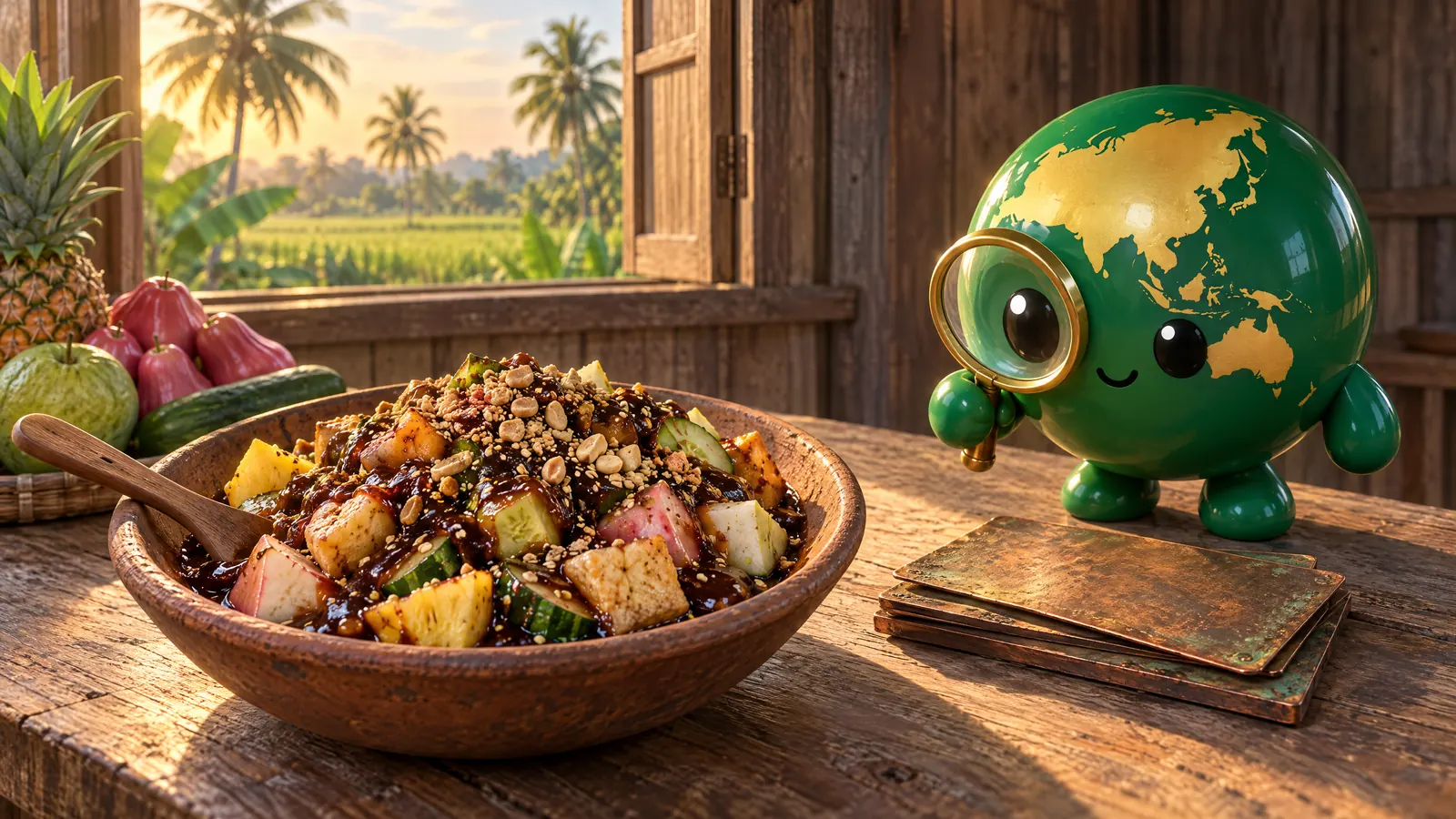
You think rojak is a fruit salad. It is older than that. Rujak is one of the oldest dishes from ancient Java, and the word "rujak" appears in a Javanese text from 901 CE, inscribed onto copper plates during a ceremony in Central Java. That makes it over 1,100 years old.
Rojak is made with various tropical fruits and a spicy dressing. The dish combines contrasting flavours and textures, embodying a balance of sweet, sour, spicy and salty in every bite. In Indonesia the spelling is "rujak". In Malaysia and Singapore, rujak is spelled "rojak". The word itself means "mixed", and the idea behind it, many things tossed together into one bowl, has not changed since someone first inscribed the name onto a copper plate.
The name: what it means and where the word came from
The word rojak is derived from Malay meaning a mixture. In modern Indonesian, "rujak" simply means a mix of fruits or vegetables served with a sauce. It can also mean "mixture" in a casual way, the way you might say "a bit of everything".
The oldest form of the word we have is "rurujak". It appears in the Prasasti Taji, a copper-plate inscription from Central Java dated 901 CE, during the Medang Mataram kingdom. The Old Javanese dictionary compiled by the scholar Zoetmulder gives "anrujak" or "rinujak" as meaning "to chop into little pieces", and "rurujak" as "a mixture of chopped unripe fruit". So the name tells you what the dish is: fruit, chopped up, mixed together.
In colloquial Malay and Singapore English, "rojak" moved beyond food. People say "rojak culture" to describe a society where many ethnic groups live side by side. Malay dictionaries carry the same meaning under the spelling "rojak". One word, many spellings, one idea.
Where it began: the place, the time, the people
Rojak history starts in ancient Java. The earliest record we have is the Prasasti Taji, a set of seven copper plates inscribed in 901 CE. The inscription records a Mataram-era ceremony granting tax-free land, with gifts of food, krises, cloth and gold; rurujak is attested from this era, though the surviving text does not name it among the gifts. The inscription was written in Old Javanese script during the Medang Mataram kingdom, a Hindu-Buddhist court in Central Java. An inscription is writing cut or etched onto a durable surface, stone or metal. It records events that mattered enough to make permanent. Rujak mattered.
The Mataram kingdom sat on fertile land. Farmers grew rice, banana, coconut and sugarcane. They had palm sugar, tamarind and chilli. Trade ships came into coastal ports, connecting Java to the rest of the Indonesian archipelago and to the Malay Peninsula. Sanskrit words appear in the same inscriptions, which tells us the courts had strong cultural ties to India. Some historians think Indian-style fruit offerings and chutneys may have shaped early rujak. That is an idea, not a proven fact. No one wrote down a recipe in the 900s. We know only that people named the dish and valued it enough to keep the name on record in copper.
Over the following centuries, the fruit-and-spice mix spread across the archipelago. Javanese, Malay and Indian families moved to port towns like Melaka, Penang and Singapore. They carried food habits with them. Rojak's history is linked to migration, trade and cultural borrowing in the region. It grew along with trade, not from a single inventor or a single kitchen.
Anatomy: what it is made of, or how it is done
Rojak is not one fixed recipe. It is a way of putting fresh fruits or vegetables together with a strong, thick sauce that is sweet, sour and spicy at once.
The shared core is simple. Raw or lightly blanched fruits and vegetables are cut into bite-sized pieces and tossed just before eating so they stay crisp. The classic Javanese rujak sauce uses palm sugar melted with a bit of water, mashed with chilli, salt and tamarind. Some versions add roasted peanuts and terasi, a fermented prawn paste that gives a deep, salty taste. This pattern appears across Indonesia and then repeats, with changes, in Malaysia and Singapore. In Malay and Singaporean rojak, the sauce turns darker and stickier. Prawn paste, often hae ko (a black prawn paste), is mixed with sugar, lime juice, tamarind and ground roasted peanuts, beaten until it is almost like a thick gravy.
The most common fruits are the ones that can be eaten crisp and slightly sour: unripe mango, jambu air (water apple), pineapple, jicama (a crunchy root vegetable also called sengkuang), cucumber, kedondong and sometimes young guava or green papaya. In places like Penang, Kuala Lumpur and Singapore, savoury additions came later: fried tofu (tau pok), you tiao (fried dough sticks from Chinese cooking), bean sprouts, cuttlefish and deep fried prawn fritters. These turn the salad into something closer to a complete meal.
Garnishes matter too. Torch ginger flower bud, called bunga kantan, appears in Penang rojak and gives a sharp, floral smell. Laksa leaf turns up in some Malaysian stalls. Crushed peanuts go on top of nearly every version. A vendor mixes and serves it with a wooden spoon, right at the stall, so the fruit stays juicy and the sauce coats every piece.
One thing, many homes: how each country or community made it its own
Regional variations of rojak have developed across Malaysia, Singapore and Indonesia. Each region shaped the dish to its own taste and pantry. This is a "many families, one thing" story, not a contest.
Java and the Indonesian archipelago
Java is the heartland. Fruit rujak, called rujak buah or rujak manis, is the form most Indonesians think of first: mixed tropical fruits in a palm sugar, chilli sauce and tamarind dressing. Rujak buah includes tropical fruits like jambu air and pineapple, cut fresh and eaten the same day.
East Java added something unexpected. Rujak cingur, from Surabaya, contains cooked buffalo lips (cingur means "mouth") alongside vegetables, fried tofu, tempeh and a dark sauce made from petis, a thick fermented prawn paste, mixed with peanuts. It is extremely popular in Surabaya and the surrounding towns. In Bali, rujak kuah pindang soaks fruits in a thin, sweet, spicy fish broth instead of a dry sauce, reflecting the island's coastal food habits. In Aceh, a coconut rujak uses young coconut and shaved fruits, served cold. Rujak cuka features shredded fruits and vegetables in a sour dressing. Rujak tumbuk is made by mashing fruits and dressing together, so everything blends into one tangy paste.
Each version reflects what grows nearby: more sea flavours in coastal towns, more coconut in Aceh, more petis in East Java.
Malaysia: rojak buah and Indian rojak
Rojak reached the Malay Peninsula through Indonesian migrants and through the shared Malay culture around the Straits of Melaka. Malaysian rojak buah mixes local fruits like pineapple, jambu air and guava with cucumber, yam bean and fried tofu, all in a thick, dark prawn paste and peanut sauce, garnished with crushed peanuts and sesame.
Then there is Indian rojak, also called pasembur in Penang. Rojak mamak includes fried dough fritters and a spicy peanut sauce, along with deep fried tofu, prawn cakes, potatoes, boiled egg, cucumber and cuttlefish, all covered in a bright orange or red spicy sauce. Indian Muslim hawkers in port towns created this version. Some Malaysians call it rojak mamak in Kuala Lumpur. The dish evolved through culinary exchanges among Chinese, Malay and Indian communities, and you can taste all three traditions on one plate, the same kind of blending that gives laksa its own layered history.
Singapore: rojak as a word for mix
Singapore, a major port under British colonial rule, became a new home for rojak. Both rojak buah and Indian rojak are common in hawker centres across the island, alongside fellow hawker staples like nasi lemak. Rojak has a culinary heritage tied strongly to street food and hawker culture in Southeast Asia, and Singapore is where that culture is most visible.
Singapore Chinese rojak uses fruits, cucumber, bean sprouts, tau pok, you tiao and cuttlefish in a dark hae ko sauce, topped with crushed peanuts and bunga kantan, often cut and mixed to order at a stall. Singapore Malay rojak Bandung pairs water spinach, tofu and cuttlefish. In Malay, "bandung" here means "paired", not the Indonesian city.
In Singapore English, "rojak" became a common way to describe anything mixed, especially ethnic background or language. Rojak reflects social harmony and multi-ethnic hybridity. A food word became a word about identity.
From the stall to the world: how it spread
For centuries, rojak stayed in Southeast Asia. It was a stall food, a village food, a hawker food. Rojak has deep roots in Malay and Indonesian traditions, and for most of its life it did not need to travel.
Malaysians, Singaporeans and Indonesians who moved to Britain, Australia and the United States opened restaurants and hawker-style stalls. They offered rojak to local diners, sometimes as "fruit salad with spicy peanut sauce". In some cities the word "rojak" stays unknown, and the dish appears under more general names. A specific history can get lost in translation that way.
Ready-made rojak sauces and instant mixes later appeared on supermarket shelves in Malaysia, Singapore and Indonesia, making it easy for families abroad to recreate the taste without a street stall. Food writers, bloggers and video channels now feature rojak in English for readers outside the region. Today you do not have to wait for a trip to Penang to know what rojak tastes like, though the stall version is hard to match from a jar.
More than a dish: what it means to people today
Rojak is now more than a plate of fruit. It carries ideas about mix, blend and shared life across Southeast Asia. Rojak is seen as a cultural metaphor for multiculturalism in Southeast Asia, and the word appears in newspapers, speeches and everyday conversation whenever someone wants to describe a society where different groups eat, live and work together.
In Indonesia, rujak holds a special place in Javanese life events. Rujak is popular among pregnant women in Javanese culture. Rujak is part of the Naloni Mitoni ceremony for pregnant women, a rite held in the seventh month of pregnancy. Families prepare rujak with specific fruits. People taste it: a sweet taste is read as a sign of a girl, a spicy or sour taste as a sign of a boy. This is belief, not science, and families know that. The ceremony matters as a gathering, a way to share food and hope.
In Malaysia and Singapore, "a rojak culture" is used warmly. It describes cities where Malay, Chinese, Indian, Peranakan and many others share streets, schools and food courts. For a person living far from home, a plate of rojak can stand for everything they miss: the sharp chilli, the dark sweet sauce, the smell of prawn paste filling a small kitchen far from the equator. The same combination of flavours that a Javanese farmer might have tossed together over a thousand years ago still brings comfort to someone eating alone in London or Melbourne.
The word has moved from a Javanese copper plate to modern slang. The same idea, many things mixed into one, fits both the dish and the societies that keep it alive, within a wider record of Southeast Asian dishes reshaped by migration.
If you like stories like this, join the Backstory Asia email list. One food origin story a week, nothing else.