
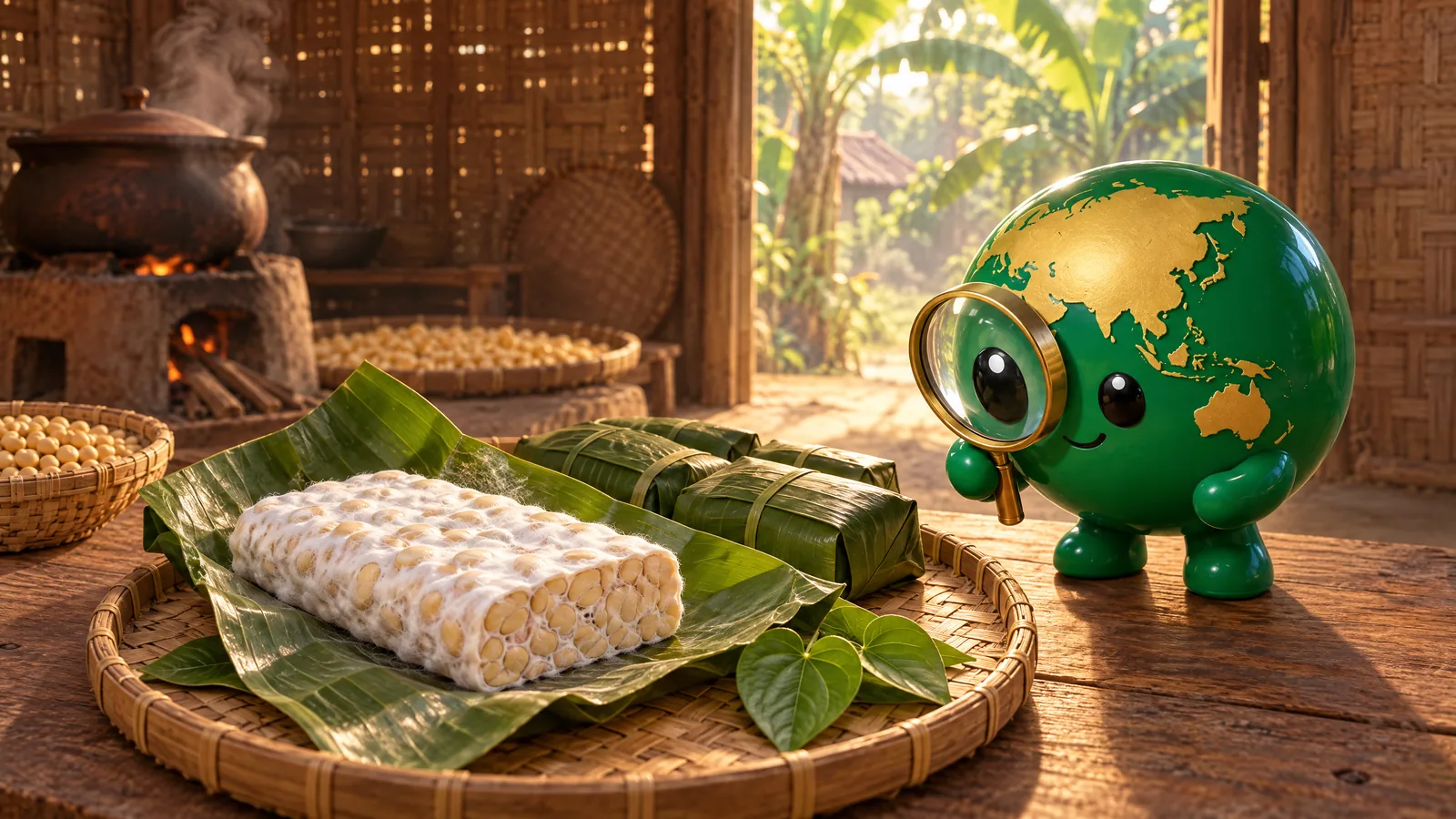
You probably think tempeh is a new vegan meat swap from a health food shop. It is not. Tempeh is an old Javanese village food that has been part of Indonesian cuisine for centuries. The earliest written record of tempe appears in Serat Centhini, a large Javanese literary work compiled around 1815 in Central Java. Some Indonesian scholars argue tempe-like foods existed even earlier, perhaps as far back as the 17th century, long before tofu reached most Javanese kitchens. Tempeh originated in Java, Indonesia, and its story starts with cooked soybeans, banana leaves and a warm room.
The likely beginning was a happy accident. A village family boiled soybeans, wrapped the leftovers in banana leaves for storage, and left them in the humid air. Natural mould spores living on the leaves did the rest. Two days later the beans were knit together into a firm white cake. That natural fermentation process gave Java a cheap, filling, protein-rich food that still feeds millions of people every day.
This page follows tempeh from those village kitchens to factory blocks in Europe and the United States, and shows how each move changed what the food means.
The name: what it means and where the word came from
We start with the word itself, because even the spelling tells a story.
In Indonesia the common spelling is "tempe", with no final "h". That follows Indonesian language rules. The spelling "tempeh" grew from older Dutch and European texts. Dutch writers added the "h" so that readers in Europe would say the last sound like the "e" in "pay", not the "e" in "pet". The first known use of the spelling "tempeh" was by a Dutch microbiologist and chemist, H.C. Prinsen Geerligs, in a German article in 1896.
In Serat Centhini, written in Javanese script (not Latin letters), the word appears as something like "témpé" when put into Latin letters. Early Dutch colonial writings tried other forms too: tempé, tèmpé, tèmpèh. None of those stuck in English the way "tempeh" did.
Where does the Javanese word come from? Some scholars point to an old Javanese term tumpi, a white snack made from sago or starch. The word "tempeh" has roots in the old Javanese term "tumpi". Others suggest links to earlier words for white or pressed foods. But language experts do not fully agree on the exact root. What everyone does agree on is simple: tempe and tempeh name the same food. Indonesians say "tempe" almost always. "Tempeh" is what you see on export packs and in English media.
Where it began: the place, the time, the people
Tempeh belongs to Java first. Not to all of Indonesia at the start, and not to any other country.
The heartland is Central Java and East Java. Towns like Surakarta (also called Solo), Malang and Bayat in Klaten all appear in research as places where tempe traditions run deep. The climate there is warm and humid, which is exactly what mould fermentation needs.
Soybeans reached the Indonesian archipelago through Chinese traders centuries ago. The botanist Rumphius noted soybeans being used in Java as early as 1747, both for food and as green manure. But the earliest solid written record of tempe itself comes from Serat Centhini. This large literary work was ordered by Pakubuwono V of Surakarta and compiled around 1815. It mentions tempe as part of everyday meals, which tells us the food was already well known by then. Tempeh's history dates back several centuries, with early documentation appearing in the 19th-century manuscript Serat Centhini.
Some Indonesian scholars, using oral stories and regional cooking patterns, argue that tempe-like foods may date to the 17th century or even earlier. But nobody wrote it down before the 19th century, so we say "may" and keep going.
The people behind tempe were ordinary Javanese farming families. Women often ran the home-scale making tempe operations. They used banana leaves or waru (Hibiscus) leaves to wrap food for cooking and storage. Tempeh's fermentation process was likely discovered accidentally: someone left cooked soybeans in those leaves, and natural Rhizopus mould spores on the leaves did the work. A day or two later, the beans held together in a white cake. That was the beginning.
Soybeans had already been grown and used in Java for generations by the time Dutch colonial rule took hold in the 19th and early 20th centuries. For many families tempe became the cheapest way to get protein on the table. During the Japanese occupation of Indonesia from 1942 to 1945, when resources were scarce, tempe became even more important as a staple food.
Anatomy: what it is made of, or how it is done
Tempeh is soybeans plus fungus plus time. Tempeh is made from fermented soybeans and Rhizopus fungus.
The core ingredients of traditional Indonesian tempeh are simple: whole soybeans, a starter culture called ragi tempe, and wrappers such as banana leaves. Traditional production of tempeh involved wrapping soybeans in natural leaves for fermentation.
The mould is from the genus Rhizopus, especially Rhizopus oligosporus. Think of it as a safe kind of fungus that grows like tiny white roots, called mycelia. These roots bind the beans together into a compact cake with a firm texture. Not all moulds are harmful. This one is part of what makes tempeh nutritious.
The production process at village scale goes like this. Whole soybeans are soaked in water for 12 to 24 hours. The skins are removed (this is called dehulling). The beans are boiled, drained and cooled. Then a small amount of starter culture is mixed in. The beans are wrapped in leaves and left in a warm spot for about 24 to 48 hours, at roughly 30 degrees Celsius. The fermentation process typically takes 24 to 48 hours. When it is done, you have a firm white block where individual beans are still visible. The smell is light and nutty, with a soft mushroom-like note from the fungus.
A 100-gram serving of tempeh contains about 20 grams of protein, which helped make it a cheap, filling staple in Javanese diets.
Tempeh can also be made from other legumes and grains. In Indonesia, people have used black soybeans, mixed beans and other grains to make tempe. Some historical versions used coconut presscake, though those carry safety risks if the fermentation goes wrong.
Industrial factories today copy the same steps but use plastic bags or trays instead of leaves, and controlled temperatures instead of open room air. Fresh tempeh in Java is usually sold within a day or two, often still warm from fermentation. Tempeh spoils fast at room temperature; pasteurising it or keeping it chilled can make it last longer.
One thing, many homes: how each country or community made it its own
Tempeh stayed Javanese for a long time. Then it followed people as they moved, first across Indonesia, then across the sea, then much further.
Java and the wider Indonesian archipelago
Over the 19th and 20th centuries, families from Central Java and East Java moved to Jakarta, West Java and other islands for work. They brought their tempe with them. Dishes like tempe goreng (tempe sliced and deep fried until crispy) and sambal tempe (tempe cooked in chilli and spices) entered kitchens far from Solo and Yogyakarta.
During colonial times and the hard years of the 1940s, tempe was the cheapest way to get more protein on a plate. That role as an Indonesian staple only grew. Today, Indonesian food activists promote tempe as national heritage and a form of local wisdom. Tempeh is a symbol of local wisdom and Indonesian cultural heritage. Indonesian heritage advocates have proposed that UNESCO add tempe to its Intangible Cultural Heritage list, a recognition it does not yet hold.
Malaysia, Singapore and the Malay world
Javanese migrants moved across the Straits for plantation and port work, carrying their food traditions with them. In Singapore, early tempeh makers and sellers were usually Javanese, settling in areas such as Geylang Serai, Kampong Gelam and Bukit Timah; one village, known as Kampong Tempeh, was said to turn out over 5,000 pieces a day in its heyday.
In Malaysia and Singapore, tempe appears in Malay dishes: fried with garlic, tossed in sambal with vegetables, mixed into rice meals. The Javanese cultural roots sit inside a wider Malay kitchen. This is shared heritage. Javanese, Malay and other communities now eat tempe as part of daily food without arguing over who started it. Many families, one food.
The Netherlands and Europe
The Dutch colonial link matters here. Soldiers, officials and Indo-European families who lived in the Dutch East Indies grew up with tempe on the table. After Indonesian independence in 1945 and decolonisation, many of these families left for the Netherlands. They missed the taste of home.
By the 1960s and 1970s, Dutch companies were producing tempe, adapting Indonesian methods to European beans and hygiene rules. One of the first, Tempe Production Inc., started in the Netherlands in 1969. Dutch cookbooks and Indonesian diaspora restaurants taught a European audience about this fermented soybean product long before it became a broader plant based item.
Japan, the United States and other new homes
Japanese researchers first wrote about tempe as a fermented soybean product in 1928, alongside their own natto and miso. Interest grew again in the 1980s, when a soymilk boom pushed Japanese food companies to make tempeh in large quantities. They studied the moulds and adapted making tempe methods for local tastes.
In the United States, tempeh arrived through macrobiotic and vegetarian food circles in the 1970s. Research at Cornell University helped isolate starter cultures and describe the fermentation process in detail. American tempeh makers went on to create their own versions of the food, a plant based wave of products that did not exist in Java.
In many Western cities, tempeh entered kitchens not as a dish with Indonesian culture behind it but as a generic meat substitute. That changed how people think about where it comes from.
From the stall to the world: how it spread
Tempeh moved along people routes: traders, migrants, students, researchers.
The rough timeline looks like this. Before the 19th century, tempe was a local Javanese traditional food. In the 19th and early 20th centuries it spread across Java and into other Indonesian islands. Dutch and Indonesian scientists published early papers on tempe fermentation in the 1930s and 1940s, making it known in academic circles. From the 1970s onwards, health food and vegetarian circles abroad picked it up. By the 2000s, tempeh was a mainstream supermarket product.
Along the way, groups working on food sovereignty promoted tempe as a safe, high-quality product ready for export.
Global plant based and climate-conscious eating trends in the 2010s and 2020s lifted tempeh alongside tofu, seitan and other soy products. Tempeh has evolved into a versatile ingredient used in many global cuisines. Today you find it in sandwich chains in Europe, frozen food aisles in the United States, and vegan cafes in Singapore and Bangkok. Tempeh stands appear at food festivals. Some high end restaurants serve it alongside local vegetables, spices and soups, exploring new flavour profiles.
At each step the form changed. Leaf-wrapped fresh cakes sold warm at the pasar (market) became vacuum-packed blocks with a long shelf life. But the core idea stayed the same: cooked soybeans, bound by fungus, left to ferment.
More than a dish: what it means to people today
Tempeh today is food, history and identity in one small block.
For many Javanese families tempe is deeply familiar. It carries the taste of home. When guests visit, serving tempe shows care. It is not a fancy dish. It is an everyday one, and that is what makes it matter. Its long history as a cheap, filling, high-protein food means it fed families when little else could.
For the Indonesian diaspora in the Netherlands, Singapore, Malaysia, Australia and beyond, tempe is a fast bridge back to childhood. A plate of crispy fried tempe with steamed rice and a little sauce can do what a photograph does: bring you back to a kitchen you remember.
Many Western eaters see tempeh as a smart plant based protein, a climate-friendly choice, sometimes without knowing its Javanese roots. Knowing that backstory changes the taste, or at least the meaning. Every small block of tempeh carries stories of a place, a people, and an accident that worked out well. A cheap, humble food that travelled far because it worked, and that now belongs to many tables while still carrying a Javanese name.
If you like stories like this, join the Backstory Asia email list. One origin story a week, nothing else.