
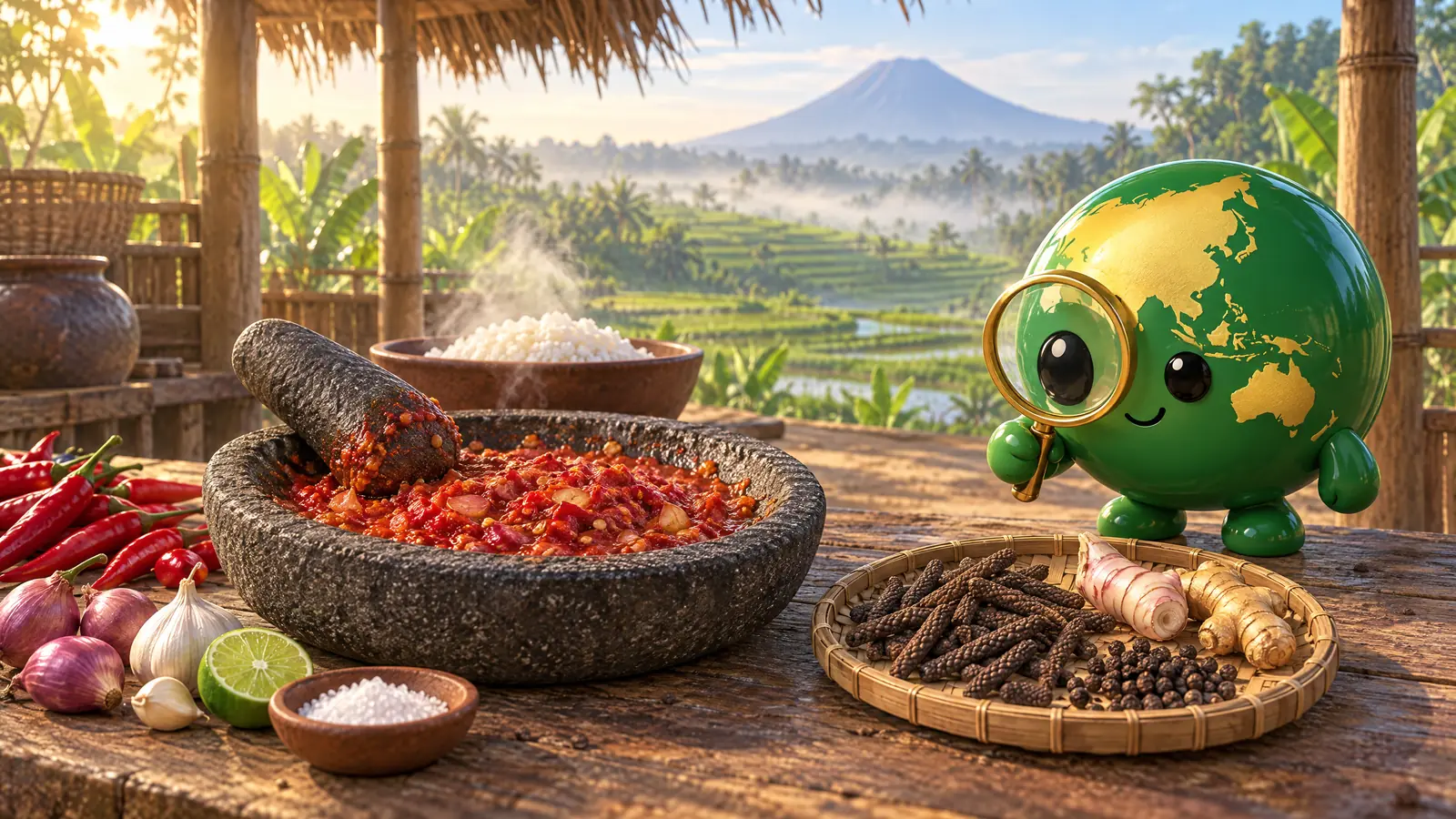
You think sambal is a chilli sauce. It is older than the chilli. The spicy condiment you know today was born from pounded relishes made with local peppers and spices in the Indonesian archipelago, long before chili peppers arrived from the Americas in the 16th century. Sambal originated in Indonesia and is a staple in Southeast Asia, and the story of how it got from a stone mortar in Java to a jar on a shelf in London is what this page is about.
The name: what it means and where the word came from
Start with the word itself: it tells you something the sauce alone cannot.
Today, sambal means a chilli-based sauce or paste in Bahasa Indonesia and Bahasa Melayu. It is a condiment, a cooking base, a side relish served with rice, fish and vegetables across Indonesia, Malaysia, Singapore and Brunei. That is the modern meaning. But the word sambal is older than the New World chilli pepper. Early forms of the relish likely used local hot spices, things like long pepper, black pepper and ginger, not Capsicum chillies. Indigenous communities in Indonesia used native spices to create early spicy relishes centuries before the Portuguese sailed into Malacca.
In Javanese the spelling is often sambel. In Malay it is sambal. Both names point to the same dish: a relish pounded fresh in a stone mortar and eaten with rice.
Some modern Indonesian dictionaries still define sambal by its style (pounded, spicy condiment) rather than by the presence of chilli. That hints at the older, pre-chilli use.
We do not have a single first written use of the word before colonial times.
Here is how the meaning shifted across time:
Pre-chilli era (before 1500s): Ground spice pastes and relishes using long pepper, black pepper, galangal and other local ingredients. The defining feature was the act of pounding, not the chilli.
Early colonial period (1500s to 1700s): Capsicum chili peppers arrived through Portuguese and Spanish trade. They merged with existing pastes.
Modern: Chilli-based sauces and pastes, raw or cooked, with wide regional variety. Sambal is a traditional chili-based sauce or paste, used in diverse culinary contexts, such as a condiment or cooking base.
Where it began: the place, the time, the people
Sambal most likely began in what is now Indonesia, especially in Java and the islands around it, before chilli peppers reached the region in the 1500s. The setting was wet-rice farming societies. Rice was the main food, and it needed flavour. Side relishes like sambal made a simple meal less plain.
Before Spanish and Portuguese ships brought Capsicum chilli from the Americas, people in the archipelago used long pepper (Piper retrofractum, sometimes called cabay), black pepper, galangal and ginger to make their relishes hot. In the Batak highlands of Sumatra, a wild pepper called andaliman gave a citrusy bite. These spices provided heat, just a different kind. Chili peppers were introduced to Indonesia in the 16th century, and over time they became sambal's main source of heat, used alongside the older native peppers.
In village kitchens, the tools shaped the food. A stone mortar and pestle (ulekan and cobek in Indonesian, lesung for a larger pounding block) sat in almost every home. Cooks crushed spices and salt together until they formed a rough paste. That texture, gritty and uneven, became what sambal meant.
The people who made sambal cut across class. Javanese and Sundanese farmers used local pungent spices. Coastal communities in trading towns added salted fish and shrimp paste.
Key ports and courts where early sambal use is recorded:
Melaka (Malacca): Hub of Portuguese arrival and the spice trade from 1511 onward.
Banten: Trading port in West Java.
Batavia (now Jakarta): The Dutch colonial centre.
Makassar: Coastal trading city in Sulawesi.
Anatomy: what it is made of, or how it is done
Sambal is not one fixed recipe. It has a shared anatomy, a set of flavour roles that have changed over time. Sambal's adaptability allows it to be made with varied local ingredients across regions.
Here are the core parts:
The base (heat): Today, fresh or dried chilli peppers. Before the 16th century, long pepper and other local spices. This is where the fire comes from.
The salt and umami: Sea salt, fermented shrimp paste (terasi in Indonesian, belacan in Malay), or salted fish. These deepen the flavor and help the paste keep longer. Sambal Terasi includes fermented shrimp paste for umami flavor.
The sour: Tamarind, lime juice, calamansi or vinegar, used to balance the heat and bring brightness.
The aroma: Shallots, garlic, lemongrass, torch ginger, tomatoes and fresh herbs. These add fragrance and make each region's sambal taste different. Sambal Bawang is made with crushed chilies and garlic.
The fat: Oil (often palm oil) for frying the paste, or coconut cream in some cooked versions. Fat carries the spice across the tongue and helps the sambal last.
Older, pre-chilli relishes would have followed the same pattern. Swap the chilli for long pepper or ginger-type roots, and you still have heat, salt, sour, aroma and fat. The idea was the same. The ingredients changed.
There are two main ways of making sambal, and both are tied to history. Raw sambal is where all the ingredients are pounded in a mortar and mixed without cooking. This is common where fresh produce is plentiful. Sambal Matah is a raw sambal from Bali, made with sliced shallots, chilli and lemongrass, and it fits this category. Cooked sambal is where the paste is fried in oil, sometimes with palm sugar and onions. Frying preserves it longer. This became important for traders, sailors and anyone who needed food to last. Sambal is often used as a base for curries and stir fries, precisely because the cooked version holds up under heat.
Fresh relishes were for home rice meals, eaten the same day. Cooked sambals were for travel, for sale at markets, for keeping a pot in the kitchen for several days. Each style answered a different need.
One thing, many homes: how each country or community made it its own
Sambal is shared across Indonesia, Malaysia, Singapore and beyond. No single home or region owns it. Each shaped it with the spices, fish and habits they had.
Indonesia: hundreds of sambals for one plate of rice
Indonesia is the earliest recorded home of sambal. Sambal has hundreds of regional variants across Indonesia, each tied to a place or a people.
A few sambals that matter for the story:
Sambal terasi: Found across Java and Sumatra, it uses fermented shrimp paste, linking to centuries of coastal fish curing and trade.
Sambal matah: A raw blend of shallots, chilli and herbs from Bali, tied to the island's use of fresh ingredients and Hindu ceremonial food traditions.
Sambal andaliman: From the Batak highlands in North Sumatra. Sambal Andaliman uses andaliman peppercorn for a citrusy flavor, connecting to highland forests and a local wild pepper.
Sambal roa: From Minahasa in North Sulawesi. Sambal Roa is made with smoked roa fish for a savory taste, showing how coastal communities used preserved fish to bring flavorful depth to a relish.
In many parts of Indonesia, sambal is not just a dip. It is a side dish, served in its own bowl alongside rice, and sometimes enjoyed as the most important part of the meal.
Malaysia: from kampung table to nasi lemak
Sambal is considered the heart of Malaysian cuisine. It crossed the Malacca Strait with Malay communities and became part of the most popular dishes in the peninsula.
The sambal for nasi lemak is slow-cooked, slightly sweet, made with chilli, onions and often a touch of palm sugar. That sweetness reflects peninsula tastes and the region's long access to cane sugar. Ikan bilis sambal (sambal with dried anchovies) carried dried seafood inland, so people far from the coast could still have a flavorful, fishy relish. Sambal tumis, a fried sambal base, is common in many Malay dishes, and Malay home cooks often keep a pot in the fridge, a habit that links back to older ways of making cooked sambal to last several days. Sambal is used in dishes like nasi lemak and ikan bakar across the country. Sambal can enhance the flavor of seafood dishes, which is why it appears beside grilled fish and prawns so often.
Singapore: stall, shophouse and hawker centre sambal
Singapore's sambal story is tied to the port. Malay, Peranakan, Indonesian, Indian and Chinese cooks met in its hawker centres and shophouses, and sambal sat on almost every table.
You find sambal beside Hainanese chicken rice, on top of stingray, stirred through kangkong (water spinach) and spooned next to mixed rice at hawker stalls. In Peranakan kitchens, sambal belacan takes its own turn: the National Heritage Board's own record of the dish notes that the Peranakan recipe adds pork alongside the shrimp paste, a mark of Chinese influence on a Malay base.
Over time, sambal moved from the home mortar to products sold ready-made. Today it is commercially produced and readily available in supermarkets across Singapore, and many families buy it rather than pound it fresh. This changed the texture (smoother, more uniform) and it made some flavours milder and more standard. But the habit of having sambal at the table stayed.
Beyond the core: Brunei, southern Thailand and the diaspora
In Brunei, sambals are close to Malay Borneo styles, and they are often served with ambuyat, a starchy dish made from sago. That tells us something: even when the main starch is not rice, sambal remains central.
In southern Thailand, Malay Muslim communities use nam prik, a family of pounded spicy relishes that overlap with sambal in method and spirit.
Sambal also left Southeast Asia with people who moved. Sambal was incorporated into the elaborate Dutch colonial rijsttafel culture, where long tables of Indonesian dishes were served to colonial officials and guests, sambal among them. Indonesian migrants later carried sambal recipes and bottles to the Netherlands, a trail that runs straight back to those colonial-era ties.
Today, you can find sambal oelek in supermarkets far from any port. Sambal Oelek is a basic sambal made with chili, salt, and lime, and it has become the global shorthand for sambal. Many families, one thing: no country owns it, and each community added its own spice and story.
From the stall to the world: how it spread
Sambal began in home kitchens and villages. It followed people on boats, into towns and then into jars.
Inside the Indonesian archipelago, coastal trade between Java, Sumatra, Kalimantan and Sulawesi spread both the chilli and the idea of pounded spicy relishes. In port cities like Melaka and later Singapore, inter-marriage and shared markets blended sambal styles. Traders carried ingredients and habits along shipping routes.
As cities grew, roadside warung (food stalls) and kopitiam (coffee houses) started serving sambal as a standard on the table. What had been a home-kitchen habit became a daily street-food fixture.
Colonial routes carried sambal abroad. Dutch colonial ties brought Indonesian sambal to the Netherlands, first through sailors and officials, then through Indonesian restaurants opened by migrants.
Today, local brands in Indonesia and Malaysia put sambal in glass jars and plastic bottles for city supermarkets. Export followed. Sambal oelek and other variants arrived on international shelves, sometimes labelled simply as hot sauce or chilli paste.
Sambal's popularity has expanded globally, adapting to different cultural cuisines. Sambal spread further as cooks abroad discovered it.
Three big waves of spread:
Archipelago spread (pre-colonial to early colonial): Coastal trade and migration within the islands.
Colonial-era export (1600s to mid-1900s): Dutch ties, sailors, officials and early diaspora.
Modern global era (late 1900s onward): Industrial packaging, restaurants abroad, internet exposure.
More than a dish: what it means to people today
Sambal is comfort, memory and identity for millions of people across Southeast Asia.
Many Indonesian, Malaysian and Singaporean families have a "house sambal" recipe handed down from older kin. It is rarely written down. You learn it by standing next to someone at the mortar and watching. Migrants and students abroad often pack jars of sambal or buy it in Asian groceries to feel closer to home. A spoonful at a meal in a cold city can bring back a kitchen thousands of kilometres away.
Sambal is a marker of shared heritage. People across Sumatra, Java, the Malay Peninsula, Borneo and Singapore all have sambal on the table, even if it looks and tastes different. Many families, one thing. It is a bridge, not a border, between communities.
In modern food culture, sambal appears in trendy cafes and fusion dishes in Jakarta, Kuala Lumpur and Singapore. Chefs outside Asia use sambal in burgers, tacos and other dishes, often starting with bottled sambal oelek. It has become one of the most popular ways to add heat and flavor to food that was never meant to be spicy.
Sambal links past and present. Pre-chilli long pepper mixes gave way to chilli-rich pastes. Stone mortar pounding gave way to electric blenders. The ingredients changed, the tools changed, but the idea of a shared, spicy relish on the table stayed the same, one entry in Backstory Asia's record of Southeast Asian food origins.
If you love stories like this, join the Backstory Asia email list. One origin story a week, nothing else.