
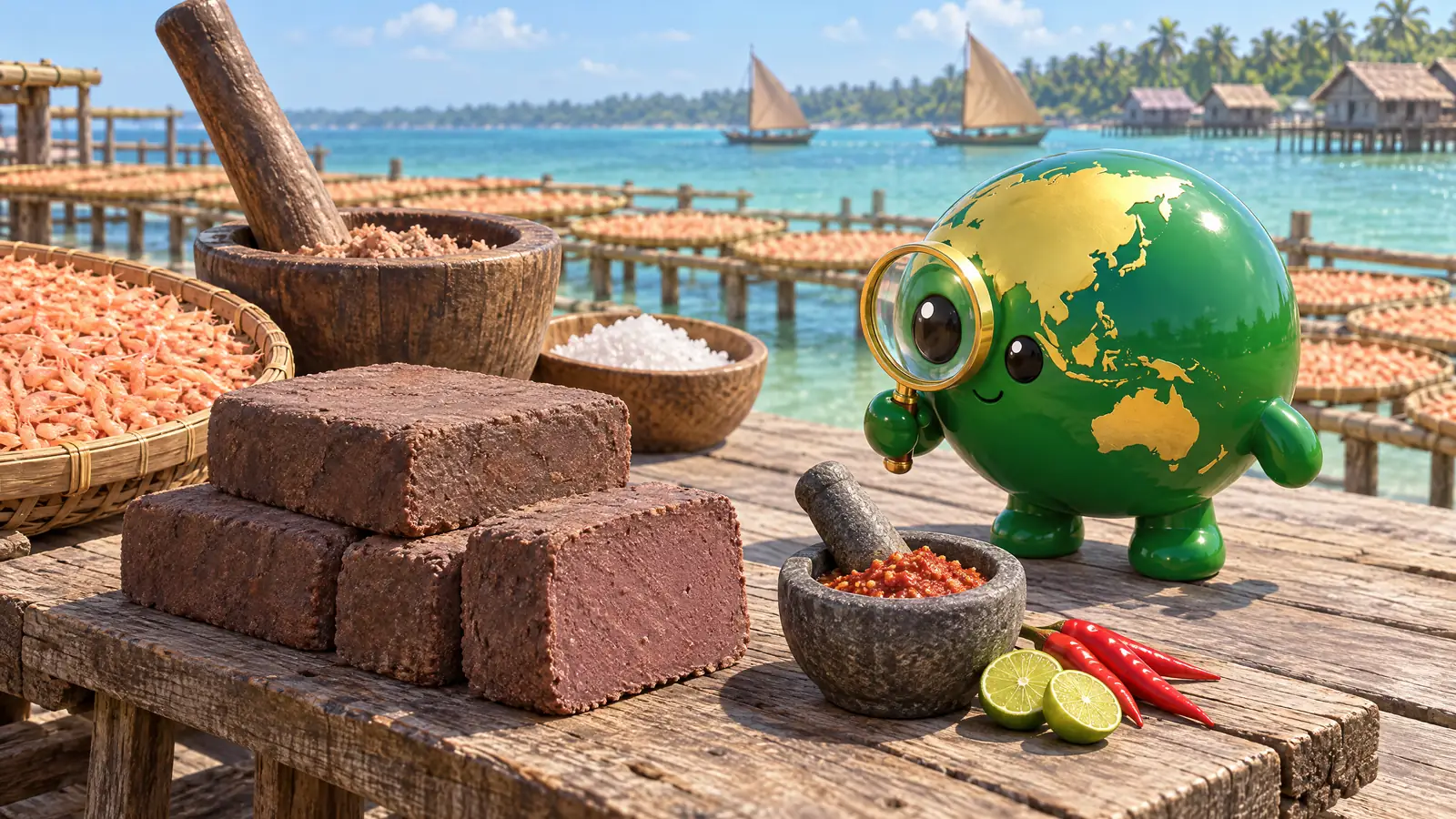
You thought belacan was just a strong smell in a Malay kitchen. It is a fermented shrimp paste that has been shaped, dried and pounded along the coasts of Southeast Asia for centuries, long before anyone drew a border on the map.
Belacan history starts with fishing villages on warm, shallow seas. Small shrimp were caught, mixed with salt, and left to ferment under the sun. The paste that came out was packed into blocks and carried on boats, traded at ports, and ground into sambal in wooden kitchens. Shrimp paste like this most likely began among the Cham and Mon peoples of mainland Southeast Asia, then spread south to the islands; belacan is the Malay Peninsula's own branch of that older story. The earliest written record of the word that this story can point to is a Malay dictionary printed in 1812 (more on that below). In Indonesia, the same idea is called terasi. In Thailand, kapi. In the Philippines, bagoong alamang. In Vietnam, mắm tôm. One idea, many names, many homes.
The name: what it means and where the word came from
The word "belacan" is Malay. It names a fermented shrimp paste used in cooking and in sambal, and it is essential to Malay and Peranakan food. When you hear this word, you are in the Malay-speaking world: the Malay Peninsula, Singapore, Brunei, and parts of coastal Indonesia.
Dictionaries in Malaysia and Singapore trace "belacan" to Malay usage, but none points to a clear older loan from Sanskrit, Chinese or any other language. The word seems to be native to the language, or so deeply rooted that its origin is lost.
Some speakers have guessed a link to "belah," a Malay word meaning "to split," or to "belah canai." These are guesses. Nobody has found them in early written texts, so we say "possibly" and move on. The evidence is simply not there.
What we do have is the word in writing. William Marsden's dictionary of the Malay language, published in 1812, already included the term. That is where the written trail is strong: we can point to a book, a page, a date.
The spelling "belacan" settled into standard Malay and Singapore use by the early 20th century. Across the water, the same paste took other names. Fermented shrimp pastes can be found under different names in Southeast Asia. Terasi in Indonesia. Kapi in Thailand. Bagoong alamang in the Philippines. Mắm tôm in Vietnam. Each name marks a coast, a language, a kitchen. But "belacan" tells you, specifically, that you are in a Malay-speaking place.
Where it began: the place, the time, the people
Belacan grew along old Malay coasts, in fishing villages close to warm, shallow seas full of tiny shrimp. Belacan became established in Malay-speaking maritime Southeast Asia, and belacan is a cornerstone of Maritime Southeast Asian cuisine. No single text tells us "the first belacan was made here," so we look at scattered records and shared methods across the region.
By the 15th and 16th centuries, port states like Melaka on the west coast of the Malay Peninsula and ports on Sumatra and Borneo were busy trade centres. Few records from that era describe food in this kind of detail, so the paste's story here leans on later Malay texts and colonial accounts, not on anything written at the time. Belacan is historically important for preserving shrimp catches, because salted, fermented paste kept well on long boat trips without any cold storage.
The people who made belacan were Malay fishing communities along the coasts of present-day Malaysia, Singapore, the Riau Islands and Sumatra. Among them were the Orang Laut, meaning "sea people," who lived on boats and on small islands and could have sun-dried shrimp products for storage well before any outsider wrote about it. Later, Peranakan communities, the descendants of Chinese settlers who married into Malay families, wove belacan into their kitchen habits in Melaka, Penang and Singapore.
Cirebon, a coastal kingdom on Java's north coast, has made terasi for about as long as anyone can trace it: one telling of the city's own name traces it to "rebon," the small shrimp the paste is made from. Ancient Sundanese manuscripts in Java mention "trasi" in texts that may predate the 6th century. So the practice of fermenting small shrimp into paste was shared across coasts and centuries, with each region keeping its own name and style. Belacan reflects a broader Southeast Asian tradition of fermented seafood. Many families, one thing.
By the 18th and 19th centuries, colonial trade logs and travel reports from the Straits Settlements describe markets in Penang and Singapore where the aroma of shrimp paste filled the air. Earlier still, in 1707, the English explorer William Dampier described a similar paste, "trassi," during his travels in Java: a mixture of shrimp and small fish, pickled with salt and water, with a strong smell and a savoury taste once cooked. The fundamental method of making it has changed little over time.
Anatomy: what it is made of, and how it is done
Belacan is simple to list and hard to perfect. Terasi is made from fermented small shrimp or fish. The ingredients are few. The process is slow.
The core is tiny shrimp or krill from shallow coastal waters, often called "udang geragau" in Malay or "rebon" in Indonesian. These small shrimp are abundant along warm coasts. Salt is the only other essential ingredient, used in large amounts to preserve the shrimp and to support slow fermentation.
Traditional production of belacan involves salting, drying, and fermentation. Shrimp is boiled, sun-dried, and pounded with salt. The mash is shaped into blocks or slabs, pressed, and left to ferment for several weeks before it is ready. The final product is a hard, dark brick with a pink or brown tint, depending on the region.
What happens inside those blocks is fermentation. Tiny microbes, the kind that love salt, slowly break down the shrimp and change the mixture into something new. They create umami, a deep savory taste, and they create the strong smell that belacan is known for. Belacan provides an intense savory backbone rich in natural glutamates. That slow change is why belacan tastes deeper than just dried shrimp and salt mixed fresh.
Terasi's colour ranges from a soft purple-red to dark brown, and changes from village to village. Bangka Island, in Indonesia, is one well-known place where it is made. On Lombok, a sweeter, more savoury version called lengkare is made instead. In Sidoarjo, in East Java, the local petis udang is a thick, dark paste with a sweetness closer to molasses than to the usual salt-forward terasi. Each version shows how one idea, fermented shrimp, can take a different form along a different coast.
Belacan is never eaten raw; it is heated before use. Singapore hawkers often toast a slice of belacan over a flame before pounding it into sambal belacan. Toasting releases its aroma and mellows its harsh notes: the colour darkens, the smell softens, and the paste turns fragrant rather than sharp. Dried, salted and fermented this way, it is a paste that keeps, the way it has always kept for coastal families without a fridge. Belacan acts as a flavour enhancer for curries, soups, and stir-fries, adding umami and saltiness in just a small spoon.
One thing, many homes: how each country or community made it its own
The paste is one idea. Each coast gave it its own shape, smell and name. Belacan represents a shared culinary heritage with regional variations. There are various regional relatives of belacan across the whole of Asia.
In Malaysia, "belacan" is the everyday word, and the most iconic application of belacan is sambal belacan: chili, belacan and lime, pounded together, served beside rice and fish. Belacan goes into kangkung stir fry, into fried rice, into dozens of dishes that families cook at home. Places like Pulau Pangkor, Penang, Malacca and Bintulu in Sarawak are each proud of their own style. The texture, the color and the saltiness differ from state to state. A block from Sarawak may look and taste different from one made in Penang.
In Singapore, belacan is a Peranakan kitchen staple. It is roasted, pounded with shallots, garlic, chili and herbs, and fried in cooking oil until fragrant. That is the rempah, the spice paste that gives Peranakan curries and sambals their backbone. You find belacan in sambal stingray at hawker centres and in fried shrimp dishes sold at corner stalls. Most families now buy belacan from a market rather than make it at home, but the smell of it cooking still means "home."
In Indonesia, the paste is called terasi. It is central to Indonesian cuisine. Sambal terasi is a popular condiment in Southeast Asia, roughly chopped tomatoes and chili mixed with toasted terasi, sometimes with fried shallots and a touch of sugar. Terasi enhances the flavor of stir-fried vegetables and noodles. Terasi can be used in dishes like ayam goreng terasi, a fried chicken recipe coated in a terasi-based combination of spices. While terasi and belacan are not identical, they are close relatives, and many Indonesian families in Malaysia and Singapore treat them as swappable. You add a spoonful, you get a similar savory heat.
In Thailand, the cousin is kapi. It is often wetter than Malaysian belacan. Thai cooks use kapi in nam prik kapi, a dipping paste served with boiled vegetables and rice, and in khao kluk kapi, a mixed fried rice. Pattani and Nakhon Si Thammarat, in southern Thailand, were part of the Srivijaya empire's sphere of influence from around the 7th century.
In Vietnam, mắm tôm serves a similar purpose, though it tends to be more pungent and is often liquid. In the Philippines, bagoong alamang is wetter, sometimes fresher, fermented for shorter periods and used as a dipping sauce alongside green mango or in stews. The idea is the same: small shrimp, salt, time.
In Peranakan homes, belacan sits beside dried chillies, lemongrass, candlenuts and all the ingredients that make up a classic pantry. A little belacan is toasted, ground with garlic and shallots in a blender or with a pestle, then fried until the smell mellows. Each family has its own recipe, its own preference for how strong the paste should be.
No single country owns fermented shrimp paste. Each coast shares the same warm seas and the same long tradition of turning a catch into something that lasts.
From the stall to the world: how it spread
Belacan spread the same way it began: with people on the move.
Malay traders and fishing families carried blocks of paste along the Straits of Malacca, across the triangle between Johor, Singapore and the Riau Islands, and up and down the Borneo coasts. In port cities, different shrimp pastes met side by side in the same market: belacan, terasi, kapi, each loading its own aroma into the air. The Srivijaya empire, which controlled parts of the Malay Peninsula, Sumatra and southern Thailand from the 7th to the 13th century, maintained trade networks that would have carried fermented shrimp pastes between coasts.
But the real spread came later, with people.
From the 1960s onwards, Malaysian, Singaporean and Indonesian students and workers moved to the United Kingdom, Australia and North America. They opened restaurants and grocery shops that imported belacan and terasi. Sometimes the label simply said "shrimp paste" for foreign shelves. Some countries set import rules about smell and packaging, which led to sealed jars and milder export versions. Commercial production of belacan often uses modern machinery for efficiency, and today you can transfer a sealed packet of belacan into a shopping bag in London or Melbourne without anyone around you knowing what is inside.
In the 2000s and 2010s, global noodle and sauce brands began to put "shrimp paste flavour" or sambal belacan styles into instant noodles and cooking sauces. These products often soften the smell and the salt, but they put the word "belacan" or "terasi" in front of shoppers who have never been to Southeast Asia. A small block, shaped and dried in a hot fishing town, now sits in a cold city flat's kitchen, sharing a shelf with cooking oil and fish sauce.
More than a dish: what it means to people today
To outsiders, belacan is a strong smell. To lots of Southeast Asians, it is the smell of home.
The first whiff of belacan toasting in a pan can remind Malaysians and Singaporeans abroad of parents, grandparents and neighbourhood kitchens. In Peranakan and Malaysian households, the family sambal belacan recipe is often passed down as part of who you are. The love for this paste sits deep.
Some people are shy about the smell in shared flats or offices, wrapping belacan tightly or only cooking it on weekends. That is real. But food writers and chefs have, in recent decades, spoken proudly about belacan on television, in cookbooks and at food festivals. The paste that once embarrassed has become a point of pride.
Fermented shrimp paste links Malaysia, Singapore, Indonesia, Thailand, Vietnam and the Philippines. Many families in mixed-heritage homes use more than one kind of paste, picking terasi for one dish, belacan for another, kapi for a third. That sharing of taste shows the long story of trade and marriage across warm seas, better than any border line on a map.
In rural fishing towns, belacan is still made outdoors by hand, spread in the sun, dried over weeks. In city factories, it is made in larger batches under food safety rules, sometimes with preservatives, sometimes without. On modern recipe blogs and in social videos, young cooks explain why they choose belacan or terasi for certain dishes, talking about flavor, texture, aroma, and the right amount of heat.
Belacan's story sits alongside other journeys on Backstory Asia's food desk, including nasi lemak and laksa, two more dishes that lean on this same paste.
The next time you taste a spoon of sambal belacan or catch a hint of paste in your fried rice, you are tasting centuries of coastal life, carried by people who moved.
If you like stories like this, join the Backstory Asia email list. One short origin story a week, nothing else.