
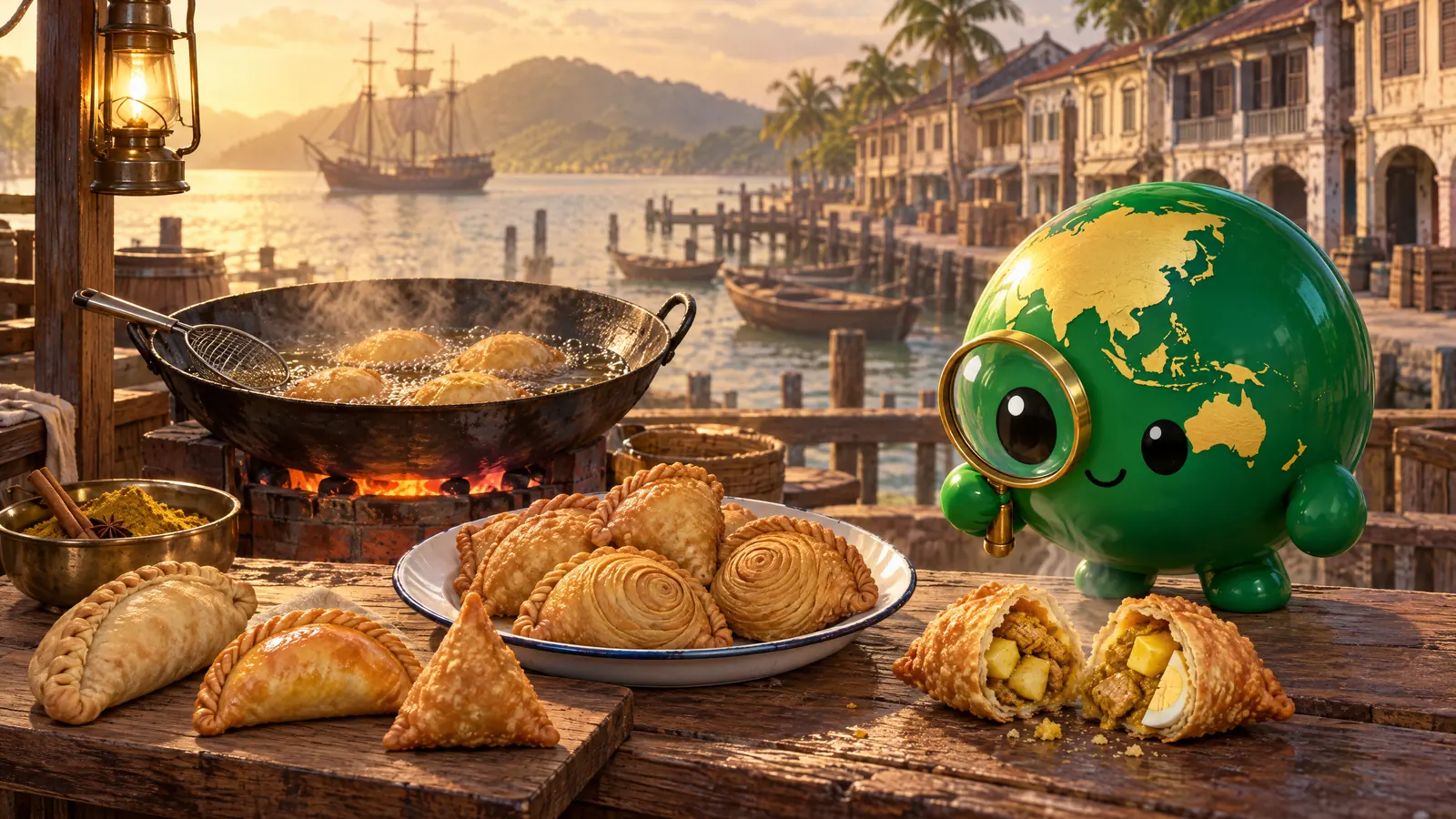
You think the curry puff is a snack from one place. It is not. The curry puff is a handheld pastry that blends global culinary traditions, born where Indian spice, British pastry and Malay language met in the same port town, one entry in Backstory Asia's record of Southeast Asian food origins.
Nobody wrote down exactly where or when the first curry puff was fried, and the sources do not fully agree. One likely telling points to the busy colonial ports of Singapore, Penang and Melaka in the 19th century, where Indian cooks, British and Portuguese settlers, and Malay, Chinese and Eurasian hawkers folded curry into pastry. A separate, older telling comes from Thailand, where food historians trace a similar pastry to the 1600s. Backstory Asia does not pick a winner. No single inventor appears in any record, in any country, and that open question is the story this page tells.
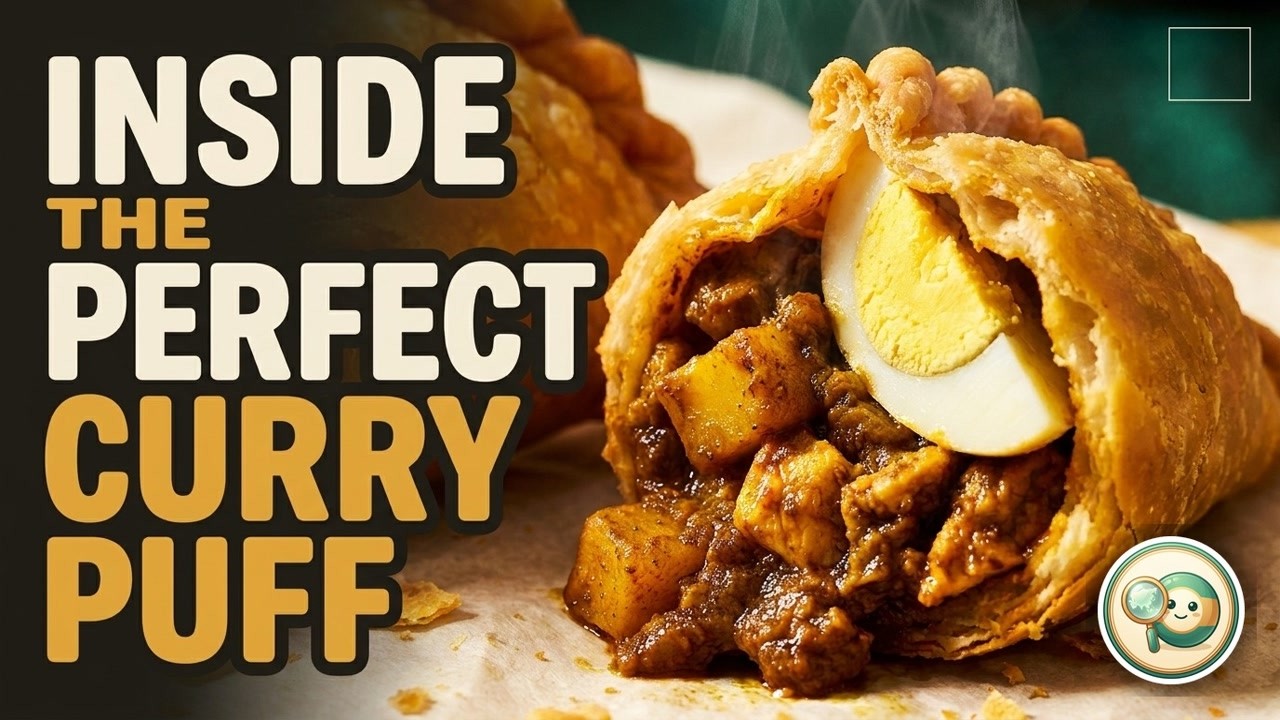
Prefer to watch? This story is Episode 3 on our YouTube channel: Why Southeast Asia Can't Stop Eating Curry Puffs.
The name: what it means and where the word came from
The words people use for this snack tell us where it came from. We look at three names: "curry puff", "karipap" and "epok-epok". Each one carries a piece of that story.
Start with the English name. "Curry" comes from the Tamil word kari, meaning sauce or gravy; British colonial kitchens used it for any spiced dish in gravy. "Puff" is an old English baking word for a light pastry that rises when it meets heat. Put together, "curry puff" means a flaky pastry filled with spiced gravy.
In Malay, the word is "karipap". The Malay dictionary Kamus Dewan defines it plainly, as a kuih (a snack) with a wheat-flour shell and a filling of potato and meat mixed with spices. It does not spell out where the word itself came from, but say it aloud and the answer is in the sound: "curry" and "puff", said the Malay way. The word is used across Malaysia, Brunei and parts of Indonesia.
In Singapore and southern Johor, many people say epok-epok instead, a Malay word for a small half-moon fried snack, typically with sardine or potato inside. Some speakers use both names for the same thing.
In Thailand, the same snack is called karipap, and food historians there trace it to the 1600s, not to the English word at all. In Myanmar, the Burmese name translates to "duck meat pastry", and tea shops also sell it under the English name "chicken puff" or "duck puff". The names took different roads to the same snack.
Put the names together and you see three streams: Indian curry, English puff, Malay pronunciation, born at one crossing point.
Where it began: the place, the time, the people
The best evidence we have points to the Straits Settlements: Penang, Melaka and Singapore, port cities under British rule from the early 1800s. These were places where Malay, Indian, Chinese, Arab and European traders and workers lived side by side.
Indian migrants, especially South Indians, brought spiced potato and meat curries and the habit of stuffing dough with curry. Portuguese settlers had been in Melaka since 1511, and their empada, a small filled pastry, is often cited as one ancestor. British colonialists brought baked meat pies and the idea of flaky pastry for miners and sailors.
Hainanese and other Chinese cooks worked in colonial homes, where they learned to cook "Western" food for European families. They picked up pie and pastry skills and mixed them with local curry flavours. Peranakan households, where Chinese and Malay traditions had already blended, adapted pastry further.
Thailand's own story runs on a different clock. There, food historians trace a close cousin of the curry puff to the 1600s, two centuries earlier, brought to the royal court at Ayutthaya by a cook of mixed Portuguese, Japanese and Bengali descent. Nothing ties that court kitchen to the Straits Settlements hawkers, and nothing in either story rules the other out.
No single inventor is named in any record, in any country. This is a story of working cooks and hawkers, not one chef with a date on a plaque.
Anatomy: what it is made of, or how it is done
Every curry puff has three parts: pastry, filling and shape. Each part carries a piece of its mixed origin.
The pastry. The most common Southeast Asian shell uses two kinds of dough: a water dough and a fat dough. You roll them together, fold, roll again and cut. This makes thin layers that puff up when fried. In Malaysia, this layered, flaky-crust version is linked to Indian bakeries, and is called karipap pusing, meaning spiral curry puff.
A simpler shortcrust style also exists: one dough, fat mixed in with flour and a little salt, denser and less flaky. This is closer to a British pie crust and is found in older home recipes.
The filling. Curry puffs are filled with potatoes, chicken, or beef as the most common base. Onions are cut small, spices are added, and the mix is cooked until thick. The spice blend typically uses curry powder, a British-style blend of spices that spread through colonial groceries, not fresh-ground masala. Sardines are a traditional filling in older Malay versions, and boiled egg appears in some varieties too.
The shape and the fry. The classic form is a half-moon, sealed by pressing and crimping the edges by hand, a fold that also appears on empanadas and Cornish pasties. Most hawkers deep fry it until golden brown, giving a crisp, blistered shell in minutes.
One thing, many homes: how each country or community made it its own
Each region in Southeast Asia made the curry puff its own. No winner. Many homes.
Malaysia: karipap in kopitiams (coffee shops) and kampungs (villages)
In Malaysia, karipap is sold in morning markets, school canteens and roadside stalls, by Malay, Chinese and Indian Muslim stalls alike, the last making larger, more strongly spiced puffs closer in taste to a samosa filling. In east coast states like Kelantan and Terengganu, the spiral-shell karipap pusing is popular too.
Singapore: epok-epok at the bus stop, Old Chang Kee down the road
By the 1950s and 1960s, curry puffs were already common in Singapore coffee shops, Malay warung (small family-run food stalls) and Indian-Muslim eateries. Epok-epok, the typical Malay version with a thinner shell and sardine or potato filling, was sold from pushcarts and later in hawker centres.
Old Chang Kee started as a small stall near Rex Cinema in the 1950s, the start of a much bigger story told later on this page.
Indonesia and Brunei: shared snack, local taste
In Indonesia, the snack is called pastel, often sold with other kue (cakes and snacks), fillings tending toward potato, egg and minced meat. Brunei's karipap is close to Malaysian styles, popular at Ramadan bazaars and tea time.
Each place bent the curry puff towards its own pantry. The history cannot belong to one flag.
From the stall to the world: how it spread
A small street snack in Southeast Asia is now found in London, Sydney and New York. Brands and migrants carried that history with them.
Urbanisation in the 1960s to 1980s in Malaysia and Singapore grew demand for quick, hand-held food for office workers and students. Curry puffs spread to kiosks, bakeries and petrol stations. Old Chang Kee grew from a single roadside stall into outlets across Singapore and several neighbouring countries, helping standardise the "Singapore curry puff" for a new generation of shoppers.
Migration did the rest. From the 1970s onward, Southeast Asian immigrants opened eateries and bakeries in Australia, the United Kingdom and the United States, adding curry puffs to counters already selling meat pies and sausage rolls. Frozen, ready-to-fry versions later appeared on Asian supermarket shelves too.
Food blogs and social media later helped readers place the curry puff alongside the samosa, the empanada and the pasty. The snack travelled far, but the core stayed the same: a spiced filling in a folded shell, easy to eat on the move.
More than a dish: what it means to people today
Curry puff history lives on every time someone buys one at a bus stop, a kopitiam or a petrol station.
It is comfort food. In Malaysia and Singapore it recalls school recess, office tea breaks and a favourite stall near a market or interchange. It crosses ethnic and religious lines too: curry puffs appear at Chinese New Year visits, Hari Raya open houses and Deepavali snack tables, on the same tray as kuih and sandwiches. Kuih is a whole family of bite-sized snacks, and the word itself came from southern China with Hokkien traders.
Younger cooks and boutique brands are making new versions today. Premium fillings like black pepper crab, rendang and Japanese curry sit alongside the old potato and chicken.
The curry puff sits in a bigger world of stuffed pastries: the Cornish pasty, the Latin American empanada and the Indian samosa are all cousins, the same way nasi lemak and laksa are cousins of other dishes born where trade routes crossed. But the Southeast Asian curry puff is its own thing, born at a three-way crossing of Indian spice, Malay language and European-style pastry.
To eat one today is to connect to port cities that never slept, to unnamed cooks who mixed flour, water, vegetables and curry powder, and to all the people who folded spice and dough together so the rest of us could hold something warm in one hand.
If you like stories like this, join the Backstory Asia email list. One origin story a week, nothing else.