
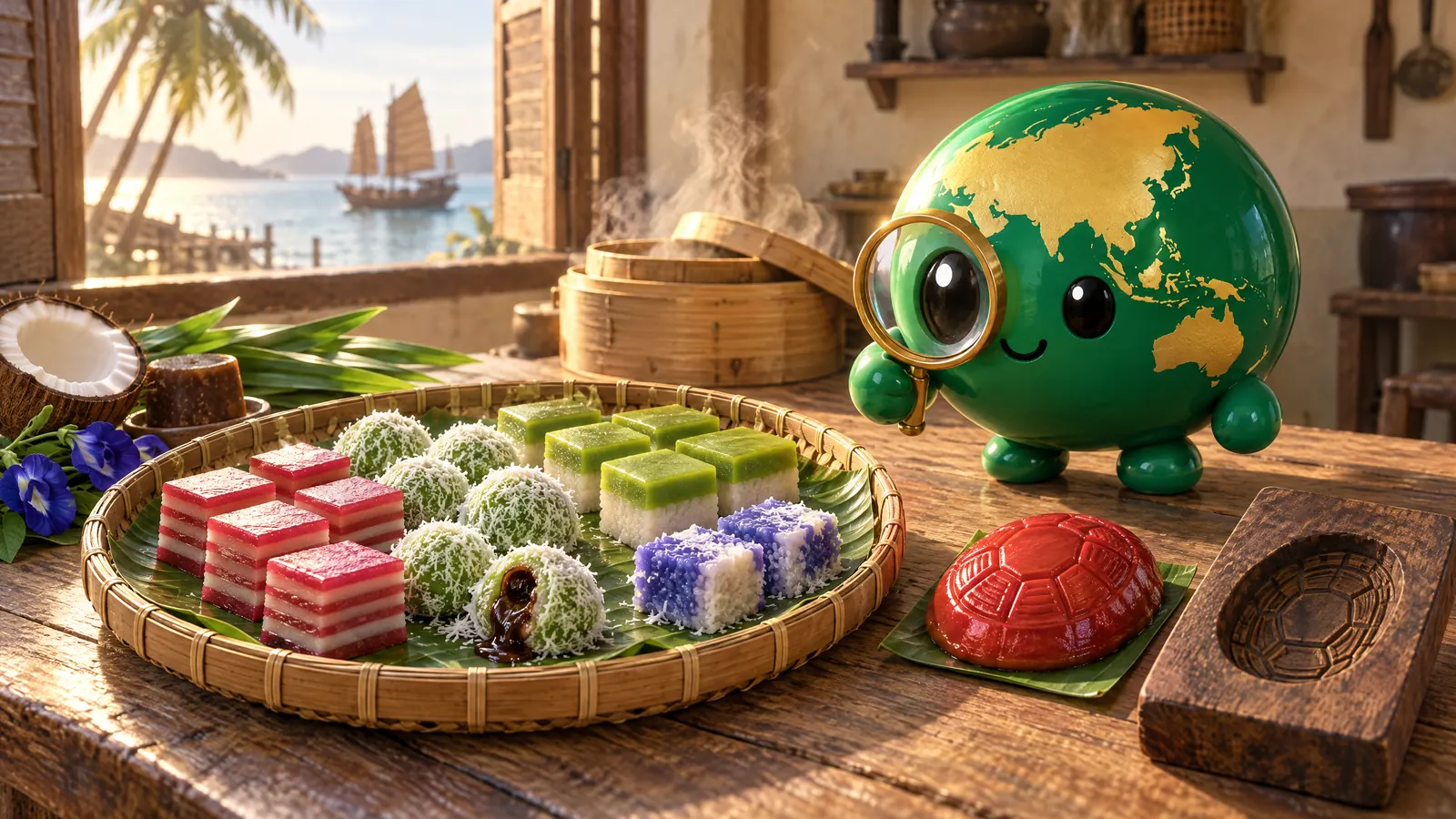
You think kuih is a Malay sweet. It is not one sweet. It is a whole family of bite-sized snacks, sweet and savoury, found across maritime Southeast Asia. The family stretches from steamed glutinous rice balls filled with molten palm sugar to firm baked cassava cakes, from soft pandan custard layers to chewy rice flour dumplings. Kuih refers to bite-sized sweet or savoury snacks found across maritime Southeast Asia, and the word itself came from southern China with Hokkien traders centuries ago. The story of kuih history is the story of rice, coconut, trade and people who shared a kitchen even when they did not share a language, one entry in Backstory Asia's record of Southeast Asian food origins.
Ask for kuih in Malaysia, kueh in Singapore, or kue in Indonesia, and you will get different plates. Some are green. Some are red. Some are sticky. Some crumble. They share a name, a starch base and a long, tangled past. That past is what this page is about.
The name: what it means and where the word came from
The word "kueh" comes from the Chinese character 粿. In the Hokkien and Teochew dialects of southern Fujian and eastern Guangdong, it is read as kóe or kuéhh. It means a steamed rice cake or rice dumpling. Kueh is typically made from glutinous rice flour, though the definition of kuih has broadened to include various starches beyond just rice flour.
The same word landed in different places and picked up different spelling. Malaysia and Brunei write "kuih". Singapore commonly writes "kueh". Indonesia writes "kue". Kueh is a broad term used across Southeast Asia, and it can refer to cakes, dumplings, and pastries. Kueh is found in Indonesia, Malaysia, and Singapore, among other countries.
Back in southern China, guo or kuéhh pointed to quite specific things: the red tortoise cake called ang ku kueh, savoury chive pockets, water chestnut cakes. In Southeast Asia, the word grew much wider. It came to cover layered steamed desserts, coconut puddings, fried doughs, and many more bites.
People sometimes call kuih "the wagashi of Southeast Asia". Wagashi are small traditional Japanese sweets served with tea. The comparison helps with size and shape, but wagashi is not an ancestor of kuih. When we say kuih history here, we mean the whole family of rice-based and starch-based bites across the region, not just one recipe.
Where it began: the place, the time, the people
Kuih grew from two older traditions that met in port towns. One came from China. The other was already in the Malay world.
In southern Fujian and eastern Guangdong, Hokkien communities made glutinous rice cakes for festivals. Among these were tortoise-shaped cakes, the ancestor of ang ku kueh. The mixture of glutinous rice flour, mung bean paste or lotus filling, and red dye pressed into carved wooden moulds shaped like tortoise shells was already old by the time traders sailed south to Southeast Asia.
Long before those Chinese traders arrived, Malay, Javanese and other Austronesian peoples already steamed and wrapped rice in banana leaves, using coconut milk and palm sugar. Indigenous communities used local flora like sago and coconut to create steamed snacks. The idea of soft, sweet rice food was not new in the region. Ancient Javanese records mention fermented rice by the 10th century. So the ground was ready.
The meeting happened in seaports. Melaka, founded in the early 1400s, was the great hub. Chinese merchants, especially from Fujian, settled there, traded and started families. Portuguese and Ming court documents from the 16th and 17th centuries record permanent Chinese settlement, though a smaller Chinese presence likely existed earlier. Later, Penang, Singapore and Batavia (now Jakarta) became similar meeting points.
From these mixed households came the Peranakan, also called Baba-Nyonya, people. They were the children and grandchildren of Chinese immigrants who married local Malay women. Peranakan communities combined Malay and Chinese culinary practices, leading to Nyonya kuih. Chinese immigrants introduced rice flour milling and steaming techniques to Southeast Asia, while Malay cooks contributed coconut, palm sugar, pandan leaves and banana leaf wrapping. Together they created the colourful, fragrant kuih tradition we know today.
Nobody wrote it down at the time because home cooks, from one generation to the next, taught by showing, not by writing.
Anatomy: what it is made of, or how it is done
Kuih is not one shape. But it typically has three parts: a starch base, flavour and colour from plants, and something to hold or shape it.
The starch base can be glutinous rice (whole grains or flour), plain rice flour, tapioca or cassava, sago, or wheat flour for some baked kinds. Cassava and tapioca arrived in Southeast Asia after the 16th century, brought by Portuguese and Spanish colonial trade. Before that, most kuih starch came from rice and sago.
Traditional kuih relies heavily on ingredients like rice flour, coconut milk, and palm sugar. Coconut appears as thick coconut milk in custard layers and as grated coconut rolled around the outside of rice balls. Palm sugar, called gula Melaka in Malaysia or gula Jawa in Indonesia, gives a deep, caramel sweetness that plain white sugar cannot copy. Coconut palms grew across the tropics, and palm sugar tapping was an old local skill, established long before sugarcane became common.
Natural colorings from ingredients like pandan and butterfly pea are traditionally used in kuih preparation. Pandan leaves give green and a fragrant aroma. Butterfly pea flowers give blue. Annatto seeds or red food dye give orange or red. Older kuih were mostly brown from palm sugar caramel or white from plain rice flour. The bright rainbow colours came later.
Kuih can be categorised by cooking methods such as steamed, fried, baked, and boiled. Steaming is the most common way for wet, soft kuih. Grilling in banana leaves over charcoal is traditional for kuih like bingka, a cassava cake flavoured with coconut milk and sugar. Deep frying is used for kuih like cekodok, a banana fritter also called cucur kodok. Baking is common for kuih like kueh bahulu, the tiny egg sponge cakes shaped in brass moulds. Kuih can be pan-fried, as seen in apam balik, a folded pancake with a crisp, crumpet-like edge. Boiling is a method for making glutinous rice balls like kueh ee or tangyuan. Slow cooking for dodol, the thick sticky sweet, can take up to 9 hours of stirring. Culinary techniques for kuih have been influenced by trade with Indian and European cultures, adding oil, butter and eggs to some recipes.
Moulds give kuih its patterns and lucky symbols. Wooden ang ku moulds carve tortoise shell lines into the skin of the dough. Brass bangkit moulds press floral shapes into dry coconut biscuits. Older presses were carved from coconut shell or clay.
The texture of kuih is part of the eating. Layered kuih lapis, a steamed layered rice flour pudding, you peel apart layer by layer. Ondeh ondeh, rice cake balls filled with molten palm sugar, burst with sticky sweetness when you bite. Baked cassava kuih is firm. Steamed sago kuih is bouncy. Kuih is a word for many feelings in the mouth.
One thing, many homes: how each country or community made it its own
Many families, one thing. Each place shaped kuih to its own taste.
In Malaysia, Malay kueh appears at morning markets and Ramadan bazaars during festive seasons. The Malay community favours heavy coconut milk and gula Melaka. Kuih Seri Muka is made of glutinous rice and pandan leaves, with a green custard layer on top. Ondeh ondeh are rolled in grated coconut. Kuih lapis is steamed in alternating colours. In Peranakan homes of Melaka and Penang, the same dishes may use more egg yolk, finer flour and ornate moulds. Malay and Nyonya homes share names but seasonings differ slightly.
In Singapore, the word "kueh" covers Hokkien, Teochew, Malay and Indian snacks all at once. Old neighbourhoods like Tiong Bahru and Joo Chiat had shophouse bakeries selling rows of kuih, the same kopitiam counters that still serve kaya toast today. Modern shops now label their trays "heritage kueh" and mix old and new flavors, sometimes adding peanut or chocolate filling.
In Indonesia, "kue" or "jajan pasar" (market snacks) fills the morning table. Kue lapis legit, a very rich, spicy layered cake, shows Dutch colonial influence through its use of butter, eggs and spice, also called spekkoek in Dutch. Klepon is the Indonesian cousin of ondeh ondeh. Javanese, Betawi and Minangkabau kitchens each keep their own lists of kue, making kuih a word with hundreds of local meanings.
In Brunei and the Malay-speaking south of Thailand, dishes like seri muka and kuih bingka appear under local spellings. The kuih family follows people more than borders.
In Vietnam, the layered steamed cake called bánh da lợn works in a similar way to kuih lapis. In Myanmar, layered "kway lapay" shares the same texture and method. In Fujian itself, ang ku kueh continues to be made in a form close to the older Chinese tortoise-cake shape.
Kuih represents a fusion of diverse culinary traditions reflecting shared regional histories. Some items are claimed as Malay kuih, Nyonya kuih or Javanese kue, but the ingredients and shapes show shared roots. We are telling a shared story, not giving medals.
From the stall to the world: how it spread
Kuih stayed home for centuries. Then it sailed again, this time with workers and students.
As Straits-born Chinese and Malay families moved within the British Empire, carrying kuih from Penang to Kuala Lumpur, from Melaka to Singapore, their childhood snacks moved with them.
Later, as Malaysians, Singaporeans and Indonesians emigrated to the United Kingdom, the Netherlands, Australia and the United States, they opened small eateries and Asian groceries where kuih sat beside curry puffs on the counter. The kinds that travelled well were those that keep their shape: baked tapioca kuih, kuih bingka, kuih bahulu and kuih bangkit, a dry coconut biscuit that could last in tins. Steamed or sticky kuih moved later still, once cold storage and plastic containers became widely available.
Factories and instant mixes changed things further on. The preparation of traditional kuih has evolved from labour-intensive methods to modern industrialisation. Premix packets for seri muka or lapis appeared on shelves. Frozen ondeh ondeh reached supermarket freezers from Sydney to London, making kuih history visible to people who had never visited Southeast Asia.
Social media then amplified awareness. Food bloggers, Instagram and YouTube posts about "Nyonya kueh" and "rainbow kueh lapis" drew non-Asian audiences, sometimes focusing on colour and shape more than old stories. Modern artisans are reviving traditional kuih recipes while using all-natural ingredients, bringing attention back to pandan, butterfly pea and palm sugar.
As kuih spread, recipes changed. Less palm sugar, more ordinary sugar. Different fats replacing coconut. Fusion fillings like chocolate or cheese. But the underlying structure, a rice or starch base shaped by leaves or a mould, steamed or baked, still traces back to that old rice cake idea from Fujian and the Malay world.
More than a dish: what it means to people today
Kuih today is breakfast, tea snack, prayer offering and memory trigger all at once. Kuih serves as a symbol of cultural identity across different Southeast Asian communities. Kuih plays a central role in life-cycle ceremonies and religious festivals in Malaysia and Indonesia.
Red tortoise cakes symbolise longevity and good fortune. They are traditionally prepared during birthdays and religious festivals. Red tortoise cakes are offered to deities during Chinese New Year and placed on altars in multiples of six for blessings, a wish for a prosperous year. Red tortoise cakes are distributed during a baby's first month celebration, and the design on the cake signifies the child's sex. The belief is that the tortoise shape will bring longevity to the child. Nobody is eating tortoises. They are eating a rice cake shaped to carry a wish for long life. That wish is separate from the one carried by cakes offered to the Jade Emperor, which asks for a prosperous year instead. Many kuih varieties are linked to cultural significances such as prosperity and longevity.
Colourful pyramids of kuih appear at weddings. Hari Raya brings kuih tins to every Malay home, where they are must haves on the table. Deepavali adds sweet biscuits and dishes of kuih to Indian households. These are special occasions where kuih tells people who they are.
Kuih connects generations. Preparation of kuih often involves communal and generational knowledge passed down through families. Many elders still make kuih by agak-agak, eyeballing amounts without a cup or a scale. Younger people now learn from YouTube and heritage workshops, trying to keep the taste alive.
In cities like Penang, Melaka, Singapore, Jakarta and Surabaya, kuih appears in heritage cafes, sometimes priced much higher than street versions, carrying "artisan" labels. This raises pride but may make old favourites less easy to afford. There is worry in many families that traditional skills may fade as elders pass on. Community classes, cultural organisations and small home businesses are working to teach kuih making and keep demand going.
When someone peels a layer of lapis or bites into an ondeh ondeh today, they are also biting into a very long story of rice, trade, faith and family across seas.
We invite you to join the Backstory Asia email list for one new origin story each week.