
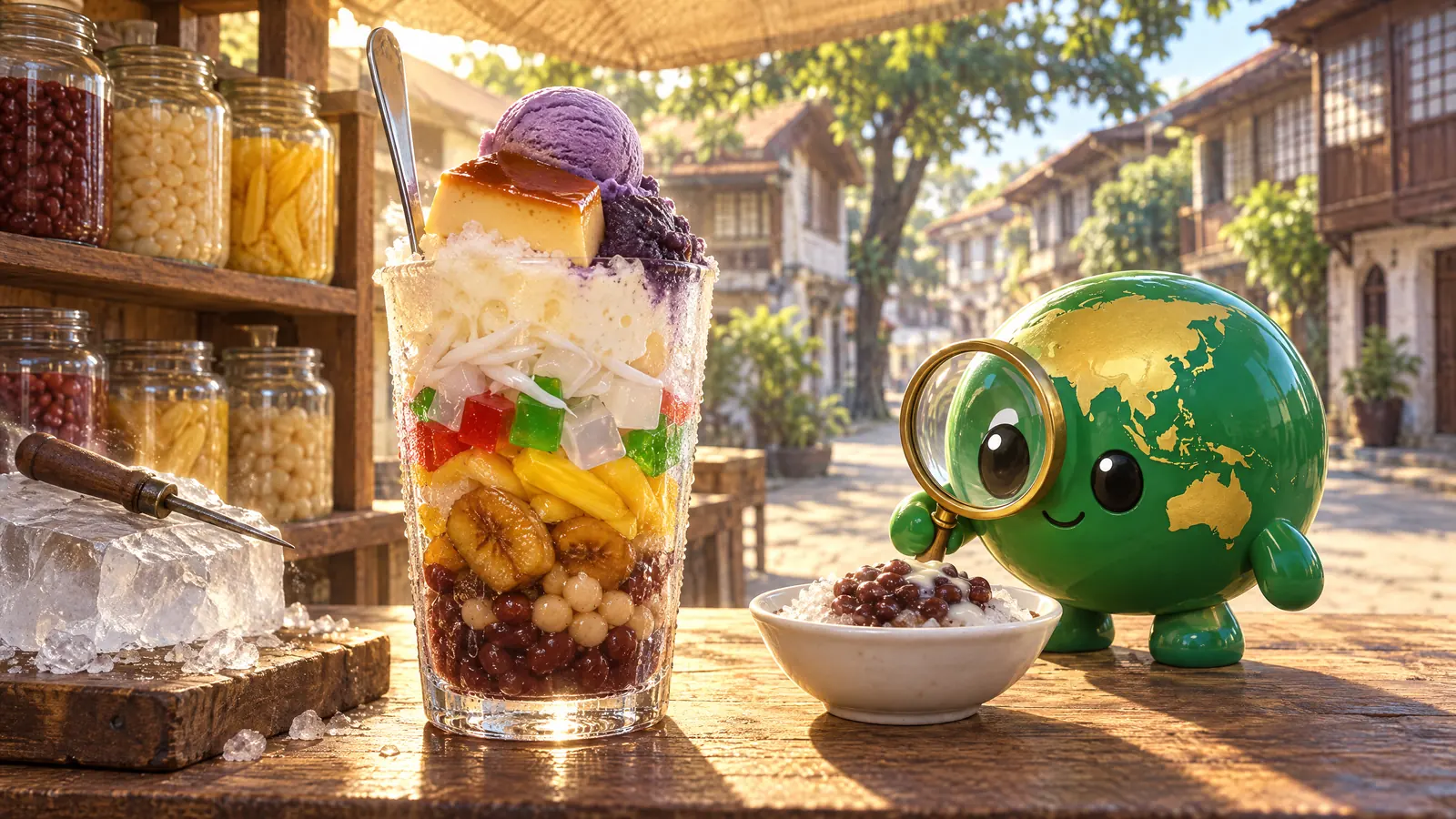
You think halo-halo is a Filipino invention. It is, but it started in a Japanese ice stall.
Before halo-halo had a Filipino name, it was a bowl of shaved ice and sweet beans sold by Japanese migrants in Manila. They called their shops mongo-ya. The dessert traces its roots to pre-war Japanese migrants in the Philippines, who brought with them the habit of eating Japanese kakigori, finely shaved ice with syrup and beans. Filipino customers loved the cold treat. They added their own sweets, saba bananas cooked in sugar, jackfruit, coconut gel, and stirred everything together. They called the result halo-halo, meaning "mix mix" in Tagalog. Halo-halo is widely considered the unofficial national dessert of the Philippines. Its history runs through three colonial periods, one world war and a dozen port cities. That is the story we tell here.
What the name halo-halo really means
The term halo-halo means "mix-mix" in Tagalog. The root word halo means "to mix." Say it twice and it becomes a casual, child-friendly way to say "mixed together." The Komisyon sa Wikang Filipino, the body that looks after the Filipino language, writes it as one word: haluhalo. But the hyphenated form halo-halo remains the spelling most people use on menus, in newspapers and in everyday life.
The name does not describe the ice. It does not describe the milk. It describes what you do. You stir from top to bottom, breaking neat layers into a pastel mixture, before you eat. That action is the whole point.
The Japanese word linked to the dessert's roots is different from the Filipino name. Kakigori means shaved ice. It is a cultural ancestor of halo-halo, not the source of its name. The word halo-halo is Filipino. The base idea of ice with beans and syrup was first brought in by Japanese migrants. So the name and the dessert come from two cultures, and both are real.
Where halo-halo began
Halo-halo became popular in the Philippines after the mid-1800s, when the first ice supply in the Philippines came from American ships. Wenham Lake ice sailed from the United States to Manila.
Things changed in 1902. The Insular Ice Plant, built in Manila in 1902, facilitated mass ice production. It stood in Ermita, near the old walled city. The availability of cheap ice made shaved ice desserts accessible to the general public.
Japanese immigrants opened shaved ice shops called kakigori in the early 20th century. In Japan, eating shaved ice goes back a thousand years. During the Heian period, roughly 794 to 1185, Japanese nobles would enjoy ice stored in special imperial ice caves during winter and served with sweet syrup in summer. For most of Japanese history, only nobles could eat it. Cheaper ice and new machines brought kakigori to common people in Japan by the late 1800s, sometimes flavoured with green tea syrup.
In Manila, Japanese communities grew in the 1920s and 1930s, around areas like Quiapo near Quinta Market. Japanese migrants ran small mongo ya stalls or pushcarts selling crushed ice topped with sweetened mung beans, syrup, milk and sugar. These stalls sat close to the Insular Ice Plant, their source of cheap ice.
Filipinos adapted the Japanese dessert by incorporating native tropical ingredients. Customers added leche flan, jackfruit, coconut strips and saba bananas. They stirred everything together and gave the concoction its Tagalog name. Halo-halo has Japanese origins linked to kakigori, but the dessert that emerged from those Manila streets was something new.
Then came World War II. The Japanese occupation of the Philippines ran from 1942 to 1945. Most mongo ya businesses did not survive the war. The Insular Ice Plant itself was defunct by 1943. But Filipino vendors had already learned the form. They kept selling shaved ice desserts, adding more local sweets, and the dessert survived under a fully Filipino name.
Written records of this period include the research of historian Ambeth Ocampo. Christine Crisol's study A Halo-Halo Menu draws on old Manila directories and prewar accounts to trace the dessert's path.
What goes into halo-halo
Halo-halo is characterised by its layers of cooked saba bananas, sweet potatoes, and jellies, all piled into a tall glass with shaved ice and milk. Each layer comes from a different place and time. We can read the history of the dessert by looking at what sits in the glass.
The glass and the ice
Halo-halo is served in a tall clear glass, sometimes a large plastic cup, so you can see the colours stacked inside. Height matters. It lets the vendor show off every layer.
Early versions used coarser crushed ice, chipped from blocks with a pick. Later, finer shaved ice machines spread across the Philippines, and electric ice shavers arrived in restaurants and fast food outlets, making the ice softer and more like snow. The texture difference matters: finer ice melts into the milk more smoothly when you mix.
The base: beans, jellies and native sweets
Halo-halo includes ingredients like sweetened beans and shaved ice at its core. The bean layer is the oldest, the part that connects the dessert to the mongo ya stalls. Sweetened mung beans, garbanzos, and white beans in syrup all echo the Japanese tradition of eating sweet beans as a dessert.
Over time, Filipino vendors layered in local sweets. Saba bananas boiled in sugar syrup. Langka, which is jackfruit. Macapuno, the soft flesh of a special coconut. Nata de coco, a chewy coconut gel made from fermented coconut water. Coloured gulaman, a jelly made from agar. Many of these ingredients came from older Filipino kakanin, rice and coconut snacks that families already had in their pantries. Halo-halo variations include sweetened red beans and fruits, depending on what is local and in season.
The crown: milk, ice cream and flan
Evaporated milk or condensed milk is poured over the ice, a pour that reaches back to the canned milk the Philippines' American colonial years made common. That pour of milk is what turns the crushed ice into a cold, sweet drink as you stir.
Spanish-influenced toppings like leche flan and local staples like ube jam are often added to halo-halo. Ube halaya, a thick jam made from purple yam, sits on the ice like a purple flag. A scoop of ube ice cream often goes on top too, standing in for or sitting beside the ube halaya.
Halo-halo requires mixing its ingredients thoroughly before eating. You push the spoon from top to bottom, breaking the flan, folding the ice cream into the milk, stirring the beans up from the base. The neat layers vanish into a single pastel cold mixture. That is the whole idea. That is the mix mix.
One dessert, many homes: how different places make halo-halo their own
There is no single traditional recipe for halo-halo; it can vary by region and personal taste. Inside the Philippines, each province treats halo-halo as a frame to fill with local flavours. Outside the country, the dessert joins a wider family of shaved ice treats across Asia.
Within the Philippines
Some provinces add their own local colour: wintermelon, durian and strawberry ice cream turn up as toppings, depending on what grows nearby. Simple barrio versions in smaller towns may use only two or three other ingredients: mung beans, saba bananas, and ice. That is enough. Halo-halo is a method, not a fixed recipe.
Shared shaved ice cousins in Southeast Asia
Halo-halo has many Asian cousins across the region. In Malaysia and Singapore, ais kacang (also called ABC, for air batu campur) uses shaved ice, red beans, jellies, grass jelly and palm sugar syrup. In Indonesia, es campur follows a similar pattern. Vietnamese chè ba màu and Thai nam kaeng sai belong to the same wider family. All these frozen desserts share only one common root idea: ice plus sweet things, adapted to whatever grows locally. Hot, humid port cities across the region arrived at the same answer to the same problem, each in their own way. Many families, one idea.
Beyond Asia: diaspora bowls
Filipino migrants brought halo-halo to America, Canada and the Gulf states, opening bakeries and turo-turo eateries (turo-turo means "point-point," because you point at the food you want). When tropical fruits are hard to find, overseas versions swap in strawberries, blueberries or canned peaches. In cities like Los Angeles, Toronto and parts of Australia, halo-halo now appears on menus where non-Filipinos order it too, sometimes served in mason jars or as a soft-serve sundae. The form changes. The core stays: beans, sweets, ice, milk, mix.
From Manila ice stalls to fast-food chains: how halo-halo went national
Halo-halo blends Japanese roots with local Filipino ingredients and American refrigeration technology. Its path from a Manila street stall to a beloved Filipino dessert runs through war, cheap ice and television.
Ice, war and the end of mongo-ya
Japanese-run mongo ya stalls grew in Manila through the 1920s and 1930s, helped by cheap ice from plants like the Insular Ice Plant. Then came World War II. The Japanese occupation from 1942 to 1945 changed everything. Most mongo ya businesses did not survive the war. Filipino vendors, already used to the shaved ice idea and already selling their own versions, carried the dessert forward. They rebuilt it with more local sweets and dropped the Japanese name entirely.
Street carts, ice plants and city summers
After the war, ice plants and refrigeration spread beyond Manila. Ice became cheaper. Street vendors with pushcarts, blocks of ice and glass jars of preserved fruits and beans appeared in provincial towns. Small carinderias, the neighbourhood eateries of the Philippines, added halo-halo to their table of offerings.
For generations of Filipino children, halo-halo was the first taste of summer. It was the refreshing dessert you ate during school holidays and power cuts, bought for a few coins from a sari-sari store.
Chains, media and pop culture
Philippine fast food chains carried halo-halo further still. Chowking, founded in 1985, counts halo-halo among its most popular desserts. Halo-halo appeared in Filipino films, TV shows and variety programmes as a symbol of summer and family life.
Blogs, YouTube food channels and social media in the 2010s and 2020s carried photo after photo of halo-halo overseas. The dessert's vivid colours made it specially suited to the camera. For tourists searching for Filipino food, halo-halo became the thing to try.
More than a dessert: what halo-halo says about us
Eating halo-halo serves as a culinary metaphor for the blending of diverse cultural influences in the Philippines. Every scoop holds something from a different time.
A glass of mixed stories
Halo-halo's structure symbolises the multicultural blending and historical influences of Filipino culture. Japanese shaved ice technique sits at the core. American-era ice plants and canned milk made it affordable. Spanish-era flan crowns the top. Native fruits, ube halaya and kakanin fill the middle. All of it goes into one glass, and you stir it into one cold, sweet bowl. The Japanese roots of halo-halo do not make it less Filipino. The way Filipinos named it, changed it and claimed it is exactly how food becomes local.
Comfort, pride and identity
Halo-halo is comfort food. People eat it on hot afternoons, during town fiestas, after school. It is the taste of sweating summers and the sound of a long spoon scraping a tall glass. For Filipinos abroad, halo-halo is a way to show their culture to friends and colleagues: eye-catching, easy to share, hard to forget. Younger Filipinos use it in hashtags and food challenges, turning a simple cold dessert into a sign of national pride on social media.
One family of shaved ice, many names
Halo-halo belongs to a wide family. Kakigori in Japan. Ais kacang in Singapore and Malaysia. Chè in Vietnam. Nam kaeng sai in Thailand. Es campur in Indonesia. All of them took the same common root, ice plus sweet things, and made something that tastes like home. Halo-halo is the Philippine member of this family, shaped by the particular history of a country where many peoples met, cooked together and gave the result a Tagalog name.
If you enjoy learning how everyday Asian food began, join the Backstory Asia email list for one new origin story each week.