
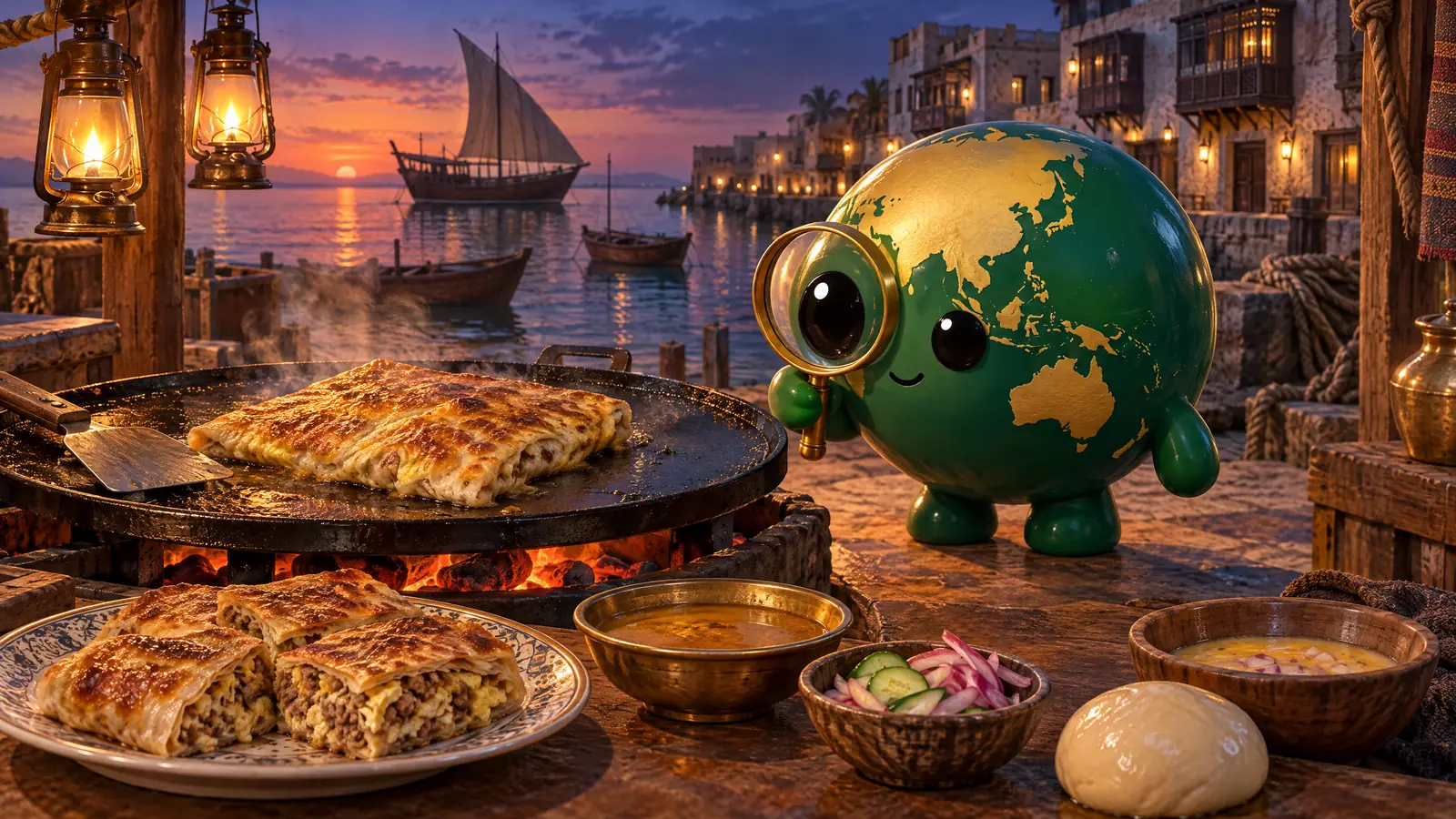
You think murtabak is a Malaysian dish. Or maybe an Indonesian one. It is older than both countries. The stuffed bread you buy at a night market stall traces back to Yemeni cooks who folded spiced meat into thin dough for sailors and traders, centuries before anyone called it street food.
Murtabak originated in the Middle East, particularly linked to Yemen and Saudi Arabia. The word mutabbaq means "folded" in Arabic. Arab and Indian traders carried the dish across the Indian Ocean, and every port where it landed gave it a new name, a new filling and a new side dish. Murtabak may have originated in Yemen as mutabbaq, but the version you know was shaped by dozens of hands in south east asia, India and the Arabian Peninsula. That is the murtabak history we are telling here.
The name: what it means and where the word came from
Most scholars trace the word to Arabic. The word mutabbaq means "folded" in Arabic. That is what the dish is: a thin dough folded over a filling.
The word left Arabia with traders. It moved along Indian Ocean trade routes, carried by Yemeni merchants and Tamil Muslim traders who sailed between the Red Sea and the ports of Southeast Asia. As it moved, the sound changed.
Here is how different places say it:
Arabic: mutabbaq (مطبق)
Malay and Singapore English: murtabak
Indonesian: martabak
Southern Thai: mataba
Older records spell it in many ways. In Malay Jawi script (the Arabic-based script once used to write Malay), early spellings were not fixed.
Where it began: the place, the time, the people
The best evidence points to the Red Sea and Indian Ocean trading world. The Yemeni port of Aden was a meeting point for Arab merchants, Indian traders and East African sailors across the ancient and medieval Indian Ocean trade. The dish's history reflects cultural exchange between Arab and South Asian Muslim communities in these busy ports.
One theory holds that Yemeni cooks, especially from the Hadhramaut region, folded minced meat and onion into thin bread to make meals that were easy to eat with the hands. No fork needed. That suited life on ships and in crowded harbour markets. The method fits the name: mutabbaq, folded.
South India had its own stuffed bread tradition. Along the Malabar and Coromandel coasts, cooks already made layered wheat breads. Further north, Mughal-era kitchens are said to have produced stuffed parathas with egg and meat. These similar ideas could blend whenever Yemeni sailors and Indian cooks shared a port kitchen.
The earliest written record of a related dish appears in the 13th-century Arabic cookbook Kitāb al-Ṭabīkh, written in 1226 by the Baghdad-based Muḥammad ibn al-Ḥasan al-Baghdādī. It contains two recipes for muṭbaq, both sweet, enclosed between two layers of bread. That tells us the idea of folding or layering bread with a filling was known by at least the early 1200s.
No medieval Malay or Southeast Asian text records a murtabak recipe. Much of the early history is oral, passed from cook to cook in markets and homes, not written down until colonial times. What we do know is who carried it east:
Hadhrami Arabs, from the Yemeni interior, who settled in ports across the Indian Ocean.
Tamil Muslim traders, from South India's Coromandel coast, who moved to Penang, Melaka and Singapore.
Gujarati merchants, who traded cloth and spices between western India and the Malay Archipelago.
These groups linked the Arabian Peninsula to Batavia (now Jakarta), Penang, Melaka and Singapore across the colonial era. Indian traders possibly introduced murtabak to Southeast Asia during this period. The dish came with the people, not through any single moment of invention.
Anatomy: what it is made of, or how it is done
Murtabak is a very thin dough sheet, filled, folded into a parcel, and fried on a flat pan. Murtabak is typically cooked on a hot grill plate until the outside is crispy and the inside stays soft.
The dough: the thin sheet that holds it all
The dough is simple: flour, water, fat (oil or ghee), salt. Some recipes add a little milk or egg. The dough rests for hours before use. That resting is what makes it stretchy.
The cook oils a ball of dough, slaps it on the counter, and pulls it outward with both hands. Murtabak dough can be stretched until transparent. The goal is a sheet so thin you can almost read through it, yet strong enough not to tear. This stretching is a small performance at mamak stalls, where the slap of dough on steel draws a crowd. The same technique appears in roti canai shops across Malaysia and Singapore, and in the making of South Indian parotta.
The filling and the sides
Common fillings include minced meat, eggs, and onions. In Singapore and peninsular Malaysia, the standard filling is beaten eggs mixed with chopped onion and ground beef or mutton. A "special" or "royal" Malaysian murtabak often contains extra meat and spices. Malaysian murtabak often contains ground meat, onions, and eggs. Turmeric, cumin and coriander enter the mix in Southeast Asia, likely from Indian spice habits rather than from Yemeni cooking.
Sweet murtabak can include banana, chocolate, and peanut butter. The sweet Indonesian version, martabak manis, uses a different batter altogether, with yeast or baking soda, and is topped with sugar, crushed peanuts, chocolate, condensed milk and sometimes cheese. It is more of a thick pancake than a stuffed bread. We will come back to it below.
Murtabak is often served with curry sauce or pickled vegetables. In Malaysia and Singapore, a light curry or thin gravy and pickled raw onion with cucumber come alongside. In Indonesia, acar (a sweet-sour cucumber relish) and sometimes tomato ketchup are common. In Yemen, the bread is often eaten with tea and little else. The sides tell you where the dish landed, because they follow the local pantry, not any original recipe.
One thing, many homes: how each country or community made it its own
Many families, one thing. Murtabak has variations across Malaysia, Indonesia, and Singapore, and also across Yemen, India, Thailand and beyond. Each place gave it a local name, a local filling and a local way of eating.
Yemen and the Arabian Peninsula
In Yemen and Saudi Arabia, the dish is called mutabbaq. Yemeni mutabbaq is filled with spiced meat, resembling shawarma in its seasoning. The bread is thinner, the filling is mostly minced meat and onion with less egg than Southeast Asian versions. It is folded into rectangular parcels and fried until crispy. Street vendors sell it in coastal towns along the Red Sea, especially in the Hijaz and Tihamah regions. It is everyday food, eaten with tea, not reserved for special occasions.
South Asia: from Mughlai paratha to street snacks
North India and Bangladesh have Mughlai paratha, a stuffed flatbread with egg, minced meat and onions. The resemblance to savoury murtabak is strong.
South India's Malabar parotta (a flaky layered flatbread) shares the layering technique, though it is not always stuffed. These traditions were already in place when Indian Muslim migrants left for Malaya and the Dutch East Indies. Those migrants, not just Arab traders, were key in carrying the dish east.
Malaysia and Singapore: mamak stalls and prata shops
In Malaysia and Singapore, murtabak is commonly associated with Mamak stalls. Indian Muslim (mamak) communities in British Malaya sold roti, prata and murtabak from kopitiam (coffee shops) and street stalls for generations. The dish called murtabak here is a large square parcel with an egg-and-onion base, options for chicken, beef or mutton, served with curry sauce and pickled onion.
Murtabak grew common enough across Malaysia and Singapore to appear in local food writing and family memories. The area's sizeable Indian population shaped the dish. Local taste pushed more egg into the filling, added bright pickles on the side, and in recent decades introduced creative versions with cheese, canned sardine and even instant noodles. A version without meat, sometimes called martabak kosong (kosong means "empty" in Malay), also exists for those who want the bread and egg alone.
Indonesia, Brunei and the sweet martabak cousins
Indonesia splits the family in two. The savoury form is called martabak telur, also known as egg martabak, with a filling of egg, meat and scallions. It is close kin to the Malaysian version: crisp thin dough, rich filling of beaten eggs, vegetables and minced meat, served at night markets in Java and Sumatra port towns. The Indonesian version often comes with acar and ketchup on the side.
Martabak manis is a sweet Indonesian pancake with various toppings. It is thick, honeycombed from yeast, and topped with butter, sugar, chocolate, crushed peanuts and condensed milk. It is sometimes also called apam balik in parts of Malaysia, though the link between the two names is not well documented. It shares the martabak name and the idea of folding, but its batter, pan and history are different. Both savoury and sweet forms show how "martabak" became a broad word for folded treats in Indonesia.
Brunei and the southern Philippines have their own versions, shaped by shared Malay and Muslim links. Some are closer to the sweet side, others are rolled stuffed breads with various fillings.
Other Indonesian variants include martabak kentang (with potato filling) and martabak kubang (from Padang, West Sumatra), each reflecting local tastes and ingredients.
Thailand and other neighbours
In southern Thailand, the dish is called roti mataba. It uses Indian-influenced roti dough filled with egg and mince, and is sold with curry or sugar. The word mataba comes from the same Arabic root as mutabbaq.
Similar stuffed breads appear in Myanmar and along the edges of the Malay Peninsula. Once the idea arrived, many cooks copied and adapted it. The fillings, the dough thickness and the side sauces change to match the local pantry, but the core method, folding and frying, stays the same.
From the stall to the world: how it spread
Murtabak is a street food staple in many Southeast Asian countries today. It reached those countries in stages.
Indian Ocean sail era: Arab and Indian traders moved mutabbaq between Yemen, South India and early Southeast Asian ports. The earliest known written recipe for a related dish dates to 1226, by a Baghdad-based author.
Colonial labour era: Under British rule in Malaya and Singapore, and Dutch rule in the East Indies, Indian Muslim and Arab workers and merchants arrived in larger numbers. They brought murtabak, parathas and roti into urban hawker culture.
Post-1960s migration: Southeast Asian communities emigrated to Australia, the United Kingdom, the United States and Gulf states. Malaysian and Indonesian restaurants abroad put murtabak on menus alongside chicken curry and rice dishes, serving both savoury and sweet versions today.
Internet and food media era (2000s onward): Social media and food television turned murtabak into a dish that appears in global street food programmes. Recipe videos showed homemade murtabak to audiences who had never visited a mamak stall.
Savoury murtabak became a fixed item in street food scenes across Southeast Asia. Murtabak holds cultural significance in various communities across Southeast Asia, especially during Ramadan, when night markets fill with stalls selling it alongside other dishes cooked fresh on the spot.
More than a dish: what it means to people today
For Indian Muslims in Malaysia and Singapore, murtabak is part of mamak culture. It is the dish served at long tables late at night, shared among friends watching football on a screen bolted to the wall, eaten with curry and too much chilli. It is comfort and habit.
In Indonesia, martabak telur is something you buy on the way home from work. Martabak manis, the sweet dessert version, is a treat you bring back for the family, folded shut in a cardboard box, topped with chocolate and cheese. It is a small celebration for no particular reason.
For Yemeni and South Asian communities, mutabbaq is everyday food that links people to home countries, to family recipes handed down, to the kitchens of coastal towns their grandparents left behind.
The shared-heritage angle matters. Arab, Indian, Malay, Javanese, Thai and Chinese cooks all left marks on this one stuffed bread. A mamak stall griddle sizzles in Kuala Lumpur. A Jakarta night-market vendor flips martabak telur under bare bulbs. Malaysian cafés abroad list both savoury murtabak and sweet martabak on the same menu. The dish moves with people. It always has.
If you like stories like this, join the Backstory Asia email list. One origin story a week, nothing else.