
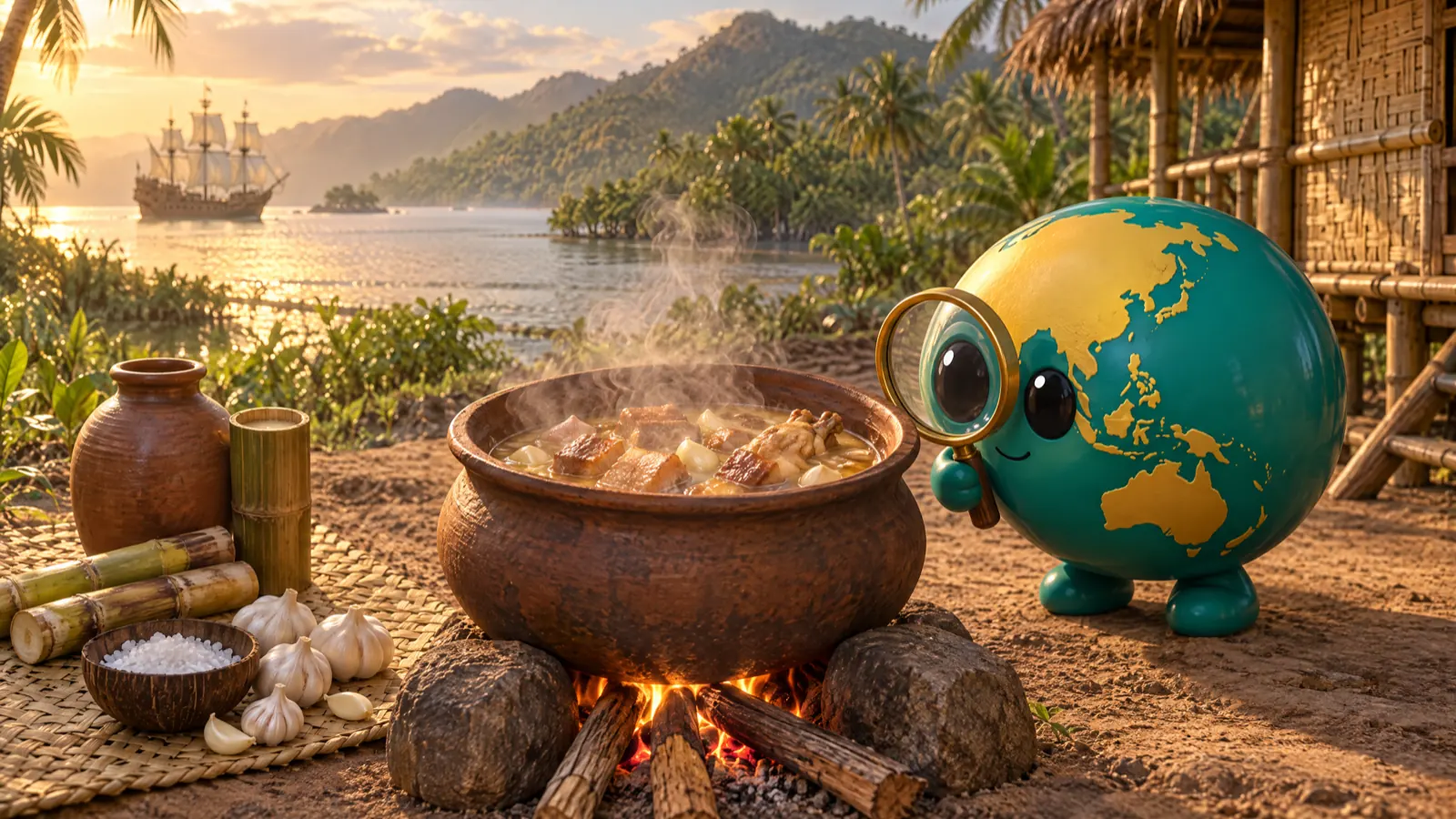
You think adobo is a Spanish dish. It is not. Adobo is a Filipino cooking method that already existed before Spain arrived in the Philippines. The Spanish gave it a name. The people of the islands gave it everything else.
Philippine adobo is meat cooked slowly in vinegar, salt and garlic. It is one of the oldest ways of keeping food safe in a hot place. The word comes from the Spanish verb adobar, meaning to marinate or to season with vinegar, salt and spices. But the cooking process itself, simmering meat or fish in sour liquid over low heat, was already part of daily meals across the islands long before any Spanish ship landed. Spanish explorers named the cooking technique adobo after observing local food preservation methods. The dish they saw was not theirs. They simply had a word for it.
That gap between the name and the thing is the real story of adobo history, and it is what this page is about.
The name: what it means and where the word came from
The Spanish word adobar means to season or to marinate food using vinegar, salt and spices. From this verb form comes adobo, which can mean the marinade itself or the finished dish. When Spanish colonisers reached the Philippines in the 1500s, they found indigenous people already cooking meat and fish in sour liquids with salt. The Spanish called this adobo de los naturales, meaning adobo of the natives.
The term adobo first appears in print in the Philippines in 1613. A Spanish Franciscan missionary named Fray Pedro de San Buenaventura wrote a dictionary of the Tagalog language. In it, he described the local cooking style using the word adobo. Later, in 1794, an updated version of that same Tagalog vocabulary used quilauìn (now called kinilaw, a kind of raw fish dish) alongside the word adobo. This tells us something important. The Spanish label stretched over time to cover several native methods, not just one.
Before the Spanish word arrived, the people of the islands already had their own ways of preserving food. They used vinegars made from coconut sap, nipa palm sap and sugarcane. They used salt. They used slow heat over fire. The word was new. The food was old.
Where it began: the place, the time, the people
Picture the lowland Philippines in the 1500s. It is hot. The air is heavy with moisture. There is no ice, no fridge, no cold room. Meat and fish go bad fast. People live near rivers, coasts and forests. They need food that lasts.
Austronesian peoples, part of a language family that spans much of maritime Southeast Asia and the Pacific, solved this problem with what they had. Vinegar and salt were used to preserve food in tropical climates before refrigeration. Coconut sap vinegar, called tuba, was easy to make. Nipa palm vinegar was common in coastal areas. Sugarcane vinegar appeared in places where cane grew. These sour liquids, combined with salt and slow simmering in small clay pots over wood fire, kept meat safe to eat for a day or more.
Spanish colonisation began in 1565 and brought new trade routes. Through Chinese traders in Manila and other ports, soy sauce slowly entered Filipino kitchens. Bay leaves and black pepper came through broader trade. But the core method was already in place. Adobo's cooking process melds various cultural influences, and the dish sits at a meeting point: indigenous braising, Spanish naming, and Chinese trade goods like toyo (soy sauce) that joined some pots later.
Early written records come mostly from Luzon and the Visayas, where Spanish friars spent the most time. They wrote vocabularies and diaries. Nobody wrote down the very first pot of adobo. What we have is the earliest mention in writing, and what we know about food needs in a tropical colony. That is enough to place adobo firmly in precolonial Filipino life.
Anatomy: what it is made of, or how it is done
Adobo is a cooking method, not a single recipe. Think of it as a pattern. You take meat or vegetables, then add vinegar. Salt, garlic, black peppercorns and sometimes soy sauce go in next. Bay leaves follow, and the pot simmers until everything turns tender. The result can be saucy or nearly dry, with crisped edges from being pan fried at the end.
Adobo's modern interpretation often includes vinegar, garlic, soy sauce, and black pepper. But early adobo likely had no soy sauce at all. The most basic ingredient was vinegar, the oldest souring agent in the Filipino kitchen. Salt was the other primary partner. Together they slowed spoilage. Garlic added flavour and also helped keep food longer.
The primary ingredients are simple. That is the point. Adobo reflects the adaptability of Filipino culture by using local ingredients and techniques.
Common "bodies" for adobo include chicken (adobong manok), pork (adobong baboy, also simply called pork adobo), or a mix of both. There are versions with beef (adobong baka, a rarer version), fish like galunggong (a common reef fish), shrimp (adobong hipon), squid, and vegetables like kangkong (water spinach) or sitaw (string beans). Adobo variations may include sugar, liver, and potatoes depending on the household.
From a historian's view, two big style families stand out. White adobo, called adobo na puti, uses only vinegar and salt. No soy sauce at all. This is closer to the precolonial form. Black adobo, the soy-based kind, uses soy sauce and produces a darker, richer sauce. Yellow adobo, called adobong dilaw, gets its colour from turmeric. The shift from white to dark tracks the arrival of soy sauce through Chinese trade.
One thing, many homes: how each place made adobo its own
There is no single official adobo in the Philippines. Each region of the Philippines has its own adobo version. Every home has its own ratio. All of them count.
In Luzon, Manila-style adobo tends to be heavier on soy sauce. The sauce is dark and carries strong umami. In Batangas and Laguna, cooks add turmeric instead, for the yellow adobong dilaw. In Cavite, some cooks add mashed pork liver to the pot. Home cooks in some Pampanga kitchens say they add a touch of brown sugar for sweetness.
In Bicol, adobo sa gata appears. Adobo ng gata includes coconut milk and green finger chilies. This reflects Bicol's wider love of coconut and spice.
In the Visayas, the regional variations multiply. Adobong pusit is squid adobo, and seafood variants are common near the coast. Some Visayan cooks say a drier adobo keeps longer on a boat trip or a day in the field, though no single record pins that reason down. There are numerous variants from island to island.
Among the Visayan peoples, an old word tells a related story. A 1711 Visayan dictionary records guinamus, a term for marinades made from fish to pork. The technique is shared. The name may differ.
Filipino families abroad adjust adobo to what their pantry holds. Away from home, many say they reach for rice vinegar or apple cider vinegar instead of coconut vinegar. Cuts of meat may differ. Onions, oregano or other local seasoning may appear. But the pattern stays: sour, salty, garlic, bay leaves, simmered low. Many families, one thing.
From the stall to the world: how adobo spread
Adobo started at home, cooked in metal pots or small clay pots over open fire. From there, many say it found its way into carinderias (small food stalls), turo-turo canteens (point-and-choose eateries), and office cafeterias across Philippine cities.
Many Filipino families say adobo makes good baon, the packed lunch, because it keeps well and tastes even better the next day, once the sauce has soaked deeper into the meat. Adobo has evolved from a humble island dish into something recognised across the world.
In the late 20th century, Filipino cookbooks such as Reynaldo G. Alejandro's The Philippine Cookbook (1985) helped set adobo's recipe down in print as a national favourite. Adobo recipes appeared in standardised form on the page, though every family still argued that their version was the right one.
Filipino migration carried adobo abroad. Many trace this to the 1960s onward, when nurses, seafarers and overseas workers are said to have brought the dish to the United States, Canada, the Gulf, Singapore and beyond. Filipino restaurants can now be found in cities like Los Angeles, New York, London and Dubai, and adobo is often one of the first Filipino dishes a visitor tries.
Packaged versions followed too: local snack products like garlic fried peanuts are now marketed as "adobo flavoured". Some avant garde cooks have reimagined the dish, including a Japanese-style take on pork adobo. Avant garde cooks coming from Philippine culinary schools continue to push the dish into new shapes. These are new branches on a very old tree. Adobo is one entry in a wider record of Southeast Asian dishes reshaped by migration, alongside pho, born where French beef, Chinese noodles and Vietnamese broth met in Hanoi, and Hainanese chicken rice, carried across the region by Hainanese migrants.
Mexican adobo, while sharing the same Spanish word, is a different dish altogether, built around dried chillies. The two share a name and a colonial root word, but their histories and main ingredients are separate.
More than a dish: what adobo means to people today
Adobo is considered an unofficial national dish of the Philippines, symbolising cultural identity. Many Filipinos name adobo when asked what their national dish is. There is no legal national dish. Sinigang and lechon share the stage. But adobo holds a special place because of its simplicity: basic pantry items, slow cooking, a sweet-sour-salty balance, served with plain rice in any kind of home.
In Filipino families, arguments happen. How much vinegar? Whether soy sauce or salt only? Should the sauce be thick or dry? Should the chicken be deep fried at the end for crisped edges, or left soft in the sauce? Adobo recipes pass down without exact measures. Memory lives in flavour, not in writing.
In Philippine cuisine more broadly, adobo appears in films, dinner-table scenes and novels. Writers use adobo to signal home. When characters are abroad, they cook adobo to feel comfort. When they share food with someone they love, it is often adobo on the plate.
There are debates in food writing about whether adobo is "Spanish" or "Filipino". The record shows a shared history. The name is a Spanish word. The roots and daily life of the dish are deeply Filipino, shaped by indigenous practice, colonial rule, Chinese trade and generations of home cooking. The name came from one side of that history. The daily cooking came from the other.
If you like stories like this, join the Backstory Asia email list for one new origin story a week.