
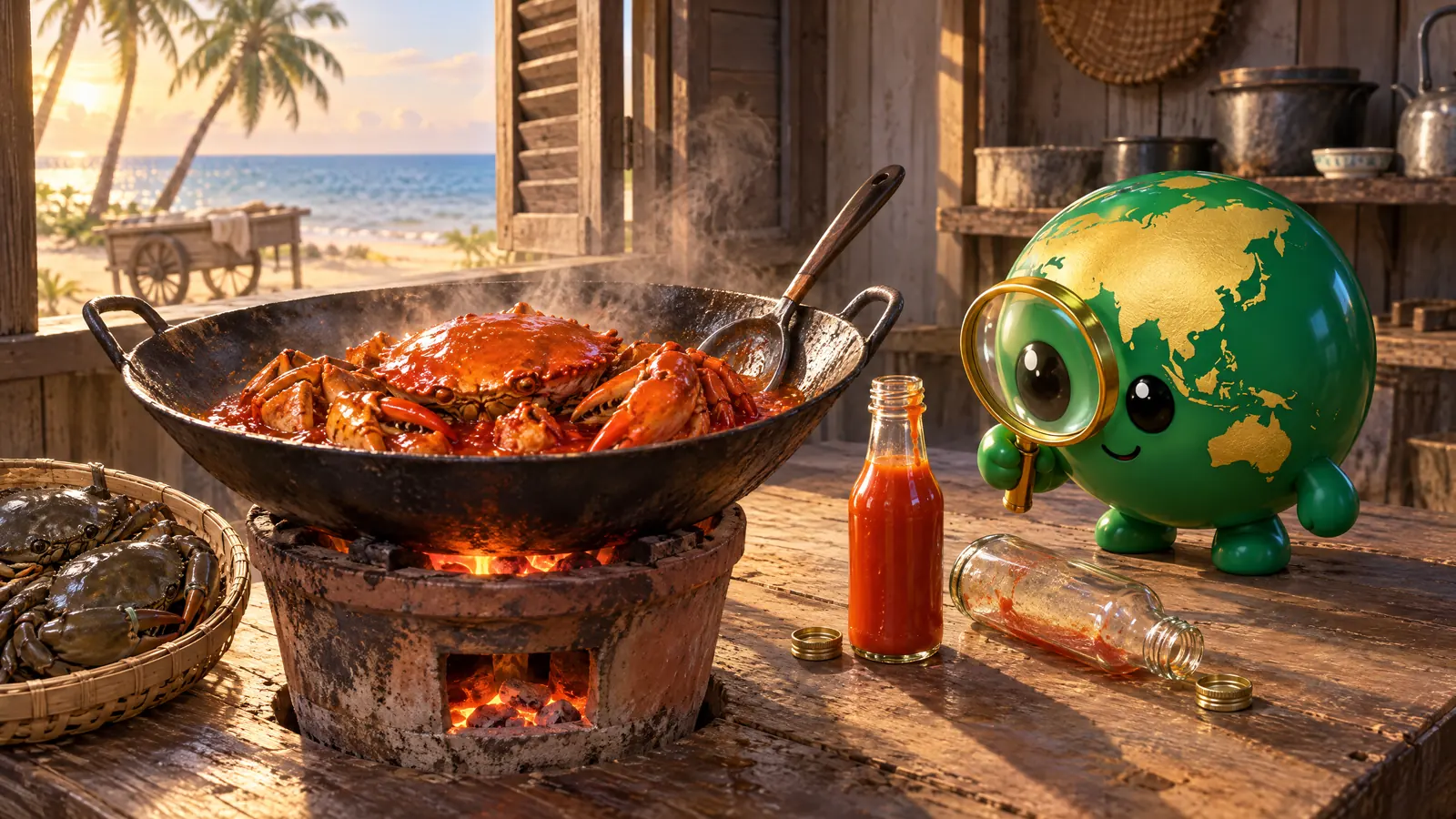
You think chilli crab was always the sweet, sticky, egg-laced dish you see on Singapore menus today. It was not. The first version was simpler than you would guess: a home cook ran low on bottled tomato sauce, reached for chilli sauce instead, and changed what Singapore eats forever.
The most commonly told version traces chilli crab back to the 1950s, and both Singapore and Malaysia claim it as their own. In Singapore's telling, the dish was created by Cher Yam Tian, a home cook with no restaurant training, who stir-fried crabs with bottled sauces by the seaside. That small family stall grew into one of Singapore's most recognised foods. Here is how a pushcart supper became a national treasure, told kindly, with both families' claims in view.
The name: what it means and where the word came from
Start with the two words. "Crab" here means mud crab, a large, heavy-shelled crustacean from the mangrove swamps and shallow coastal waters of Southeast Asia, prized because its thick shell holds plenty of meat and lets the sauce cling.
"Chilli" means fresh red chillies, not dried chilli powder, and that matters: the sauce is sweet and savoury first, the heat arriving after as a warm tingle rather than a sharp burn. Most people eating it for the first time notice the sweetness before the spice.
Most locals say "chilli crab" in English, even at hawker centers and coffee shops, not in Malay or Chinese. Older menus sometimes wrote "chili crab" with one l, following American spelling, but Singapore media and tourism boards now mostly use "chilli crab" with two.
On many menus the dish sits next to black pepper crab, white pepper crab or butter crab. Those share the same crab but use very different sauces. Here, "chilli crab" means the specific tomato-and-chilli egg sauce dish, not every spicy crab plate in Asia.
Where it began: the place, the time, the people
The story most people repeat starts in 1950s Singapore, on the east coast, in one family's home business, nothing more at first than supper for neighbours and passing lorry drivers.
After the Second World War, Singapore was still under British colonial rule, when food came from pushcarts, small coffee shops and makeshift shacks by the sea, and bottled sauces were common because fresh imports were limited. Cher Yam Tian initially stir-fried crabs with bottled tomato sauce at her seaside home, with her husband Lim Choo Ngee by her side. When the tomato sauce ran low one day, she added bottled chilli sauce instead.
By around 1956, Madam Cher and her husband sold their stir-fried crab from a pushcart. Chilli crab grew in popularity from that pushcart, though nobody wrote down exactly where it stood. What the sources share is the same family, the same idea, and the same stretch of Singapore's east coast.
Early customers were families, office workers and lorry drivers, and word spread mouth to mouth. The pushcart's success led the Lims to open a restaurant, Palm Beach Seafood, on Upper East Coast Road.
The version most people cook today came later, in the 1960s, from chef Hooi Kok Wai, one of four well-known Singapore chefs of that era. What exactly he changed is not recorded; what is recorded is that his take became the one most restaurants still serve.
Many stories, one shared origin
Some families in Singapore tell similar stories of inventing a spicy crab dish in the 1950s and 1960s, often along the old east coast shoreline. The earliest widely reported version with a tomato-chilli gravy is linked to Madam Cher's stall, which grew into Palm Beach Seafood. But not every detail was recorded, and oral histories sometimes disagree on small points.
Chinese, Malay and Eurasian home cooks were already cooking crab in strong sauces before chilli crab appeared, sambal crab, black bean crab, soy sauce crab, part of a shared coastal habit it grew from, not from empty air.
We can name the known people, respect all the family memories, and still see chilli crab as a dish that belongs to many Singapore homes, not only one address.
Anatomy: what it is made of, and how it changed
This is not a recipe, but a look at how the dish's structure shifted over seven decades.
The earliest version was simple: whole crabs, cleaned and chopped, stir-fried and coated in bottled tomato sauce and chilli sauce. No thick gravy, no egg swirl, no long list of ingredients.
In the 1960s, chefs in Chinese restaurant kitchens added layers: fresh ground chillies joined the bottled sauce, garlic, shallots and ginger became core ingredients, and tomato paste gave a deeper colour than diluted ketchup. Cornstarch thickened the sauce so it coated the shells without sliding off, and a long-cooked base let the flavours meld, sweet, savoury and tangy.
The beaten egg changed everything: poured in at the last moment and swirled quickly, it gave the gravy a silky, foamy texture that ties those notes together. Overcooked crab turns tough, and ingredients stir-fried too slowly can burn, the small details behind why it is made this way.
On the table, chilli crab rarely arrives alone: mantou, a type of Chinese bun deep-fried until golden, comes along to mop up the sauce, alongside steamed rice or noodles. Best eaten right away, since the sauce thickens as it cools.
Compared with black pepper crab, butter crab or a dry-roast version, chilli crab is wetter, sweeter and far less creamy. Its subtle flavor comes from balance, not from one loud spice.
One thing, many homes: how each place made it its own
The story did not end at one pushcart. The dish spread across Singapore, then to neighbouring countries, each place adding small changes.
Within Singapore: from coast to housing estate
Early chilli crab stalls hugged the old shoreline, East Coast, Bedok, Upper East Coast Road, the Kallang River, diners on plastic stools.
Different restaurants built house styles. Some sauces are hotter and less sweet, some thick with lots of egg, some rich with extra crab roe. Halal versions use the same crab but with pork-free stocks.
Across the causeway and the region
Variations travel too: "Singapore chilli crab" turns up on menus in Johor Bahru and Kuala Lumpur, and as "kepiting saus Singapore" in Jakarta and the Riau Islands. Malaysia's own claim has real roots: Weng Fung, a Hainanese coffee shop on the island of Langkawi since the 1920s, became a seafood restaurant in the 1950s and says it served Malaysia's first chilli crab from 1958, a dish it still serves today. The crab species may change with what is local and cheap, mud crab, flower crab or swimming crab, but the idea, a whole crab in a sweet-spicy tomato and egg sauce, traces back to the same history, one entry in Backstory Asia's record of Southeast Asian food origins.
From the stall to the world: how it spread
From one family stall in the 1950s, Singapore chilli crab became a dish visitors now fly in for, and one that turns up in restaurants from Sydney to London to New York.
In the 1980s and 1990s, big seafood restaurants opened multiple outlets and standardised their own recipe, turning a home dish into a flagship item.
Singaporean and Malaysian migrants opening zi char and seafood restaurants abroad brought the dish with them, adapting with frozen crab or other shellfish when fresh mud crab was hard to find far from Southeast Asia.
Somewhere along the way, it became a global culinary ambassador for Singaporean cuisine. Tourism and travel writing often call it Singapore's best-known dish, a fame that grew slowly through families, then hawkers, then restaurants, then media, then travel shows and food bloggers who told the 1950s backstory to viewers overseas, the same slow climb that carried satay from street vendors to a regional icon.
More than a dish: what it means to people today
People think of chilli crab as a "must-eat" for visitors. For many Singaporeans it holds something more personal: the dish turns up at weddings, festive occasions and family gatherings, a shared plate rather than a private one.
For older Singaporeans, chilli crab recalls open-air suppers by the sea, plastic chairs on sand. For younger diners, it turns up at birthday dinners, where the table shares one or two big crabs. Everyone reaches in, cracks a claw, passes the mantou.
It shows up in school compositions, tourism posters and diaspora interviews as the taste that "feels like Singapore," a marker of home far from the east coast.
There are gentle debates: how sweet the sauce should be, how much egg is right, whether prices have climbed too high. These talks keep the dish alive and changing. At heart, it remains what it was from the start: a dish born from making do, from a cook who played with bottled sauces when the tomato ran low.
It keeps changing because new cooks take it on in their own kitchens. That is what makes chilli crab a living part of Singaporean culture, not a museum piece.
If you like stories like this, join the Backstory Asia email list. One origin story a week, nothing else.