
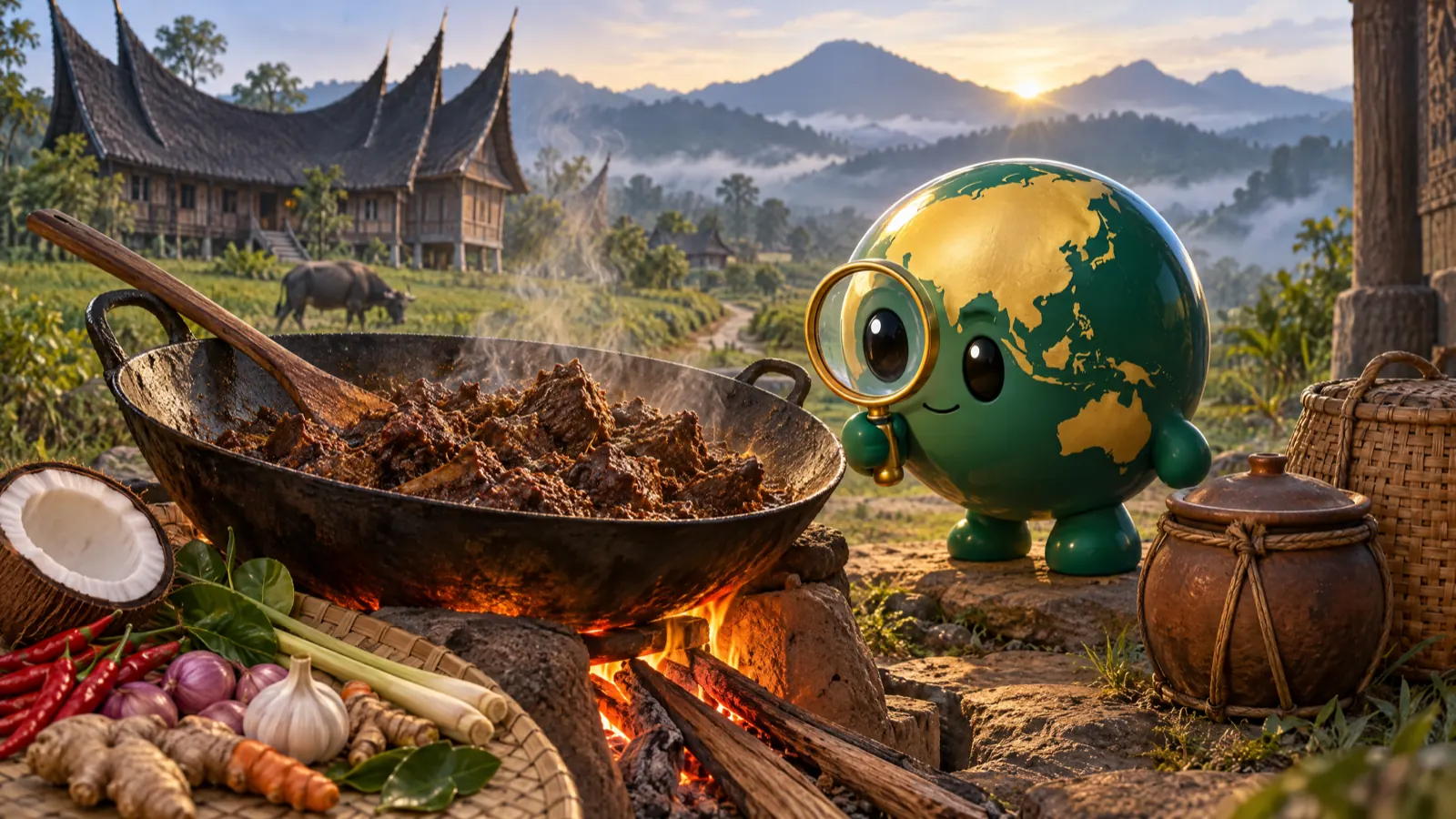
You think rendang is a curry. It is not. It is meat cooked so slowly, for so long, that the liquid evaporates and the coconut milk turns into oil, wrapping every piece in spice and fat so it can survive weeks without a fridge. Before ice boxes and cold rooms, the Minangkabau people of West Sumatra needed a way to carry meat on long journeys across mountains and seas. Rendang was their answer.
The name rendang means cooking over low heat for a long time. It is one of the oldest preserved foods in Southeast Asia.
Prefer to watch? This story is Episode 8 on our YouTube channel: The Dish That Lasts for Weeks: Rendang.
The name: what it means and where the word came from
The Kamus Besar Bahasa Indonesia, Indonesia's main dictionary, defines rendang as meat cooked with coconut milk until the sauce is completely dry, leaving only pieces of meat coated in spices. The verb merendang means the act of cooking rendang. The Malay dictionary Kamus Dewan carries a similar meaning. In older Malay usage, merendang had a broader sense: to cook and dry something slowly in fat or thick liquid, closer to what we might call braised or fried gently.
The earliest reference to rendang dates back to the 16th century. The food historian Fadly Rahman traced the words rendang and merendang to the Malay manuscript Hikayat Amir Hamzah, written during the Malacca Sultanate period, roughly the 1400s to 1520s. The text describes people roasting goat meat and calls it "daging kambing rendang," goat meat rendang.
In the 17th century, European word collectors in the Malay world wrote the term down too. A 1623 Dutch-Malay dictionary by Caspar Wiltens and Sebastiaan Danckaerts listed rendang as meaning "to fry in butter or oil, to fry, to fricassee." A 1677 dictionary by Frederik Gueynier translated randang similarly.
An 1891 Minangkabau-Malay-Dutch dictionary by van der Toorn records randang in the Minang language, linking it to the Minangkabau region specifically. British colonial officials on the Malay Peninsula around the same period described a dry curry made from beef cooked until the sauce had gone, separating it from gulai, the wet curry.
Whether the original root word is marandang in the Minang language or merendang in Malay, and whether the earliest versions were fully dry or just drier than gulai, nobody can say with certainty.
Where it began: the place, the time, the people
Rendang originates from the Minangkabau people of West Sumatra, from inland highland villages where families raised cattle and buffalo. The Minangkabau are a matrilineal society, meaning land and property pass through women. They have been Muslim since about the 15th or 16th century. They were also great traders and travellers, known for their tradition of merantau, leaving home to seek fortune elsewhere.
The highlands of West Sumatra are hot and wet, with no refrigeration. Minangkabau traders walked overland from their villages to coastal ports like Padang, and from there sailed across the Malacca Strait to the Malay Peninsula. Rendang, with its low water content and oil coating, was food that stayed safe for days or weeks on long journeys.
Buffalo meat and beef came from highland herds, coconut milk from coastal groves, and spices from Indian Ocean trade routes carried up rivers to inland markets. Historians also trace a possible Portuguese influence: chili peppers are thought to have arrived through Portuguese trade routes after they took Malacca in 1511, and the pepper found its way into the spice paste from there.
Anatomy: what it is made of, or how it is done
Rendang is chunks of meat, coconut milk, a spice paste, slow fire, and time, cooked until the liquid is gone and the meat is coated in oil and spice.
The main ingredient is traditionally beef or buffalo meat. The spice paste, called rempah, is a mixture of chili, shallot, garlic, ginger, galangal, turmeric, lemongrass, and kaffir lime leaves.
What makes rendang different from a normal curry or gulai (a wet curry) is the cooking process: the dish starts as a wet stew, then dries out over several hours.
From wet stew to dry rendang
The pot moves through the change gradually, not in named, official steps. First, the meat simmers gently in the coconut milk and spices, starting as a soupy broth. Many cooks stop here, or soon after, while there is still plenty of gravy; that wetter version is close to what is called gulai or kalio elsewhere, though those are their own related dishes, not formal stages of rendang's own recipe.
Keep the pot going, and the liquid reduces. The coconut milk's own oil separates out, and the cooking shifts from simmering to slow frying. Keep going further, and the meat darkens, frying in its own thickened, oil-rich paste until it is coated dark brown or nearly black. That is dry rendang: the version made for travel and storage, because once the sauce is gone there is almost no free liquid left for spoilage to start in.
For about five kilograms of meat, over a slow fire, reaching that dry stage takes around five hours in total: roughly three hours for the broth to reduce down in the wok, then about two more hours to reach the traditional dry consistency.
How the slow cooking keeps meat without a fridge
Long heat drives water out of the meat and the sauce. When the liquid evaporates, there is very little free water left, and free water is what germs need to grow.
As the coconut milk thickens and splits, it turns into oil. That oil wraps the surface of every piece of meat, creating a barrier against air and moisture. Many of the spices used, like chili, garlic, ginger, and galangal, have mild natural germ-fighting powers that help slow spoilage.
In a cool, covered place, traditional dry rendang stayed safe at room temperature for days or longer.
One thing, many homes: how each country or community made it its own
Rendang variations exist across Indonesia, Malaysia, and Singapore, and even reach Brunei and southern Thailand, each community shifting the dish to fit local ingredients and tastes.
Minangkabau heartland in West Sumatra
Classic Minangkabau rendang is very dry, dark, and richly spiced, traditionally reserved for major lifecycle events and religious celebrations such as weddings, Eid gatherings, and adat ceremonies, where clan and religious leaders sit together.
Rendang darek, the highland style, is very dry and sometimes smoky; rendang pesisir, the coastal style, is a bit wetter and more aromatic. Minang cooks also make chicken, egg, offal, and even young jackfruit rendang: for them, rendang is a method, not one cut of meat.
Across the Indonesian archipelago
Javanese, Acehnese, and Kalimantan versions may be lighter, sweeter, or include local herbs and vegetables. Some stop at kalio rather than pushing to full dryness. Rendang has been recognised as one of Indonesia's national dishes, and it has been voted the world's most delicious food in culinary polls.
On the Malay Peninsula and in Singapore
Minangkabau migrants carried the rendang method into Negeri Sembilan and other parts of the Malay Peninsula from at least the 18th and 19th centuries. Perak's rendang tok is extra dry and fine; Negeri Sembilan's is rich and sometimes very spicy; Kelantan and Terengganu versions lean sweeter or use local herbs.
Rendang was recognised as Malaysia's National Heritage food in 2009. During Hari Raya celebrations in Malaysia and Singapore, rendang is often served with nasi lemak, ketupat, or lemang. In Singapore, the Malay community brought both Minang and wider Malay rendang styles, so the city holds many strands at once.
Shared heritage, not a contest
Public debates appear when global media praise rendang as belonging to one country or another. The oldest roots sit with Minangkabau communities in West Sumatra and Negeri Sembilan, and from there the dish spread across the Malay world. The food historian Fadly Rahman points out that the 2011 CNN ranking gets used to claim rendang as Indonesian rather than Malaysian, turning a shared dish into a point of national pride. Trade, intermarriage, and migration made rendang a shared dish long before anyone drew a map. Many families, one thing.
From the stall to the world: how it spread
Rendang spread in two waves: first within the Malay world, on foot and by boat, then outward to the globe with migrants, workers, and media in the 20th and 21st centuries.
Minangkabau traders carried pots of rendang on long journeys to Malacca, Penang, and Singapore. By the mid 20th century, Padang restaurants opened in Jakarta, Medan, Surabaya, and beyond. Minangkabau and Malay migrants settled in Kuala Lumpur, Johor Bahru, and Singapore, opening small stalls and home kitchens serving rendang to mixed city communities.
Global fame in the late 20th and early 21st century
In 2011, CNN International named rendang among the world's most delicious dishes, turning it into a global "must-try" across Indonesia and Malaysia.
Indonesian and Malaysian diaspora communities in the Netherlands, the United Kingdom, Australia, and the United States opened international restaurants and took rendang abroad. Packed, ready-to-eat rendang pouches appeared from about the late 20th century, easy to ship and sell abroad.
Modern adaptations, like rendang burgers and rendang-flavoured instant noodles, show the spice mix can travel into new formats while keeping its traditional flavours.
More than a dish: what it means to people today
For many Minangkabau and Malay families, rendang is more than food: a lesson in patience and togetherness in one pot.
Rendang is a communal dish: cooking it well takes many hands and hours. Men and women take turns stirring heavy pots through the night, and children watch: a kind of teaching, passed down without a written recipe.
The four main ingredients of rendang symbolise different societal roles in Minangkabau culture. People say the beef stands for the niniak mamak, the traditional leaders. The coconut stands for the thinkers and wise people. The chili stands for the alim ulama, the religious teachers. The spices stand for the wider community.
Rendang holds deep meaning for migrants: a taste of home packed in luggage, shared in student halls abroad, cooked to mark Eid in small flats in London, Sydney, or Kuala Lumpur.
Governments and tourism boards in Indonesia and Malaysia now promote rendang as part of national identity, alongside dishes like soto and nasi goreng.
This proud, celebrated, delicious dish began as a smart village way to keep meat safe without cold. Knowing that backstory makes each bite feel different.
If you like stories like this, join the Backstory Asia email list for one short origin story a week.