
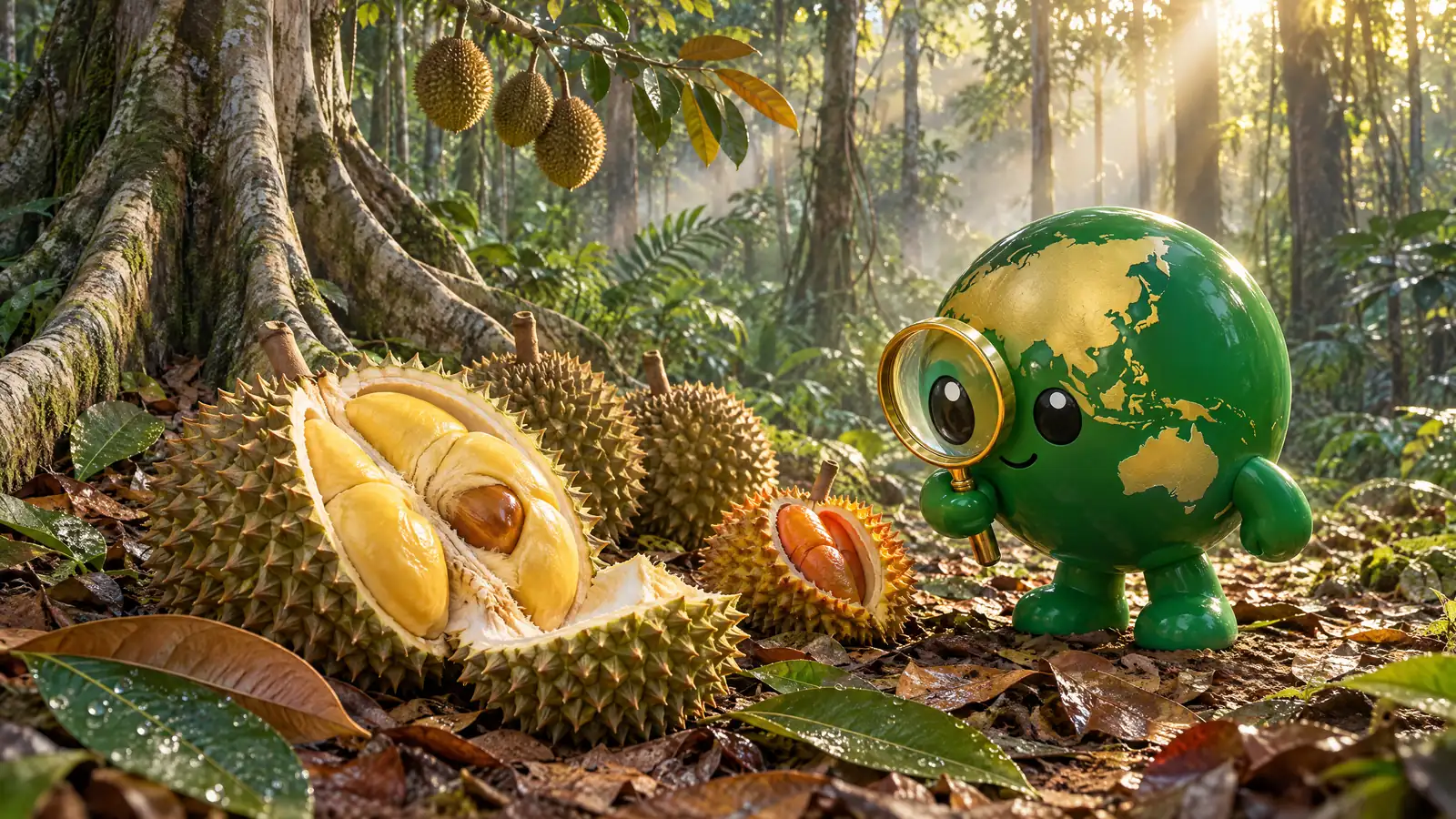
You think durian is a Thai export or a Chinese craze. It is older than both. The durian fruit grew wild in the rainforests of Borneo and Sumatra long before any writer, local or foreign, put its name on paper.
The genus Durio is native to Southeast Asia. Borneo is the centre of the genus's diversity, with 15 species found nowhere else, out of about 30 Durio species in total. The earliest European reference to durian was in the 15th century, but the fruit itself is far, far older than that record.
This is the story of how one spiky, strong-smelling edible fruit became the king of fruits across a whole region, and how it is still changing today.
The name: what it means and where the word came from
The name durian comes from the Malay word duri, meaning thorn. Add the suffix -an and you get "the thorny one." That is it. The name describes the fruit exactly: a ball covered in hard, sharp spines.
The word traces back to Proto-Malayic, the ancestor language of Malay and Indonesian, as duri-an. Linguists track it even further to Proto-Malayo-Polynesian duʀi-an, an even older language family that Malay, Indonesian, Tagalog and many other Southeast Asian languages all grew out of. The local name came first. It was old before any European arrived.
Other languages borrowed the word from Malay, not the other way round. In Thai the fruit is called thurian. In Hokkien, a southern Chinese dialect spoken by traders across the region, the word became liû-liân, which passed into Mandarin as 榴蓮 (liúlián). These are all echoes of the Malay original.
The scientific name Durio zibethinus came much later. Durio is simply a Latin coat put on the Malay word. Zibethinus refers to the civet cat, specifically Viverra zibetha, and nobody is fully sure why: some say civets are fond of durian, others think the fruit's strong smell simply reminded people of the animal. Carl Linnaeus is usually credited with giving the plant its formal Latin name, though scholars still dispute whether Linnaeus or a botanist named Murray is the correct authority for it. The people of Borneo and Sumatra had known the fruit for centuries before any of this naming took place in Europe.
Where it began: the place, the time, the people
Durian likely originated in Borneo and Sumatra. That is where the genus Durio has its widest spread: Borneo alone holds 15 species found nowhere else, out of about 30 in the whole genus, and only 11 of those produce the edible fruit people call durian. Wild durian trees grew in hot, wet lowland rainforests long before any human record. There is no reliable fossil that gives us a date for their first appearance, but one 1949 theory holds that early animals, not just today's, carried durian seeds away in their stomachs before the fruit took its modern shape.
Indigenous communities across Borneo, and others in Sumatra, Sabah and Brunei, knew wild durian species well. They ate species such as Durio graveolens, Durio kutejensis and Durio dulcis. Each had a local name and a local story. These are not museum pieces. People in Borneo still eat them today.
Cultivated durian, especially Durio zibethinus, seems to have spread from Borneo and Sumatra outward to the Malay Peninsula, Java and beyond. Nobody wrote down the early steps. Durians were traded across Myanmar 400 years ago, so the fruit was already moving long distances before modern borders existed. European explorers documented the durian in the 16th and 17th centuries. Portuguese visitors around Malacca used spellings like "durion." D. zibethinus was introduced to Ceylon by the Portuguese in the 16th century, showing how far European ships carried tropical plants. Rumphius gave the most detailed early botanical account in his Herbarium Amboinense, and Linnaeus built on that work.
By the time Western writers praised or mocked the fruit, local people had already been growing and trading it for many generations. Durian cultivation began at the village level in Southeast Asia in the late 18th century, though informal planting around homes was likely much older.
Anatomy: what it is made of, or how it is done
A durian tree is tall, evergreen and built for the equatorial heat. Certain species can reach 40 to 50 metres. The trunk grows buttress roots, large fin-like supports at the base that larger trees usually need to stay upright in shallow rainforest soil. The leaves are elliptic, often with dense copper-brown scales on the underside. Durian trees can live for decades and are often associated with family heritage. A single old tree in a kampung (village) can feed a whole neighbourhood during the season.
Durian flowers bloom mostly at night. They are creamy white with heavy nectar, designed to attract bats. The cave nectar bat (Eonycteris spelaea) and various flying foxes are the main pollinators. Without bats, many durian trees would not set fruit.
The fruit itself is a brownish green or golden yellow husk covered in hard spines, the thorns that gave the fruit its name. It looks a bit like a large horse chestnut, but much bigger and much more dangerous to stand under. Inside, the husk splits into compartments. Each compartment holds large, shiny brown seeds wrapped in flesh called aril. This aril is the part people eat. It is pale yellow to golden yellow, soft, creamy, and often described as rich custard or cream cheese. The British naturalist Alfred Russel Wallace ate durian in Borneo in 1856 and called its flavour "indescribable," then tried again: "a rich custard highly flavoured with almonds gives the best general idea of it, but there are occasional wafts of flavour that call to mind cream-cheese, onion-sauce, sherry-wine, and other incongruous dishes." Wallace admitted he had been reluctant to even try the fruit because of its smell, but after eating one outdoors he wrote that he "at once became a confirmed Durian eater," later calling it a food "of the most exquisite flavour."
The strong odour comes from sulphur-rich compounds in the flesh. The aroma of durian can be compared to rotten onions or gym socks, with occasional wafts of sweetness underneath. In the wild, that smell attracts larger animals that eat the flesh and scatter the seeds. Durian's powerful aroma plays a key role in its identity and market perception.
There is more than one kind. Besides Durio zibethinus, the main commercial species, wild species like Durio graveolens have flesh that ranges from yellow to orange to red. Durio dulcis is sweeter, Durio kutejensis milder. "Durian" is a whole family, not just one tree. Even Annona muricata, sometimes called durian belanda in Malay, is a completely different plant that merely borrowed the durian name because of its spiny skin.
One thing, many homes: how each country or community made it its own
Durian is one fruit with many hometowns. Each place shaped it to local taste, in the same way as other Southeast Asian classics like cendol.
In Borneo, communities still recognise individual wild durian trees by name. Village stories attach to favourite trees. Wild species are prized for different durian varieties of flavour and colour. A 2022 study found low genetic diversity in durian species in Kalimantan, a sign that wild populations need protection.
Malaysia has over 200 registered durian varieties as of 2021. Durian cultivation involves a high degree of selective breeding, and cultivar names reflect taste, texture and seed size. Musang King was discovered in the 1980s in Malaysia and became the most talked-about cultivar in the region. D24, also called Sultan durian, is an older cultivar with golden yellow flesh; Musang King is often described as a more potent version of it. Small mixed orchards grew around family homes in states like Pahang, Johor, Penang and Sarawak, and durian season became a shared event, almost a holiday.
In Thailand, large-scale durian plantations developed through the 20th century, the same decades that shaped other Thai favourites like mango sticky rice. Mon Thong is Thailand's most commercially sought after durian cultivar. Thai durian lovers often prefer firmer flesh, eaten less ripe, a different sensation worth noting beside the soft, custardy style favoured in Malaysia and Singapore. Thailand produced around 700,000 tonnes of durians in 2018.
Indonesia has more than 100 durian varieties cultivated across Sumatra, Kalimantan and Java. River trade historically moved seedlings and fresh durians between islands. Markets from Medan to Jakarta sell regional types with different durian varieties of taste and fat content.
Philippines' popular cultivars include Arancillo and Puyat, each suited to local growing conditions.
In Singapore, as in Malaysia, buyers tend to want durian at its ripest and most pungent, often letting it keep ripening even after the husk has already cracked open. At that stage, the flesh turns richly creamy, and faintly alcoholic, the texture connoisseurs wait for.
Many families, one fruit.
From the stall to the world: how it spread
For centuries, river boats and coastal ships moved durian within Southeast Asia. Seeds and seedlings travelled from Borneo and Sumatra to the Malay Peninsula, Java, Sulawesi and the Philippines along the same routes that carried spices and cloth.
The shift from home orchards to commercial plantations came in the 20th century. Thailand's eastern provinces, especially Chanthaburi, became major growing areas. Parts of Peninsular Malaysia followed, then Sabah and Sarawak.
Key turning points in trade arrived with cold storage. Frozen whole durian, frozen pulp and vacuum-packed segments let the fruit travel far beyond the tropics. Durian chips, durian sweets and durian ice cream turned up in Asian supermarkets in Sydney, London and Vancouver, alongside other regional sweets like kuih. Durian is integrated into various culinary traditions across Southeast Asia, from sugar-rich desserts to savoury dishes, and even to forms that might call to mind other incongruous dishes to an outsider.
The durian craze in mainland China increased international trade significantly in the early 2020s: regional export value rose from about US$550 million in 2017 to roughly US$6.7 billion by 2023, and the Philippines and Vietnam both gained export access to China in 2022. China has become a major centre for global durian consumption, and demand there pushed more land into large-scale planting. Durian went from a local fruit to a global commodity.
Durian trees and seeds were also taken to non-native places: Sri Lanka (where the Portuguese first brought it), parts of South India, tropical Australia, even Central America. Results were mixed. Climate, soil and the right pollinators are hard to replicate outside the native range. The main reason most durian still comes from Southeast Asia is simple: that is where the trees belong.
More than a dish: what it means to people today
Durian is more than food. It is a smell, a season and a shared memory.
Durian is a seasonal luxury in regions where it is cultivated, associated with communal events. People gather at roadside stalls at night in Kuala Lumpur, Penang, Johor Bahru, Singapore and Bangkok. Families drive to orchards. You eat durian together, not alone. The protein content, carbohydrate content and fat content of the flesh make it filling, but the real draw is the taste, that exquisite flavour of rich custard that durian lovers describe with such warmth.
Durian appears in language too. In Malay folklore, durian is associated with the idiom durian runtuh, meaning sudden luck. A saying in Malay means "getting a fallen durian" signifies windfall gain, because a ripe fruit drops without warning. Javanese believe durian has aphrodisiac qualities and impose consumption rules around it. The durian is regarded as the king of fruits in Southeast Asia, a title no other fruit has seriously challenged.
Durian's smell can create social boundaries between enthusiasts and newcomers. Durian is often banned on public transport in Singapore due to its smell. Hotels and airlines across the region post the so called "no durian" sign. Durian symbolizes subjective beauty in Southeast Asian culture: what smells delicious to one person smells unbearable to another. Durian is portrayed in media as a symbol of cultural identity in Southeast Asia.
The boom in demand brings worries. In the Gua Musang District, the state government approved the conversion of 40 km² (10,000 acres) of forestry into durian plantations. Deforestation for durian cultivation threatens endangered species like the Malayan tiger. Bats that pollinate wild durian trees lose habitat when old forests fall. The general idea is simple: more demand means more planting, and more planting can mean less forest. Wild plants and wild durian varieties may shrink if the balance tips too far.
From wild trees in Borneo and Sumatra to a shared symbol of a whole region, still changing today, the durian story is not finished. It never was one country's story. It belongs to many families, one fruit.
If you like stories like this, join the Backstory Asia email list. One origin story a week, nothing else.