
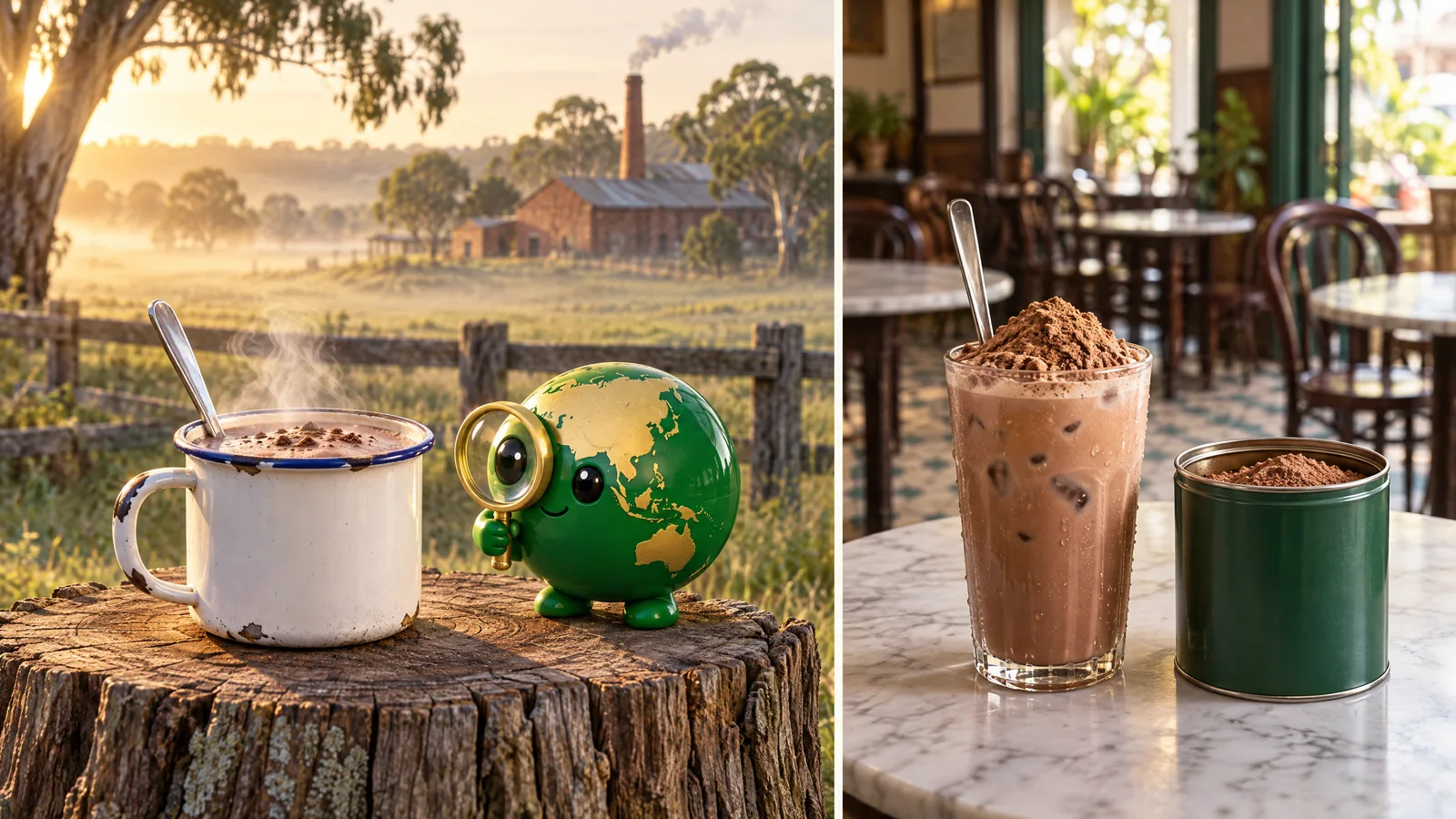
The thing you thought you knew
You think Milo is a Malaysian drink, or maybe a Singaporean one. It was invented in a small Australian factory town during the Great Depression.
MILO was introduced in 1934 during the Great Depression. Thomas Mayne, an Australian industrial chemist working for Nestlé, developed the powdered chocolate malt drink at the company's factory in Smithtown, New South Wales. He created it to help undernourished children get vitamins and energy when many families could barely afford food. Nestlé first served it to children at the 1934 Sydney Royal Easter Show. The brand took its name from Milo of Croton, an ancient Greek wrestler known for legendary strength. That is the short answer. The longer story is about a farm town, a chemist, and a world economic crisis that turned one crunchy brown powder into a comfort drink across Southeast Asia, from mamak stalls (roadside Indian-Muslim cafes in Malaysia) in Kuala Lumpur to kopitiams (traditional coffee shops) in Singapore.
We are Backstory Asia. We tell the origin stories behind everyday Asian things.
The name: what it means and where the word came from
Milo is not a made-up word. It comes from a real person in old Greek stories.
Milo of Croton was a famous wrestler, an athlete from southern Italy, recorded by Greek writers in the 6th century BC. He was known for great strength and many wins at ancient games. The name borrowed his reputation for strength, which suited a drink marketed as a tonic food for children's growth and energy. Nestlé was not trying to teach Greek history. There is no direct link between the chocolate malt powder and ancient Greece beyond the borrowed name and the idea behind it.
The brand styles the word as MILO in all capitals on its tins and packaging. In daily life, people write and say Milo. One reason the name travelled well is that it sounds nearly the same in English, Malay, and Chinese. A child in Sydney, a child in Kuching, and a child in Manila can all say the word and mean the same green tin.
Where it began: the place, the time, the people
The Great Depression hit Australia hard. From the late 1920s into the early 1930s, many families had little money. Many children were not getting enough to eat. Nestlé wanted to help, and they wanted to sell something useful.
Smithtown is a small town in New South Wales. Nestlé had run a milk-processing plant there since 1921. This factory became the place where Milo was first produced in large amounts.
Thomas Mayne, born in 1901, was the man given the job. He was an industrial chemist at Nestlé. The company brief was clear: create a tasty, cheap, shelf-stable drink that could deliver vitamins and minerals to children, using local raw materials like milk powder, malt barley, and cocoa. It had to be something kids would actually want to drink.
Mayne went through rounds of trial and error to get the flavour, the texture, and the way the powder mixed with hot water or milk. One problem he kept hitting was that tiny granules would not fully dissolve. They sank to the bottom or floated on top. That same undissolved powder is now a selling point: the Milo Dinosaur, a modern iced version, piles extra dry powder on top on purpose.
Milo had its first public moment at the Sydney Royal Easter Show in 1934. Nestlé gave out samples to children. The product was branded as a "tonic food" or "fortified food drink" for growth and energy. Thomas Mayne developed MILO to combat child malnutrition, and that purpose shaped everything about the product. Early tins were made in Smithtown, and the brand later reached markets across the British Empire, including British Malaya (what is now Malaysia and Singapore). But in those first years, the story was still very Australian and very rural.
Anatomy: what it is made of, and how the original drink worked
Milo looks like simple brown powder. Each grain was designed in the 1930s to carry what children needed.
The key original ingredients were malt barley (grain that has been soaked and allowed to sprout, which brings out a natural sweetness), dried milk powder, cocoa powder, sugar, and added vitamins and minerals. Milo is high in calcium, iron, and B vitamins. Nestlé released an Australian version called Milo B-Smart in 2008, with added B vitamins and iodine, though it is no longer sold today. Today, Milo contains 1,680 kJ per 100 g serving. The malt powder and cocoa gave it that chocolate malt taste that set it apart from Ovaltine and other beverages of the period.
In the 1930s, families were told to mix one or two spoons of Milo powder into hot milk or hot water and stir. Some families added extra sugar if they could afford it. The idea was simple: one mug a day to fill gaps in a child's diet.
The crunchy bits became part of the experience. What started as a mixing problem is now part of the fun: in Malaysia, the Milo Dinosaur piles extra dry Milo powder on top on purpose, undissolved and crunchy. Decades later, that same crunch is still what many people love most about Milo.
The main base has stayed much the same over the years: malt, milk solids, sugar, cocoa. What has shifted is the fortification mix and the sweetness level, which can vary by country. Milo is 46% sugar in its New Zealand version. In some markets, palm oil appears in the ingredients. As of 2021, Milo's Australian plant also makes high protein, reduced sugar, and plant-based versions.
The 1930s marketing promised "strength" and "energy" for sports and growth. The actual function was a drink with calories from sugar and malt, protein from milk powder, and natural ingredients fortified with minerals and vitamins, filling nutritional gaps for children whose diet was limited by the Depression. It was not medicine. It was a food supplement in a mug.
One thing, many homes: how each country or community made it its own
Milo was invented in Australia. But ask anyone in Malaysia or Singapore and many will tell you it feels like it belongs to their childhood.
In Australia and New Zealand, people drink Milo hot or cold, mix it into cold milk at breakfast, or sprinkle the powder straight on top and eat the crunchy layer with a spoon. School canteens sold it for decades. From the mid-20th century, marketing tied Milo to kids and sports, printing images of children running and playing on every tin. The Smithtown factory produces more than 13,000 tonnes of Milo a year for Australia and New Zealand, as of 2021.
In Malaysia, Milo arrived as an imported product, and Nestlé later built local production there. In Malaysia, Milo has a 90% market share. Malaysia had the world's highest per capita consumption of Milo in 2009. Milo is served in specialised trucks at community events in Malaysia, the famous Milo vans that show up at school sports days. At mamak stalls, the same roadside cafes that serve roti canai, you order Milo Ais (iced Milo with condensed milk) or a Milo Dinosaur, which is iced Milo topped with a heap of undissolved Milo powder. Milo influenced local food cultures, inspiring variations like the "Milo Dinosaur" in Southeast Asia.
In Singapore, colonial trade brought Milo in through the same British Malaya supply lines. A local factory in Jurong began production. Milo appeared at school tuck shops, national sports days, and kopitiam counters, the same coffee shops that serve kopi. People order Milo Ais (iced Milo), Milo Peng, or Milo with condensed milk.
Across the rest of Southeast Asia, Milo spread in its own ways. Iced Milo is popular in Malaysia and Indonesia, served at roadside warungs and convenience stores, often sold in single-serve sachets. In the Philippines, Thailand, and Vietnam, Milo is mixed with ice, condensed milk, or used as a topping on toast, pancakes, and desserts. In some homes it is a morning drink. In others it is what parents give children before a late-night study session, or what Muslim families drink at sahur, the pre-dawn meal during Ramadan.
Beyond Asia, Milo is sold in countries from Jamaica and Trinidad and Tobago to Chile, and produced locally in some regions to suit local taste. In Nigeria and Ghana, Milo was also sold as a snack cube in 1975, a different form from the drink most people know. Milo is consumed with fruits in Colombia, like bananas and strawberries, giving it yet another local life in Latin America.
No single country owns Milo. Many families, one green tin.
Local tastes, same green tin
The green tin with its splash logo looks similar worldwide. But the contents shift. Sugar levels, cocoa strength, and the mix of vitamins and nutrients change depending on the country and its local dietary needs. The Southeast Asian versions tend to taste sweeter and more chocolatey than the Australian one.
The pictures on the front change too: sporty Australian kids on Australian tins, football teams in Malaysia, school sports scenes in South Africa. In some countries Milo is sold mostly in big tins for home use. In others, single-serve sachets and ready-to-drink cans are how most people first meet the brand. These small design choices help Milo feel "from here" in each market, even though the same Nestlé logo sits on every pack.
From the stall to the world: how it spread
From the Smithtown factory, Milo moved outward through the British Empire. Within a few decades, tins sat in cupboards on three continents.
Early exports went to New Zealand, then to British Malaya, Singapore, and parts of Africa, helped by Nestlé's global distribution network. Local manufacturing followed in some of these markets over the following decades.
Local factories changed everything. Once Nestlé opened production in Jurong (Singapore), Milo stopped being an imported Australian product and became something that felt local. The brand heavily promotes itself in connection with grassroots sports and youth athletic programmes. Milo's association with sport has helped establish its cultural relevance in many regions. Milo vans at school sports days in Malaysia and Singapore became a fixture from the mid-20th century. Kids who grew up drinking free cups of Milo at track meets became parents who bought tins for their own kids.
In the late 20th century, sachets and ready-to-drink packs made Milo easy to sell in vending machines, petrol stations, and corner shops. Milo product line extensions include ready-to-drink versions, snack bars, and breakfast cereals, turning a single beverage into a whole product family, including Milo snack bars and breakfast cereals. Milo has maintained popularity for decades due to its distinctive flavour, marketing, and adaptability to local cultures.
And when Southeast Asians moved abroad for study or work, they brought the Milo habit with them. Asian supermarkets in the US, UK, and Canada now stock Malaysian and Singaporean tins. Australian expats abroad do the same. Milo followed the people who loved it, and Milo has a glycemic index (a score for how fast a food raises blood sugar) of 55 when mixed with water, a number some health-conscious buyers overseas now check.
From home kitchen to fast-food menu
Milo moved from the family kitchen into branded food outlets. McDonald's Australia has sold a Milo McFlurry, an ice cream mix with Milo bits and sauce. In Malaysia and Singapore, café chains serve Milo milkshakes, Milo blended drinks, and Milo toast. The powder became a flavour in its own right: you find it in ice cream, breakfast cereals, and snack bars across the region.
These examples show how a simple chocolate malt powder crossed from the home mug to the fast-food menu, from a morning drink to a food ingredient.
More than a drink: what Milo means to people today
Milo started as a Depression-era health drink for kids who did not have enough to eat. Now it is comfort and memory for millions, from Kuala Lumpur to Sydney.
For many people, the taste of Milo is the taste of childhood. School sports days, the rumble of the Milo van, a hot mug during exam week, a cold cup at a kopitiam on a weekend morning, poured beside a glass of teh tarik. In some families, Milo is the first hot drink a child is given. In others, it is what appears on the table before dawn during Ramadan. These habits pass from parents to children without anyone thinking about it.
Milo vans still turn up at sports and community events and schools in Malaysia. At the same time, sugar content and health debates have grown. Some parents now watch portion size more carefully. Nestlé has responded with reduced-sugar and high-protein versions. The conversation is ongoing, and it is a fair one.
On social media, Milo Dinosaurs and Milo Godzillas fill feeds. Diaspora communities hunt for authentic tins abroad, a way to feel closer to home when home is far away.
From one small Australian factory town to mamak tables and kopitiam counters across Southeast Asia, Milo shows how one product, born to feed children in hard times, can settle into the daily lives of many different communities and feel like it has always been there.
If you like stories like this, join the Backstory Asia email list. One origin story a week, nothing else.