
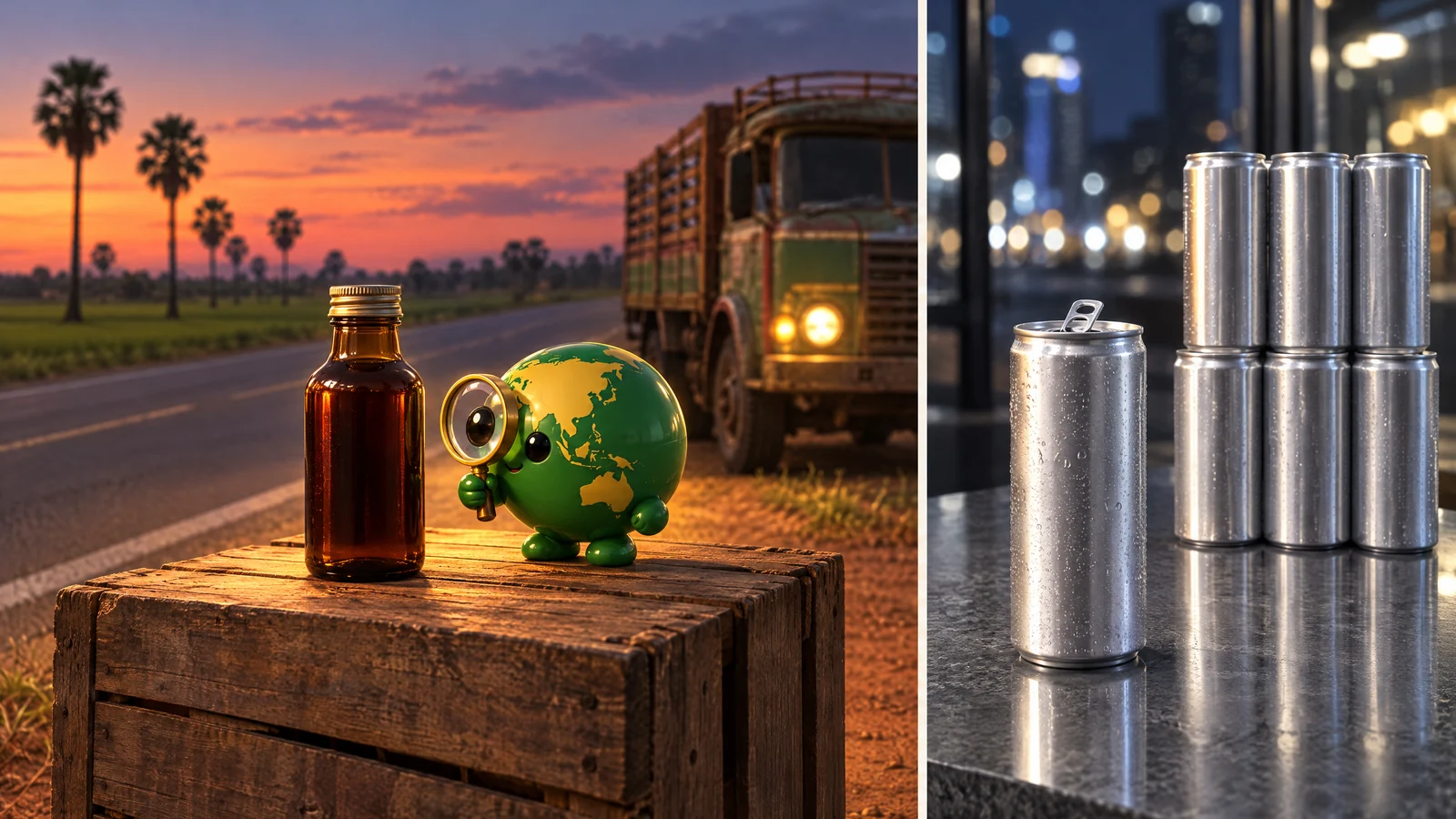
You think Red Bull is a slick European energy drink, the one that "gives you wings" and sticks its logo on Formula One cars. It is not. Red Bull began as a small Thai product called Krating Daeng, a thick, sweet tonic sold warm in glass bottles to truck drivers and factory workers in 1970s Thailand.
Here is the short answer. Krating Daeng was created in 1976 in Thailand by a man named Chaleo Yoovidhya. In the early 1980s, Austrian businessman Dietrich Mateschitz discovered the drink on a business trip, tried it to fight jet lag, and saw something bigger. By 1984 the two men founded Red Bull GmbH (a German-style limited company) in Austria. The first Red Bull energy drink was sold in Austria in 1987. One formula became two drinks with two lives. Krating Daeng stayed in Asia. Red Bull went to the rest of the world. We at Backstory Asia tell the people story behind that can, step by step, with dates and names you can check.
The name: what it means and where the word came from
The name tells you almost everything.
"Krating Daeng" is Thai. "Krating" means gaur, a large wild cattle animal found across South and Southeast Asia. "Daeng" means red. So Krating Daeng means "red gaur." The original Thai logo showed two red gaurs charging at each other. Chaleo Yoovidhya created this design for his company, T.C. Pharmaceutical Industries.
When Mateschitz and Chaleo prepared the brand for international markets, they made a simple translation. "Krating" became "bull." "Daeng" became "red." They kept the twin charging animals. The brand name Red Bull GmbH was registered in Austria in the 1980s. Krating Daeng stayed as the Thai name at home.
The export logo got some changes. The bulls became sleeker. The can was slim aluminium, coloured blue and silver. But the core image, two charging animals, remained the same. Credit for the name and the idea belongs to both men, not to Mateschitz alone. Chaleo built Krating Daeng in 1976. Mateschitz adapted it. Two men, one brand, shared from the beginning.
Where it began: the place, the time, the people
The story starts in a province called Phichit, in northern Thailand.
Chaleo Yoovidhya was born there around 1923. His parents were Chinese-Thai. They sold ducks and fruit. Chaleo had little formal schooling. He moved to Bangkok, worked as a salesman selling antibiotics, and in the early 1960s started his own company, T.C. Pharmaceutical Industries.
In 1976, he put a new drink on the market. It was Krating Daeng: a sweet, non-carbonated energy tonic in a small glass bottle. Thailand in that decade was growing fast. Factories ran night shifts. Trucks drove long distances. Construction sites stretched into the dark. Workers needed a cheap energy boost to get through. Chaleo did not invent the idea of an energy tonic. Other brands sat on the same shelf. But his formula and price matched the Thai taste and the Thai wallet.
Then came Dietrich Mateschitz. Born in Austria in 1944, he worked as a marketing manager for Blendax, a German cosmetics company. On a business trip to Thailand in the early 1980s, he tried Krating Daeng. He said it helped his jet lag. He met Chaleo. The two saw a partnership.
Red Bull GmbH was co-founded in 1984 by Dietrich Mateschitz and Chaleo Yoovidhya. Each invested US$500,000. Chaleo held 49 percent through his Thai company. Mateschitz held 49 percent. The remaining 2 percent went to Chaleo's son, Chalerm Yoovidhya. The company was based in Fuschl am See, a small town in Austria. Mateschitz would run the brand outside Thailand. Chaleo would keep Krating Daeng at home. Two men, one from a Thai factory floor, one from an Austrian office, shook hands over a small brown bottle.
Anatomy: what it is made of, or how it is done
This section is about what was inside the original Thai Red Bull, and how it changed for Europe.
The core of Krating Daeng was simple: water, cane sugar, caffeine, taurine (an amino acid), B vitamins and flavourings. The drink was thick and sweet, not carbonated, sold in a small glass bottle you could drink in one or two gulps. Thai drinkers sometimes poured it over ice or mixed it with soda water or local drinks. It was sold in small shops and near petrol stations, primarily aimed at physical workers, not office staff. It sat on the shelf beside many other Asian energy tonics at a low price.
For the European version, the formula changed. The team added carbonation so the drink felt lighter and more like a soda. They adjusted the sugar level and tweaked the caffeine and taurine amounts to fit Austrian and later EU food rules. They put it in a 250 millilitre slim aluminium can. A Western Red Bull can holds 40 to 80 milligrams of caffeine, depending on the country. The taste was made less sweet compared to Krating Daeng, so people could sip it slowly instead of shooting it in one go. But the basic promise stayed: a short energy boost from caffeine, taurine and sugar.
Red Bull was not sold as medicine. From day one in Europe, it was positioned as a "functional beverage," a soft drink with a claimed use case. Labels listed caffeine, taurine and B vitamins, with warning lines in small print. One formula gave birth to two versions: a dense brown tonic in a bottle in Bangkok, and a fizzy golden drink in a can in Salzburg.
One thing, many homes: how each country or community made it its own
Like laksa in different port towns, this drink sits in different places and means different things.
In Thailand, Krating Daeng is part of everyday life. You find it in every 7-Eleven, every roadside store. Taxi drivers, construction workers and farmers grab a bottle, the same way workers elsewhere in the region start a shift with a cheap plate of roti canai or a glass of kopi. Some mix it into yaa dong, a local herbal liquor, or into soda water. It is not glamorous. It is daily fuel. In nearby countries like Laos, Cambodia and Myanmar, similar tonics line the same shelves. Krating Daeng keeps its place as one of the older names there.
In Japan, South Korea and other East Asian markets, Red Bull had to live beside strong local vitality drinks that were already popular. It adjusted its marketing, and sometimes its sweetness level, to fit local taste and rules.
Southeast Asian communities overseas carried both names with them. Thai shops stock Krating Daeng bottles where the law allows. Western supermarkets stock Red Bull cans. Some Asian export bottles carry the "Red Bull" name under licence, which can cause confusion.
In Europe and the United States, Red Bull became linked with young people: students during exams, clubbers on late nights, office workers pushing through deadlines. People consumed it chilled, sipped it slowly, or mixed it with vodka. The meaning shifted. In Thailand it was about labour. In London or New York it was about fun, speed and late-night adventure.
Many countries developed their own energy drink brands in reply. But the original Thai Red Bull and its Austrian sibling kept their form: same basic logo, same thin can, same short name.
From the stall to the world: how it spread
Think of a small glass bottle on a roadside stall in Bangkok. Then think of a stack of Red Bull cans in a store in Sydney or San Francisco. That is Red Bull's rise in one picture.
The key dates: Red Bull GmbH was founded in 1984 in Austria. The first Red Bull was sold in Austria on 1 April 1987. Through the early 1990s, it spread to neighbouring European countries. It entered the United States, via California, in 1996. Red Bull helped establish the energy drink category in Western markets. Before it arrived, most Westerners had no name for this new product category.
Early marketing was unusual. Instead of big TV ads, the company gave out free cans at university campuses, nightclubs and ski resorts. Friends told friends. Red Bull focuses on brand loyalty over traditional advertising methods. Word of mouth did much of the work.
Then came sports events. Red Bull sponsors extreme sports events like Formula 1 and motocross. It started with smaller extreme sports: cliff diving, snowboarding, freestyle motocross. Red Bull created its own sports events like Red Bull Rampage, a mountain bike competition. It purchased the Jaguar Formula One team in 2004, relaunching it as Red Bull Racing in 2005. It founded football clubs: Red Bull Salzburg in Austria, RB Leipzig in Germany.
The Red Bull Stratos project featured Felix Baumgartner's jump from the stratosphere on October 14, 2012. Millions watched live. In many places, people first saw the logo on a race car, a parachute or a snowboard before they ever tasted the drink.
Red Bull has evolved into a media powerhouse too, built around Red Bull Media House, a company specialising in sport, lifestyle, music and games content. Red Bull has helped bring eSports into the mainstream. Red Bull has become a symbol of energy, adventure, and performance in youth culture.
The numbers followed. Red Bull is recognized in over 170 countries worldwide. As of the mid-2020s, Red Bull sold around 13.9 billion cans annually across over 171 countries, with group turnover reaching roughly EUR 12 billion and about 22,000 employees.
While Red Bull grew across the world, Krating Daeng stayed focused on Thailand and some Asian markets, with less flashy promotion but a loyal community of everyday workers.
More than a drink: what it means to people today
For many Thais, Krating Daeng is part of the history of leaving the village. It was the bottle you grabbed before a night shift at a factory or a long highway drive in the 1970s and 1980s. It was energy for survival, not for show.
The Yoovidhya family rose with the brand. They became one of Thailand's wealthiest families, while staying out of the public eye. Chaleo Yoovidhya passed away on 17 March 2012. Dietrich Mateschitz died on 22 October 2022. Ownership passed to the next generation. The partnership their fathers built holds.
For young people in Europe, the Americas and parts of Asia, Red Bull is a symbol of late nights, exams, road trips, clubs and e-sports. It is linked less to physical labour and more to mental effort and lifestyle.
The brand has also sat at the centre of health debates about sugar and caffeine in energy drinks. Some countries have age guidance or health advice on the sale of these drinks. We note the debate but offer no medical advice here.
There is something strange and worth sitting with. The same charging-bull logo appears on a plastic table at a Thai truck stop and on a carbon-fibre Formula One car. The same idea, a small drink for a quick energy boost, travels from a roadside stall in Bangkok to a nightclub in Berlin. The origins are Thai. The evolution is global. The success belongs to both sides of the partnership.
The next time someone tells you Red Bull is a cool European can, you know where it really came from. A Thai labourer's tonic, part of a much older Asian habit of bottled energy, made by a man who sold ducks and fruit before he sold refreshment to the world, one entry in Backstory Asia's record of Southeast Asian food origins alongside other local products that went global, like Indomie.
If you like stories like this, join the Backstory Asia email list. One origin story from around Asia each week, nothing else.