
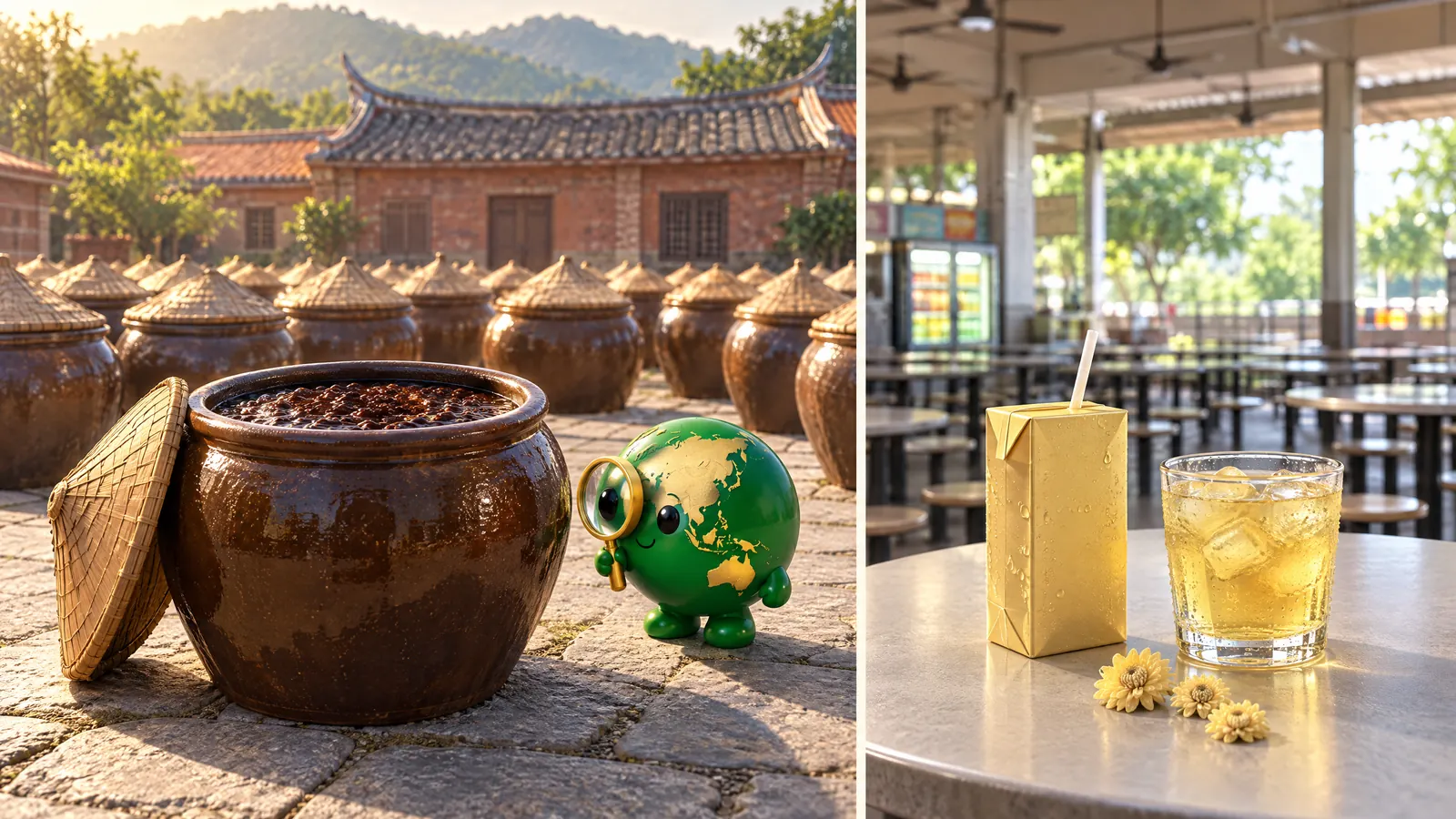
Most people know Yeo's as the brand on a packet of chrysanthemum tea. The kind you grab from a hawker stall fridge or a 7-Eleven in Singapore. But Yeo's started as a small soy sauce workshop in Zhangzhou, a port city in Fujian province, in 1900.
Yeo Keng Lian, a Hokkien trader, set up the workshop to brew soy sauce in clay urns. He called the business Hiap Seng. In 1938, Yeo Keng Lian moved the business to Singapore and re-established the factory there. Through the 1950s, the company shifted from a condiment maker into a full food and beverage operation, launching canned curry chicken, bottled asian drinks and Tetra Brik packaging for asian drinks. Yeo Hiap Seng was listed on the Singapore stock exchange in 1969. Today Yeo Hiap Seng produces and distributes products in over 60 countries globally.
We are going to follow that story across three stages: the Fujian soy sauce years, the move to Singapore and Malaysia, and the packet drink age that took the brand across the Asia Pacific and beyond.
The name: what it means and where the word came from
The full company name is Yeo Hiap Seng. On bottles and cartons, the short form is simply Yeo's.
"Yeo" is the family surname. In Hokkien, the Chinese dialect spoken in Fujian, the character 楊 is said "Yeo." In Mandarin it becomes "Yang." Many migrants from Fujian and Guangdong who settled in Singapore carried this surname.
"Hiap Seng" is written 協成 in Chinese. The only source that explains the name ties it to faith, not trade: Hiap Seng is said to mean the unity of Christ, read against Yeo Keng Lian's own Presbyterian faith.
The short English brand name "Yeo's" helped customers who did not read Chinese say the name and spot the bottle on a shelf.
The company went through a few official name changes along the way. In 1955, it incorporated as Yeo Hiap Seng Canning & Sauce Factory in Singapore. When the company listed on the stock exchange in 1969, it became Yeo Hiap Seng Ltd, the name it still carries.
Where it began: the place, the time, the people
The story starts in Zhangzhou, a port city in southern Fujian province, around 1900. The Qing dynasty was ending. Many Fujianese families were planning to leave for Nanyang, the old Chinese word for Southeast Asia, looking for steadier work and better trade.
Yeo's was founded in 1900 in Zhangzhou, China, when Yeo Keng Lian, a Hokkien speaker and a Christian, began making soy sauce there. He named the business Hiap Seng, then added his own surname to the front: Yeo Hiap Seng.
Zhangzhou at that time was a hub for fermented soy products and salt. It had long trade links to overseas Chinese communities, who sent money home and imported familiar foods. Soybeans, wheat and salt were easy to get. The early business was a small scale proprietorship: brewing soy sauce in clay urns, fermenting under the sun, and selling loose sauce to nearby homes and shops.
By the 1920s and 1930s, growing Chinese communities in Singapore and British Malaya wanted familiar condiments. Yeo Keng Lian himself immigrated to Singapore in the 1930s, and in 1938 he re-established the Hiap Seng factory there.
Yeo's was part of a wider pattern. Fujian sauce makers followed their customers to new ports, carrying tastes and business skills along.
Anatomy: what it is made of, or how it is done
To see how Yeo's changed, we can look at what came out of its bottles and cans in each age.
From clay urns to bottled soy sauce
Traditional soy sauce in Fujian around 1900 was made step by step. Soybeans were soaked, steamed, and mixed with wheat flour. A mould called koji (a starter culture) was added. The mix sat in big clay jars filled with salt brine, fermenting under the sun for months. Light soy sauce was drawn off early. The rest aged longer to produce dark soy sauce, thicker and sweeter.
Early Yeo Hiap Seng in Zhangzhou followed that pattern, selling loose soy sauce in bulk. Buyers brought their own containers.
When the business came to Singapore in 1938, things changed. Glass bottles replaced clay jars for the final product. Branded labels went on each bottle. Brewing became more standardised as demand grew. These culinary sauce products matched the cooking habits of Hokkien, Teochew and Cantonese homes across Singapore.
From sauces to cans: curry and noodles
Yeo Hiap Seng transitioned from a primarily condiment manufacturer to a diversified food and beverage company during the 1950s. Yeo's launched canned chicken curry in the 1950s, aimed at busy urban families and overseas Chinese who wanted a quick meal.
Soon after came instant noodles, bottled cooking sauces, and pastes. The company shifted from single condiments to full meal helpers. Canning and sterilisation meant food manufacturing could produce goods that shipped beyond Singapore and stayed safe without a fridge. Popular products include chrysanthemum tea and instant noodles.
Drinks in bottles, then in packets
During the 1950s, Yeo Hiap Seng began bottling soy bean milk, turning staples of the kopitiam (that means coffee shop) into factory-made beverage products. These early drinks were sweet, shelf-stable, and spoke to homesick Chinese migrants. They also found customers among Malay and Indian families who had grown to like them.
Then came the biggest step. During the 1950s, Yeo's began packaging asian drinks in Tetra Brik containers using the ultra-high temperature process. UHT means heating the drink very hot for a short time, then sealing it in a multi-layer box so it keeps for months without a fridge. That innovation changed where and how people could drink chrysanthemum tea or soy milk. No glass to break. Light to ship. Safe for children.
By the late 1960s, the anatomy of Yeo's was no longer only soy sauce: sauces, canned foods, instant noodles and packet beverages that could travel. Yeo's offers a range of asian traditional beverages alongside its food lines.
One thing, many homes: how each country or community made it its own
Yeo's began as a Fujian family business. Its products settled into many Southeast Asian homes in different ways.
Singapore: from soy sauce brand to school drink
In Singapore from the 1950s to the 1980s, Yeo's soy sauce sat in many Chinese home kitchens. Canned curry and sambal sauces suited HDB flat life as more women worked outside the home. Yeo's packet drinks became part of school canteen life and hawker meals. Chrysanthemum tea, winter melon tea, lemon barley and soy bean milk were common orders alongside chicken rice or nasi lemak.
The brand celebrated its 120th anniversary in 2020 amidst the COVID-19 pandemic. Yeo's has over a hundred years of heritage in Singapore. Malay and Indian families bought canned curry and packet drinks even if they used other brands for soy sauce. Yeo's is synonymous with traditional Southeast Asian cuisine for many Singaporeans.
Malaysia: canned curry on the highway, packet drinks at kenduri
Yeo Hiap Seng is also a manufacturer in Malaysia, alongside its operations in Singapore and China, though no source checked gives a date for when that began.
Canned chicken curry, curry pastes and packet drinks like chrysanthemum tea became common at roadside stalls, petrol stations and kenduri (festive gatherings) across Peninsular Malaysia. Malaysian tastes nudged the product lines: stronger sambal sauces, satay sauces tuned to local palates.
Beyond the Straits: Indonesia, Cambodia, China and the diaspora
Yeo's entered Indonesia, Cambodia, Hong Kong and mainland China through local plants and partners. Each market saw a different mix of products: more packet teas in Cambodia, more soy-based drinks and sauces in China, halal-certified lines where consumers needed them.
Overseas Chinese in the United States, Australia and the United Kingdom met Yeo's on supermarket shelves and in Asian groceries from the 1990s onward, often through chrysanthemum tea, soy milk and canned curry. Yeo's drinks at Asian cultural festivals became a taste of home for the diaspora. In each place, the same core idea travelled: familiar Asian tastes in ready-to-use form, but the best-selling flavour changed with the local community.
From the stall to the world: how it spread
Yeo's did not spread only through advertising. It spread through people on the move: migrants, students and traders who wanted familiar tastes far from Fujian and Singapore.
Post-war Southeast Asia: rebuilding and branching out
Through the 1950s and 1960s, urban growth in Singapore, Kuala Lumpur and Penang created demand for convenient food. The company incorporated as a private limited company in 1955 and expanded rapidly.
Listing and the packet drink leap
That Tetra Brik innovation from the 1950s made export easier, shipping lighter, and shelf life longer. Yeo Hiap Seng was listed on the Singapore stock exchange in 1969, which brought capital to automate plants and invest in development. By the 1970s and 1980s, Yeo's drinks and sauces moved into airlines, school schemes and regional hotel chains, making the brand visible beyond traditional Chinese groceries.
Going global: supermarkets and new flavours
Yeo's expanded into markets across Europe, Australia and New Zealand through importers and direct operations. Packaging kept changing: from glass to cans to cartons to PET bottles, in sizes that fit vending machines, school canteens and big-box supermarkets. Pink Dolphin and other new products joined the Yeo's range.
Yeo Hiap Seng has factories or offices in Singapore, Malaysia, Indonesia, Cambodia, China, Hong Kong and beyond, with ownership linked to Far East Organization, making it a regional player across the beverage industry. Yeo Hiap Seng's corporate strategy emphasizes product innovation, market adaptation, and maintaining cultural heritage, a hallmark of the brand's hard work over more than a century.
More than a dish: what it means to people today
Yeo's started as a workshop making soy sauce from natural ingredients in Fujian. It has become a marker of memory for many Asians, one chapter in a wider record of migration and taste across the region.
For older Singaporeans and Malaysians, Yeo's soy sauce and canned curry recall shophouse kitchens and early HDB flats. For younger people, Yeo's may mean school canteen packet drinks, sports day giveaways, National Day fun packs and supermarket six-packs in the fridge. For overseas students and migrants, spotting a pack of Yeo's chrysanthemum tea in a foreign supermarket can feel like meeting an old friend from home.
The company has adapted its product offerings to include lower-sugar options and plant-based beverages in response to changing consumer preferences and consumer needs. It still leans on its heritage: traditional herbal teas brewed with herbs, classic condiments, halal lines and a highest quality promise carried from its humble beginnings in Zhangzhou.
The next time someone picks up a Yeo's drink in a Singapore convenience store or an Asian grocery store overseas, they are holding a small piece of a 1900 Fujian soy sauce shop that followed its people across the sea.
If you like stories like this, join the Backstory Asia email list. One origin story a week, nothing else.