
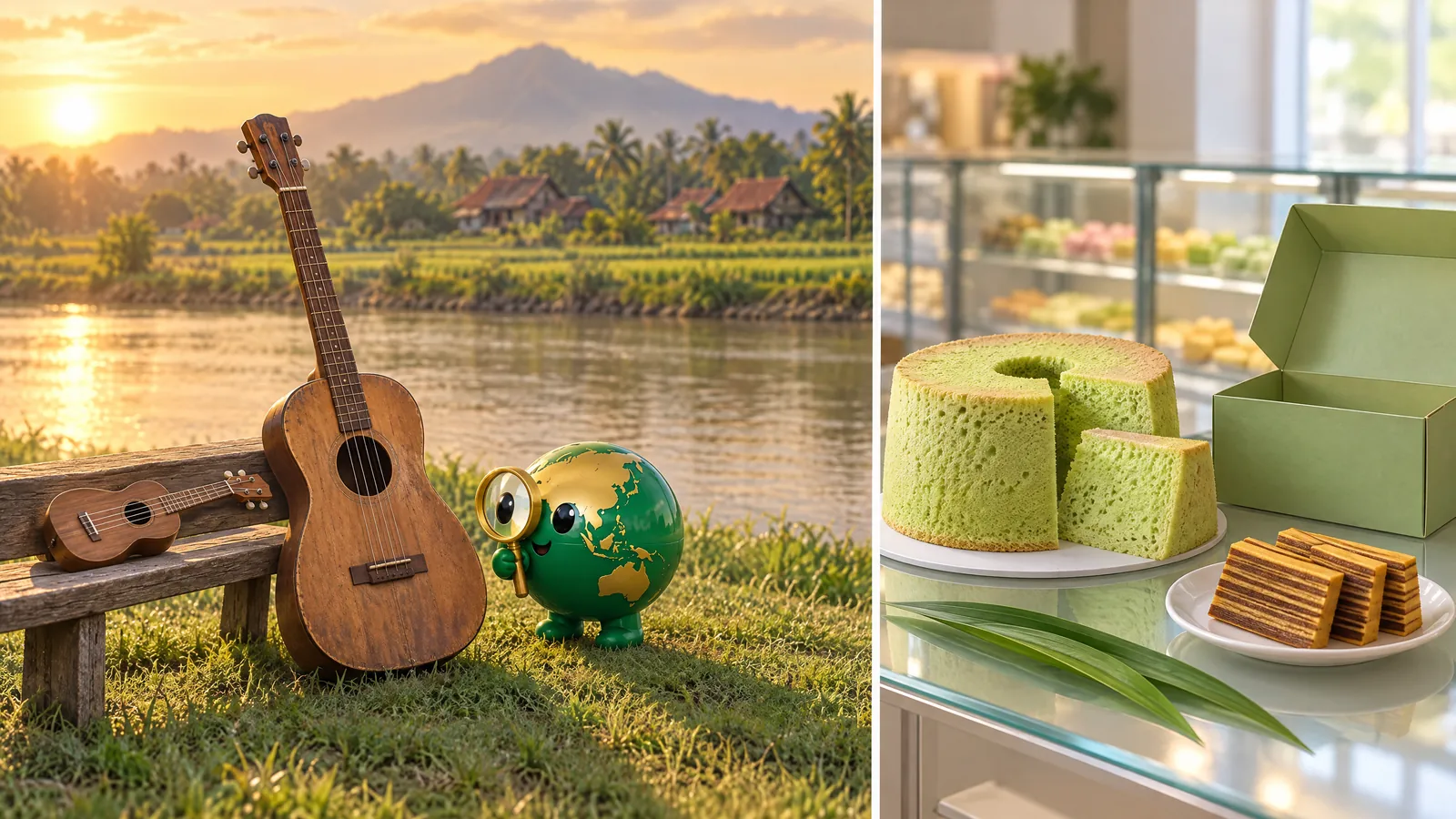
The thing you thought you knew
Most people in Singapore think Bengawan Solo is a cake shop. They picture the green boxes, the pandan chiffon cake, the kueh lapis at Chinese New Year. They see the outlet at Changi Airport and the stores in malls along Orchard Road. That is true, but it is only the last chapter.
Bengawan Solo is also a song. And before that, it is a river. The name holds all three.
Here is the short answer. Bengawan Solo the bakery was founded in 1979 by Anastasia Tjendri-Liew, an Indonesian-born baker who opened her first shop at Marine Parade on Singapore's east coast. She named it after "Bengawan Solo", a famous Indonesian kroncong song composed in 1940 by Gesang Martohartono. That song is about the Solo River, the longest river on the island of Java. So the story of this established Singaporean brand starts not in a mall but beside a river in Central Java, more than eighty years ago.
We will tell the story of all three: the river, the song and the shop. One name, three lives.
The name: what it means and where the word came from
This section is only about the name. No recipes yet.
The name "Bengawan Solo" is derived from an Old Javanese term for a large river. "Bengawan" means river. "Solo" is the old name for a city in Central Java, known today as Surakarta, and for the river that flows through it. Put them together and you get the name of a real waterway: the Bengawan Solo, a river that stretches approximately 600 kilometres across Central and East Java, from highland sources down to the Java Sea near Gresik.
In 1940, a young songwriter named Gesang Martohartono sat in Surakarta and wrote a song about that river. He called it "Bengawan Solo". It was gentle and slow, sung in Bahasa Indonesia, the Indonesian language, in the kroncong style, an old form of Indonesian music that uses guitars and small stringed instruments. The song spread across Indonesia during the Japanese occupation in the 1940s, then crossed borders into Japan and Hong Kong through radio, records and cover versions. For Javanese and Indonesian people abroad, the words "Bengawan Solo" sound like home.
So there are three layers inside the name:
The river: the longest on Java, a trade route and flood plain for centuries.
The song: a 1940 melody that carried the river's name across Asia.
The shop: a Singapore bakery that borrowed the song's name in 1979, because its founder missed the sound of home.
Where it began: the place, the time, the people
The story of the name begins in Java. Then it moves to Singapore in the 1970s.
By the Solo River in Java
The Bengawan Solo river has served as the primary inland highway for ancient Javanese polities. It connected inland communities to trading routes along the northern coast of Java. The river deposits rich volcanic silt onto surrounding plains, making wet-rice cultivation possible across a wide area. Agricultural activities along the river have sustained millions of people for centuries. The Bengawan Solo basin drains a watershed area of about 16,100 square kilometres, and the Solo River basin is known for the discovery of Homo erectus fossils, known as Java Man.
Severe floods have historically challenged the region, necessitating water-management projects. During the colonial era, Dutch authorities constructed a 12-kilometre canal to redirect the river's flow. The river's ecology has been altered by human activity, leading to challenges such as pollution.
But the river achieved cultural recognition far beyond Java through the 1940 kroncong song "Bengawan Solo" composed by Gesang Martohartono. Gesang was born on 1 October 1917 in Surakarta. He was self-taught, about 23 years old, and the Dutch East Indies had not yet become Indonesia. He wrote the song in 1940. Recordings spread through radio during the Japanese occupation. Japanese soldiers stationed in Java took the tune back with them after the war, and a Japanese version by Toshi Matsuda became popular in 1947. Later, Poon Sow Keng recorded a Mandarin version in Hong Kong in 1956; Rebecca Pan's own Hong Kong recording, "By the River of Love", was in English. The song entered the popular music of several Asian countries and never left.
In a Singapore flat in the 1970s
Anastasia Tjendri-Liew grew up in Palembang, Indonesia, and moved to Singapore in the early 1970s.
In her home kitchen at Marine Terrace, she prepared Indonesian cakes and kueh for friends and neighbours.
By the late 1970s, demand outgrew the flat. Mrs Anastasia Liew was supplying shops and supermarkets without a factory licence. Singapore's Ministry of Environment told her she needed a proper licence and premises. Instead of stopping, she decided to open a licensed shop. Anastasia opened her first bakery in 1979, named Bengawan Solo, at Marine Parade. She chose the name because the song reminded her of Indonesia. The opening of a second outlet followed in 1983 at Centrepoint on Orchard Road, a more central location where more customers could discover the brand.
Anatomy: what it is made of, or how it is done
There are two things to break down here: the song as a piece of music, and the bakery as a way of making cakes at scale in Singapore.
The song: verses about a river and a memory
"Bengawan Solo" is built in the kroncong style. Kroncong is an old Indonesian music form that uses guitars and small ukulele-like instruments. The rhythm is slow and lilting, easy to hum, easy to remember.
The lyrics describe the Solo River's source in the mountains of Central Java, its path across the land, people living along its banks, boats carrying merchants. There is a feeling of memory and longing. The river changes with the seasons, and so do the lives beside it.
Because of war and displacement in the 1940s, many listeners heard it as a song about missing a place. Japanese soldiers who had been in Java recognised the melody. Indonesians who left their homeland carried it with them. Versions appeared in Japanese, Mandarin, and other languages. The song travelled further than the river ever could.
The bakery: pandan, kueh lapis and a central kitchen
Bengawan Solo in Singapore became known for a small set of signature products: pandan chiffon cake, kueh lapis legit, kueh salat, ondeh-ondeh, pineapple tarts, lapis sagu, cookies and other sweet confections rooted in Indonesian and Peranakan tradition.
Pandan chiffon cake is a light, airy sponge flavoured with pandan leaf, a fragrant tropical plant, and coconut milk. It is baked in a ring tin so it rises high and stays soft. Kueh lapis is a traditional Indonesian layered cake, rich with butter, spices like cinnamon and cloves, and many thin layers baked one at a time. Making it demands patience and steady heat.
Instead of baking in every shop, the company built a central kitchen. The first production kitchen was set up at Harvey Road by 1987, about 9,500 square feet. Production later moved to a larger factory in Woodlands. This central kitchen supplies all outlets, delivering fresh butter and chiffon cakes several times a day so that freshness and quality stay the same everywhere. Recipes stay close to their Indonesian and Peranakan roots, using coconut milk, gula melaka (palm sugar), pandan and spices, but are prepared for a wide Singapore audience.
The founder was known for her commitment to perfection, a standard the company has carried as it grew.
One thing, many homes: how each country or community made it its own
The river lives in Java. The song lives in Indonesian and Asian popular music. The Bengawan Solo brand lives in Singapore's malls and airports. Many families, one name.
In Java and across Indonesia
In Central Java, especially around Surakarta and Yogyakarta, people think of Bengawan Solo first as their river. It carries long memories of floods, farming and trade. The song by Gesang was promoted nationally by President Sukarno after independence in 1945. For many Indonesians in Singapore and Malaysia, hearing the name of the cake shop brings a smile, because it sounds like the old song and like home.
In Singapore: a Javanese name in a HDB town
When the first Bengawan Solo shop opened in 1979 at Marine Parade, Singapore was already a mix of Chinese, Malay, Indian and Peranakan communities. The name was unusual on a shopfront in a Housing Board estate. But the sweet confections inside, pandan sponge, pineapple tarts, kueh lapis, felt familiar enough for Singaporean Chinese and Peranakan families.
Over the 1980s and 1990s, as outlets multiplied at locations like Centrepoint and other stores island-wide, Bengawan Solo became tied to Singapore city life. It became the place for office birthday cakes, festive goodies for Chinese New Year and Hari Raya, and premium quality cakes for celebrations. The company sells celebration vouchers, serving the tradition of giving cakes for occasions like a baby's first month. Today, Bengawan Solo is a household name. Many Singaporeans know the brand but have never heard the original song or seen the Solo River. We hope this story joins those dots.
In the wider region: shared sounds and shared sweets
The song "Bengawan Solo" is covered in Japanese, Mandarin and other languages. People in Japan or Hong Kong may know the melody without knowing where Solo is. Japanese war veterans later erected a statue of Gesang in Surakarta in 1991. Travellers passing through Changi Airport meet the Bengawan Solo brand as a "Singapore gift" shop, with neatly boxed confectionery to carry to corners of the world. This gives the name three overlapping homes: Java for the river, Indonesia for the song, Singapore for the bakery. None cancels the others.
From the stall to the world: how it spread
This section tracks two spreads: the song across Asia after the 1940s, and the bakery from one shop to a celebrated brand with an airport presence.
The song's path through Asia
"Bengawan Solo" became popular among Japanese soldiers in Java during World War II. They took the tune home. In Japan, Toshi Matsuda recorded a Japanese version in 1947. Through radio, films and covers, the song entered the popular culture of countries across the region. Indonesian state radio also used it in national programmes, fixing it as part of Indonesia's musical identity.
The bakery's growth across Singapore and beyond
The timeline is clear. First shop: Marine Parade, 1979, the flagship store on the east coast. Second outlet: Centrepoint on Orchard Road, 1983. By 1987, the business needed a central kitchen, built at Harvey Road. Production later moved to a larger factory in Woodlands.
As of 2019 to 2020, Bengawan Solo had over 40 outlets across Singapore. The company remains a force in Singapore's confectionery industry. Its cakes travel in luggage across Asia and beyond. The brand appears in local media, including the Straits Times, whenever writers talk about what to buy in Singapore. Bengawan Solo's green-box kueh is one entry in Backstory Asia's record of Southeast Asian food origins, standing alongside the wider family of kueh and kuih its pandan chiffon cake and kueh lapis belong to, the Hainanese-run kaya toast stalls that share its Singapore hawker-era streets, and the Indonesian roots of tempeh, carried to Singapore along the same migration routes as its founder.
More than a shop: what it means to people today
Bengawan Solo today is not only a place to buy cake. It is a bridge between Indonesia and Singapore, between old songs and modern malls, between tradition and daily life.
For Indonesian migrants in Singapore, hearing the name on a shopfront is recognition of heritage, a reminder of radio at home or of school music lessons. For Peranakan families, it carries the taste of recipes they already knew. For Singaporeans collecting new products for Chinese New Year or Hari Raya, it means trusted quality in a green box. For overseas visitors at Changi looking for something local to bring home, it means premium quality cakes and a story they can share.
For younger Singaporeans, the brand can mean childhood birthday cakes, the smell of pandan when a box is opened at the office, or the taste of kueh lapis at grandparents' homes, even if they do not know its Indonesian roots.
A Javanese river, an Indonesian songwriter and an Indonesian-born woman baker in Singapore together gave the region a set of sweet things and sounds that cross borders and belong to all of them at once. That is the story of Bengawan Solo.
If you like stories like this, join the Backstory Asia email list. One origin story a week, nothing else.