
Prefer to watch? This story is Episode 16 on our YouTube channel: The Kebaya: The Blouse Five Nations Share.
The kebaya you thought you knew
You think kebaya is a single national costume from one country. It is not. The kebaya is a traditional front-opening upper garment worn by women in Southeast Asia, and it started life as a loose court blouse in Java, shaped by West Asian and Portuguese trade, then carried by ships and migrants across the whole Malay world.
The kebaya most likely originated in the 15th century in Java, on the island's north coast, in port towns near the Majapahit court. A rival account instead traces its start to Malacca, across the strait, and the written record weighs the two about equally. Court women and elites wore it first. Arab traders brought cloth and clothing ideas. Portuguese sailors brought more. By the late 18th century, commoners began wearing simpler kebaya versions, encouraged under Dutch rule. From Java, the kebaya spread to Sumatra, Melaka, the Malay Peninsula, Singapore, Bali and Peranakan homes everywhere in between.
This page follows the kebaya from those Javanese courts, through colonial ports and Peranakan households, all the way to a shared UNESCO bid by five countries.
The name: what "kebaya" means and where the word came from
"Kebaya" is not an old Javanese word. Its sound points outward, to Arabic, Persian and Portuguese, proof that the garment was born where trade routes met.
From abaya to kebaya: Arabic and Persian links
The word kebaya is believed to derive from the Arabic word qaba, meaning clothing. Qaba described a loose robe or cloak worn across the Arab world and Persia. Arab Muslim traders moved through Java's north-coast ports, and likely brought both the loose robe style and the word. The shift from qaba or abaya to kebaya probably happened in Malay and Javanese mouths over time. No single dated document records the exact switch. The earliest colonial word lists, written centuries later, spell it cabaya, cabai or cabaia.
Portuguese and Iberian hints
After the Portuguese took Melaka in 1511, their records mention cabaya and cabaia for a long robe worn by upper classes in India and the Malay world. Portuguese settlers and Peranakan communities in Melaka may have passed the word into Malay. Other everyday Malay and Indonesian words are borrowed from Portuguese too, so the pattern fits. The word turns up in the region itself earlier than most sources let on: a 1614 English trading letter, printed in the Hobson-Jobson dictionary, asks for "the white Cabas" to be sent to Bantam, on Java's own coast, for sale. We say "may be linked" to the Arabic qaba because the full change from qaba to kebaya is still not pinned to one dated document.
Local meanings in Javanese and Malay texts
By the 18th and 19th centuries, the word kebaya appears in Javanese and Malay sources with a clear meaning: a woman's upper garment, a tailored blouse worn over a kemben (a cloth wrapped around the chest) or a sarong. In those texts, it describes a front-opening blouse with long sleeves, made of cotton, without the sheer lace or closely stitched embroidery that came later. The name itself carries the history of contact between Java, the Indian Ocean and Europe.
Where kebaya began: Java, courts and coastal ports
The earliest strong home of kebaya was not a modern capital or a shopping mall. It was the royal courts and port towns of Java's north coast, from the late Majapahit period through the rise of its successor courts, such as Cirebon, and into the Dutch colonial era from the 17th century onward.
From kemben and long tunics to tailored blouse
Before kebaya, women in Java wore a kemben, a simple wrap cloth around the chest and torso, paired with a lower cloth called a jarik or sarong. Temple reliefs from the Majapahit period appear to show this style: bare shoulders, no sleeves. After Islam grew along the coast from the 15th century, modesty norms encouraged covering more of the body. A more tailored, front-opening blouse begins to appear in Dutch colonial reports from the 17th century, describing court women in Cirebon wearing buttons, brooches and sleeves. Early kebaya was long, loose and opaque. It looked nothing like the fitted sheer blouse many people picture today.
Port cities: where styles mix
Melaka, Cirebon and later Dutch Batavia were meeting points. Arab, Indian, Chinese and Portuguese ships called at these ports from the 15th century onward. The kebaya absorbed design elements from multiple cultures due to maritime trade. Local women saw foreign robes, jackets and veils, and tailors adapted these into a front-buttoned blouse worn over batik or songket (a cloth hand-woven with gold or silver thread). Kebaya panjang, a longer form of the blouse, was influenced by Portuguese designs. The garment was first a marker of rank and respectability, especially in courts and among wealthy merchant families.
From royal courts to town streets
By the 18th and 19th centuries, kebaya gradually moved beyond courts and elites into town streets. Dutch East India Company officials in Batavia described local town women wearing simpler cotton kebaya. European and Eurasian women adopted light cotton or lace versions as home wear in the hot tropics. These versions used imported lace, lighter fabric, and served as social, informal clothing. Cut, cloth and decorative style changed as kebaya left the court and met materials from Europe and India.
Anatomy of a kebaya: cloth, cut and craft
We now look at what makes a kebaya a kebaya: its parts, its fabric, its needlework. This is not a sewing manual. It is a map of how the blouse changed as it moved through hands and centuries.
The classic Javanese court kebaya
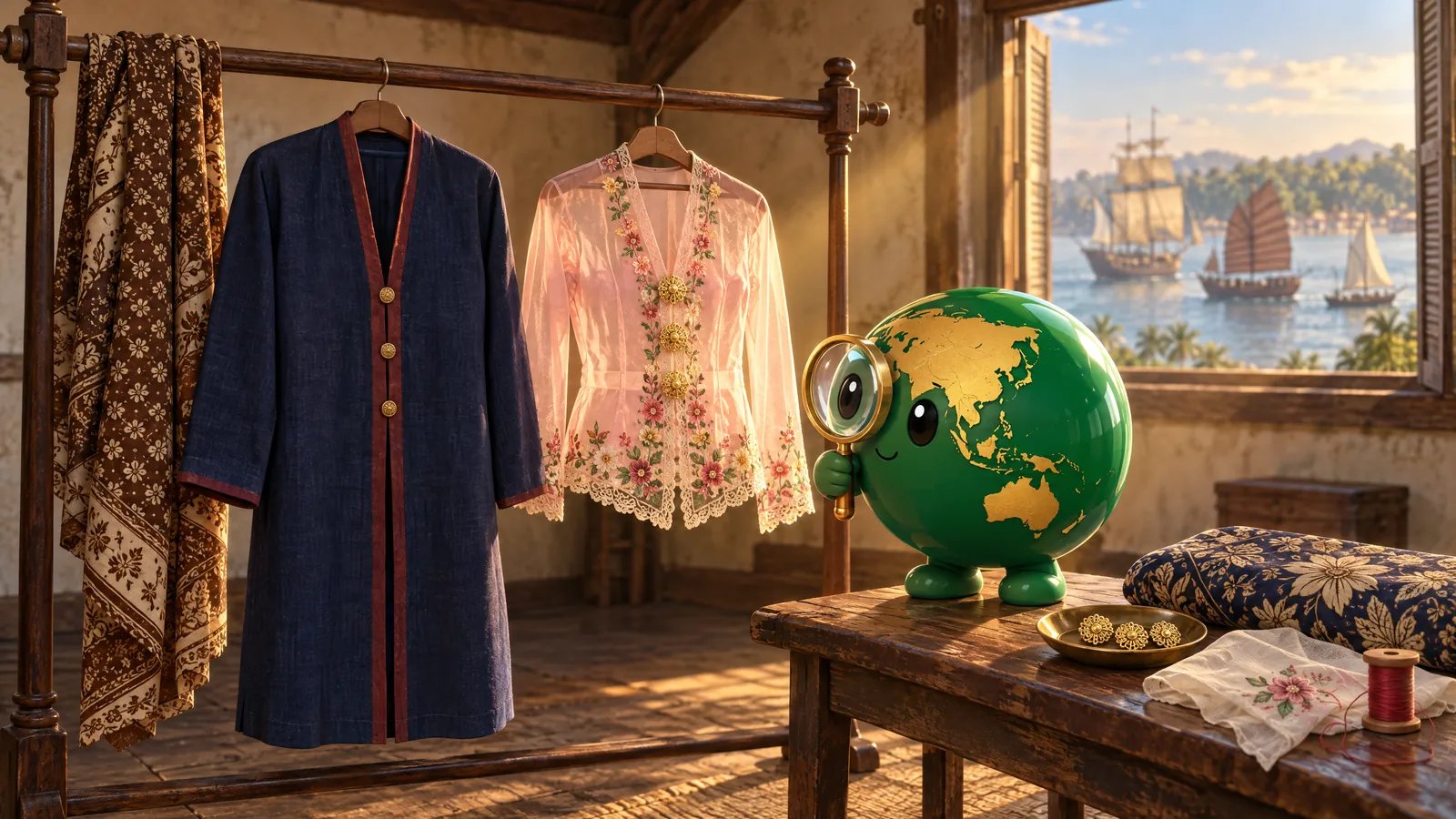
The early Javanese court form was hip-length or longer, with a straight cut, long sleeves and a front opening, worn over a kemben and paired with a sarong or batik panjang. Fabrics before wide European trade were homespun cottons and hand-woven cloths, often darker colours with simple borders. Fastenings changed over time, from simple ties to hooks, flat buttons and decorative brooches called kerongsang.
Peranakan and coastal innovations
In port cities like Melaka, Penang, Batavia and Singapore, a style known as the nyonya kebaya developed in these mixed trading communities. Peranakan women, the descendants of Chinese traders who married into local Malay communities, created a shorter, more fitted version. Nyonya kebaya merges Malay, Chinese and Western influences into one garment. It features closely stitched hand embroidery in nature motifs, typically made from sheer fabrics like silk or lace. Kebaya Encim, a related coastal style, features floral lace and colourful threads. These lace trimmed forms suited the humid climate and let the maker's skill show through every stitch.
Motifs, needlework and batik pairing
The kebaya's craftsmanship involves skills in cutting, weaving, and embroidery passed down generations. Decoration includes hand embroidery, cutwork and drawn-thread lace. A kebaya is often worn with a batik sarong, a traditional Malay garment. The motifs on the Indonesian batik cloth paired with the blouse carry meaning: phoenix and peony for Peranakan brides, local flowers and birds for Javanese versions. Colours, fabric types and motif size can signal the wearer's age, social standing or the event, from weddings to religious ceremonies. The kebaya's design allows for expressions of personal taste and social standing.
One kebaya, many homes: Java, the Malay world and beyond
Kebaya became many local garments sharing a core. No single country owns it. Each community shaped its own version.
Central and north-coast Java
In the courts of Yogyakarta and Surakarta, priyayi (Javanese nobles) wore refined kebaya in muted tones with fine batik. Later, the Kebaya Kartini style, linked to Raden Ajeng Kartini (1879 to 1904), introduced a higher neckline and simple lines. It became a symbol of educated Javanese women and of modernity itself. The kebaya symbolizes women's emancipation in Indonesia. Javanese kebaya influenced Indonesian state attire in the 20th century, worn at Independence Day events and diplomatic gatherings.
Malay Peninsula and Straits settlements
Kebaya travelled to Melaka, Penang and Singapore with Javanese, Bugis and other migrants. Malay court women adopted their own versions, longer and less sheer, paired with kain panjang (a long wrap skirt), and distinct from the baju kurung (a loose tunic). Nyonya kebaya unites diverse ethnic groups in Malaysia. In the Straits settlements, Peranakan women mixed Chinese embroidery, European lace and Malay silhouette into a garment that became a proud identity marker.
Eastern islands and Bali
On Bali and other eastern islands, kebaya arrived through Javanese influence and Dutch administration. Today's Balinese kebaya is a fitted blouse worn with a kamben (wrap skirt) and sash, especially for temple ceremonies. Older Balinese women's clothing did not include a front-opening blouse, so kebaya there is a relatively recent layer over older cloth traditions.
Many families, one blouse
Kebaya represents cultural identity across Indonesia, Malaysia, and Singapore. Indonesians point to Javanese court roots. Malaysians and Singaporeans point to Peranakan heritage. Bruneians wear it at the palace. The influence of the kebaya extends across colonial and post-colonial societies in Southeast Asia. Documentary evidence points to Java as the earliest strong centre, but centuries of mixing make kebaya a shared regional garment. Many families, one thing.
From the sarong kebaya to the world
Kebaya left home the same way it arrived: with people on the move, through ships, cameras and aeroplanes.
Colonial portraits and postcards
In 19th and early 20th-century photography studios in Batavia, Surabaya, Penang and Singapore, elite and colonial women dressed in lace kebaya with batik sarongs for studio portraits. These images became postcards and museum prints seen in neighboring regions and in Europe. They showed beauty, silk and wealth. They did not show the full daily range of kebaya worn by market women and farmers in small towns.
National symbols and airline uniforms
After Indonesian independence in 1945, the kebaya became a symbol of grace, respect, and feminine identity during cultural celebrations and official events. Dutch-educated activist S. K. Trimurti, the only woman present at the Proclamation of Indonesian Independence, wore kebaya that day, and first president Sukarno then chose it as the national attire for Indonesian women. Between them, this cemented the kebaya as a symbol of Indonesian nationalism from 1945 onward. Singapore Airlines launched its renowned "Singapore Girl" uniform in the 1970s, based on a sarong kebaya cut, making one version of the garment famous worldwide. Other airlines and government functions in Malaysia and Indonesia also use kebaya-inspired outfits.
Migration, fashion weeks and screen stories
Southeast Asian migrants carried kebaya to the Netherlands, the United Kingdom, Australia and beyond. They wear it at weddings, community events and special occasions. Designers have shown kebaya at contemporary fashion weeks in Jakarta, Kuala Lumpur and Singapore, treating it as living design inspiration rather than museum art. Modern kebaya incorporates trendy details like ruffles and pockets, fitting modern fashion without losing its roots. Film and television dramas with Peranakan or Javanese settings feature different styles of kebaya, helping younger viewers put a story to the garment. The kebaya reflects a living tradition, continually reinterpreted by new generations.
More than a blouse: what kebaya means today
Kebaya carries memory, identity and a quiet pride. It is not just a piece of fabric. It is a symbol that stands for something larger than any one person.
Everyday wear to heritage symbol
By the mid-20th century, Western clothing became everyday wear across the region. Kebaya became reserved for weddings, ceremonies and formal occasions. Older women in some villages kept wearing it daily, keeping skills like hand embroidery alive. Kebaya has evolved from royal attire to everyday wear in Southeast Asia, and back again to heritage symbol. Recently, younger people have taken it up for graduations, cultural days and creative photography shoots.
Shared UNESCO bid: many countries, one heritage
Indonesia, Malaysia, Singapore, Brunei and Thailand jointly nominated "Kebaya: Knowledge, Skills, Traditions and Practices" for UNESCO's Representative List of the Intangible Cultural Heritage of Humanity. The five countries held working meetings together from early 2022, and Malaysia's own ministry for tourism, arts and culture confirmed the joint nomination was filed with UNESCO in 2023. In December 2024, the kebaya was inscribed on the UNESCO Representative List of the Intangible Cultural Heritage of Humanity. The listing recognises shared heritage, seeks to protect craft skills, and celebrates unity across borders. The joint nature of the bid fits the true history: the kebaya is a shared cultural thread across various Southeast Asian communities, and the kebaya is recognised for bridging ethnic, religious, and national divides in Southeast Asia.
Identity, feminism and quiet power
Women like Kartini chose kebaya as a sign of serious, educated, local womanhood. It signalled intention, not just beauty. Different versions of the kebaya have diverse social meanings in various cultural contexts. Some women today see kebaya as both soft and strong: shaped to the body, yet tied to stories of learning, work and care. For Peranakan women it remains part of lineage. For diaspora women in Amsterdam or Melbourne it connects them to a region, a culture and a past. Someone pulling on a kebaya for a family event in Jakarta, Penang, Singapore or the Netherlands carries centuries of trade, craft and fusion on their shoulders, without needing to say a word. Kebaya remains far more than a garment. It is heritage you can wear.
If you like stories like this, join the Backstory Asia email list. One origin story a week, nothing else.