
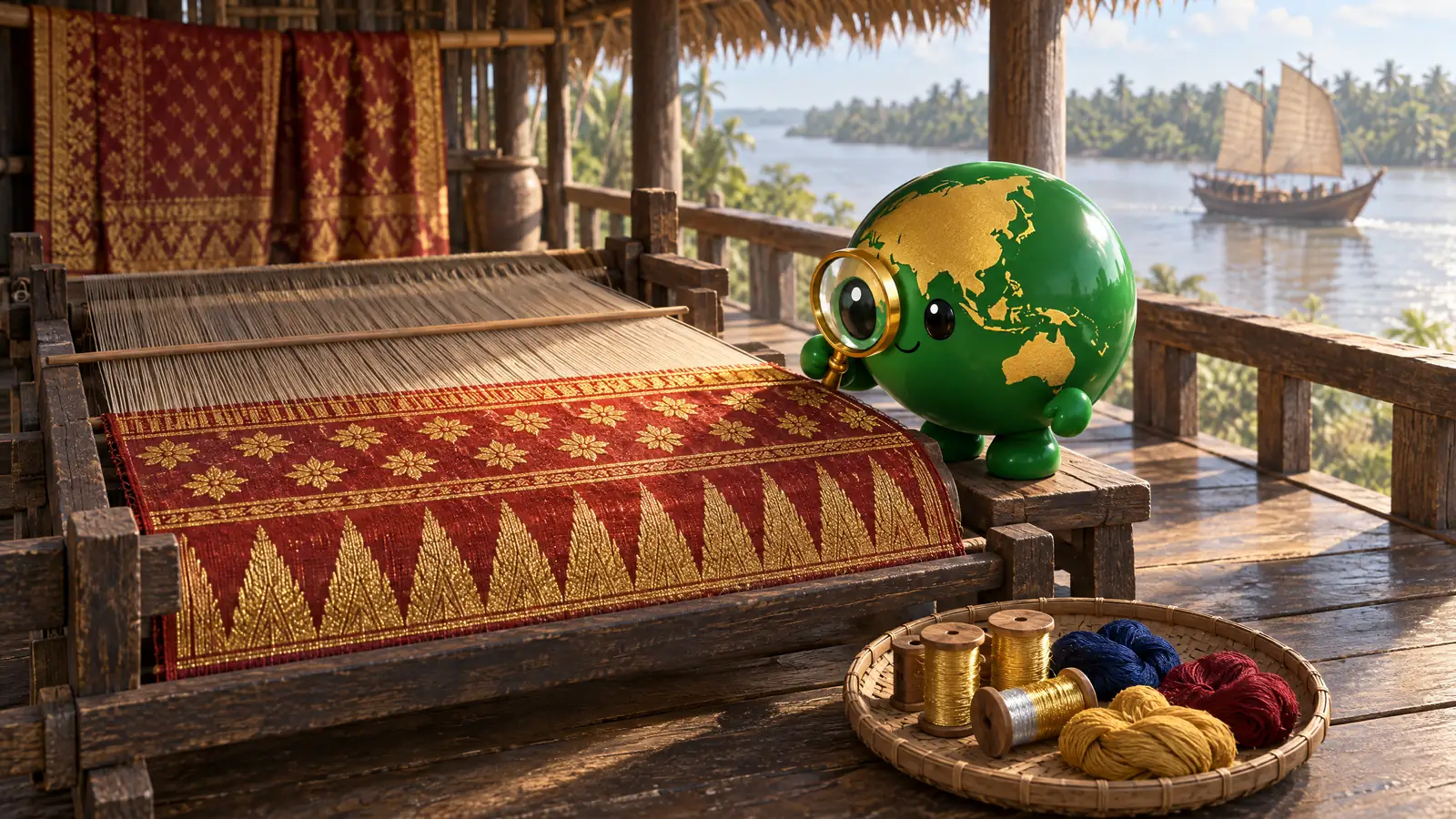
You think songket is just wedding cloth. It began as a royal textile woven with gold threads brought by sea from India and China, tied to Srivijaya, the old sea power based near today's Palembang.
Songket is a hand woven fabric. A weaver sits at a loom and picks up tiny metallic threads, gold or silver, and lays them across the cloth to make shining patterns. The base is silk or cotton. The gold sits on top, raised and bright. This is called a supplementary weft technique, which means the metallic thread is extra, added beyond the plain weave. Songket likely formed between the 7th and 13th centuries in the Malay world, around Sumatra and the Malay Peninsula, when local weavers met imported gold thread arriving on merchant ships. Today people link songket with Malay culture, Minangkabau adat ceremonies and Palembang courts, but the cloth also appears across Indonesia, Malaysia, Brunei and southern Thailand. In old times, only rulers, nobles and brides in court circles could wear it. Commoners were barred from certain motifs and colours. A king might wear songket covered entirely in gold. A farmer could not.
This is a story about ships, gold, looms and the people who sat at them. It is a story about how one cloth crossed the Straits of Malacca and became heritage for many homes.

Prefer to watch? This story is Episode 18 on our YouTube channel: Songket: The Gold Thread That Floats.
The name: what "songket" means and where the word came from
"Songket" is a Malay word. It is used in Indonesia, Malaysia, Brunei and Singapore. There are a few ideas about what it means, and none is proved beyond doubt.
The most common explanation is that the word songket is derived from the Malay term sungkit, meaning "to hook." This matches the weaving motion exactly. The weaver uses a small stick or hook to lift certain warp threads, then slides the gold thread underneath. The verb menyongket means to embroider with gold or silver thread. So the name describes the hand action of making the cloth.
People sometimes mix up songket with other textiles. "Tenun" means plain woven cloth without metallic thread. "Limar" refers to a style where motifs are scattered across the fabric rather than covering all of it. "Brocade" is a European word for a similar idea. But songket always means one thing: cloth with metallic supplementary weft. If there is no gold or silver thread picked into the weave, it is not songket.
The word is Malay, but the idea of weaving metal into cloth links the Malay world to older textile centres in India, China and the Middle East. The threads came from far away. The name was given at home.
Where it began: the place, the time, the people
The earliest strong clues for songket weaving point to the old Malay world around Sumatra and the Malay Peninsula. These were port cities tied to the Srivijaya Empire. Srivijaya was a sea power based near today's Palembang in South Sumatra. It was active from about the 7th to the 11th century and controlled trade between India and China. The Srivijaya Empire is linked to the origins of songket weaving in the 7th century.
Traders brought silk, gold thread and fine yarns into port. Local weavers learned to mix these with their own cotton and plant-dyed yarns. Songket weaving is rooted in the maritime history of Southeast Asia along ancient trade routes.
Direct proof is hard to find. Tropical humidity destroys fabric. But stone carvings at the Bumiayu temple complex in South Sumatra, dated to the 8th and 9th centuries, show figures wearing cloth with textile patterns like the "lepus" motif. This tells us that patterned weaving already existed by then. A Terengganu songket cloth held at the Textile Museum of George Washington University dates to the 19th century, and it already shows a mature style.
Several places were early centres of songket:
Palembang in South Sumatra, often called a cradle of classic gold-thread songket, tied to the legacy of Srivijaya.
The Minangkabau highlands and the port of Pariaman in West Sumatra, where matrilineal clans used songket in adat ceremonies, the customary rituals that mark big family and community occasions.
The Malay courts of Terengganu, Kelantan, Pahang and Johor on the east coast of the Peninsula.
Brunei and the west coast of Borneo, where court dress also used metal-thread cloths.
In all these places, songket signalled status. It was part of royal gifts, dowries and palace ceremonies. Songket patterns reflect animist, Hindu-Buddhist, and Islamic philosophies, depending on the period and the court. Indian patola patterns, Chinese cloud and floral motifs, and Islamic geometry all left marks on the cloth. Scholars do not agree on a single birthplace, so we treat songket as a textile that formed along the Straits, shared between many Malay-speaking trading communities.
Anatomy of songket: how the cloth is made
Understanding songket means understanding two things: what goes into it, and how slow the process is.
Threads, tools and motifs
The base cloth is traditionally fine silk or cotton, forming the warp (the long threads on the loom) and the ground weft (the threads that go side to side). Songket is a luxurious, handwoven textile traditionally made from silk or cotton.
The metallic threads are the heart of it. Historically, these were drawn gold or silver wire wrapped around silk. Later, cheaper materials appeared, like artificial gold thread made of nylon instead of real gold. The introduction of synthetic metallic threads made songket more accessible to the public.
The loom is simple. A backstrap or frame loom sits on the floor. The weaver uses small bamboo or metal hooks to lift selected warp threads, then passes the gold thread through. Some weavers memorise the pattern. Others follow a sketch or a set of counting sequences kept in the family.
Authentic Palembang songket features hundreds of unique motifs. Classic patterns include "pucuk rebung" (bamboo shoot, linked to growth), "naga besaung" (a stylised dragon from old myth and Chinese motifs), and flower patterns like "bungo mawar" (rose) and "bungo melati" (jasmine). Songket motifs can symbolise social status, morality and nature. In some courts, certain patterns were once restricted to royal use. Others were open to the wider group.
The slow work of weaving
Making songket requires patience and diligence. In the past, women dyed yarns with plant dyes: indigo for blue, morinda for red, turmeric for yellow. Today synthetic dyes are common. The weaver sets up the warp on the loom and ties the borders, which fix the size and position of the main motifs before any weaving begins.
First the plain ground is woven. Then the supplementary weft patterns are added by hand, row by row, picking warp threads one group at a time. A large ceremonial piece with dense gold patterning takes long, careful hand work. Mistakes cannot be easily undone once the metallic thread is in place. The work demands strong memory and focus.
By contrast, mass-produced songket is far quicker, made with machines or shortcuts that skip the hand-picking entirely.
Early songket production was home-based. Women of the household, or specialist court weavers, did the work. Children learned by watching. Designs passed from mother to daughter, not through books. This is how patterns survived for centuries, and also why some have been lost.
One cloth, many homes: songket across Southeast Asia
Different regions in Southeast Asia developed distinct songket techniques and motifs. Many places now claim songket as part of their heritage. We think that is fair. It is a shared cloth of the Malay world.
Palembang and South Sumatra
Palembang songket is one of the best-known classical styles. Local pride stories connect it to the glory of Srivijaya. The cloth often features heavy gold thread on deep red or maroon grounds, with dense border patterns. Songket motifs reference Palembang's classic designs, like "naga besaung" and "tabur limar".
Songket artisans face rising raw material costs. Museums and local historians work to keep old patterns alive, but the reality is that fewer people are learning the craft each year.
Minangkabau and West Sumatra
In Minangkabau culture, descent runs through the mother's line. Songket plays a central role in adat ceremonies and wedding celebrations. Minang songket tends toward strong geometric and floral designs, often on black or bright-coloured grounds, worn as sarongs, headcloths and shoulder cloths. Certain motifs mark clan identity. The cloth is often handed down as pusaka, which means heirloom, kept in wooden chests in the family home.
The Malay Peninsula: Terengganu, Kelantan and beyond
On the east coast of the Peninsula, states like Terengganu and Kelantan have long been centres of songket weaving. The courts patronised weaving workshops for centuries. Designs use fine metallic thread and silk, with motifs like "pucuk rebung", stars and Islamic geometric repeats. The ground tends to be more open than in Palembang styles. Certain colours and patterns were once reserved for sultans and their families. Today, modern Malaysian designers use songket in office wear, baju kurung and even shoes and bags, blurring old lines between royal and everyday use.
Brunei, Sarawak and the north
Metal-thread weaving also appears in Brunei court dress and in parts of Sarawak, sometimes called "kain tenunan Brunei". The structure and technique are similar to songket, but motifs and colour choices follow local taste. Related cloths also appear in southern Thailand and the Riau islands. Regional variations of songket include distinct patterns and ceremonial uses, and all of this is evidence that the textile family crosses modern borders.
Many families, one cloth
Palembang ties songket to Srivijaya courts. Malaysia centres the story on east coast royal workshops and national symbols. Minang villages treat their patterns as the oldest. Each claim is made with pride and some evidence. The weaving skill and trade goods moved back and forth along the Straits for centuries, so no single place owns the history of songket. We see many families around one cloth.
From court cloth to global symbol: how songket spread
Songket spread through three forces: old trade routes, colonial rule and modern states building national images.
In the 17th to 19th centuries, court gift-giving and marriage alliances moved songket pieces and techniques between royal houses in Sumatra, the Peninsula, Brunei and Borneo. When Dutch and British officials arrived, they collected songket for museums in Europe, far from the looms that made them. Colonial rule weakened some courts. Merchant families and urban elites began to commission songket instead, and the cloth moved beyond the palace.
After independence, Indonesia, Malaysia and Brunei all brought songket into official dress codes, state awards and cultural shows. UNESCO added songket to its Representative List of the Intangible Cultural Heritage of Humanity in 2021. Government-backed weaving schools and cooperatives, such as those in Terengganu and Palembang, tried to keep the skill alive. Songket is an essential part of life-cycle ceremonies such as weddings, and this steady demand from families has helped sustain the craft.
Tourism from the late 20th century onwards brought new buyers. Visitors wanted songket as souvenirs. This led to lighter, cheaper versions and sometimes factory-made imitations. Designers in Kuala Lumpur, Jakarta and Singapore placed songket panels on modern jackets and gowns, and showed them overseas. Southeast Asian families abroad began wearing songket for wedding celebrations and cultural days, turning it into a marker of identity far from home. But higher demand also encouraged shortcut ways. Printed cloth sold as "songket" put price pressure on the hand woven work of real artisans, and that tension has not been resolved.
More than a cloth: what songket means to people today
Songket is no longer only palace dress. It carries stories about identity, memory and change for many groups of people.
It appears in national day parades, cultural performances and school textbooks across the region. At weddings and coming-of-age events, it connects children to the customs of their elders. Songket is recognised for its shimmering metallic threads that create detailed patterns, and when a young bride wears it, she wears centuries of making and meaning.
On the economic side, songket weaving remains a source of income for rural women and family-based workshops. But the numbers are sobering. Training takes years. City jobs pay faster. The craft cannot be appreciated or kept alive if the people who do it cannot feed their families.
Heritage protection has brought some rise in attention. National heritage listings now cover songket styles in both Indonesia and Malaysia. Museums display old pieces. Community projects teach young people to weave, or at least to recognise the classic motifs.
The debates are real. When a machine can produce in days a metallic cloth that once took a weaver long, careful hand work, what counts as songket? Elders and younger designers see this differently. Some experiment with new colours, fibres and uses, from tablecloth sets to runway pieces, while still honouring old patterns. Others feel that if the hand, the patience and the time are missing, so is the cloth.
You might see songket in a relative's cupboard, in a museum case, or on a stage. Each piece is tied to the same story: ships that once crossed the Straits with silk, gold and the knowledge of how to weave them together.
If you like stories like this, join the Backstory Asia email list. One origin story a week, nothing else.