
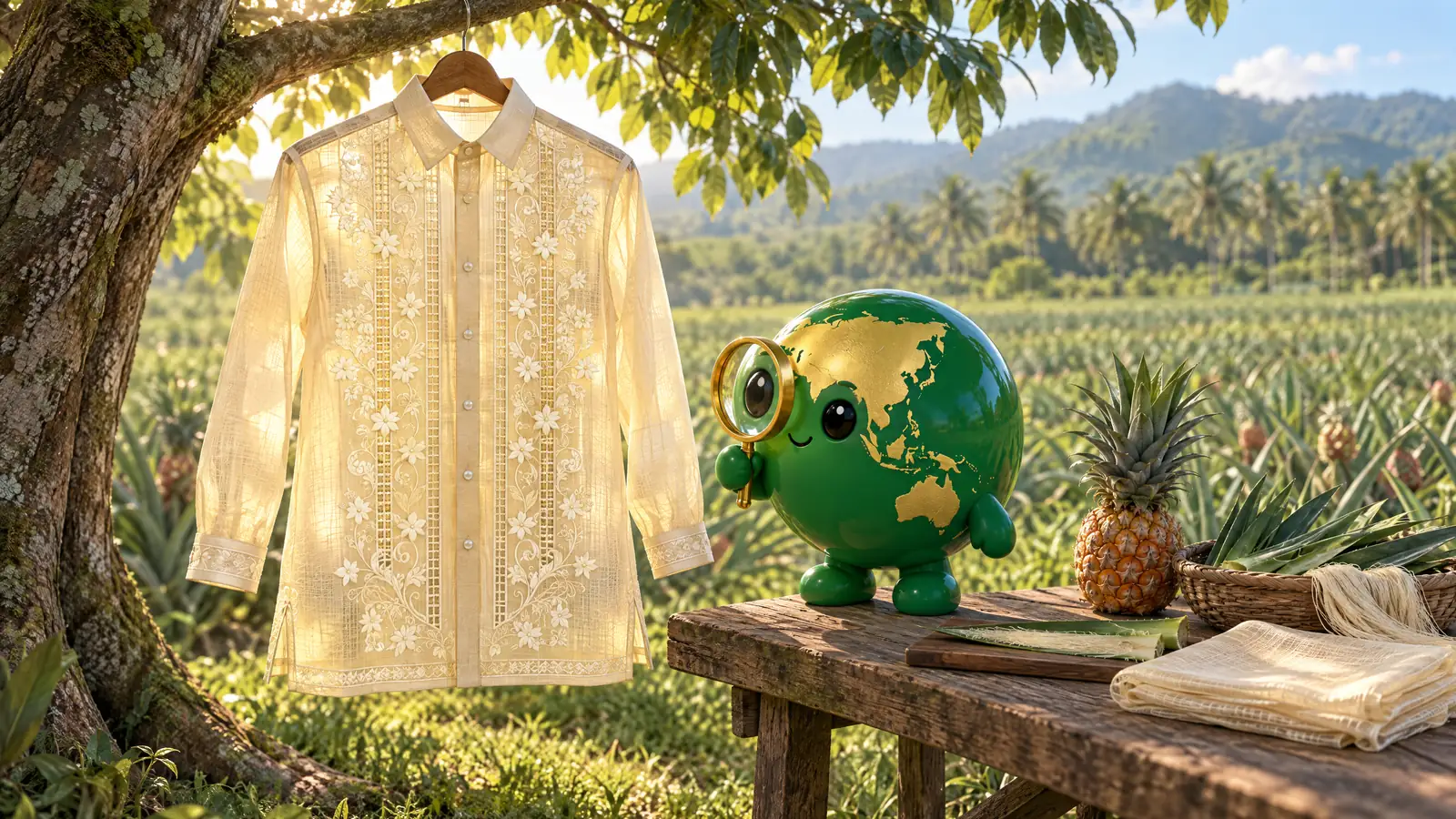
The shirt you thought you knew
Most people think the barong tagalog is a see-through wedding shirt. It is older than that, and it carries a longer story.
The barong tagalog history runs from pre-Hispanic times, when Tagalog men wore a plain cotton shirt called a baro, through 300 years of Spanish rule that added collars, buttons, embroidery and sheer piña fabric, to the national dress it is today, a status it earned through decades of use by presidents and ordinary Filipinos, not through one single decree. The Barong Tagalog evolved over four centuries. It is a shirt shaped by farmers, ilustrados (the educated Filipino elite), priests, presidents and weavers, and it still shows up at weddings, graduations, and state events across the country today.
Picture a Manila church on a Saturday afternoon. The groom stands at the altar in a long sleeved garment that falls past his hips, left untucked. The fabric is pale gold, almost see-through, intricately embroidered across the chest. He wears no tie. That shape, that sheerness, that untucked line, all come from choices and pressures laid down in the 1600s and 1700s. We at Backstory Asia tell the story through the people who wore it, stitched it and argued over what it means.
The name: what "Barong Tagalog" means and where the word came from
"Barong Tagalog" comes from two Tagalog words. Baro means shirt or upper garment. The linker -ng connects it to Tagalog, the language and people of central Luzon. So baro ng Tagalog means "shirt of the Tagalog people."
The word baro was already in use before Spaniards wrote about the islands. Early Spanish chroniclers described native clothes in the late 1500s and early 1600s, but they did not use the full phrase "barong tagalog." They wrote about the baro on its own.
The two words came together in print later. By the late 19th and early 20th century, dictionaries and writers started using Barong Tagalog to refer to the formal men's shirt of lowland Christian Filipinos. English spellings vary. You will see Barong Tagalog, barong tagalog, or simply barong. In daily speech, many Filipinos have shortened it to barong. The term "barong" is often used informally, but Barong Tagalog carries deeper cultural significance. It is the proper name for the national dress shirt of Filipino men, and it does not belong only to the Tagalog ethnic group. Lowland Christian communities across several regions wore it during colonial times.
Where it began: place, time, people
The story starts in 16th-century Luzon. Tagalog areas like Manila, Tondo and Batangas are where the first Spanish records of native shirts appear after 1565, the year colonial rule began.
Before the Spaniards arrived, men wore a collarless, loose baro. It sat at the waist or hip. It was made from abaca fibre, rough cotton, or other local cloth. Men wore it over a tapis (a coloured wrap) or wide trousers called salawal. Early Spanish accounts from the 1500s and 1600s describe this native dress. The garment existed long before colonial rules changed it.
Spanish colonisation introduced European fashion elements to the barong. Linen and silk arrived on galleons. Buttons, standing collars, cuffs and plackets from European shirt styles mixed with the native cut. Clothes became class markers. Spaniards and Spanish-born elites wore coats and cravats. The principalia, the local native elite, wore finer, sheerer baro over wide trousers. Farmers and fishermen kept coarser fabrics and plain cuts. The distinction in cloth told you a person's place in colonial society.
A popular story says the Spanish colonial government forbidden indios from tucking in their shirts and forced them to use sheer fabric so they could not hide arms. This tale is commonly repeated. But historians have found no written colonial law that orders either rule. The untucked style existed before the Spaniards came, and sheer fabrics only became widespread in the 19th century.
The barong tagalog grew in port towns. Manila, the shores of Laguna de Bay and other trading centres were places where Tagalog, Chinese and Spanish traders met. They swapped cloth and ideas, and the shirt changed with each exchange.
From baro to "dress shirt" under Spain
By the 17th and 18th centuries, the baro had started to look different. Native men began wearing longer shirts, sometimes reaching below the knee. This style was called the barong mahaba, meaning "long baro." It had wide sleeves and bold stripes. Standing collars and small buttons appeared, influenced by Spanish camisas and European doublets.
The shirt stayed untucked and worn over trousers. That silhouette slowly became a dress code marker for indios and mestizos (people of mixed ancestry) in town life. Jusi, a sheer cloth hand-woven from abaca fibre that often interweaves silk, shaped the texture and the look of the elite barong.
Anatomy of the Barong Tagalog: fibres, cut, and embroidery
To know its history, we have to look at how a barong is built. The core parts are a sheer fabric shell, a straight or slightly fitted body, long sleeves, side slits for ease of movement, a small collar, a buttoned front, and an untucked hem. It is customary to wear it over a white undershirt. There are no pockets. There is no tie.
From rough cotton to pineapple leaves
Early baro used abaca and rough cotton. These were good for the heat but not sheer. Barong Tagalog is often made from piña fibre, known as the "Queen of Philippine fabrics." Piña comes from pineapple leaves. The pineapple plant, a Red Spanish cultivar, was brought to the Philippines from the Americas by Spanish colonists in the 1500s. By the 1700s, weavers in places like Kalibo in Aklan had learned to strip the leaves, scrape off the pulp, split the fibres, knot them end to end, and weave them on hand looms into very thin, slightly stiff, pale gold cloth with a soft shine. Pure piña production is slow and entirely by hand, from stripping the leaf to the final weave.
Barong Tagalog can also be made from jusi, the abaca-based fabric that became common in the 19th century. Jusi was often cheaper than pure piña. Later came blends: piña-seda (pineapple and silk), ramie, organza, and modern polyester mixes. These let 20th-century makers balance cost and appearance. The barong is a reflection of Filipino craftsmanship and local textile traditions, whether made from piña, jusi, or a modern blend.
The cut: untucked lines
The classic cut stabilised in the mid-1800s. Formal barong fell to mid-thigh length. The body was straight. Side slits let it move. Cuffs had small buttons. Barong Tagalog is traditionally worn untucked as a cultural symbol, and that untucked line became the visual sign that set it apart from Western suits, which were tucked and belted. Worn untucked, the embroidery and the fabric's sheen stay in full view, which is part of why the style stuck.
Collars changed over time. The earliest baro was collarless. By the 19th century, a standing collar had appeared. During the American colonial period, softer Western shirt collars replaced the stand-up style, mirroring global menswear changes of the era.
Embroidery and motifs
Barong Tagalog features dense embroidery inspired by Spanish lace. The hand-embroidery and weaving take care and long hours, skills passed down through generations. The main technique is calado, a drawn-thread method. Weavers pull out threads to make tiny windows in the fabric, then stitch patterns across the gaps. Related techniques include doble calado (double openwork), sombrado (shadow embroidery), and encajes de bolilio, a lace-style border.
In the 19th century, embroidered panels started as simple chest pieces. Over time they spread across the front, cuffs and hem. Common motifs include Spanish-style scrolls, local flowers like the sampaguita, geometric borders and symmetrical patterns down the placket (the chest panel, sometimes called pechera). The town of Lumban in Laguna province became famous for barong handwork. In the piña-weaving regions of Aklan, Iloilo and Antique on Panay island, Nicholas Loney, the British vice-consul at Iloilo from 1856, is remembered for his dealings with the region's handloom-weaving industry, which long predated Spanish rule.
One shirt, many homes: how Filipinos made it their own
There is no single barong. There are many barong tagalog styles that grew in different islands and classes. All share key traits: sheer or semi-sheer cloth, embroidery, and an untucked hem. But the cut, the motif and the fabric change with place, faith, social class and time.
Spanish-era elites and everyday men
In the 18th and 19th centuries, principalia and ilustrados wore long, finely embroidered barong with European-style trousers. Some wore a European coat over the barong. Their clothes were piña or jusi, their patterns elaborate. Peasants and fishermen wore simpler, plain cotton or abaca baro without heavy embroidery, made for work in fields and on boats. Studio portraits of ilustrados from late 19th-century Manila helped fix the image of the barong as an elite garment. That image has shaped the way Filipinos think about it ever since.
Regions and faiths
While "Tagalog" points to a language group in Luzon, by the late 19th and 20th centuries the barong had spread to other lowland Christian communities in the Visayas and Mindanao. Elites in Cebu and Iloilo adopted the barong for formal photos and town events during the late Spanish and early American period. Piña weaving was a major tradition in those islands too.
Muslim communities in Mindanao and Sulu kept their own dress, like the badju and malong. But some officials also wore barong in state settings after independence.
The women's side
The baro also shaped women's clothing. The baro't saya (blouse and skirt combination) shares the same root garment but diverged into different cuts and symbols. Both use piña fabric and similar embroidery patterns. In the late 20th and early 21st century, designers began making barong-style tops and dresses for women, re-using Lumban embroidery patterns and piña cloth. The heritage belongs to all Filipinos, not only Filipino men.
From the plaza to the world: how the Barong Tagalog spread
In the Spanish era, the barong appeared at town plazas, church steps and formal gatherings. During the American colonial period (1898 to 1946), Western suits became popular in schools, courts and offices, and the barong lost ground as everyday wear. President Manuel L. Quezon, who led the Commonwealth government from 1935, wore a baro with the Commonwealth's emblems embroidered on its pechera (the chest panel), a visible sign of his nationalist aims.
President Ramon Magsaysay wore a barong tagalog at his inauguration in 1953. That moment mattered. Newspapers noted the contrast with the Western suit. It helped make the barong respectable statewear, not just folk costume. In 1975, President Marcos's government issued Proclamation No. 1374, naming 5 to 11 May as Barong Filipino Week for a national exposition. The proclamation did not itself declare the barong the national dress; its wording already assumed that status, a sign the title had grown through use rather than arrived by one decree.
Barong in diplomacy and media
At Asia-Pacific summits held in Manila, heads of state have worn barong for group photographs. Philippine presidents and officials have gifted piña barong to foreign leaders, turning the shirt into a quiet tool of diplomacy. State events like Independence Day and the State of the Nation Address show a wide range of barong styles on television, spreading new cuts, colours and fabrics to a national audience.
Migration and the diaspora
From the 1960s onward, Filipino migrants carried barong tagalog to the United States, Canada, the Middle East, Europe and Southeast Asia. Filipino communities abroad use the barong for weddings, funerals, church events, cultural shows and Philippine embassy gatherings. Specialist shops appeared in cities like Los Angeles and Dubai. Ready-to-wear and online shops now ship piña and jusi barong worldwide, so a second-generation Filipino in London or Singapore can order one for special occasions or a school project.
More than a shirt: what the Barong Tagalog means today
Today, the barong tagalog is both formal clothing and a symbol of Filipino heritage. It appears at baptisms, graduations, weddings, funerals and national holidays. Family photos at these events frequently show three generations of men in barong. It is a gentle claim that Filipino clothes can stand beside Western suits in any formal room, without a tie.
Class, protest, and pride
The Barong Tagalog became a symbol of resistance during the revolutionary period. The old story, that colonisers forced natives to wear sheer, untucked shirts to show they carried no weapons and to mark them as lower status, has no documented colonial law behind it. But the story lives on, and it gives the barong a quiet rebel meaning in Filipino culture. Activists and reformist politicians in the late 20th and early 21st century chose barong instead of Western suits at rallies or hearings to stress Filipino roots. Some accounts say the national hero José Rizal wore native-style shirts in a few portraits, though no museum or national archive record checked for this piece confirms it. Later generations who hold the story read those images as early signs of cultural pride and national identity.
Craft, fast fashion, and the future
Filipino textile artisans preserve skills passed down through generations related to the barong. In towns like Lumban and Aklan, weavers and embroiderers keep slow, hand-made barong work alive, often within families. But there is tension between cheap machine-embroidered polyester barong sold in malls and authentic heirloom-quality pieces where the hand-embroidery alone can take weeks.
Contemporary adaptations of the barong include modern silhouettes and new materials. There are coloured barong, slim fits, short sleeves polo barong for office wear, and unisex cuts inspired by both tradition and current fashion. Yet the core signs remain: sheer or semi-sheer cloth, embroidery, and an untucked hem. When someone slips on a pineapple-leaf shirt for a big day, they wear four centuries of change on their shoulders.
If you like stories like this, join the Backstory Asia email list. One origin story a week, nothing else.