
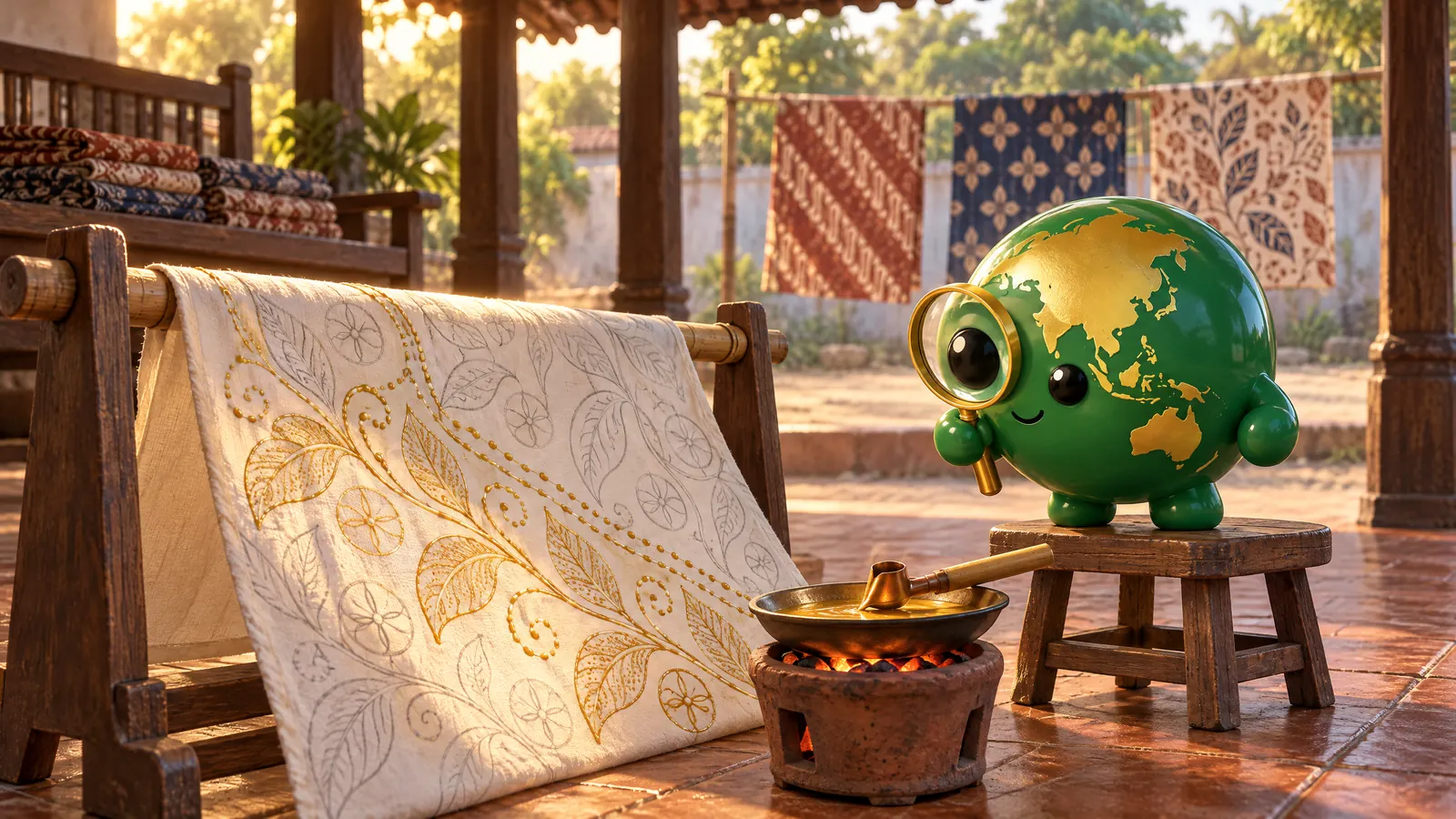

Prefer to watch? This story is Episode 13 on our YouTube channel: The Cloth That Crossed Two Oceans: Batik.
The cloth you thought you knew
You think batik is a pretty printed cloth from Indonesia. It is not a print at all. It is a way of drawing with hot wax on fabric, then dyeing the cloth so the wax blocks the colour selectively, and repeating the steps until a pattern appears.
Wax resist dyeing methods have ancient roots spanning over 2,000 years. Cloth with wax resist traces has been found on Egyptian linen used to wrap mummies, dating to roughly the 4th century BCE. Wax resist reached China by the Tang dynasty (618 to 907 CE) and Japan by the Nara period, the 8th century. Batik's own start in Indonesia is less settled. Some historians think the wax-resist technique reached the region as early as the 6th or 7th century, from India or Sri Lanka. Others say the word and the craft we now call batik are first clearly documented much later, from around the 16th century, after the Majapahit kingdom's decline, and that batik's artistic and technical peak came on the island of Java between about the 17th and 19th centuries under royal courts and busy coastal ports.
Today most people link batik with Indonesia, but related wax resist traditions also live in Malaysia, Singapore, parts of India, Sri Lanka, Thailand and beyond. We treat them as many families, one cloth, not as rivals.
We are Backstory Asia. We tell the origin stories behind everyday Asian things. This page follows batik from its first known traces to what it means in Southeast Asia now.
The name batik: what it means and where the word came from
The word "batik" is Javanese. Javanese is a language spoken mainly in central and eastern Java, the most populated island in the Indonesian archipelago.
The term "batik" comes from the Javanese word "ambatik". Many people say it breaks into two parts: "amba", to write, and "titik", dot or point, giving "to write with dots". It is a neat story. The historians who study the word say that neat split has no clear source of its own: it may be a tale invented after the fact to explain a name nobody fully traces. An artisan making batik sits with a small spouted tool called a canting and draws tiny dots and lines of molten wax onto cloth.
The earliest written records using the word appear in Dutch colonial documents from the 17th and 18th centuries, where spellings like "batick" and "mbatek" show up in cargo lists and letters. Stamford Raffles described the craft in his 1817 book about Java. Before these records, we do not know what local makers called the technique. Older Javanese texts mention cloth painting and drawing, but they do not yet use the word "batik" as far as scholars have found.
While the name is Javanese, wax resist dyeing as a technique is older and wider. Here is how the words compare:
Javanese: batik, "to write in dots".
Malay and Indonesian: batik, same spelling, now part of national identity in both countries.
Indian workshop terms: local words for wax printing and resist dyeing that differ from region to region, but are often grouped as batik today for export.
The rest of this article separates the global technique from the named Javanese art form we call batik.
Where batik began: the places, the times, the people
Batik has two stories at once. One is the long story of wax resist cloth around the world. The other is the focused story of batik in Java and Southeast Asia.
Wax and cloth before Java
The idea of using wax to block dye is very old. In ancient times, people in Egypt painted wax or scratched it onto linen before dyeing. These cloths, found on burial wrappings, date from roughly the 4th century BCE onward. In China, wax resist dyed cotton pieces have been found in tombs along the old trade routes, and the technique was practised by the Tang dynasty (618 to 907 CE). In Japan, a related wax-resist method appeared in the Nara period, the 8th century.
People in all these places learned the same simple thing: if you paint hot wax on cloth, dye cannot enter that part. When you take the wax off, a pattern appears. Nobody at this early stage used the word batik. They shared the technique, not the name.
The rise of batik in Java
Historians disagree on batik's starting point. One early theory places the wax-resist technique in the region by the 6th or 7th century, brought from India or Sri Lanka. The stronger evidence points later: the word and the craft we call batik today are first clearly documented from around the 16th century, after the decline of the Majapahit kingdom. From there it grew strong in central Java under royal courts like Yogyakarta and Surakarta, especially between about the 17th and 19th centuries. Historically, batik was practised by Javanese royalty and nobility. Women in aristocratic households sat for hours with a canting in hand, drawing wax lines onto cotton.
Batik evolved through cultural exchange, not in isolation. Indian Ocean trade brought luxury textiles like patola, a double ikat cloth (ikat is a way of tie-dyeing the threads before they are woven), prized across the region. Local artisans copied these patterns in drawn wax on local cloth, in the same Islamic-court era that reshaped Java's batik. The story most often told says this happened as Islam reached the region, sometime between the 13th and 15th centuries, when some courts discouraged pictures of living things and abstract, geometric batik designs grew more common.
Dutch colonial records from the 18th and 19th centuries describe and collect Javanese batik in detail, which is why we have firm dates for this period. Batik techniques spread to other regions through these same trade routes.
Many families, one cloth: other early centres
While Java became the best known home of batik, wax resist dyeing took root elsewhere too. On the north coast of Java, port towns like Pekalongan, Lasem and Cirebon traded with Chinese, Arab and European ships, absorbing diverse patterns and colours. Along the Malay Peninsula, shared royal and trade links with Java carried batik into what is now Malaysia and Singapore. In parts of India, artisans in Gujarat and later West Bengal used block printed wax to create cloth for local use and for export.
Some Indian and Sri Lankan writers point to very early wax resist cloth in their regions. We note these claims, and we note that the clearest early detailed development of batik by that name is in Java. The same simple idea was tried in many places. Each region left its own mark on the cloth.
How batik is made: the anatomy of a wax-drawn cloth
Batik is not a batik print stamped by a machine. It is a slow set of steps. Batik is created using a wax-resist dyeing process. This section walks through the main parts.
The tools: canting, cap and cloth
The canting is a small pen-like spouted tool with a tiny metal cup and spout. It holds molten wax and lets the artisan draw fine lines and dots on cloth. The invention of the canting allowed for exceptional detail in batik designs. "Tulis" means "to write", so batik tulis means hand-drawn batik.
The copper stamp method, called cap, is often said to have taken off in the 19th century, speeding up batik production. A copper stamp presses hot wax onto fabric in repeating motifs, making the process faster. Its rise links to increased demand under colonial trade.
Batik fabric is typically made from cotton or silk. In older times, the base was hand-woven cotton. Later, machine-woven cloth and silk became common. Traditional batik used natural dyes: indigo for blue, soga bark for brown, and other plant-based colours. The colonial period introduced chemical dyes to batik production, changing the palette.
The steps: write, dye, crack, reveal
Making batik follows a clear sequence:
Draw the pattern on cloth in pencil or charcoal.
Trace lines with hot wax using a canting, or press the cap for repeated motifs. The applied wax resists dyes in later steps.
Dye the cloth. The waxed parts stay the original one colour.
Dry, then add more wax on areas you want to keep in the new colour.
Dye again in a darker shade. Repeat for more layers. The fabric is dyed multiple times for depth and variation, building up multiple colours.
Finally, remove the wax by placing the cloth in boiling water. The final design appears.
The famous "crackle" lines happen when tiny breaks in cooling wax let in thin lines of dye, creating the fine web of veins people now expect from real batik. Traditional batik is valued for its fine, many-layered patterns and the slow, hands-on process used to create it. Court pieces could take months to finish, which is why historic few pieces were treasured and worn only on special days.
Styles and symbols woven into the cloth
Batik patterns often carry deep philosophical meanings and symbolism. Batik designs can communicate ideas about balance, perseverance, and lineage. Central Javanese batik often used fine batik tulis with brown, blue and cream. Coastal batik used brighter imported dyes and more cap stamping.
A few motif groups show how method and meaning sit together:
Parang: slanting, knife-like lines once linked to royal courts in Yogyakarta and Surakarta, stamped or drawn only for nobles to wear.
Kawung: rows of circles connected with royal status and old spiritual meanings, whose exact messages are now partly lost. Some batik-like patterns resemble clothing carved on 13th-century East Javanese statues, a sign of how old these motifs may run.
Semen: leaf, tendril and creature mixes, shaped by Hindu-Buddhist and later Javanese views of life and fertility.
Batik patterns often convey stories and cultural messages. In the past, people in Java could "read" these patterns like quiet messages. They knew which detailed designs suited weddings, births, or a visit to the court.
One cloth, many homes: how each place made batik its own
Once batik was strong in Java and nearby coasts, every town put its own weather, beliefs and trade links into the cloth. Different regions in Indonesia have unique batik styles and motifs, and batik patterns vary significantly across Indonesia's islands.
Central Java: court batik of Yogyakarta and Surakarta
Royal courts in these cities shaped classic traditional batik. Colours were limited: mostly soga browns, indigo blue, cream. Strict rules governed which motifs royal families could wear. Batik here was often made inside palace compounds and noble homes, with patterns passed down as family heritage. These courts helped stabilise and record batik designs, so many "traditional" patterns we know now were fixed in this era.
North coast of Java: Pekalongan, Lasem and Cirebon
These ports met Chinese, Arab, Indian and later European traders. The art of batik absorbed this mix. Pekalongan became known for bright colours and floral buketan patterns inspired by European flower bouquets and Chinese ceramics. Lasem showed strong red shades and Chinese cloud and phoenix motifs, linked to long-settled Chinese communities. Cirebon featured mythical creatures and coastal symbols, mixing local stories with outside styles. In these places, pictures of birds, animals and even people stayed common, unlike in stricter central courts.
Batik across the Malay world: Malaysia and Singapore
Malay courts and port towns along today's Malaysia and Singapore shared people and cloth with Java through marriage, trade and religion. Kelantan and Terengganu in northeast Malaysia favour batik with bold, large floral motifs, often hand-painted. Many people call this style batik lukis. Malay batik often avoids human and animal forms more strictly, following local readings of Islamic teaching, so plants and abstract shapes dominate. Singapore, as a port, became a market and a place to see fine Javanese batik, with Peranakan families collecting these sarongs. Those same Peranakan women often paired a batik sarong with a kebaya, a fitted blouse with its own cross-strait story. Malay courts also prized songket, a cloth woven through with gold and silver thread, as the formal cousin to drawn-wax batik.
Batik is often a symbol of national identity in Indonesia and Malaysia. People in both countries call it batik, using the shared Javanese word.
India, Sri Lanka and beyond
Indian artisans had their own resist dye and block print histories. In the 19th and 20th centuries, workshops in Gujarat and West Bengal adopted or revived wax resist cloth that global markets now call "Indian batik". Sri Lankan batik grew in the 20th century as a craft art, blending local motifs with Javanese tools and steps. These are neighbours in the same big family of wax resist cloth, shaped by their own older textile skills as well as influences from Java and other countries.
From courts and kampungs to the world: how batik travelled
Batik spread not by adverts but by people carrying cloth in ships, suitcases and later in fashion shows.
Colonial trade and museum shelves
From the 17th century, Dutch traders of the VOC, the Dutch East India Company that ran much of the Netherlands' Asia trade, carried Javanese batik within the wider Indian Ocean trade. Cargo bills record "batick" cloths in bills of lading from around the mid-1600s. European collectors in the 19th century bought batik for museums in Amsterdam and elsewhere, helping the word "batik" enter European languages. Some European workshops began to experiment with batik techniques in the early 20th century as an art hobby, spreading the idea of wax resist painting on cloth.
Migration, independence and national pride
In the 20th century, batik moved with people more than with ships. Javanese migrants brought batik skills to other Indonesian islands. Malay, Javanese and Chinese communities around the Straits wore batik clothing daily at home.
The story often told says that after Indonesia's independence in 1945, leaders and officials wore batik shirts as formal dress. UNESCO recognised batik as a Masterpiece of Oral and Intangible Heritage of Humanity in 2009, boosting its status and export appeal. Malaysia and other neighbours also promote their own batik traditions as part of cultural policy. Many families, one cloth.
Global fashion, factories and fakes
Batik patterns were copied by industrial printing in Europe and Asia in the late 19th and 20th centuries. Modern batik techniques include both traditional hand-drawn and stamped methods as well as printed imitations. Cheap batik print materials made the look of batik global, but put pressure on small batik workshops who could not match the prices.
Modern designers from Southeast Asia and abroad now use authentic batik as high-end fashion fabric, appearing on catwalks and in formal wear worldwide. Indonesian batik is used in both traditional settings and contemporary fashion. For makers in Yogyakarta, Pekalongan, Kelantan and beyond, the main line is simple: hand-drawn or hand-stamped with wax is batik, plain print is not.
More than a cloth: what batik means to people today
Batik began as everyday cloth and royal finery. Today it carries memory, belief and pride in each pattern. The history of this ancient art runs deep.
Batik as identity and memory
Families in Java, Malaysia and elsewhere keep old batik sarongs and kain panjang, a long cloth, as heirlooms. Each pattern is tied to a wedding, a birth, or a move overseas. Batik accompanies individuals in various life cycle events including birth, marriage, and death. Batik sarongs are symbols of cultural identity in Indonesia.
In Indonesia, batik shirts are now common office wear and school uniforms on certain days, turning a once court-bound art into daily life. The art of batik is deeply ingrained in Indonesian culture. Batik patterns still carry quiet codes: some designs are chosen for weddings, others for older people, some for visits to important places, even if not everyone remembers the full symbolism.
One Southeast Asian cloth, many stories
Javanese, Malay, Chinese Peranakan, Indian, Sri Lankan and other communities all claim batik as part of their own story, each with different dates and heroes. Indonesian schoolchildren learn that batik is a national treasure. Malaysian designers rework batik motifs into modern baju and dresses. Singapore museums show batik as part of Peranakan and Malay heritage, not tied to one modern border.
We see batik as many families, one cloth, shaped by ports and trade winds more than by flags. Batik is one entry in Backstory Asia's record of everyday Asian objects, alongside other cloths carried by the same ports and courts.
The cloth that keeps changing
Young artists today experiment with new motifs, city skylines, abstract art, new materials and new dyes, while still using canting and cap. They create work that shows this ancient art is alive, not frozen. Slow and fair-trade batik workshops try to keep hand-made work going against cheap printed fabric. The diverse patterns keep growing.
The next time someone tells you batik is just a printed shirt from one place, you know its deeper, shared history.
If you like stories like this, join the Backstory Asia email list. One short origin story a week, nothing else.