
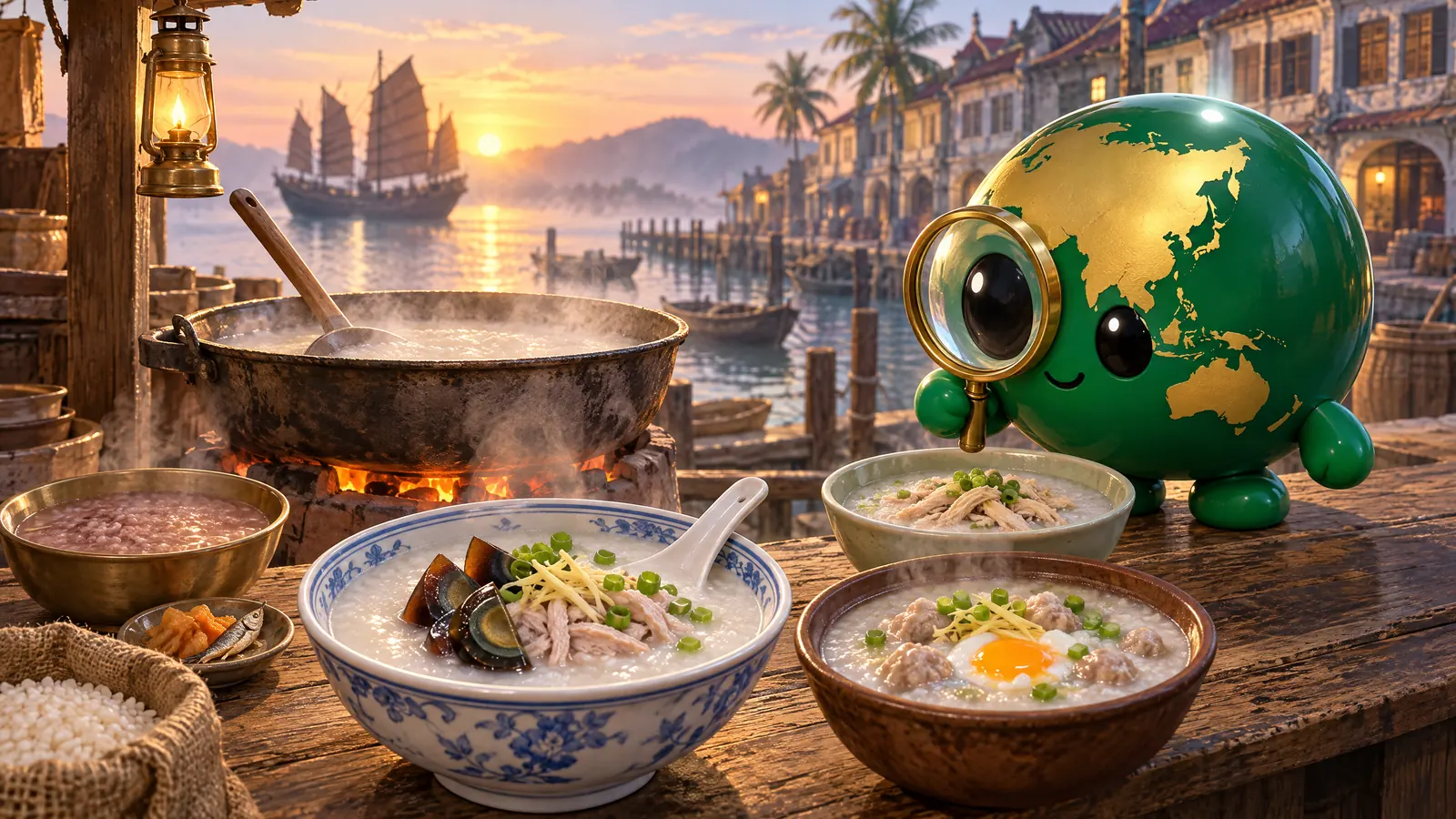
You probably think congee is a Chinese word for a Chinese dish. The twist is this: the English word congee comes from Tamil, a South Indian language, not from any Chinese dialect at all. Congee is a traditional Chinese rice porridge, yes, made by boiling rice in a large amount of water until the grains break down into something soft and thick. It dates back over 2,000 years to the Zhou Dynasty, an early ruling period in ancient China, and even further if you count the earliest rice farming in the Yangtze River Valley, long before anyone wrote the word down. But the name English speakers use for it travelled a completely different road, one that started in Tamil Nadu, passed through Portuguese colonial ports, and landed in European languages centuries later.
Ask for congee in Guangzhou, Chennai, Bangkok or Manila and four different bowls arrive. They share rice, water and time. They do not share a single name, a single topping or a single story. That story, the one behind the bowl, is what this page is about.
The name: what it means and where the word came from
This section is about the word, not the recipe. The English word "congee" comes from the Tamil word kanji, which means "boilings," rice boiled in plenty of water until it turns thin and soupy. Tamil is a language spoken in Tamil Nadu in South India, in Sri Lanka, and by Tamil communities across Southeast Asia.
Portuguese traders on the Coromandel Coast, on India's southeast coast, in the 1500s heard local people say kanji. They wrote it down their own way, as canje or canji; the first document to use the word dates to 1563. That same year, in Goa, the physician Garcia de Orta published an important book on Indian plants and drugs, though no source ties his book to the word itself. From Portuguese the word moved into other European languages.
The word appears in English travel writing by the late 1600s, describing a thin rice gruel in forms close to "congee." It meant watery rice porridge, the kind given to the sick or the poor.
In Chinese the dish has its own names entirely. In Mandarin it is zhou (粥). In Cantonese it is juk or jook. In Teochew and Hokkien dialects it is muay or moi. All of these simply mean cooked rice porridge. In most Asian languages the local name never changed. But in English, the Tamil word stuck. That is why a very Chinese bowl carries a Tamil name when you say it in English.
Food moves with words. Both crossings matter in congee history.
Where it began: the place, the time, the people
Rice porridge began in ancient rice-growing parts of Asia, long before anyone wrote the word "congee." Congee originated in the Yangtze River Valley of China. Rice farming there goes back long before anyone wrote the word "congee," and soft cooked rice likely appeared soon after, though nobody wrote recipes down at the time.
The earliest written records we have come from the Zhou Dynasty in China, roughly 1045 to 256 BCE. Texts from this period mention zhou, a thin grain porridge. Congee was historically a practical way to stretch limited grain supplies: add more water, feed more mouths. In Chinese history zhou was often linked with times of famine or frugality, because rice could be stretched further as porridge than as plain boiled grain.
A parallel tradition grew in South India and Sri Lanka. In Tamil Nadu and Kerala, kanji was a cheap, filling meal for labourers, temple visitors and the sick. Local rulers sometimes gave it out during seasons of hardship. These are not copies of each other. Rice and water are basic everywhere. The idea of cooking grain soft is so simple that people in coastal India, Southeast Asia and China all arrived at it on their own.
The people who made congee part of daily life in China were farmers, workers and the unwell, for whom porridge was easier to digest than firm boiled rice. Over time, ports and trade routes between South China, Southeast Asia and South India linked these rice porridges, and their names, together.
Anatomy: what it is made of, or how it is done
This section is not a recipe. It is a look at what makes congee, congee, in any country. Congee is made by boiling rice in a large amount of water or stock, for a long time, until the grains break and the starch thickens the liquid into something creamy.
Textures differ. Very thin congee, sometimes called rice water, is almost see-through. Medium-thick congee is the everyday kind most families cook. Very thick styles, like bubur in Malaysia and Indonesia or mue in some Chinese dialects, are almost pudding-like. Cantonese congee, known as jook, is traditionally cooked to a silky, smooth texture, while Thai jok tends to be thicker and more seasoned.
Plain white rice is the most common base. Sometimes broken rice or leftover rice goes in. In poorer times or places, other grains like millet or barley were mixed in, showing how rice porridge can be prepared using various grains. In parts of India, red rice or mixed grain versions of kanji are still common today.
Among the key ingredients in Chinese congee are ginger, spring onions, dried seafood like scallops and shrimp, stock from chicken bones or pork bones, and preserved egg. These add flavour and richness to what is otherwise a very plain dish.
Plain congee often sits on the table as a base. People eat it with side dishes: preserved vegetables, fermented tofu, salted fish, soy sauce. It is a gentle, soft meal. In contrast, one-pot congee has meat, fish or organs cooked right inside the bowl. Cantonese century egg and lean pork congee is one of the most common types. Fish slice congee and offal congee are others, richer and more festive.
In morning stalls across Hong Kong, Guangzhou, Penang and Bangkok Chinatown, congee is a popular dish for breakfast or as a late dinner, served hot from large pots to workers and families before the day begins.
The simple method and cheap parts are why congee spread, changed shape, and stayed a comfort food across so many Asian cuisines.
One thing, many homes: how each country or community made it its own
Congee history is a family story across Asia. No single country owns it. Congee has adapted into various regional styles in Asia, each with distinct characteristics. Below, by region, are the shared base and the local twists.
China: from famine food to morning comfort
In China, zhou appears across many dynasties. It was poor people's food in hard times, hospital food for the sick, temple food for monks. Congee has been associated with fasting and ritual practices in Buddhist observance. In Northern China, mi zhou is plainer and more watery. In Guangdong and Hong Kong, Cantonese juk is silkier, served with rich toppings. There is also Laba congee, a special multigrain porridge eaten on the Laba Festival, sweetened with nuts and fruit. In Traditional Chinese Medicine, congee is recommended for its digestibility and healing properties.
From the 1800s onwards, Chinese migrants from Guangdong and Fujian carried their congee habits to Southeast Asia, where the dish mixed with local food cultures in port towns.
South India and Sri Lanka: kanji in temple and home
In Tamil Nadu and Kerala, kanji is a thin rice gruel eaten with dried fish, pickles or simple curries, sometimes prepared with red rice. It holds a place in local customs: served in temples, given as a free meal during certain fasting months. Tamil and Malayalee migrants to Malaya, Singapore and Sri Lanka carried the word kanji with them. That word, reshaped by Portuguese traders, is why English speakers everywhere now say "congee."
Southeast Asia: bubur, porridge and jok
In Malaysia and Indonesia the rice porridge is called bubur. Bubur ayam, chicken porridge, is a popular dish across both countries. Sweet versions exist too: bubur cha cha, popular among the Betawi and Peranakan people, is made with sweet potatoes, yams and bananas. Bubur terigu is a sweet wheat porridge from Malay origins, sometimes flavoured with pandan leaves and grated coconut. Chendol, a sweet, chilled dessert, has its place of origin claimed by both Indonesia and Malaysia; most sources simply say Southeast Asia and leave it there.
In Thailand, jok and in Laos, chok, words borrowed from Min Nan Chinese, are standard breakfast foods. Thai jok often includes minced meat and a soft egg, giving it a thick, rich texture. In the Philippines, congee called lugaw is often prepared with ginger and served when someone is ill. Arroz caldo, another Filipino version, shows both Spanish and Chinese touches on the same rice porridge idea. Korean congee, called juk, is associated with wellness and often served as a restorative food. Japanese congee, known as okayu, is typically prepared with a higher water-to-rice ratio and is associated with recovery.
Homes in the Chinese diaspora
Chinese workers and traders in the 19th and 20th centuries carried congee to California, Vancouver, Sydney and London. In those cities it served as baby food, sick food, and a way for older migrants to keep a link to home. Congee was often the first dish cooked in a new kitchen in a new country. The taste might change, a different fish, a local sauce, but the feeling of a warm, soft bowl stayed the same.
From the stall to the world: how it spread
Congee started as a way to stretch rice. Then it followed ships, trains and planes. Congee has evolved from a survival food to a staple in various culinary traditions.
Sea trade between South China and South India across the Bay of Bengal brought both rice and ideas of how to cook it into the same ports, well before the first millennium CE, even if written records are thin. Chinese coastal migration in the 1800s and early 1900s to Singapore, Penang, Batavia and Bangkok turned congee into common port-town hawker food, eaten by dock workers and shopkeepers at dawn.
British and other European colonial officers in Asia tasted the dish, used the word "congee" in their letters and reports, and carried it back into English writing. By the 20th century, English-language cookbooks used "congee" to describe Chinese-style porridge, which spread the Tamil-rooted word more widely than juk or zhou ever reached on their own.
After the 1960s, migration from Asia carried congee to cities like New York, Toronto and Sydney. It first stayed inside Chinatown, then slowly moved onto fusion and hotel menus. Today instant congee products and frozen packs sit in Asian supermarkets worldwide, a late chapter in congee history. Congee is known for its creamy texture and versatility, which is part of why it adapted so well to new places.
Traders, workers, students and families, not chefs or brands, spread congee.
More than a dish: what it means to people today
Today congee is comfort food, sickbed food, festival food and memory food, all at once. Congee is viewed as a comfort food and a remedy for illness across Asia. There are numerous cultural and ritual associations with congee across the continent, linking it to caregiving and familial bonds.
Many Chinese families see congee as the gentlest food: for newborns, for the elderly, for anyone unwell. People sometimes call it "the chicken soup of Asia." It is also eaten during some Chinese festivals and on Buddhist fasting days, when simple porridge is the correct meal.
In Southeast Asia, congee and bubur cut across lines of community and faith. Chinese, Malay, Indian and Eurasian families all have some kind of rice porridge in their kitchens. The same bowl might be served with halal meat in one home and with fish and vegetables in another. Congee has been consumed for centuries in various Asian cultures, and that depth shows.
For migrants and students overseas, congee is powerful nostalgia. A quick pot of rice and water, maybe a little salt, soy sauce and ginger, can taste like home when nothing else does.
Chefs today sometimes dress congee up with luxury toppings, lobster, wagyu, truffle oil, but the base stays the same: rice, water, time and care. The dish you might call Chinese congee carries a Tamil word in English and has cousins in every corner of Asia. That tells you something about how mixed our daily food really is.
If you like stories like this, join the Backstory Asia email list. One new origin story a week, nothing else.