
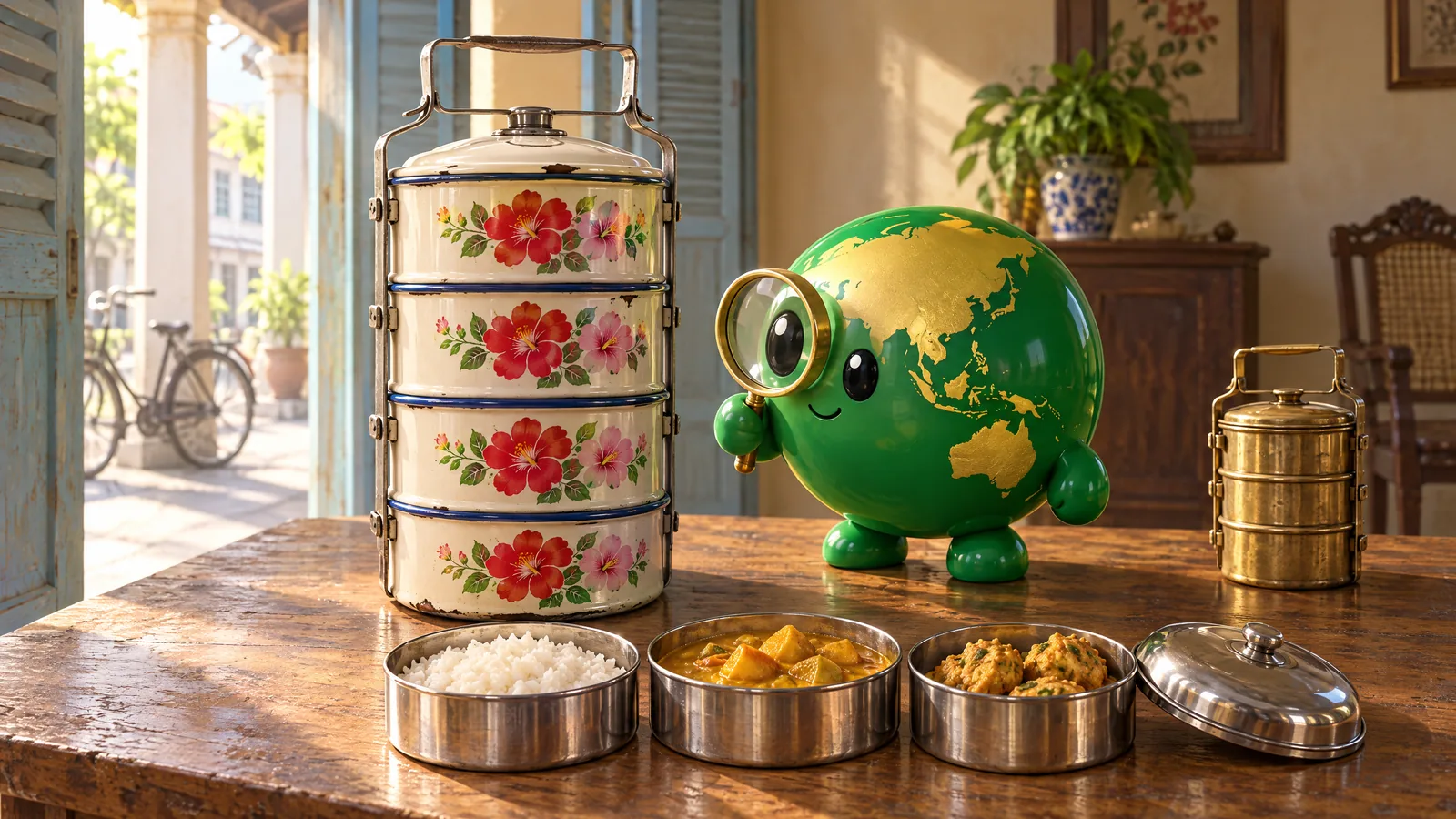
You probably picture the tiffin carrier as a cute retro lunchbox. It is older than colonial railways, and its story crosses ports from Mumbai and Kolkata to Penang, Singapore and Jakarta.
The stacked metal lunchbox shows up clearly in late 1800s Bombay, where office workers used it to carry home cooked meals to their desks. The English word tiffin began as British slang for a small bite between meals, and became the Indian word for lunch. The Malay word tingkat means tiered. Both words ended up naming the same object: a set of round containers, locked together, built to keep a home lunch intact across a crowded city.
Picture a clerk in Bombay around 1900. He opens a three-tier steel carrier at his desk. Rice at the bottom, curry in the middle, something sweet on top. Now picture a family in 1960s Singapore. A caterer on a bicycle drops off a stack of enamel tins at an HDB flat, filled with rice and dishes for the evening meal. Same idea, different place, different time.
The name: what it means and where the word came from
Two words name the same thing. Each word tells part of the story.
The term tiffin comes from 19th-century British slang for a light midday meal. It grew from the old English verb "to tiff", which meant to take a small sip between proper meals. By the mid-1800s, tiffin was the ordinary word in India for that meal. At first the word meant the food, not the box. But over time, in many parts of India, people started calling the metal carrier "tiffin" too. The meal and the container shared a name.
Tingkat is a Malay word for tiered, and in Singapore and Malaysia it came to name the carrier itself.
The term dabba is commonly used for tiffin containers in India and Pakistan. In Hindi and Marathi, the carrier is a "dabba", which simply means box. The person who carries it is a "dabbawala", the box carrier. In Malay, the same object is called "mangkuk tingkat", the tiered bowl. In Indonesia the word is "rantang".
Where it began: the place, the time, the people
People in South and Southeast Asia carried cooked food to fields and workplaces for hundreds of years before the metal tiffin carrier appeared. They used brass pots, clay vessels, woven baskets and wooden boxes, sometimes stacked. But the direct line to the modern tiffin carrier runs through the port cities of British India.
In the late 1800s, migrants from across India were pouring into Bombay for work, where canteens and fast food barely existed, and people often went hungry by lunchtime because each household wanted its own home-cooked meal, not bazaar food. In 1890, a man named Mahadeo Havaji Bachche answered that with a lunch delivery service built on about a hundred men. It worked, and it grew.
A similar push happened in colonial Malaya and Singapore. Office culture in Penang, Melaka, Kuala Lumpur and Singapore meant people worked away from home for long hours. By the 1960s, tingkat lunch deliveries were a normal part of life in Singapore's HDB estates and shophouses.
There was no single inventor. Hundreds of small makers across India, Malaya and Java adapted older food-carrying habits to the needs of a new kind of urban working life.
Anatomy: what it is made of, and how it works
The classic carrier has three or four round compartments stacked on top of each other. A metal frame with a handle on top locks them together. Side latches or a top bar keep the tiers tight so sauces do not spill on trains and buses. The design mirrors how a home meal is already divided: rice, dal, vegetables and a pickle, each in its own place.
In India, early carriers were brass, because that was the traditional metal for kitchen things. Later, aluminium became popular, lighter and cheaper but easily dented. In Southeast Asia, enamel-coated steel became the favourite by the mid-20th century, in bright colours with painted flowers, roosters or geometric patterns. Later, stainless steel took over. It was stronger, easier to clean and safer for sour food like tamarind curries.
Heavy, dry food like rice or roti goes at the bottom for balance. Wet curries sit in the middle tiers. Delicate items like fritters go on top. The design lasted because it has no hinges to break, no electronics, and almost no waste. Dabbawalas in Mumbai and tingkat delivery riders in Singapore both rely on the same qualities: stackability, strength and speed.
One thing, many homes: how each place made it its own
In Mumbai, the dabbawala network is the most famous example. The Mumbai Dabbawalas delivery system has operated since the late 19th century. Between 175,000 and 200,000 lunches are moved every day, carried by around 4,500 to 5,000 dabbawalas using trains and bicycles. Colour codes and symbols painted on the lids tell each carrier where to go, which train to ride, which building and which floor. One person picks up, another sorts, another rides the train, another delivers. The dabbawalas carry a famous reputation for near-perfect accuracy, often repeated as one mistake in six million deliveries, but that number traces to a single manager's offhand estimate from 1998, not a measured count. In Mumbai, "tiffin" means both the carrier and the service, and the box stands for the comfort of home food in a hectic city. Many dabbawalas come from the same village near Pune and are related to each other.
Singapore and Malaysia tell a quieter story. From the 1960s onwards, tingkat delivery was how many families in HDB towns got their evening meals. Caterers cooked rice and dishes, packed them into stacked carriers, and delivered them by bicycle or motorbike. Some families kept their own enamel tingkats and sent them to nearby stalls to be filled, long before plastic takeaway boxes existed.
In Indonesia, the word is rantang. Enamel and metal rantang carriers are used to send rice and side dishes, called lauk, to workplaces, to neighbours and to relatives after a birth or a death. Giving food in a rantang is a kind of social glue.
No single city or country can claim to have invented the idea. Many cultures solved the same problem in similar ways. What Mumbai, Singapore and Jakarta each did was make the tiffin carrier fit their own daily life: mass logistics in one place, home catering in another, gift-giving in a third.
It sits alongside other everyday things with the same kind of split story: the dough in roti canai crossed from South India into Malay kitchens, and the broth in laksa did the same between Chinese and Malay tables. Read more shared-heritage stories on the Backstory Asia hub.
From the stall to the world: how it spread
Tiffin carriers stayed local for a long time. They began to travel when people did.
Indian, Malaysian and Singaporean migrants in the United Kingdom, North America and the Gulf took their stainless steel carriers with them when they moved for work, keeping a home-cooked lunch within reach of an office desk abroad. The carrier travelled further than that usual story tells, too: tiffin carriers are used widely enough to count as a lunchbox of the Caribbean as well as of Asia, having reached Trinidad and Tobago alongside Malaysia and Singapore.
The Hindi film "The Lunchbox" (2013) presented the dabbawala system and the stacked carrier to millions of viewers worldwide. The story stressed the human network behind the tins, turning a plain lunchbox into a model of smart coordination.
Western eco and zero-waste groups later discovered stainless steel tiffin carriers as an alternative to disposable plastic, and online shops began selling "Indian-style tiffin boxes" and "stackable lunchboxes", sometimes without mentioning their long Asian background. Plastic-waste campaigns in South and Southeast Asia have since pushed many people back to steel tiffins and tingkats.
Some Indian and Southeast Asian restaurants in cities like London, New York and Sydney now serve set hot lunches in small tiffin towers, more nostalgia than necessity, far from a crowded commuter train near Churchgate Station.
More than an object: what it means to people today
In many Indian families, a full tiffin sent to school or office stands for care. Nobody needs to say the word. The meal is the message. In Singapore and Malaysia, older people remember parents or grandparents sending tingkat to workers at shipyards, banks or factories in the 1960s. The experience of opening a familiar tin and smelling home food is a reminder of where you come from, especially for people who live alone in big cities.
While the English word tiffin came from British India, the habit of stacked carriers belongs to many Asian ports and towns at once. Malay, Chinese, Indian and Indonesian families all see their own food and their own memories in the same basic metal shape. That is the unique thing about the tiffin carrier. It belongs to everyone who used it.
The tiffin carrier is also a very old answer to a very current worry: single-use packaging and plastic waste. Some younger people in Kuala Lumpur, Singapore and Jakarta now bring their own tingkats or steel boxes to hawker stalls and warungs again, sometimes pushed by city campaigns. Vintage enamel tingkats, collected by enthusiasts and museums, now appear in cafes, heritage exhibitions and home decor across the region, their worn dents and faded patterns telling personal stories. A Malaysian book, "Tiffin: An Untold Story," brought together 172 vintage tiffin carriers, some more than a century old.
This everyday object links British words, Indian trains, Malay flats and Indonesian neighbours. If you like stories that trace the secret lives of things people use every day, join the Backstory Asia email list.