The thing you thought you knew
You probably know Eu Yan Sang as a chain of bright shops in Singapore malls, selling bottled tonics and bird's nest in neat rows. The twist: the brand started in 1879 inside a dusty shophouse in a tin-mining town called Gopeng, in Perak, where Chinese miners were hooked on opium and had almost no doctors.
Eu Kong opened the first shop named Yan Sang in 1879. He set it up in Gopeng, Perak, to sell herbal remedies to coolie miners. Coolies were labourers, mostly from southern China, who dug tin out of the ground for very little pay. Many of them spent their wages on opium because it dulled the pain of hard work and there was no other medicine nearby. Eu Kong wanted to give them something better: herbs, not opium.
The story of Eu Yan Sang runs from that one small medicine hall to a brand with about 200 retail outlets and TCM clinics across Asia, as of 2022. This page tells how it happened, step by step, from a tin town in Perak to airports and online shops.
The name: what it means and where the word came from
In Chinese families, a name is not just a sound. Every word carries meaning.
"Eu" is the family name, written 余 in Chinese. "Yan" (仁) means "people" or "caring for mankind." "Sang" (生) means "life" or "to give life." Put them together and you get something like "the Eu family cares for human life." The name "Yan Sang" translates to "caring for mankind" in Cantonese.
When Eu Kong first opened his shop in Gopeng, he called it simply "Yan Sang." The family name "Eu" was only added later, under his son Eu Tong Sen, to mark it clearly as a family business. The name is Cantonese, the dialect spoken by migrants from Foshan in Guangdong province, who ran many of the early medicine halls in Malaya.
On the earliest signboards in Perak, the Chinese characters 余仁生 were carved into wood. As the company grew, the romanised form "Eu Yan Sang" was printed on tins and bottles so that non-Chinese-reading customers and traders could recognise it. Today the same three characters appear on shops in Hong Kong, Malaysia, Singapore and Macau. For overseas Chinese, those characters signal a trusted, shared heritage that goes back to one family from Foshan.
Where it began: the place, the time, the people
In the 1870s, British Malaya was in the middle of a tin rush, and thousands of Chinese workers, mostly from Guangdong and Fujian, crossed the sea to dig for it. After a long shift underground, many bought opium on credit from licensed, government-backed opium farms.
Eu Kong was born in Foshan, Guangdong. He established his first shop in Gopeng, Perak, in 1879. The shop was placed close to where the coolie lines and opium dens stood, so miners could walk in after work. Some accounts say Eu Kong bought a site that had once been used as an opium outlet and turned it into a medicine hall. Whether the building was literally a former opium den or simply stood beside one, the point was the same: herbal care, planted right where addiction lived.
Eu Kong died in Penang in 1890. One record says he was 38. Another says 37. Even the family's own history does not agree on his age, which tells you something about how thin the paper trail is this far back. Eu Kong's only son, Eu Tong Sen, was born in Penang on 23 July 1877. Eu Tong Sen took over the business in 1898, at age 21, and from there the small yan sang shop in Gopeng would become something much larger.
Anatomy: what the business was made of and how it worked
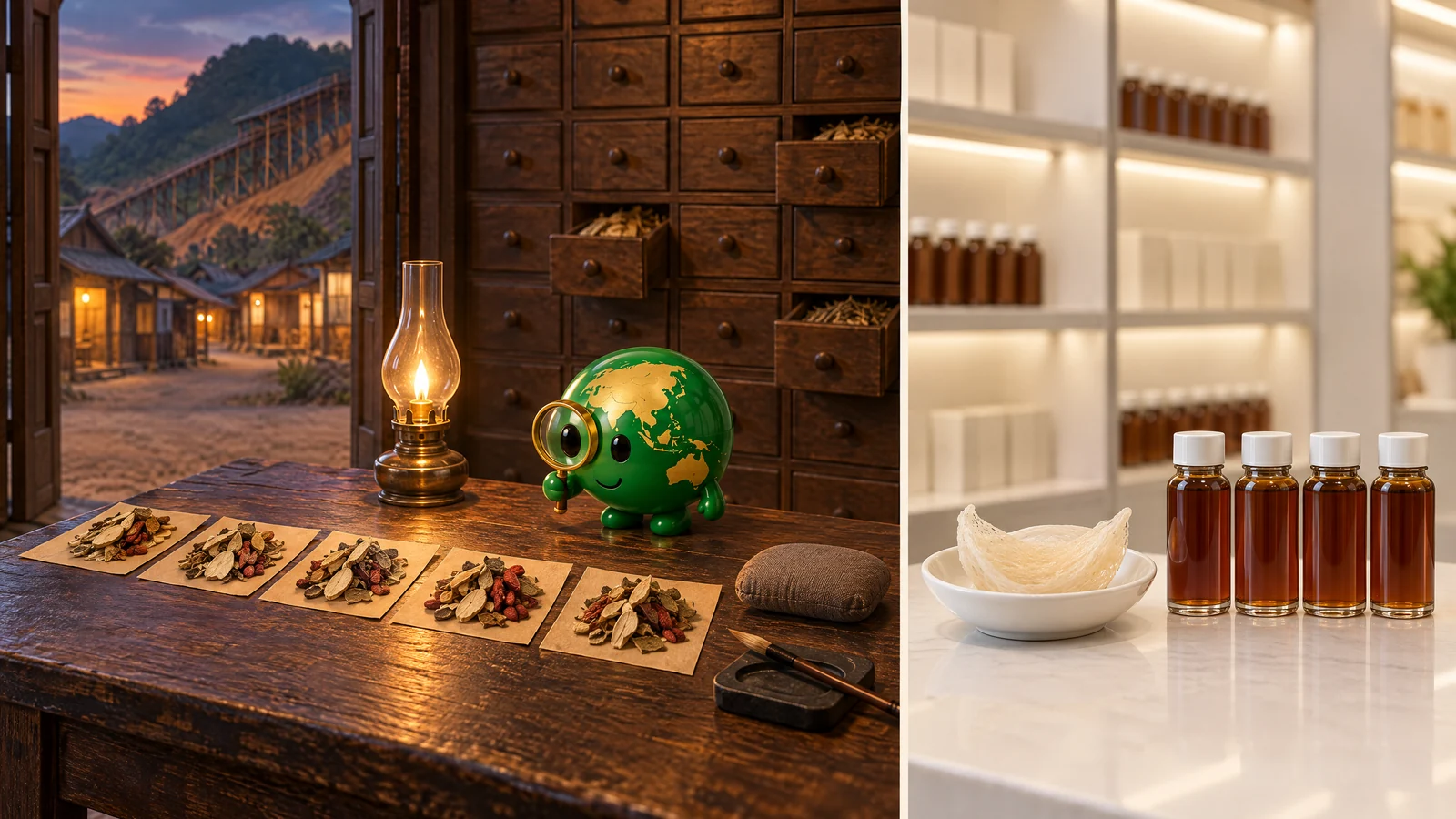
Walk into an early Eu Yan Sang outlet and you would not find air conditioning or glass counters. You would find a wooden shopfront with rows of small drawers, each holding a different dried herb or root. Brass scales sat on the counter. A sinseh, a traditional Chinese medicine practitioner trained in southern Chinese village methods, sat at a table and read the pulse of each patient before writing out a formula on a slip of paper.
The medical hall business worked like this. Eu Kong imported dried herbs and roots from Guangdong and Fujian through the ports of Penang and Singapore. He blended house formulas aimed at common problems among miners: cough, wounds, fatigue, heatiness (a Chinese medicine term for too much internal heat) and poor sleep. He sold on credit to mine workers and towkays (mine bosses), because wages were irregular and many workers had no cash on hand.
After Eu Tong Sen took charge, he standardised some products. The same pill or tonic could now be sold in Ipoh, Kampar, Kuala Lumpur and Singapore. Eu Kong's vision of serving miners grew into a medical business that also included tin mining, rubber estates, remittance services (sending money back to families in China) and property. Wherever Eu Tong Sen set up a tin mine or plantation, he often opened a Eu Yan Sang outlet next to it, so the same workers he employed could also buy his medicine.
Today there are fewer handwritten prescriptions and more factory-packed bottles. But the base is still the same: herbs, diagnosis and the promise carried in the name, caring for mankind.
One brand, many homes: how each place made Eu Yan Sang its own
Eu Yan Sang grew along the routes of Chinese migration in the Asia Pacific region, and each town gave the brand a different shape.
Malaysia. From the Gopeng shop in 1879, the brand spread to Ipoh, Kuala Lumpur and other tin towns, serving Cantonese, Hakka and other dialect groups. After Malaya became Malaysia in 1963, Eu Yan Sang became part of Chinese Malaysian community life. Families bought herbs for confinement (post-birth care for mothers), festival tonics and everyday health. The Malaysia and Singapore operations shared roots but answered to different local laws and tastes.
Singapore. In the early 1900s, Eu Kong's son, Eu Tong Sen, expanded the business across Malaya and Singapore. He moved his base to Singapore, where the family's flagship store stood at South Bridge Road. In 1919, a different Singapore street, Wayang Street, was renamed Eu Tong Sen Street in his honour, after he gave a fighter plane and money for a tank to the British war effort in the First World War. Singapore branches served dock workers, rickshaw pullers and, over time, office staff. Singapore also became the home of the group's later headquarters and its stock market listings.
Hong Kong and southern China. By the early 1910s, Eu Tong Sen had carried the family trade into Hong Kong and other parts of southern China. The Hong Kong outlets served an urban, Cantonese-speaking crowd and kept the link back to Foshan and Guangdong, spreading the brand name across southern China-linked communities.
After Eu Tong Sen died on 11 May 1941, ownership split among his many sons. Different branches in Malaysia, Singapore and Hong Kong sometimes took different paths. The brand was one name, many families, one thing, adapting to each place rather than fighting over a single version.
From the medicine hall to the world: how Eu Yan Sang spread
The distance from a wooden counter near an opium den to a bright store in Changi Airport is about 150 years and several sharp turns.
1940s to 1980s. After Eu Tong Sen's death in 1941, his estate was divided among his sons. Some assets were sold. Different branches of Eu Yan Sang survived at smaller scale, and the brand's reach shrank.
Late 1980s onwards. Richard Eu, a great-grandson of Eu Kong, joined the business in 1989. He led the effort to buy back scattered parts of the family business, reunite the brand under one roof and modernise it. In 1993, Richard Eu and his cousins bought back an outside investor's shares in the family holding company, returning it to full family ownership and renaming it Eu Yan Sang International. In 2000, Eu Yan Sang International was listed on the SGX mainboard.
The company uses Herb Fingerprinting Technology, a lab method for checking each herb's unique chemical make-up, to keep its herbal products consistent. It has also worked with tertiary institutes in Singapore, Hong Kong and China on research into traditional herbal benefits.
In 2016, Eu Yan Sang delisted from the Singapore Exchange. The privatisation was led by Righteous Crane Holding Pte, a consortium of the Eu family, Tower Capital Asia and Temasek Holdings.
Eu Yan Sang expanded into international markets in 2017, and in 2024 it was acquired by Rohto Pharmaceutical and Mitsui & Co. Under the deal, Mitsui and Rohto together hold 86% ownership, with the Eu family holding the rest. Richard Eu remains involved, and Eu Yan Sang called the deal a step towards becoming a broader wellness company, backed by two established Japanese firms.
Today Eu Yan Sang operates about 200 retail outlets and TCM clinics across Asia, as of 2022, from its headquarters at Tai Seng Drive in Singapore to shops in Hong Kong, Macau, China and Malaysia. Its tonics, teas and health foods are sold through an online portal dedicated to reaching overseas Chinese communities. The same brand that once tried to pull miners away from opium now sits in airports and on screens, selling wellness to travellers and students.
More than a brand: what Eu Yan Sang means to people today
Eu Yan Sang is not just an old company. It is part of how many families in Southeast Asia understand traditional Chinese medicine TCM and Chinese heritage.
Grandparents who remember walking into dim, smoky medicine halls now see the same name on clean clinics where their grandchildren get consultations. Families buy Eu Yan Sang products for confinement, New Year tonics and everyday "bu" (补), the Chinese idea of nourishing the body.
In the long debate between tradition and science, Eu Yan Sang stands as one example of how old herbal knowledge can sit next to western medicine in the same city. That work does not settle the debate, but it keeps the conversation going.
For overseas Chinese, walking past a Eu Yan Sang shop in Hong Kong or Malaysia, or browsing its online store, can feel like a small piece of home. The "since 1879" line on its packaging signals continuity through colonial times, two world wars, independence and globalisation. The heritage is real: Eu Kong, Eu Tong Sen, multiple generations of the Eu family, and now Japanese partners carrying the name forward.
Eu Yan Sang began as a way for one family from Foshan to care for miners far from home, in the shadow of opium dens. It has become a shared symbol of care, tradition and change for people across Asia.
We keep finding this same pattern across the region: one family, one hard place, one small product that outlives everyone who started it. Tiger Balm, the jar from a Rangoon shophouse, and Milo, the malted drink, both carry the same shape. Explore more Southeast Asian origin stories to see where else it leads.
If you like stories like this, join the Backstory Asia email list. One origin story a week, nothing else.