
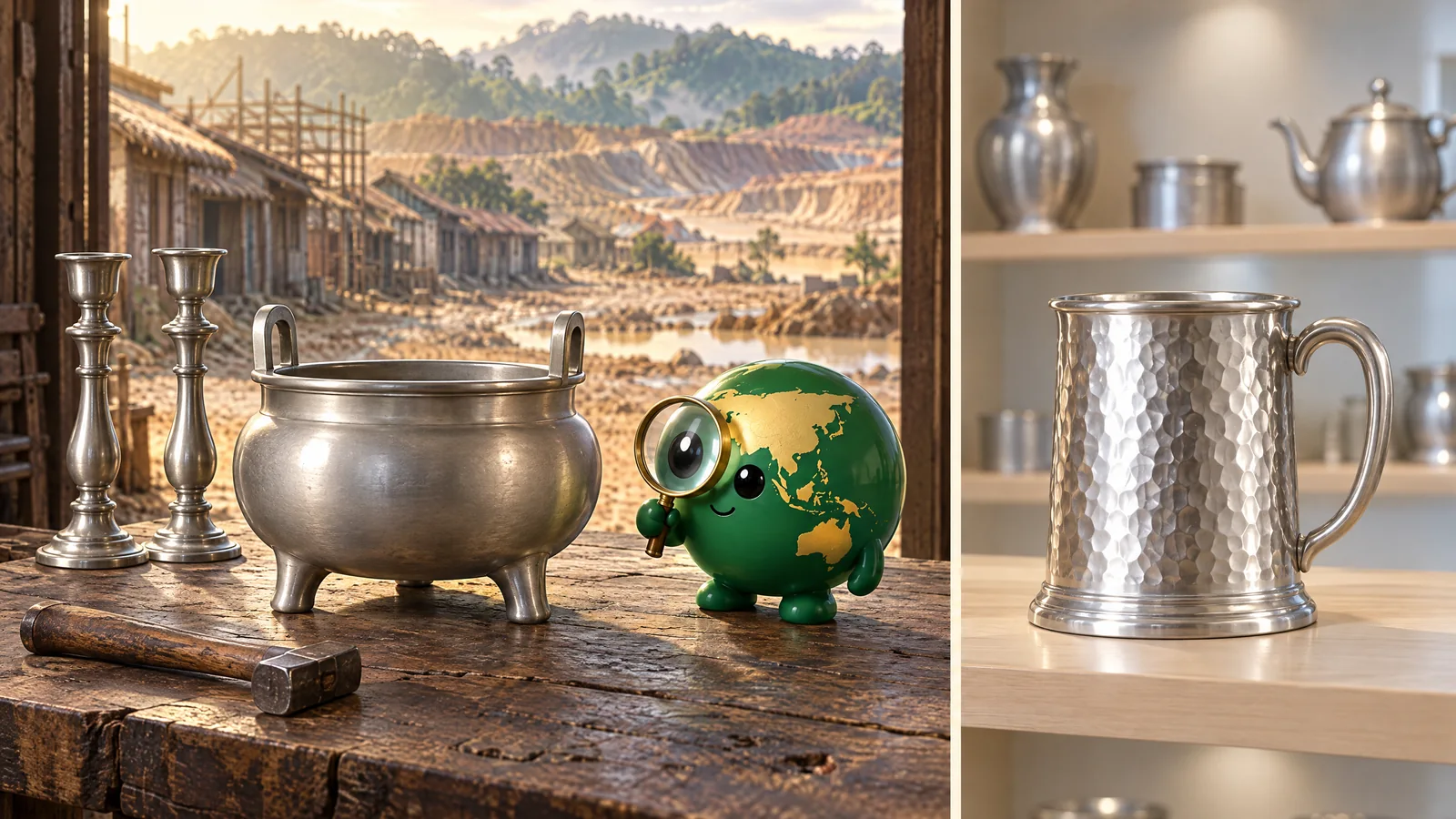
Most people meet Royal Selangor as a gift shop in an airport or a shiny tankard on a shelf. The twist is that it began as three brothers' tinsmith shop in a muddy, half-built tin mining town in 1885.
Royal Selangor was founded in 1885 by Yong Koon, a young man who sailed from Shantou, China, to Kuala Lumpur, then a fledgling tin mining town in the state of Selangor. He joined his two brothers, who were already working there as tinsmiths, and together the three of them made ceremonial items for the local Chinese community. The business grew with the city. It became Selangor Pewter in the mid-20th century. The company was awarded a royal warrant in 1979 by the Sultan of Selangor. In 1992, the company was rebranded from Selangor Pewter to Royal Selangor. Today it is a global brand with retail outlets across the world, from London to Singapore to Melbourne.
This article tells how one family workshop followed the rise of a whole city and turned tin into a craft house known across the globe.
The name: what it means and where the word came from
"Royal Selangor" is a name built in two parts, and neither part was there at the start.
"Selangor" is a state on the west coast of Peninsular Malaysia. In the 19th century, Selangor was rich in tin. Calling the brand after the state linked it to local tin and to trusted pewter craft from that country.
But the company did not begin with the name Selangor. Yong Koon opened his shop under the Chinese name Ngeok Foh, meaning Jade Peace. Older customers in Kuala Lumpur's Chinese communities still sometimes use that original shop name when they talk about the brand.
By the 1930s the business was called Malayan Pewter Works. By the 1960s it traded as Selangor Pewter. The word "Royal" came only after the Sultan of Selangor granted a royal warrant in 1979. A royal warrant is a formal right, given by a ruler, to use the word "Royal" and the royal arms. It marks the company as an official supplier to the palace. The rename to Royal Selangor happened in 1992, honouring that warrant and reflecting a product range that had grown well beyond pewter items alone.
Where it began: the place, the time, the people
The year was 1885. The place was Kuala Lumpur, then a rough meeting point of Chinese tin miners, Malay rulers, and British colonial officers. Tin exports drove the town's economy and created steady demand for metal goods.
Yong Koon sailed from Shantou, China, to Kuala Lumpur. He joined his two brothers, who were already working there as tinsmiths, and the three of them began creating pewter incense burners, joss stick holders, and candlesticks for Chinese temples and homes. Together they made ceremonial items for the local Chinese community, the miners and traders who filled the town's clan halls and prayer rooms. Royal Selangor started as a small family-run business, a cottage industry shaped by one craft and one neighbourhood.
Malaya was among the world's largest tin producers in that century. Chinese kongsi, meaning clan mining groups, ran many of the mines. They needed altar ware. They needed household metal. Yong Koon saw that demand and filled it.
The Yong family and a growing town
Royal Selangor's history is also a Yong family story. Yong Koon's sons joined the trade in the early 20th century and began to widen what the shop made. In 1930, the business moved to a shoplot the family bought on Pudu Road and took the name Malayan Pewter Works. The low price of tin pushed a shift from Chinese ceremonial pieces to European-style items: cigarette boxes, ashtrays, vases, teapots, and other everyday goods.
Kuala Lumpur changed around them. From wooden shophouses and open mining pits in the 1890s, it grew into the capital of the Federated Malay States in 1896, with brick buildings and a rising population of buyers.
The family also took hard knocks. The Great Depression of the 1930s cut demand sharply. Then came the Second World War. In 1942, during the Japanese occupation, three of Yong Koon's four sons, Peng Sin, Peng Kai and Peng Seong, started Selangor Pewter and began making sake sets for the Japanese military, after tin was declared a controlled commodity. When the war ended in 1945, Peng Kai kept Selangor Pewter running out of Pudu Road.
Anatomy: what it is made of, or how it is done
Royal Selangor's pewter today is nothing like the soft, grey metal of the 19th century. The modern alloy is lead-free: 92 to 97 percent pure tin, with small amounts of copper and antimony for hardness and structure. That meets international food-safety standards. You can drink cold drinks or hot coffee from it safely.
Older pewter in Malaya, and across much of Europe, often contained lead. Lead made the metal softer and easier to hammer but was harmful to health.
The making process at the Setapak factory in Kuala Lumpur still blends machine and hand. Designers create shapes, sometimes through collaborations with international designers. The metal is cast into moulds or spun from sheets. Then comes hand-finishing: hammering texture into surfaces, engraving motifs, polishing to satin, antique, or bright finishes. Quality control checks every piece. Touchmarks are applied. Royal Selangor's pewter is hand-hammered in Kuala Lumpur.
Royal Selangor collaborates with international designers for unique pieces. Danish designer Erik Magnussen, from Denmark, worked with the company, shaping a signature collection. UK designer Nick Munro also shaped collections. Partnerships with museums brought in new forms: Royal Selangor's V&A William Morris collection was created with the Victoria and Albert Museum in London. Work with the Islamic Arts Museum in Malaysia drew on Malay and Islamic design traditions.
Signatures of Royal Selangor design
Some shapes and textures are now closely linked with the brand.
Early signature objects mark stages in its history. Pewter joss stick holders and pewter incense burners served Chinese temples in late-19th-century Kuala Lumpur. Cigarette boxes, ashtrays, vases and teapots came next, as European styles took over in the 1930s. Telepuk designs date from the early 1920s, and the Telepuk Collector's Set features six historic designs in pewter, preserving Malay textile patterns in metal. More recent work, like the Timepieces collection, shows the brand moving into personal accessories and high-end collectibles.
The satin finish, the cool touch of the metal, and the clear ring when you tap it have become part of Royal Selangor's identity.
One thing, many homes: how each country or community made it its own
Royal Selangor pewter came from Kuala Lumpur, but different people read different meanings into the same object.
Chinese communities in Malaysia used Yong family pewter first, mainly for altars and clan associations. These were trusted local makers who understood Chinese ritual forms. Malay royal courts and palaces in Selangor and other states began to commission ceremonial pieces during the 20th century, especially after the royal warrant.
Malaya won independence in 1957, then Malaysia formed in 1963. Royal Selangor's own story ran alongside the new nation's. Tourists became a growing customer base from the late 1960s onward.
Royal Selangor abroad: how people see it
Royal Selangor began exporting in the 1970s, first to Singapore and Hong Kong, then to Australia. Europe followed towards the 1980s, with Japan later still. Customers in those places first met the brand in department stores and duty-free shops.
Overseas Chinese and Southeast Asian diaspora bought it as a taste of heritage. Western clients mainly saw it as fine pewter tableware and design objects. Royal Selangor offers homeware, gifts, and personal accessories in a huge variety of forms.
From the stall to the world: how it spread
The main growth steps happened in clear stages. A small shop in 1885 became a formal company and factory. The company moved to a modern factory in Setapak in 1962, where it still operates today. The royal warrant came in 1979. The rename to Royal Selangor followed in 1992. Then came global exports and standalone stores.
The shift from cottage industry to factory changed the craft. Mechanisation allowed more consistent production, but the company kept many hand-done steps: finishing, engraving, texturing.
Royal Selangor operates standalone stores in major international cities including London and Singapore. The company has stores and distributors worldwide, with over 40 retail outlets across the globe.
The brand grew beyond pewter. Royal Selangor acquired the English sterling silver house Comyns in 1993 and the Canadian pewter maker Seagull Pewter in 2002. The Selberan brand offers fine jewellery under the same group. These sister companies let the business extend into silver, gold, and diamonds.
The Royal Selangor Visitor Centre opened in 2004, showcasing pewter-making heritage. The visitor centre in Setapak is a combined factory tour, museum, and gallery. It tells the story of the company's beginnings, the history of pewter, and the story of tin in Malaysia. Visitors can watch pewter being cast. The centre also houses the giant tankard, cast in 1985 to mark the company's centenary: 1.987 metres tall, 1,557 kilograms, and holding 2,796 litres. It holds a Guinness World Record.
Royal Selangor and big public moments
Royal Selangor is known for bespoke commissions and trophies. The company produces bespoke commissions for trophies and mementos used at major sports events and corporate occasions across Malaysia and abroad.
Special collections made with the Victoria and Albert Museum in London, and with the Islamic Arts Museum Malaysia, brought museum design into everyday pewter. Royal Selangor collaborates with international designers for unique products, from tableware to timepieces, connecting Kuala Lumpur craftsmanship with global design. Product launches and advertising for these collections helped present Kuala Lumpur as a city of craft and manufacture, not only of tin and palm oil.
The pattern is clear: from local temple orders to royal courts, to multinationals and collectors around the world.
More than an object: what it means to people today
For many families in Malaysia and Singapore, a Royal Selangor piece is more than metal. It is a wedding gift kept in a cabinet, a company award on a desk, a travel souvenir that reminds someone of a visit to Kuala Lumpur.
Older customers remember buying pewter for ancestral altars or as marriage gifts. Younger buyers may know the brand from designer collaborations or limited-edition collectibles. The company positions itself today as a heritage craft house from Kuala Lumpur that respects old skills, uses modern safe alloys, and tells the story of tin and migration.
The visitor centre plays a part in this. School groups, tourists, and locals visit to learn about tin mining history, Chinese migration, Malay royal customs, and how a metal is shaped by hand. Pewter is also recyclable. Factory swarf, meaning metal shavings, is melted and reused. Long-lasting objects stay out of waste for decades or longer.
The next time you see a Royal Selangor tankard or tea set, you will know it started with three brothers, a tin rush, and a town still finding its shape.
Royal Selangor's story is one entry in Backstory Asia's record of Asian brand stories, alongside other crafts shaped by the same courts and trade routes: the songket cloth woven with gold thread for Malay royalty, the keris blade carried as a mark of status, and the batik cloth dyed across the region's courts.
If you like stories like this, join the Backstory Asia email list. One origin story a week, nothing else.