
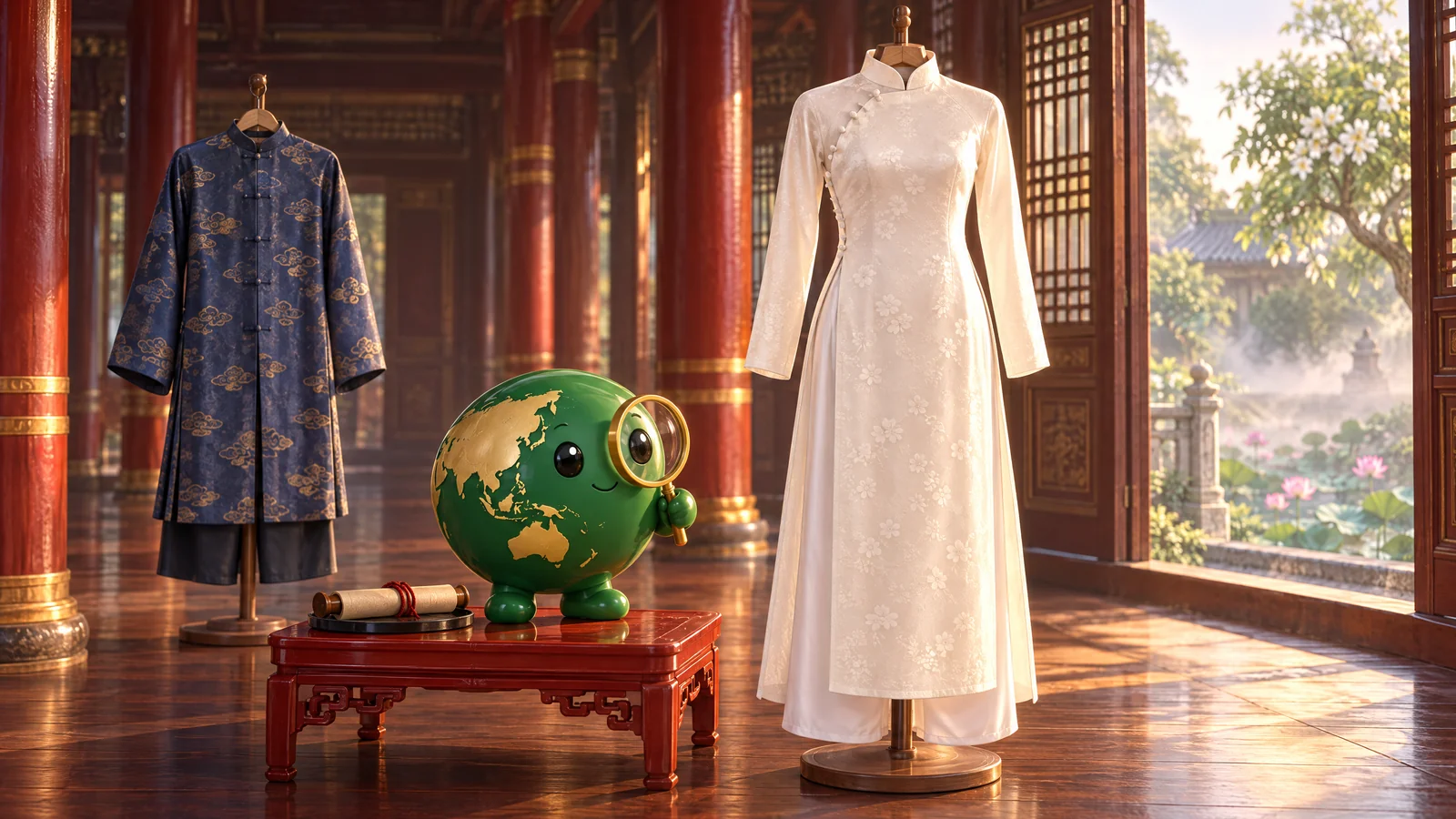

Prefer to watch? This story is Episode 15 on our YouTube channel: The 300-Year Story Behind Vietnam's Áo Dài.
The ao dai you thought you knew
Most people picture the ao dai as an ancient, unchanging gown. Tight at the waist, flowing panels, high collar, worn by Vietnamese women for centuries. That picture is wrong.
The modern ao dai only took its familiar shape in the 20th century. Its story starts much earlier, with a very specific court order in 1744. Lord Nguyen Phuc Khoat, ruling southern Vietnam from Phu Xuan (later Hue), told his court to wear a new kind of long tunic over trousers. That order created the ancestor of the dress we see today. But the garment changed many times after that. In the 19th century, the ao ngu than took the five-panel form that carried into the modern ao dai. In the 1930s, tailors in Hanoi and Saigon added Western darting and floor-length panels. In the 1950s, Saigon dressmakers introduced the ao dai raglan sleeve. Each generation remade the dress.
The ao dai's origins date back even further than 1744. Earlier styles, like the cross-collared ao giao lanh, were worn before the 19th century; one surviving painting from the 14th century already shows it in use. But the garment we recognise today started with that 1744 decree.
At Backstory Asia, we tell this story as one about people, ports and trade, the same forces that shaped the kebaya and batik cloth elsewhere in Southeast Asia. Many traditions met to form this dress. No single region or country owns it.
The name "ao dai": what it means and where the word came from
The name is simple Vietnamese, but the history behind it is not.
The two words break down like this:
Ao means shirt or tunic.
Dai means long.
Together, ao dai simply means "long shirt" or "long dress." The term is Vietnamese. It was not borrowed from Chinese or French, even though the cut of the garment drew on many sources over the centuries.
The style existed long before people called it "ao dai." Earlier forms had their own names. The ao tu than (four-panel dress) was a traditional costume. The ao ngu than (five-panel dress) was the version ordered by Nguyen Phuc Khoat in 1744. "Ngu" means five, "than" means body or panel. These dresses were known by those names for decades.
The phrase "ao dai" itself is much older than the modern dress: Vietnamese dictionaries record it from the 16th to 18th century, naming other garments, and it appears in print as early as 1827. It only settled into use for this specific modern dress in the early 20th century, promoted by writers of the Tu Luc Van Doan (Self-Reliant Literary Group) alongside the fitted designs of the time.
Where it began: court orders, ports and the Nguyen lords
The year is 1744. The place is Phu Xuan, in southern Vietnam. Lord Nguyen Phuc Khoat rules from his court there, separate from the Trinh lords in the north.
In 1744, Lord Nguyen Phuc Khoat standardised the ao dai for courtiers. He wanted his people to look different from the northern court. He ordered men and women to wear trousers under a long gown with front-opening buttons. This was a big change. Before this, local people in his region wore cross-collared robes, skirts and looser garments. The new dress had five panels and became known as the ao ngu than.
This was not the tight, flowing modern ao dai. It was looser, wider and less fitted. But it set the shape: a long tunic, worn over trousers, with slits at the sides.
Many influences came together in that court. Han Chinese court robes, especially Ming-style long gowns worn with trousers, were the source the 1744 decree itself drew on. Local Viet traditions, like the four-panel ao tu than and the yem (a simple under-bodice), added the panels and layers underneath. Many families, one garment.
Over the 19th century, the ao ngu than kept its five-panel form, the cut that carried into the modern ao dai. Rural people wore it in cheaper cloth. The court refined its fabrics and tied colours to rank. This set the stage for everything that came next.
Anatomy of the ao dai: from five panels to raglan seams
We now look at how the garment is built and how that changed over time.
The ao ngu than: five panels and first hip slits
In the 19th century Nguyen dynasty, the common form of the dress was the ao ngu than. It had five panels: two at the front, two at the back, and a small hidden fifth flap tucked inside one of the front panels. This small piece is sometimes called the "baby flap."
Side slits ran from the hip downward so the wearer could walk freely. Wide trousers were worn underneath. The cut was loose, not tight at the waist, and the length was sometimes shorter than today's versions. Silk was used for royalty and the court. Deeper, darker colours were common for everyday wear. Both Vietnamese men and Vietnamese women wore versions of this dress. At court, fabric colour and ornamentation marked rank.
French Indochina and the birth of the modern silhouette
In the 1920s and 1930s, Vietnam was under French colonial rule. Tailors in Hanoi and Saigon saw Paris fashion magazines. They wanted something that felt modern yet still Vietnamese.
In 1930, a Hanoi designer named Cat Tuong, known by his French name Le Mur, introduced a more form-fitting ao dai. He used Western darting (small folds sewn into the fabric to shape the bust and waist), new shoulder lines and panels that reached the floor. The design caused a sensation in 1935, when model Nguyen Thi Hau wore it for a feature in the newspaper Today. Painter Le Pho, trained at the Ecole des Beaux-Arts in Hanoi, helped soften the design in the 1930s. He brought back Vietnamese lines, keeping the dress long and slim but less like a French coat.
The technical changes were clear. The bodice sat closer to the body. The high collar stayed. Panels were extended to the ankle or the floor. Softer silk was used, fabric that hugged the body and moved when walking. This is when the look we now call "traditional" actually became common in cities. The evolution of the ao dai had entered its modern chapter.
Saigon's raglan sleeves and the post-war cut
In the 1950s and 1960s, Saigon in south Vietnam became a style workshop for the ao dai. Dressmakers experimented with comfort and movement.
The raglan sleeve was introduced in the 1950s, by Saigon tailors Tran Kim and Dung, to improve comfort in the ao dai. Instead of a straight seam at the shoulder, a diagonal seam runs from the neckline to the underarm. This gives better arm movement and a cleaner shoulder line. Office workers and students found it much easier to wear. The ao dai raglan is the modern version most people recognise today.
Tran Le Xuan, known as Madame Nhu and the president's chief advisor's wife, became famous for bold ao dai designs in the late 1950s. Beginning in 1958, she made headlines in a boat-neck version with no high collar, showing the collarbone. Her style drew attention and debate.
By the late 1960s and 1970s, variations included shorter panels, flared trousers and louder prints. Synthetic fabrics made the dress cheaper and more widely worn. In the south, it was everyday clothing for students and workers. In the north, it was less common in daily life after 1954.
One dress, many homes: north, south and the diaspora
There is no single ao dai. Each region and community shaped it differently.
In northern Vietnam, Hanoi's images from the 1950s and 1960s show women in dark ao dai and conical hats, a picture fixed in posters and photographs. After 1954, wearing ao dai became less common in daily life in the north, where it was sometimes seen as too urban. It was kept for formal occasions and ceremonies.
In southern Vietnam, Saigon's 1960s boom made the ao dai a daily garment. City women, students and workers wore it in bold colours, printed silk and synthetic fabrics. The feminine appeal of the fitted cut and bright patterns made it popular and expressive.
In central Vietnam, Hue's link to the imperial court meant softer, more muted tones. High collars, subtle patterns and a quieter elegance defined the style there. Riverside and school images from Hue helped fix a romantic view of the ao dai in popular memory.
Vietnamese men have always been part of this story. The male version has a straighter cut, often in richer brocade fabrics. It is worn at weddings, ancestor worship and formal events. Men were among the earliest wearers in court and ritual settings, even if global images tend to focus on the female version.
Vietnamese communities abroad kept wearing the ao dai, among them the Miss Ao Dai beauty pageant held every year in Long Beach, California. The roots stay the same, but the garment keeps changing with each new home. Many families, one dress.
From Hue and Saigon to the world
The ao dai left Vietnam the same way many of its fabrics arrived: through ports, routes and people on the move.
Films set in wartime Saigon, often made outside Vietnam, used the ao dai as a visual symbol of Vietnamese identity. In 2008, Vietnamese designers made the ao dai worn by contestants at that year's Miss Universe pageant in Nha Trang, bringing the dress to an even wider audience. Beauty pageants and cultural shows helped fix one very slim, very fitted look as the standard image worldwide.
Contemporary designers continue to reinterpret the ao dai with modern styles and fabrics. Vietnamese designers have shown ao dai-inspired collections at fashion weeks in Paris, New York and Tokyo. Outside Vietnam, the largest annual Ao Dai Festival is held in San Jose, California, home to a large Vietnamese American community. Modern ao dai can be made from chiffon and lace. The ao dai serves as a formal uniform for various professions in Vietnam, from airline staff to hotel workers, adapted for both grace and practicality.
More than a dress: what ao dai means today
For many Vietnamese people, at home and abroad, the ao dai carries memory, cultural pride and ongoing conversation.
The ao dai symbolises cultural pride and national identity in Vietnam. It is one of the most visible symbols in state events, school uniforms and tourism branding. Students wear ao dai uniforms in high schools and universities. The ao dai is commonly worn during Tet holidays, and it is worn during Vietnamese wedding ceremonies. After years when it was less visible, especially in the north, it came back strongly in public life in the late 1980s and 1990s.
In Vietnam, the ao dai comes in many colours. White is worn by students, red by brides, and other colours appear in older photographs, among them blue, purple and yellow. The meaning attached to a given colour varies by family and region.
Ao dai for women is commonly made from silk. Brocade, similar in spirit to songket further south, is often used for men's ao dai. The choice of fabric carries meaning and tradition, shaped by region, occasion and personal taste.
Some students and workers find the tight cut hard to wear all day. New designs loosen the fit, use stretchy fabric and adjust proportions to suit more body types. This is not about losing the traditional attire but about making the national costume something more people can wear with comfort.
Museums and local exhibitions across Vietnam record regional styles, famous garments and the history behind them. School days, graduation photos and Tet family portraits, these are the moments when the ao dai marks a life stage.
Vietnamese in other countries wear it to connect their children with a language and a home they may not know first-hand. The popularity of the garment keeps growing, shaped by each new generation.
What began in 1744 as a court order about how to dress is now a garment people choose, for themselves, to say who they are.
If you like stories like this, join the Backstory Asia email list. One origin story a week, nothing else.