
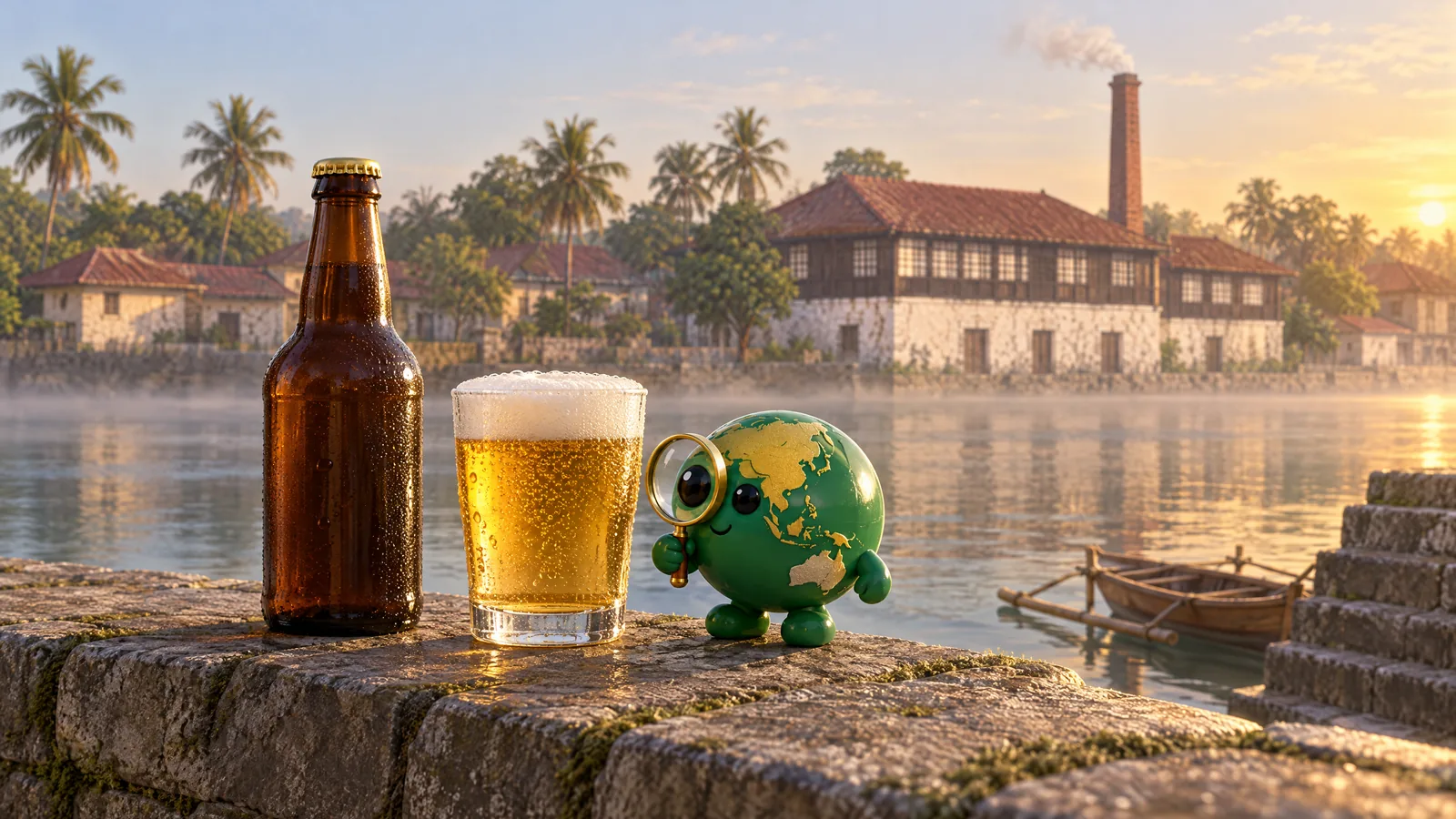
Most people think San Miguel is a Spanish beer. It is not. It began as a small brewery in Manila in 1890, in a riverside district called San Miguel.
San Miguel was established in 1890 as La Fábrica de Cerveza San Miguel by Enrique María Barretto de Ycaza, a Filipino-Spanish businessman who held a royal patent from Spain. The factory was among the first in Southeast Asia to use modern equipment and facilities. The business was renamed San Miguel Brewery, Inc. in 1913, and the company expanded across the Philippine islands and then overseas. In 1948, San Miguel bought and renamed an existing brewery in Hong Kong, its first plant outside the Philippines. A separate Spanish branch opened later, and the two lines split into different companies. Today there are two San Miguel beer families: the Philippine original under San Miguel Brewery Inc, and a European brand under Mahou San Miguel in Spain. They share a name and an 1890 beginning, but they are run by different people, with different recipes and different markets.
The name: what "San Miguel" means and where it came from
San Miguel is Spanish for Saint Michael. Saint Michael is an archangel in Christian belief, often shown as a fighter and protector.
In 19th-century Manila, Spain ruled the Philippines. Many districts, streets and churches carried saint names. The brewery sat in the San Miguel district, a mostly well-off area on the north bank of the Pasig River, close to the old walled city of Intramuros. That district was home to the San Miguel Church and stood near Malacañang Palace, the seat of the Philippine president.
When the brewery opened in 1890, its full name was La Fábrica de Cerveza San Miguel. That translates to "the San Miguel beer factory." The name tied the beer to both the place and the saint. Over the years the company name changed to San Miguel Brewery, then to San Miguel Corporation (SMC) as the business grew beyond beer into food, drinks and more. But the beer label kept the San Miguel name and an escudo that recalls the 1890 royal grant, tying the beer to its origin.
There is also a San Miguel brand brewed in Europe today. It kept the saint's name too. We will explain how that split happened further on.
Where it began: the place, the time, the people
The year was 1890. The place was the San Miguel district of Manila, then part of the Spanish Philippines. Enrique María Barretto de Ycaza received a royal patent, a Patente de Invención, giving him the right to produce beer in the country for 20 years. He set up both a brewery and an ice plant at 6 Calle Avilés, near Malacañang.
A brewery made sense. Spanish officers, friars and merchants in Manila wanted European-style beer, and shipping bottles from Europe was slow and costly, especially in tropical heat. San Miguel contributed to the industrial development of the Philippines as a significant commercial entity from the very start. It was one of the first modern, steam-powered food factories in the country, a world apart from village-made drinks like tuba (coconut toddy) or lambanog (coconut spirit), which were processed in simple stills.
Early partners included Pedro Pablo Roxas, who joined as managing partner and brought in a German brewmaster, Ludwig Kiene, to run the technical side. Their imported equipment and know-how established a large-scale brewing tradition in a part of the world where none had existed before. San Miguel helped to establish a large-scale brewing tradition in Southeast Asia.
Then the political backdrop shifted. Spain lost the Philippines to the United States in 1898. San Miguel survived this change. Under American rule, the beer market grew. American soldiers, officials and a rising Filipino middle class all bought bottles.
The first beers and early growth
The earliest product, launched in 1890, was simply called San Miguel beer, a pale lager styled after European pilsners but made for a hot climate. In its first year, the factory produced about 3,600 hectolitres (roughly 360,000 litres) and employed around 70 people. San Miguel won its first major award in 1895, a sign that quality was taken seriously from the beginning.
By the late 1890s and early 1900s, the brewery added darker beers and seasonal brews, including Cerveza Negra, Eagle Extra Stout and Doble Bock. But the pale pilsen stayed the main drink.
Distribution started with horse-drawn carts around Manila, then moved to steamships reaching port cities like Cebu, Iloilo and Zamboanga. This early period set a pattern: San Miguel as a bottled, labelled, modern product, sold in glass bottles with printed paper labels. It looked and felt different from local drinks served in reused containers or clay jars.
By 1914, San Miguel began exporting beer to Hong Kong, Shanghai, and Guam.
Anatomy of San Miguel Beer: how it is made and what is in the glass
When people in the Philippines say "San Miguel Beer" today, they usually mean San Miguel Pale Pilsen, the flagship pale lager. It has long been the company's core product.
The ingredients are simple. Water from treated local sources. Malted barley, which is grain that has been soaked and dried so its sugars come out. Hops, the small green flowers that give beer its gentle bitterness and smell. Lager yeast, a tiny living thing that eats sugar and makes alcohol and bubbles. And sometimes rice, added as an adjunct grain to make the beer feel lighter and easier to drink in the heat.
The basic process goes like this. First, the grains are mashed in hot water to pull out the sugars. Then the liquid is boiled with hops. After that, it is cooled. Next, lager yeast is added, and the beer ferments under controlled cold conditions over days or weeks. Finally, the beer is matured, filtered and put into bottles or cans. From the start, San Miguel focused on pale lagers, which many drinkers find easier to drink in Manila's tropical climate than heavier ales, which may be part of why the brewery kept making them.
San Miguel Beer has expanded its portfolio to include products like Red Horse and San Mig Light. Red Horse, launched in 1982, is a stronger beer aimed at a different taste and budget crowd. San Mig Light is a lower-calorie lager that broadened the lineup beyond the flagship pilsen. San Miguel expanded into nonalcoholic beverages in 1922 as well, broadening the business early on. And in 1987, San Miguel acquired La Tondeña Distillers, expanding its hold on the domestic drinks market.
The logo, the bottle, and the look
The label carries a red shield, an escudo, with a golden crown and a lion. It is the symbol of the royal grant that let the brewery open in 1890, not a Manila coat of arms. Early bottles were short brown glass with paper labels. Over time, the bottle shape shifted to the familiar stubby brown bottle, then to returnable long-neck bottles and cans. Brown glass protects beer from light. The red, gold and white colour scheme on packaging helped the brand stand out in sari-sari stores (small neighbourhood shops that sell almost everything) and bars across the Philippines.
One beer, many homes: how San Miguel became local in many places
San Miguel grew roots in different countries across the Asia Pacific region, and each place gave it its own story.
The Philippine San Miguel: national beer and daily drink
San Miguel has long been the dominant brewer in the Philippines. It is the beer people know. It became part of fiestas, karaoke sessions, office farewell parties and basketball watching.
The company built plants across the islands. After the Second World War, it acquired and modernised a second major plant in Polo, Bulacan in 1947. More followed in Cebu, Davao and other cities, supporting growth across the archipelago. The workforce expanded with each new plant.
Picture a cold brown bottle on a plastic table in a carinderia (a simple eatery), or a bucket of beers packed in ice at a Manila night spot. That is where San Miguel lives in the Philippines.
San Miguel in Hong Kong, China and Southeast Asia
San Miguel moved overseas after the Second World War, and the move was a buyout, not a new build. In 1948, the company bought Hong Kong Brewers and Distillers Ltd, a brewery in Sham Tseng, in Hong Kong's New Territories, that Jehangir Hormusjee Ruttonjee had set up in 1930, and renamed it. It was San Miguel's first plant outside the Philippines. Over decades, it supplied drinkers across Hong Kong, southern China and parts of Southeast Asia.
Later, San Miguel built a presence across Southeast Asia: by the mid-1990s it had plants running in Indonesia and Vietnam, and it later added Thailand, often through joint ventures with local firms. Marketing adapted to local habits: ice-cold beer with spicy food, cold bottles at outdoor stalls. San Miguel's expanding presence took a Philippine brand into new markets across the region.
The Spanish San Miguel: how the brand split
Although the beer was born in Manila, a specific deal brought a separate San Miguel brand to Europe. In 1953, the shareholders of a Spanish brewing company called La Segarra signed the Manila Agreement with Andrés Soriano, chairman of the Philippine parent, who granted them the right to brew and sell under the San Miguel name in Spain. La Segarra, independent of its Philippine namesake from the start, renamed itself San Miguel, Fábricas de Cerveza y Malta, S.A. in 1957, the same year it produced its first bottle of San Miguel Especial at its brewery in Lleida. Over the following decades, legal and ownership changes meant the Spanish brewery and the Philippine company went their own ways, and in 2000 Mahou bought the remaining stake, forming the Mahou San Miguel group.
Today, a bottle of San Miguel in Madrid is made by a different company from a bottle of SMB Pale Pilsen in Manila. They share a name and a point of origin in 1890, but they have different owners, different recipes and different markets. Both lines are among well loved brands in their own regions.
From a Manila brewery to a global brand: how it spread
San Miguel followed people on the move. Colonial officers carried the taste first. Then seafarers, migrant workers and overseas Filipino workers brought it further. San Miguel marked one hundred years in 1990, a century after that first batch in Manila.
Key milestones in expansion
Here are the major steps, each a new era in the company's story:
1913: San Miguel Brewery was renamed San Miguel Brewery, Inc.
1947: A second major plant, acquired and modernised in Polo, Bulacan, began production.
1948: The Hong Kong brewery in Sham Tseng was acquired and renamed, the company's first operation outside the Philippines.
1953 to 1957: The Manila Agreement granted branding rights in Spain; the renamed Spanish company began production at its Lleida brewery in 1957.
1982: Red Horse beer launched in the Philippines, expanding the product line.
mid-1990s: Plants running in Indonesia and Vietnam, with Thailand added later.
2007: San Miguel Brewery Inc was incorporated as a separate subsidiary of San Miguel Corporation; its shares began trading on the Philippine Stock Exchange in 2008.
San Miguel in the diaspora and on export shelves
For Filipinos abroad, a can of San Miguel became a taste of home. You can find it in Asian grocery shops in California, in Filipino restaurants in Dubai and Singapore, and on shelves in London corner shops. Many non-Filipino drinkers first met the brand not in Manila but in these spaces, or in Spanish holiday bars, which added to the confusion about which San Miguel is which. Export versions often carry extra labelling that names the brewery location, so a careful reader can tell the two lineages apart.
More than a beer: what San Miguel means to people today
San Miguel has maintained its cultural significance in the Philippines, becoming synonymous with social gatherings. It appears at barangay (neighbourhood) celebrations, late-night talks, music gigs and office farewell parties. Its position in Filipino culture is hard to overstate.
The brand's long links with Philippine sports matter too. The San Miguel Beermen, a basketball team in the Philippine Basketball Association founded in the 1970s, turned the beer name into a courtside chant. TV commercials built around barkada (friend group) themes and catchy jingles became part of popular memory, and many Filipinos just call the beer "San Mig" for short.
Like any beer, San Miguel is part of wider talks about drinking habits and public health. But its story is mostly about people gathering.
Here is one last image. Someone in Manila raises a bottle after singing karaoke. Someone in Madrid clinks glasses at a tapas bar. Someone in Dubai opens a can at a Filipino gathering. Their bottles come from different companies, brewed in different countries, but all three trace back to one small factory in a riverside district of Manila in 1890. That is the part most people skip. It is the best part.
If you like stories like this, join the Backstory Asia email list. One origin story a week, nothing else.